Budolfi Church, Aalborg Travel Guide
Free Guide: Aalborg’s snow‑white cathedral, where Gothic stone, Baroque woodwork and a singing carillon weave a thousand years of seafaring, faith and city life into one intimate space.


A brief summary of Budolfi Church
Aalborg’s snow‑white cathedral, where Gothic stone, Baroque woodwork and a singing carillon weave a thousand years of seafaring, faith and city life into one intimate space.
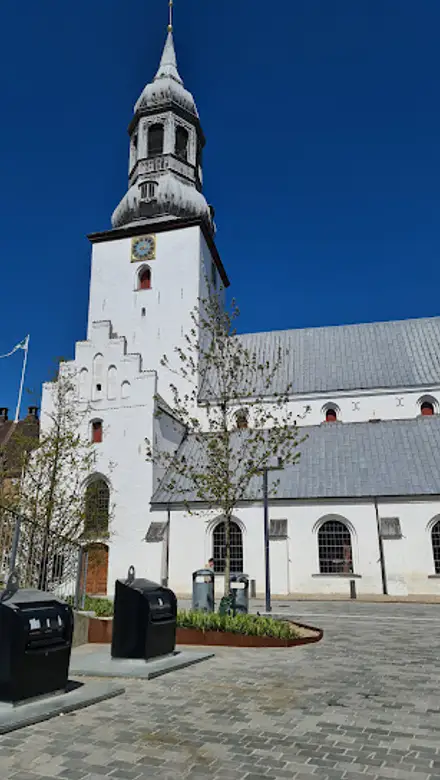
Budolfi Church, Aalborg’s snow‑white cathedral, anchors the old town between Algade and Gammeltorv. Denmark’s smallest cathedral, it blends a 15th‑century Gothic church with a striking 18th‑century Baroque spire that rises high above the rooftops. Inside, you’ll find richly carved 17th‑century furnishings, frescoes, ship models and a rococo organ, while outside the 48‑bell carillon rings out hourly, giving the city centre its distinctive soundtrack.
On-site amenities
 Restrooms
 Seating areas
 Trash bins
 Information boards
Opening hours
- Mon10 am–3 pm
- Tue10 am–3 pm
- Wed10 am–3 pm
- Thu10 am–3 pm
- Fri10 am–3 pm
- Sat10 am–12 pm
- SunClosed
Opening hours as listed on the venue’s Google Business Profile. Hours can change for services and special events, so check with the venue before you go.
- Address
- Aalborg Domkirke, Algade 40, 9000 Aalborg
- Phone
- Website
Getting there
City bus
Regional train plus walk
Bicycle
Taxi from Aalborg Airport
Discover more about Budolfi Church
A White Cathedral at the Heart of Old Aalborg
Budolfi Church, officially Budolfi Domkirke, stands right in the middle of Aalborg’s historic core, tucked between the old main street Algade and the market square of Gammeltorv. Its whitewashed exterior immediately catches the eye, a bright, almost luminous presence amid the tighter brick facades around it. Although it serves as the cathedral for the diocese, it is in fact the smallest cathedral in Denmark, which gives it a surprisingly intimate and welcoming feel compared with grander European churches.The building’s proportions are modest but carefully balanced: the church stretches about 56 metres in length and 22 metres across, framed by a tower whose spire climbs more than 60 metres above the streets. This compact footprint means you are never far from the details; stone, wood and plaster all seem within reach, encouraging you to look closely at carvings, coats of arms and painted ornament rather than simply gazing up from afar.
From Viking-Age Chapel to Gothic Cathedral
The site has been sacred ground for over a thousand years. Archaeological traces reveal a wooden church here from around the year 1000, at the transition between Viking traditions and Christianity in northern Jutland. The present masonry church dates to the 1400s, when a Gothic structure replaced earlier buildings, echoing the pointed arches and ribbed vaults then spreading across northern Europe.In the mid‑16th century, after the Reformation, Budolfi became the cathedral church of Aalborg’s new Lutheran diocese. Over the centuries its appearance evolved, with extensions, interior refurbishments and the addition of side aisles. Yet that medieval Gothic core still shapes your experience today: the narrow nave, tall windows and cool, pale walls create a vertical pull that naturally draws the gaze toward the chancel and altar.
Saint Bodolfus and the Seafaring City
Budolfi is named after Saint Bodolfus (or Botwulf of Thorney), an English Benedictine monk from the 7th century, honoured as a protector of travellers and seafarers. In a busy Limfjord port like Aalborg, where livelihoods depended on ships and trade routes, dedicating the main church to such a patron was more than symbolic. It tied the town into the wider North Sea world of merchants, monks and mariners.That maritime identity is still visible inside the church. Suspended models of ships hang beneath the vaults, echoing a Danish tradition of offering votive vessels in thanks for safe passage. They hover like miniature fleets over the pews, a reminder that for centuries the congregation included sailors, captains and families whose lives were closely bound to the sea and the fjord just beyond the old town.
Carved Wood, Painted Walls and a Towering Spire
Stepping into the interior, you enter a space richly furnished in carved wood and coloured stone from the 17th and 18th centuries. The altarpiece and pulpit, both dating from the late 1600s, are a showcase of baroque craftsmanship: dense with twisting columns, figures and decorative flourishes that contrast with the church’s otherwise white surfaces. Nearby stands a marble baptismal font from the 1720s, smooth and cool to the touch, its pale tones mirroring the light that filters through the tall windows.Look up to spot wall paintings and galleries illustrating biblical scenes, the Ten Commandments and episodes from the Passion of Christ. These details, some partly hidden by later additions, reward slow exploration. At the west end, a rococo organ façade from the mid‑18th century crowns the nave, its pipes and curving woodwork marking the importance of music in the life of the cathedral.Outside, the most distinctive feature is the dark Baroque spire, added in 1779 above the older Gothic tower. Topped with a weathercock and clock faces, it rises to about 63.5 metres, making it one of Aalborg’s key landmarks. From many angles in the city centre, the spire acts as a compass point, guiding you back toward the historic core even when the winding streets are unfamiliar.
The Hourly Carillon and Daily Life Around the Square
Perhaps the most memorable aspect of Budolfi is one you hear before you see: the carillon of 48 bells that plays every hour from morning until late evening. First installed in the 1930s and later expanded, the instrument now weighs many tons in total, its largest bell measuring well over a metric tonne. The repertoire changes with the liturgical calendar and seasons, mixing hymn melodies with other tunes.In summer, regular carillon concerts highlight the instrument’s full musical range, but even brief hourly chimes mark time gently throughout the day for shoppers, office workers and café‑goers in the surrounding streets. The sound floats out over Gammeltorv and Algade, creating an aural link between the sacred space inside and the everyday bustle outside.
Experiencing a Working Cathedral Today
Budolfi remains a living parish church as well as a cathedral. Regular Lutheran services are held here, including a main Sunday service, and at times you may encounter baptisms, weddings or choir rehearsals rather than a quiet monument. Seating for around 650 people means that on religious holidays the church can feel full yet still personal, with the congregation close to the altar and pulpit.At various points in the year, the cathedral hosts organ recitals and classical concerts that make use of the acoustics shaped by stone vaults and wooden galleries. On an ordinary weekday, though, you are just as likely to find a handful of people sitting silently in the pews, taking in the filtered light and the faint echo of bells outside. In that calm, Budolfi’s long history feels close: a millennium of worship, seafaring, trade and town life layered into one compact, white‑walled space.
Evendo Review Centre
 Google
Guest reviews
Best time to go
Quietest: Jan, Feb & Mar · before 8am or from 9pm
Busy times are Evendo estimates for a typical year, to help you plan. Actual crowds vary with events, school holidays and the weather.
Explore Budolfi Church on the map
A handpicked selection of must-see spots near Budolfi Church, mapped for you.
Get your free copy of our complete guide to Budolfi Church, delivered straight to you.
Everything on this page, from opening hours and how to get there to Eve’s tips and the best time to go, in one PDF you can read offline, print or share.
Already have an account? Sign in
Your Budolfi Church guide is ready.
We'll send it to · Not you? Sign out

Getting your guide ready…
We are putting together a fresh copy of the Budolfi Church guide. This can take up to a minute.
This can take a few moments. If your browser asks, choose Allow so the download can start. You'll find the guide in your Downloads folder.
Nothing happened? Download it again
Sorry, the guide is taking longer than usual. Please try again in a minute, or get it by email instead.
Unlock the best of Budolfi Church
Skip-the-line tickets, guided tours with entry, and walking tours of the area, booked in a few clicks.


Other nearby places you may find interesting
The closest places of the same kind, if this one is not quite what you had in mind.
-
-
-
-
-


Swipe for more places
More to explore near Budolfi Church

 Best experiences near Budolfi Church
 Best hotels near Budolfi Church
 Best landmarks near Budolfi Church
 Best attractions near Budolfi Church
 Best shops near Budolfi Church
 Best restaurants near Budolfi Church
 Best bars near Budolfi Church
Do you manage this location?
Take control to get all the benefits, like improved information, better appearance, and stronger visibility across AI-powered discovery.
Explore more
Explore more of Aalborg
Discover Aalborg, Denmark's northern gem, where medieval charm meets modern vibrancy. Enjoy rich history, cultural landmarks, and a lively culinary scene.
Explore Aalborg
Explore more of Denmark
Discover Denmark: A perfect blend of history, modern design, and the cozy concept of hygge. Explore vibrant cities, serene landscapes, and world-class cuisine.
Explore Denmark