The Round Tower, Koge Travel Guide
A 17th‑century brick spiral rising above central Copenhagen, the Round Tower blends royal astronomy, literary history and sweeping city views in one compact landmark.
Rising above the pedestrian bustle of Købmagergade, the Round Tower is a 17th‑century brick observatory and one of Copenhagen’s most distinctive landmarks. Commissioned by King Christian IV and completed in 1642, it’s famed for its wide spiral ramp that coils 7.5 times to a city‑viewing platform and Europe’s oldest functioning observatory building. Midway up, the historic Library Hall now hosts exhibitions, concerts and cultural events, blending science, history and art in a single, atmospheric tower.
A brief summary to The Round Tower
- Købmagergade 52A, Copenhagen, Indre By, 1150, DK
- Click to display
- Click to display
- Duration: 1 to 2 hours
- Budget
-
 Mixed
Mixed
- Mobile reception: 5 out of 5
- Monday 10 am-6 pm
- Tuesday 10 am-9 pm
- Wednesday 10 am-9 pm
- Thursday 10 am-6 pm
- Friday 10 am-6 pm
- Saturday 10 am-6 pm
- Sunday 10 am-6 pm

Know before you go
Hi, I'm Eve. Here are a few practical things to know before exploring The Round Tower.
- Aim for clear weather to fully enjoy the 360‑degree views from the top platform; on grey or foggy days the panorama is far more limited.
- Allow extra time in the Library Hall, where changing exhibitions and events often add an unexpected cultural layer to your visit.
- Wear comfortable shoes for the 7½‑turn spiral ramp; the gradient is gentle but the cobbled surface and distance can be tiring for some visitors.
- Check in advance for evening observatory openings if you want to look through the telescope, as access is typically limited to specific days and seasons.
Do you manage this location?
Take control to get all the benefits, like improved information, better appearance, and stronger visibility across AI-powered discovery. Learn more about listing your business on Evendo
Activate your presenceOther nearby places you may find interesting
The closest places of the same kind, if this one is not quite what you had in mind.
Explore The Round Tower on the Map
A handpicked selection of must-see spots near The Round Tower, mapped for you.
Unlock the Best of The Round Tower
Buy tickets
-
No tickets available
Book tours with entry


Getting There
-
Metro from wider Copenhagen
From most districts, travel by metro to Nørreport Station on lines M1, M2, M3 or M4; trains usually run every few minutes and the ride from hubs like Kongens Nytorv or Frederiksberg is about 5–10 minutes. A single zone‑2 ticket typically costs around 20–25 DKK. From Nørreport, it is a level, well‑paved walk of just over 5 minutes through central streets to the Round Tower, suitable for most visitors and pushchairs.
-
City bus within central Copenhagen
Several city bus routes stop near Nørreport Station and along Øster Voldgade, about 5–10 minutes’ walk from the tower. Depending on your starting point, the ride usually takes 10–20 minutes and uses the same ticket system as the metro, with single fares in the 20–25 DKK range. Buses can be a better option in bad weather, but expect occasional traffic delays in peak hours around Indre By.
-
Bicycle from inner districts
Copenhagen’s dense bike‑lane network makes cycling to the Round Tower straightforward from inner neighbourhoods like Vesterbro, Nørrebro or Østerbro, typically taking 10–20 minutes depending on distance and fitness. Many visitors use city bikes or short‑term rentals that generally cost from about 15–25 DKK per half hour. Cycle lanes can be busy at rush hour, so be comfortable with urban cycling etiquette and always park only in marked bike stands near Købmagergade.
-
Taxi from central hotels
From central hotels near Tivoli or the main station, a taxi ride to the vicinity of the Round Tower usually takes 5–15 minutes, depending on traffic and pedestrian congestion close to the pedestrian streets. Fares for such short inner‑city trips commonly range between 80 and 150 DKK. Taxis will drop you on nearby streets, and you continue on foot through the car‑free section of Købmagergade for the final few hundred metres.
For the on-the-go comforts that matter to you
-
 Restrooms
-
 Drink Options
-
 Drinking Water
-
 Food Options
-
 Seating Areas
-
 Sheltered Areas
-
 Trash Bins
-
 Information Boards
-
 Visitor Center
Discover more about The Round Tower
A royal tower for science and the stars
Built between 1637 and 1642 under King Christian IV, the Round Tower was conceived as a monumental home for astronomy at a time when Denmark wanted to stand at the forefront of scientific discovery. Rising from the Trinitatis Complex, which also includes Trinitatis Church and the former university library, it offered scholars an elevated, stable platform above the city smoke to chart the heavens and refine navigation in an age of exploration.From the outside, the tower’s cylindrical brick form stands out against the surrounding roofs of Indre By. A band of gilded letters, personally sketched by Christian IV, winds around the façade as a cryptic rebus invoking learning, justice and divine guidance for the king. This fusion of piety, power and scientific ambition set the tone for a building that has always been more than just a viewpoint: it was designed as Copenhagen’s “star castle,” a statement of royal investment in knowledge.The remarkable spiral ramp within
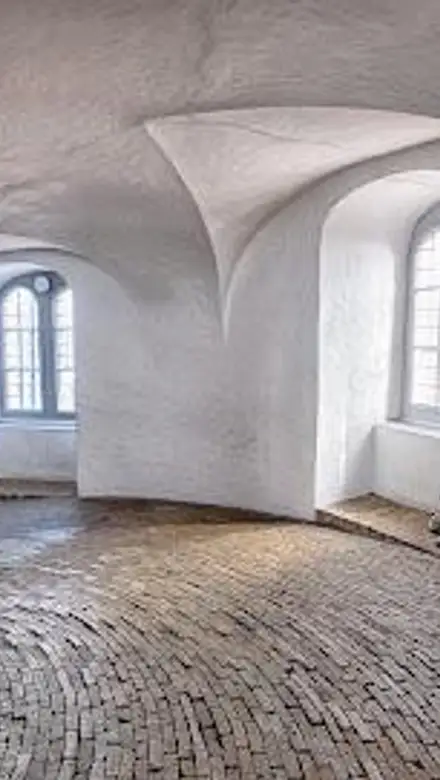
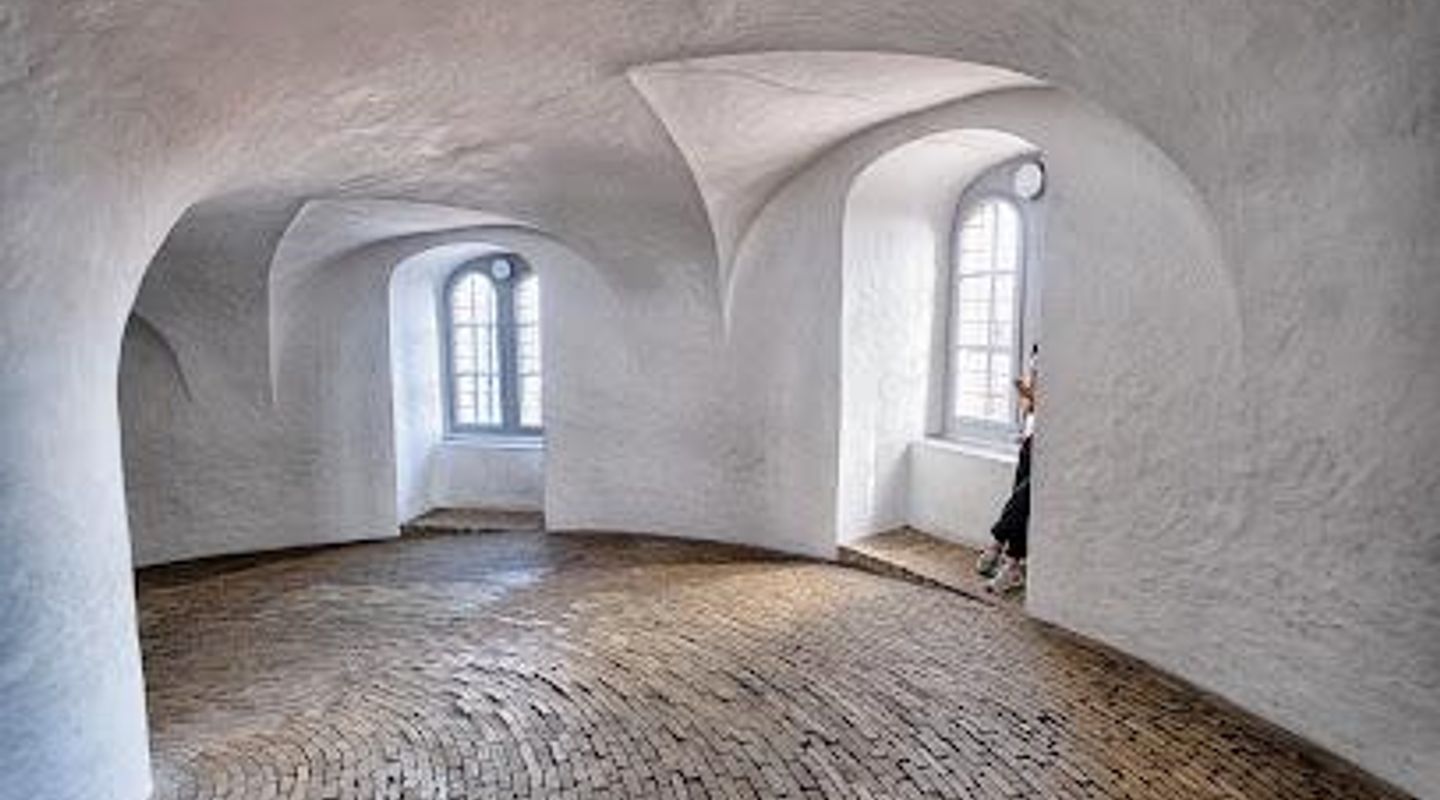
Step inside and instead of a staircase you find a broad, whitewashed spiral ramp that coils 7½ times around a hollow core to reach the top platform, almost 35 metres above street level. The ramp was engineered so that horses and carts could haul heavy astronomical instruments up to the observatory, avoiding steep, narrow steps. Its cobbled surface and gentle gradient make the ascent feel more like walking a sloping lane than climbing a tower.Over the centuries, the ramp has seen some unusual ascents. In 1716, Tsar Peter the Great reportedly rode up on horseback, and in 1902 a motor car was driven all the way to the top, proving the ingenuity of its design. Today, the slow spiral reveals changing perspectives on the tower’s brickwork, niches and thick walls, with small windows offering glimpses of the city outside as you gradually rise above the rooftops.Library Hall: from bookshelves to cultural stage
Roughly halfway up, the ramp opens into the spacious Library Hall, originally created to house the University of Copenhagen’s book collection above the church below. For generations, this was a centre of scholarship, where theologians, astronomers and students worked under the timbered ceiling surrounded by shelves of volumes.The hall has deep literary connections: a young Hans Christian Andersen came here soon after arriving in Copenhagen, and he later wove the tower into his imaginative universe, even likening a giant dog’s eyes to its size in a fairy tale. Today, the room functions as a flexible cultural venue, hosting changing art exhibitions, design shows, concerts, talks and seasonal events that keep the building vibrantly in use rather than preserved as a static monument.The observatory and Copenhagen panorama
At the top, the ramp gives way to a final short staircase and an open platform encircling the observatory. The Round Tower is widely recognized as Europe’s oldest functioning observatory building, and although the instruments have been renewed over time, it still serves as a place to peer at the moon, planets and star clusters through a refracting telescope on selected evenings.The viewing platform offers a 360‑degree panorama over Copenhagen’s copper spires, red rooftops and narrow streets. From here you can pick out landmarks from the old harbour to church towers and newer high‑rises at the city’s edge, tracing how the capital has grown far beyond the compact Renaissance centre that the tower originally surveyed. In clear weather the light over the Øresund and the orderly geometry of the city’s blocks give a calm, almost model‑like quality to the scene.A living landmark in the heart of the city
Although its scientific role has shifted as modern observatories moved to darker skies, the Round Tower remains an active part of Copenhagen’s cultural life. The building frequently hosts thematic exhibitions, seasonal installations and occasional astronomy events that reconnect visitors with its original purpose. Its central location on busy Købmagergade means that stepping inside is like ducking out of a shopping street into a time capsule of 17th‑century brickwork and royal ambition.The tower’s relatively gentle ascent and covered interior make it accessible in varied weather, while the mix of history, architecture, views and arts programming appeals across ages and interests. More than three centuries after Christian IV’s masons laid the first stones, the Round Tower continues to do what it was built for: lifting eyes – and thoughts – above the everyday city to a wider horizon.












Your all‑in‑one travel companion app
Explore expert travel guides, compare and book tours, experiences, hotels, and more—all from the palm of your hand. Download now for seamless trip planning wherever your wanderlust takes you.


Explore More of Koge
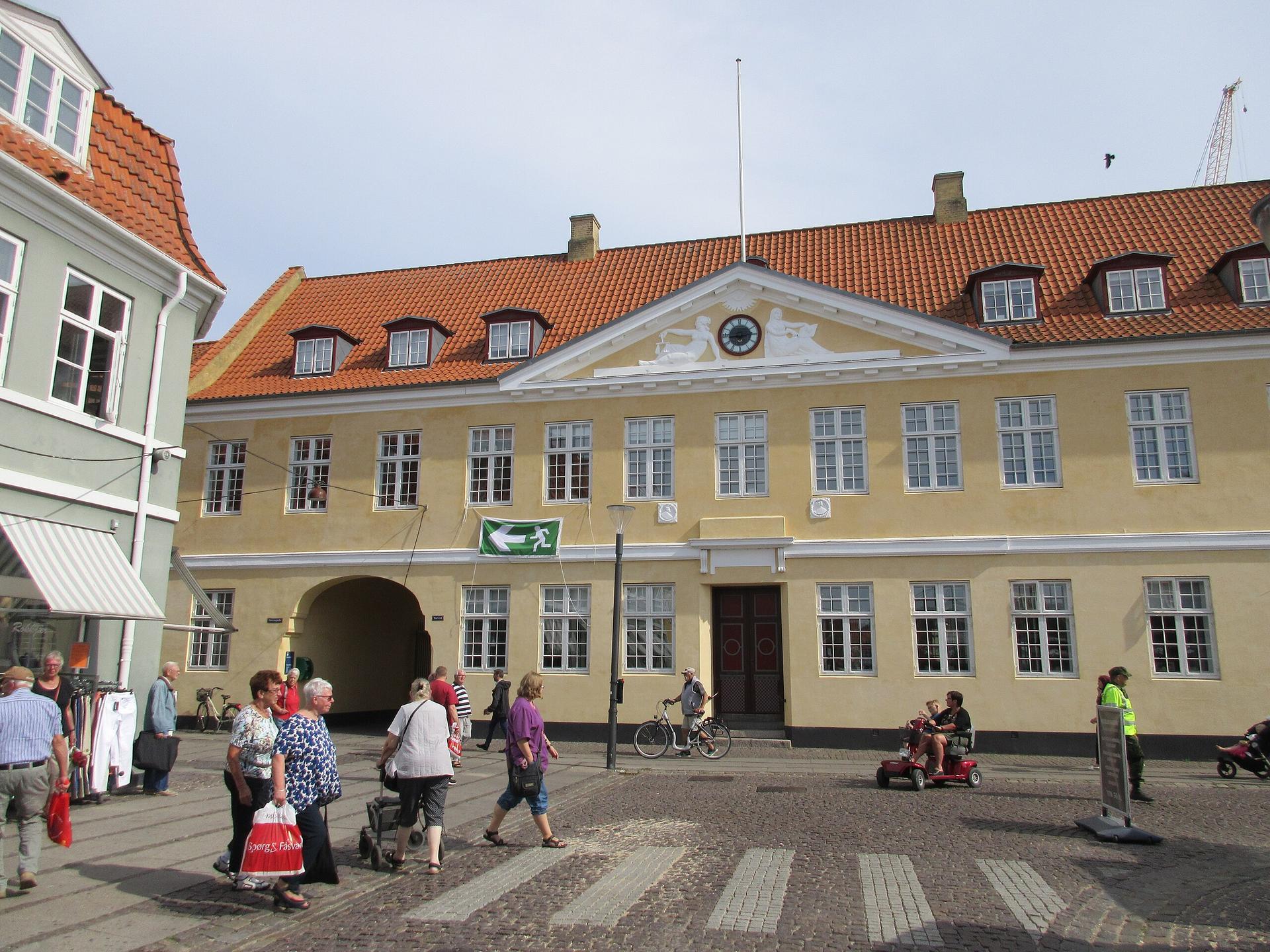
Looking beyond The Round Tower? Discover Koge for broader travel guides, local hot-spots, and regional highlights.
Explore Koge