

Berlin Cathedral, Berlin Travel Guide
Free Guide: Explore Berlin Cathedral: A majestic landmark with a turbulent history, offering stunning architecture, panoramic views, and a glimpse into the Hohenzollern dynasty's legacy on Museum Island.


A brief summary of Berlin Cathedral
Explore Berlin Cathedral: A majestic landmark with a turbulent history, offering stunning architecture, panoramic views, and a glimpse into the Hohenzollern dynasty's legacy on Museum Island.
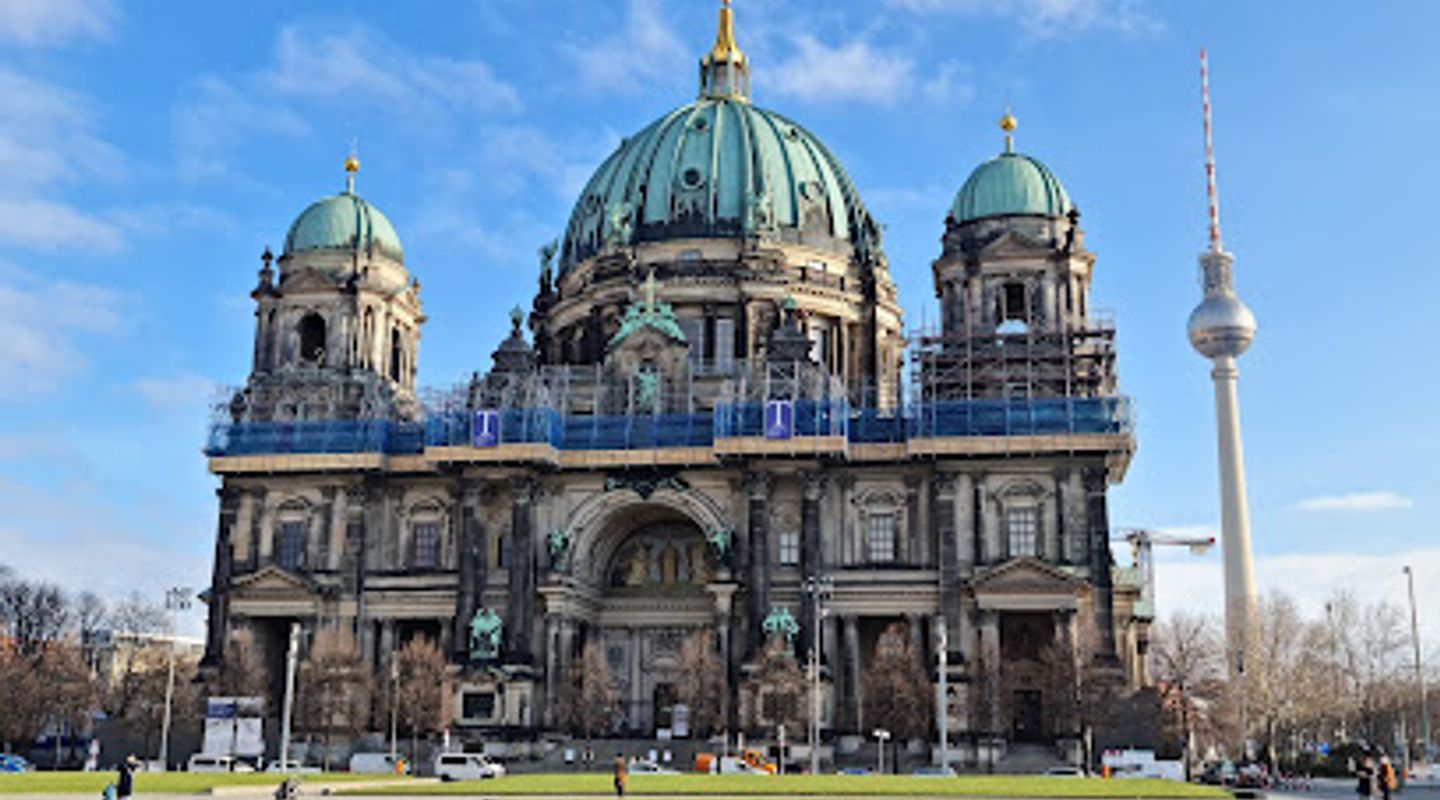
The Berlin Cathedral, or Berliner Dom, is a magnificent landmark gracing Berlin's Museum Island. This iconic Protestant church, with its impressive dome and ornate facade, has a rich history dating back to the 15th century. The current structure, built between 1894 and 1905, replaced an earlier neoclassical building at the behest of Emperor Wilhelm II, who envisioned a cathedral rivaling St. Peter's Basilica in Rome and St. Paul's Cathedral in London. Severely damaged during World War II, the cathedral was painstakingly restored, a testament to Berlin's resilience. Today, visitors can explore its stunning interior, climb to the dome for panoramic city views, and descend into the Hohenzollern Crypt, making it a must-see attraction for anyone visiting Berlin.
Opening hours
- Mon–Sat10 am–5 pm
- Sun12 pm–5 pm
Opening hours as listed on the venue’s Google Business Profile. Hours can change for services and special events, so check with the venue before you go.
- Address
- Am Lustgarten, 10178 Berlin
- Phone
- Website
Getting there
Public Transport
Walking
Taxi/Ride-Share
Driving
Discover more about Berlin Cathedral
Overview
The Berlin Cathedral, known locally as Berliner Dom, is more than just a church; it's a powerful symbol of Berlin's history, resilience, and architectural ambition. Situated on Museum Island, surrounded by world-renowned museums and the flowing Spree River, the cathedral stands as a testament to the city's evolving identity. Originally, a church was established on this site in the 15th century, serving as the court church for the Hohenzollern dynasty, the rulers of Prussia and later the German Emperors. Over the centuries, the church underwent several transformations, reflecting changing architectural tastes and political climates. In 1747, Frederick the Great commissioned a baroque church with a tambour dome. About 70 years later, Karl Friedrich Schinkel renovated the building in the classicist style. However, by the late 19th century, Emperor Wilhelm II deemed the existing structure insufficiently grand for the imperial capital. He desired a cathedral that would rival the great churches of Europe, a visible expression of Prussian power and Protestant faith. To realize this vision, Wilhelm II appointed Julius Carl Raschdorff to design and construct a new cathedral. Raschdorff's design, completed between 1894 and 1905, resulted in the impressive Neo-Renaissance and Baroque Revival structure that stands today. The new cathedral was significantly larger and more ornate than its predecessors, intended to be a Protestant counterweight to St. Peter's Basilica in Rome. The cathedral's exterior is characterized by its monumental dome, rising 98 meters (322 feet) high and adorned with a golden cross. Four corner towers flank the dome, adding to the building's imposing presence. The facade is richly decorated with sculptures, mosaics, and intricate architectural details, reflecting the late 19th century's love of grand gestures and display. The interior of the Berlin Cathedral is equally breathtaking. Visitors are greeted by a vast nave, soaring arches, and an abundance of light streaming through stained-glass windows. The chancel features three stained-glass windows, created by Anton von Werner, that depict the birth, crucifixion and resurrection of Christ. The main altar, crafted from white marble and yellow onyx, was designed by Friedrich August Stüler for the cathedral's predecessor. The nearby pulpit was hand carved in oak following a design by Otto Raschdorff, son of the cathedral's architect. The reconstructed pipe organ, built by the Wilhelm Sauer manufactory, is one of the largest in Germany, boasting over 7,000 pipes. One of the most remarkable features of the Berlin Cathedral is its stunning dome, which stands at 98 meters high. The interior is equally impressive, adorned with intricate mosaics, sculptures, and a grand organ with over 7,000 pipes. The cathedral also houses the Hohenzollern Crypt, where members of the Hohenzollern dynasty are buried. This combination of architectural beauty and historical significance makes the Berlin Cathedral a must-see for architecture enthusiasts and history buffs alike. The Hohenzollern Crypt, located beneath the cathedral, is one of Germany's most important dynastic burial places. It contains nearly 100 tombs spanning from the late 16th century to the early 20th century, including those of Prussian kings and German emperors. During World War II, the Berlin Cathedral suffered severe damage from Allied bombing. The dome was partially destroyed, and much of the interior was ravaged by fire. After the war, the cathedral found itself in East Berlin, and reconstruction efforts began in 1975. The restoration was completed in 1993, four years after the fall of the Berlin Wall. However, due to financial constraints, the restored cathedral was somewhat simplified compared to its pre-war glory. Today, the Berlin Cathedral serves as a vibrant center for Protestant worship and a major tourist attraction. Visitors can attend services, concerts, and other events held within its walls. Climbing the 270 steps to the dome's observation deck rewards visitors with panoramic views of Berlin, including iconic landmarks such as the TV Tower, the Reichstag, and the Brandenburg Gate. The cathedral museum displays the cathedral's drawings, designs and models illustrating the history of the Cathedral Church. The Lustgarten, a park located in front of the cathedral, provides a tranquil space for visitors to relax and admire the building's grandeur. The park has also undergone numerous transformations throughout history, serving as a kitchen garden, a parade ground, and a site for political rallies. Today, it features lawns, fountains, and tree-lined paths, offering a peaceful oasis in the heart of the city. Visiting the Berlin Cathedral requires purchasing a ticket. The ticket price includes access to the main areas of the cathedral, the dome climb, and the Hohenzollern Crypt. It's advisable to dress modestly when visiting the cathedral, as it is a place of worship. While there is no strict dress code, visitors should aim to wear clothing that covers their shoulders and knees as a sign of respect. The Berlin Cathedral stands as a symbol of Berlin's past, present, and future. Its imposing architecture, rich history, and spiritual significance make it a must-see destination for anyone visiting the German capital.
Evendo Review Centre
 Google
Guest reviews
Explore Berlin Cathedral on the map
A handpicked selection of must-see spots near Berlin Cathedral, mapped for you.
Get your free copy of our complete guide to Berlin Cathedral, delivered straight to you.
Everything on this page, from opening hours and how to get there to Eve’s tips and the best time to go, in one PDF you can read offline, print or share.
Already have an account? Sign in
Your Berlin Cathedral guide is ready.
We'll send it to · Not you? Sign out

Getting your guide ready…
We are putting together a fresh copy of the Berlin Cathedral guide. This can take up to a minute.
This can take a few moments. If your browser asks, choose Allow so the download can start. You'll find the guide in your Downloads folder.
Nothing happened? Download it again
Sorry, the guide is taking longer than usual. Please try again in a minute, or get it by email instead.
Unlock the best of Berlin Cathedral
Skip-the-line tickets, guided tours with entry, and walking tours of the area, booked in a few clicks.


Other nearby places you may find interesting
The closest places of the same kind, if this one is not quite what you had in mind.
-
-
-
-
-


Swipe for more places
More to explore near Berlin Cathedral

 Best experiences near Berlin Cathedral
 Best hotels near Berlin Cathedral
 Best landmarks near Berlin Cathedral
 Best attractions near Berlin Cathedral
 Best shops near Berlin Cathedral
 Best restaurants near Berlin Cathedral
 Best bars near Berlin Cathedral
Do you manage this location?
Take control to get all the benefits, like improved information, better appearance, and stronger visibility across AI-powered discovery.
Explore more

Explore more of Berlin
Berlin: A fascinating blend of history, culture, and modernity, offering everything from historic landmarks to vibrant nightlife and culinary delights.
Explore Berlin
Explore more of Germany
Experience Germany: where history meets innovation, and urban energy blends with natural beauty. Discover diverse cultures, delicious cuisine, and stunning landscapes.
Explore Germany
