

Mount Katahdin Travel Guide - Free Web & App
Your ultimate guide to Mount Katahdin. Discover top landmarks, proposed trips, and local tips. Free on the web or via the Evendo companion app.


Mount Katahdin in Maine rises above Baxter State Park, offering rugged hikes, Appalachian Trail history, alpine views, wildlife and backcountry adventure.
Mountain and Wilderness
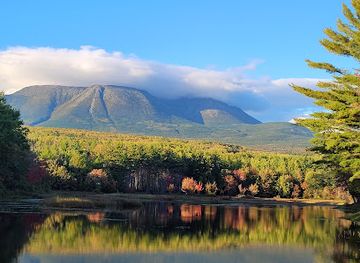
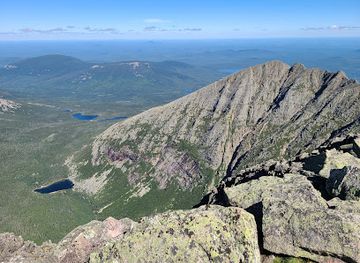
Mount Katahdin rises at the northern end of the Appalachian Trail within Baxter State Park, a large wilderness preserve in north-central Maine. The mountain is not a single pointed cone but a rugged massif of granite ridges, alpine basins and exposed summit terrain. Baxter Peak, at 5,269 feet, is Maine’s highest point, while nearby Hamlin Peak reaches 4,756 feet. The celebrated Knife Edge ridge links the main summit area with Pamola Peak, although its narrow, rocky crest demands careful judgement and favourable weather.Read more about Mount Katahdin
Exploring Katahdin
Culture and Conservation
When is the best time to visit Mount Katahdin?
Best: June–August · 20–22°C| Month | High (°C) | Rainfall (mm) |
|---|---|---|
| January | -5 | 75 |
| February | -3 | 65 |
| March | 2 | 75 |
| April | 8 | 85 |
| May | 14 | 85 |
| June (best) | 20 | 90 |
| July (best) | 22 | 95 |
| August (best) | 21 | 90 |
| September | 17 | 90 |
| October | 10 | 90 |
| November | 4 | 90 |
| December | -2 | 85 |
Getting to and around Mount Katahdin
How to get there
Transportation
Best attractions in Mount Katahdin
Mount Katahdin’s principal attractions are its mountain routes and the distinctive landscapes encountered along them. The Chimney Pond area provides a close view of the basin beneath the Great Basin and the steep walls of the Katahdin massif, while trails from Roaring Brook reach the summit area through rugged terrain. From Katahdin Stream, hikers can climb towards Baxter Peak and the Appalachian Trail’s northern terminus, or undertake routes associated with Hunt Spur and the exposed Knife Edge. Hamlin Peak offers a different high-level perspective across the park’s forests and lakes. At lower elevations, the approaches pass through boreal and northern hardwood woodland, with opportunities for seasonal views and wildlife observation rather than guaranteed sightings. Access to these attractions is governed by Baxter State Park’s wilderness policies, and each route demands careful preparation; there is no road to the summit and no casual sightseeing alternative comparable to a conventional mountain visitor centre.
-
State park
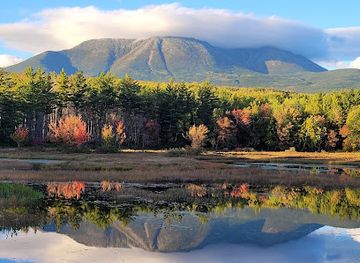
Baxter State Park
Explore the wild heart of Maine at Baxter State Park, where stunning landscapes and outdoor adventures await every visitor.
-
Tourist attraction
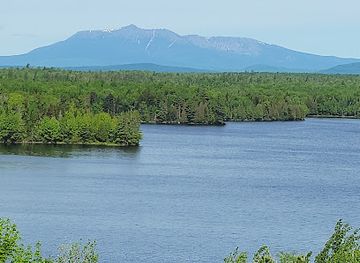
Mount Katahdin Scenic Overlook
Discover the stunning vistas of Mount Katahdin at this scenic overlook in Medway, Maine, perfect for nature lovers and outdoor enthusiasts.
-
Campground
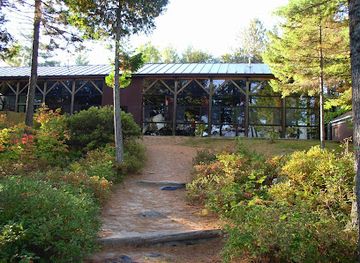
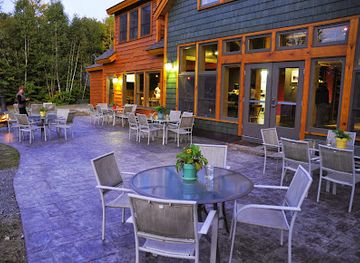
Penobscot Outdoor Center
Experience the thrill of nature at Penobscot Outdoor Center, your gateway to camping, cabin rentals, and unforgettable rafting adventures in Maine.
-
Campground
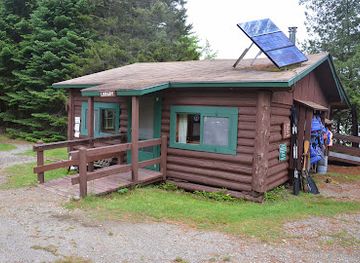
Daicey Pond Campground
Experience the tranquility and beauty of nature at Daicey Pond Campground in Millinocket, Maine, a perfect escape for outdoor enthusiasts and families.
Best landmarks in Mount Katahdin
The defining natural landmark is the Katahdin massif, whose principal summit, Baxter Peak, reaches 5,269 feet and forms the northern endpoint of the Appalachian Trail. The summit monument gives the long-distance route a memorable physical conclusion, while nearby Pamola Peak and the Knife Edge create one of the region’s most recognisable alpine ridges. On the eastern side, Chimney Pond lies beneath a dramatic cirque framed by Cathedral, South Turner and the surrounding walls of the massif. Hamlin Peak is a separate high point with broad views across Baxter State Park. At lower levels, Katahdin Stream, Roaring Brook and the extensive forested park landscape demonstrate the contrast between Maine’s lowland wilderness and its exposed alpine summit. These landmarks are valued not for monumental architecture but for their geological form, cultural associations, wilderness setting and place in the conservation history of northern Maine.
-
Mountain peak
Mt Katahdin
Discover the breathtaking beauty and adventurous spirit of Mt. Katahdin, Maine's highest peak, nestled within the stunning Baxter State Park.
-
Park
Appalachian Trail Northern Terminus
Explore the Appalachian Trail Northern Terminus in Millinocket, Maine – a breathtaking gateway to adventure and natural beauty.
Explore Mount Katahdin on the map
Plan your trip on one map. See where the top attractions, landmarks, restaurants and hotels are, and book hotels and experiences in a few clicks.
Best hotels in Mount Katahdin
Best restaurants in Mount Katahdin
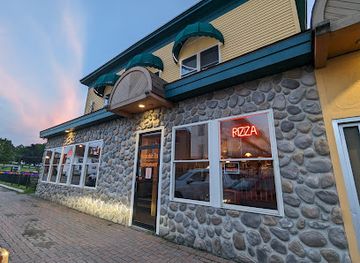
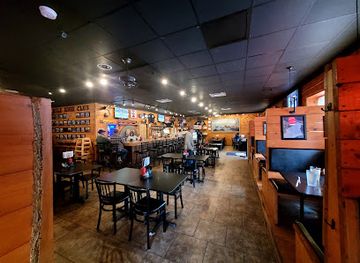
Mount Katahdin itself has no restaurant district, and Baxter State Park’s deliberately limited infrastructure means that hikers normally eat food brought from outside or arranged through permitted overnight facilities where applicable. The main concentration of cafés, diners, groceries and casual restaurants is in Millinocket, the principal southern gateway, with additional rural services in nearby communities such as East Millinocket and Patten depending on the approach. Regional food reflects northern Maine’s working landscape, with familiar New England fare, baked goods, hearty breakfasts, sandwiches and locally sourced products available in gateway settlements rather than on the mountain. Visitors heading into the park should obtain meals, snacks and extra water beforehand, as trailheads are not shopping or dining centres. Evening dining options are generally informal and community-oriented, and opening patterns can vary seasonally in this remote part of the state.
-
American
Scootic In Restaurant
Discover Scootic In Restaurant in Millinocket: A culinary delight offering American, Italian & seafood specialties amidst Maine's natural beauty.
-
Grill
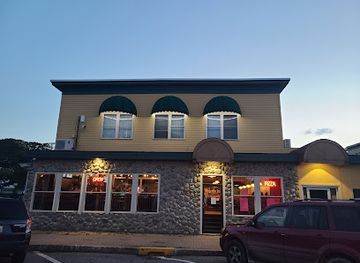
Sawmill Bar & Grill
Discover Sawmill Bar & Grill in Millinocket: where local flavors meet a cozy atmosphere for an unforgettable dining experience.
-
Brunch
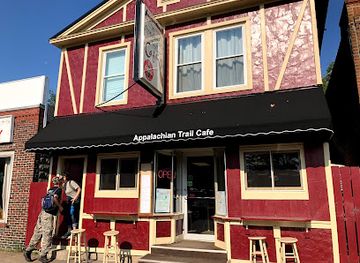
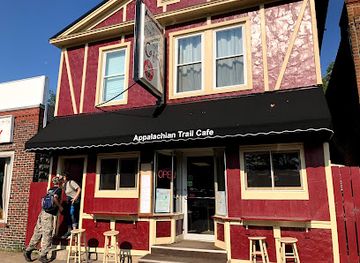
The Appalachian Trail Cafe
Experience delightful brunch at The Appalachian Trail Cafe in Millinocket, Maine - where comfort food meets adventure.
-
American
River Driver's Restaurant
Experience the best of American cuisine at River Driver's Restaurant in Millinocket, Maine – where flavor meets stunning natural beauty.
Best bars in Mount Katahdin
Katahdin is a wilderness mountain, so nightlife is limited and there are no clubs or entertainment districts within Baxter State Park. After a day outdoors, the evening atmosphere is more likely to centre on a traditional pub, inn, restaurant or accommodation common room in Millinocket and nearby settlements. These gateway communities serve hikers, hunting and fishing visitors, and residents of the surrounding forest region, giving social venues a practical, informal character rather than a late-night scene. Seasonal community events and occasional local performances may add variety, but visitors should not assume that a particular programme or venue will be operating. Within the park, evenings are defined by quiet campsites, dark skies and the need to prepare for the following day’s route, with park regulations taking precedence over entertainment.
-
American
Scootic In Restaurant
Experience the best of American, Italian, and seafood cuisine at Scootic In Restaurant in Millinocket, Maine.
-
Grill
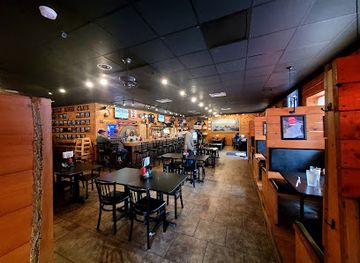
Sawmill Bar & Grill
Experience the best of Maine's culinary scene at Sawmill Bar & Grill, where fresh flavors and a cozy atmosphere await.
-
Brunch
The Appalachian Trail Cafe
Discover the delightful flavors of brunch at The Appalachian Trail Cafe, a must-visit spot for travelers in Millinocket, Maine.
-
Fast Food
McDonald's
Discover the comfort of classic fast food at McDonald's in Millinocket, Maine, where delicious meals meet affordability in a welcoming atmosphere.

Best shops in Mount Katahdin
Shopping at Mount Katahdin is concentrated outside the mountain in gateway communities, particularly Millinocket, where visitors can obtain groceries, fuel, outdoor essentials and locally made goods before entering Baxter State Park. Small businesses in the wider Katahdin region may offer Maine food products, crafts, artwork, books, clothing and equipment associated with the area’s outdoor culture, although the retail selection is modest compared with larger towns. Millinocket’s identity has been shaped by forestry, river travel and mountain tourism, and local products often reflect those connections rather than a formal luxury-shopping tradition. There are no shops on the summit or a conventional commercial centre inside the park. Advance planning is sensible for specialist hiking equipment, replacement supplies and substantial provisions, which may require travelling to a larger regional town outside the immediate gateway area.
-
General store
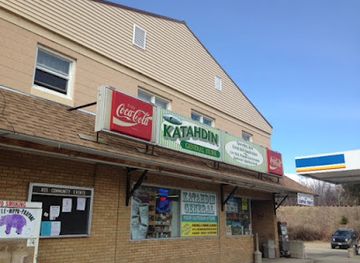
Katahdin General Store, LLC
Discover the heart of Millinocket at Katahdin General Store—your go-to stop for local goods, outdoor gear, and unique finds in Maine.
-
Grocery store
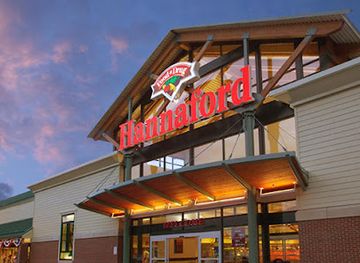
Hannaford
Explore the flavors of Maine at Hannaford in Millinocket, your essential stop for fresh groceries and local delights.
-
Grocery store
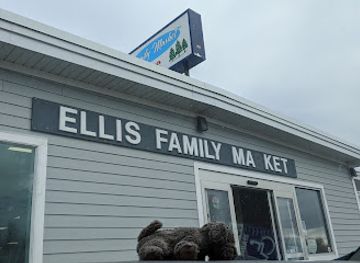
Ellis Family Market
Explore Ellis Family Market in East Millinocket, Maine – your destination for fresh local produce and unique local products.
-
Grocery store
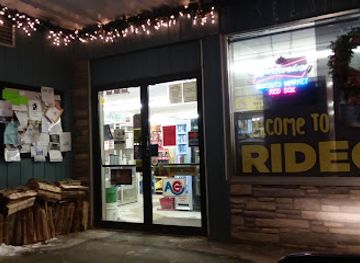
Rideout's AG Market
Explore the authentic flavors of Maine at Rideout's AG Market, your go-to grocery store in Millinocket for fresh produce and local specialties.
Get your free copy of our complete guide to Mount Katahdin, delivered straight to you.
Everything on this page, from attractions and restaurants to essentials and local phrases, in one PDF you can read offline, print or share.
Already have an account? Sign in
Your Mount Katahdin guide is ready.
We'll send it to · Not you? Sign out

Getting your guide ready…
We are putting together a fresh copy of the Mount Katahdin guide. This can take up to a minute.
This can take a few moments. If your browser asks, choose Allow so the download can start. You'll find the guide in your Downloads folder.
Nothing happened? Download it again
Sorry, the guide is taking longer than usual. Please try again in a minute, or get it by email instead.
Mount Katahdin essentials
Currency and Payment
Safety
Emergency Situations
Do's and Don'ts
Local Tips
From Eve
Local phrases worth knowing
You don't need to get them perfect. A few words go a long way, and locals appreciate the effort.
Basics
| English | Local | Say it |
|---|---|---|
| Hello | Wassup | [wah-suhp] |
| Goodbye | See ya | [see yah] |
| Yes | Yup | [yuhp] |
| No | Nah | [nah] |
| Please/You're welcome | Sure thing | [shur thing] |
| Thank you | Much obliged | [muhch uh-blahy-did] |
| Excuse me/Sorry | Pardon me | [pahr-dn me] |
| How are you? | How's it going? | [hows it goh-ing?] |
| Fine. And you? | Good. You? | [gud. yoo?] |
| Do you speak English? | Ya speak English? | [yah speak ing-glish?] |
| I don't understand | I'm lost | [ahm lohst] |
Eating & Drinking
| English | Local | Say it |
|---|---|---|
| I'd like to see the menu, please | Can I check the list? | [kan eye chek thee list?] |
| I don't eat meat | No meat for me | [noh meet fohr mee] |
| Cheers! | Cheers! | [cheers!] |
| I would like to pay, please | Please, the bill | [pleez, thee bil] |
Emergencies
| English | Local | Say it |
|---|---|---|
| Help! | Help! | [help!] |
| Go away! | Get lost! | [get lohst!] |
| Call the Police! | Call the cops! | [kahl thee cops!] |
| Call a doctor! | Get a doc! | [get a dok!] |
| I'm lost | I'm lost | [ahm lohst] |
| I'm ill | I'm sick | [ahm sik] |
Shopping
| English | Local | Say it |
|---|---|---|
| I'd like to buy... | I wanna buy... | [eye wah-nuh buy...] |
| I'm just looking | Just browsing | [just broh-zing] |
| How much is it? | How much? | [how much?] |
| That's too expensive | Too pricey | [too prye-see] |
| Can you lower the price? | Can you do better? | [kan yoo doh bet-ter?] |
Time & Numbers
| English | Local | Say it |
|---|---|---|
| What time is it? | What's the time? | [whats thee time?] |
| It's one o'clock | It's one | [its wuhn] |
| Half past (10) | Half ten | [haf ten] |
| Morning | Morning | [mohr-ning] |
| Afternoon | Afternoon | [af-ter-noon] |
| Evening | Evening | [eev-ning] |
| Yesterday | Yesterday | [yeh-ster-day] |
| Today | Today | [toh-day] |
| Tomorrow | Tomorrow | [toh-mor-row] |
| 1 | One | [wuhn] |
| 2 | Two | [too] |
| 3 | Three | [three] |
| 4 | Four | [fawr] |
| 5 | Five | [fahyv] |
| 6 | Six | [siks] |
| 7 | Seven | [sev-uhn] |
| 8 | Eight | [eyt] |
| 9 | Nine | [nahyn] |
| 10 | Ten | [ten] |
Transport & Directions
| English | Local | Say it |
|---|---|---|
| Where's a/the...? | Where's...? | [wheres...?] |
| What's the address? | Address? | [uh-dress?] |
| Can you show me (on the map)? | Show me (map)? | [shoh mee (map)?] |
| When's the next (bus)? | Next (bus)? | [nekst (bus)?] |
| A ticket (to ....) | Ticket (to ...) | [tik-it (to ...)] |
History of Mount Katahdin
A Sacred Mountain of the Penobscot
Mount Katahdin stands within the traditional homeland of the Penobscot Nation and holds enduring cultural significance for Indigenous communities of the region. The name is commonly translated from an Abenaki-related language as “Greatest Mountain”. Long before the arrival of European settlers, Indigenous peoples travelled through the wider Maine woods for hunting, fishing and seasonal movement. Katahdin’s prominence made it an important geographical reference point, while the surrounding rivers, lakes and forests formed part of a much larger cultural landscape rather than an isolated wilderness.
Early European Exploration
European knowledge of the mountain developed gradually through exploration of the Maine interior. In 1804, the surveyor and explorer Charles Turner Jr. made one of the earliest recorded ascents by a non-Indigenous visitor, reaching the summit with companions from the east. The mountain remained remote and difficult to approach, separated from settled coastal Maine by extensive forests and waterways. Reports of its scale and isolation contributed to the growth of scientific, surveying and exploratory interest in the northeastern interior during the nineteenth century.
Nineteenth-Century Settlement and Industry
The forests around Katahdin were increasingly shaped by the logging economy during the nineteenth century. Rivers such as the West Branch of the Penobscot supported the movement of timber, while settlements including Millinocket grew as transport and industrial centres. Logging altered access to the region but did not bring conventional urban development to the mountain itself. Artists, writers and naturalists also began visiting Katahdin, attracted by its exposed rock, dramatic cirques and contrast with the surrounding lowland forest.
Percival Baxter and the Creation of the Park
The modern conservation history of Katahdin is closely linked to Percival P. Baxter, a Maine governor and legislator who believed the mountain should remain protected from intensive development. Beginning in the 1930s, Baxter acquired and donated land to the state, helping establish the area that became Baxter State Park. His gifts continued over several decades, and the park’s governing principles developed around wilderness protection, limited mechanisation and restrained visitor infrastructure. The mountain is now the central feature of a preserve of more than 200,000 acres.
The Appalachian Trail and Modern Stewardship
Katahdin became the northern terminus of the Appalachian Trail, which extends roughly 2,190 miles to Springer Mountain in Georgia, when the long-distance footpath was completed in the 1930s. The trail’s endpoint at Baxter Peak gave the mountain an international profile among hikers, but Baxter State Park has continued to manage access more quietly than a conventional tourist attraction. Modern stewardship emphasises wilderness character, seasonal protection, careful trail use and the preservation of the mountain’s forests, alpine areas and waterways.
Mount Katahdin in Photos
Browse through our photo collection highlighting the charm and character of the destination.
Neighbouring destination travel guides
The closest destinations to Mount Katahdin, if you have time for more than one.
-

-
-

-

-
 Mount Desert Island
Discover Mount Desert Island in Maine: A blend of Acadia National Park's natural wonders, charming towns, and coastal adventures. Perfect for nature lovers and explorers.
Mount Desert Island
Discover Mount Desert Island in Maine: A blend of Acadia National Park's natural wonders, charming towns, and coastal adventures. Perfect for nature lovers and explorers.


Swipe for more destinations
Explore more

Explore more of Piscataquis County
Piscataquis County offers Moosehead Lake, Katahdin landscapes, forest trails, historic villages and spacious outdoor adventures in northern Maine.
Explore Piscataquis County
Explore more of Maine
Discover Maine's breathtaking landscapes, charming coastal towns, and rich cultural heritage. From Acadia's cliffs to fresh lobster feasts, Maine promises an unforgettable adventure.
Explore Maine