

Black Mesa State Park Travel Guide - Free Web & App
Your ultimate guide to Black Mesa State Park. Discover top landmarks, proposed trips, and local tips. Free on the web or via the Evendo companion app.


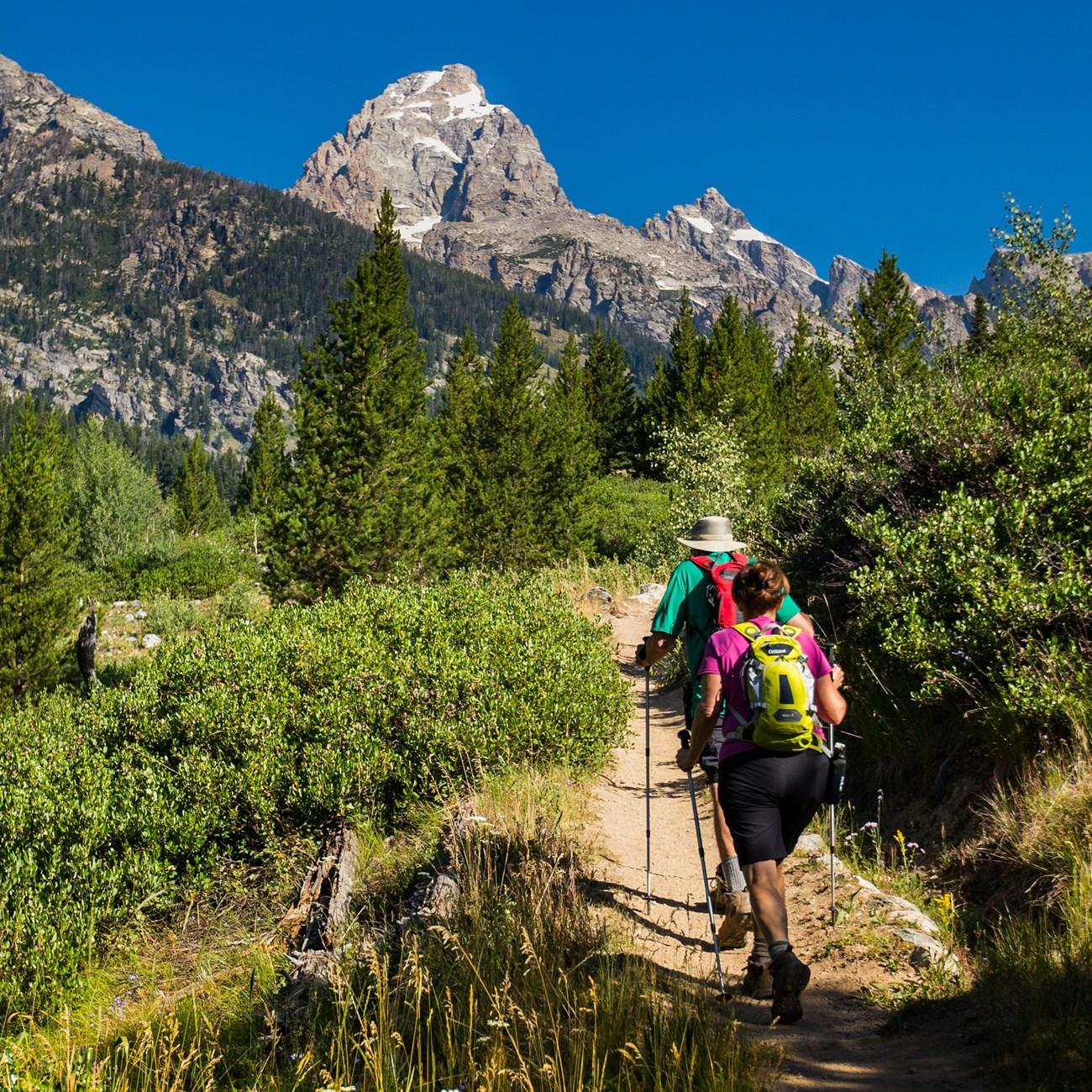


Black Mesa State Park in Oklahoma offers lake recreation, mesa landscapes, remote camping, fishing and some of the United States’ darkest skies.
A Remote Panhandle Landscape
Black Mesa State Park occupies a quiet corner of the Oklahoma Panhandle near the small settlement of Kenton, close to the New Mexico and Colorado borders. Its setting is defined by the stark relief of the mesa country, wide grasslands, dry air and the deep blue waters of Lake Carl Etling, a reservoir surrounded by the darker volcanic-looking ridges and arid plains of far-western Oklahoma. The park is a compact outdoor destination rather than a town-based resort, with camping, cabins, boating and fishing centred on the lake and its shoreline.Read more about Black Mesa State Park
Desert Light and Dark Skies
The Wider Black Mesa Region
When is the best time to visit Black Mesa State Park?
Best: April–May, October · 21–26°C| Month | High (°C) | Rainfall (mm) |
|---|---|---|
| January | 9 | 15 |
| February | 11 | 18 |
| March | 16 | 24 |
| April (best) | 21 | 30 |
| May (best) | 26 | 41 |
| June | 32 | 48 |
| July | 34 | 51 |
| August | 33 | 49 |
| September | 28 | 42 |
| October (best) | 22 | 32 |
| November | 16 | 24 |
| December | 10 | 17 |
Getting to and around Black Mesa State Park
How to get there
Transportation
Best landmarks in Black Mesa State Park
The defining natural landmark is the Black Mesa landscape itself, a series of dark, weathered uplands and eroded formations rising above the grasslands of Oklahoma’s Panhandle. Lake Carl Etling is the principal man-made feature within Black Mesa State Park and gives the otherwise dry setting a concentrated body of water for recreation. Nearby Black Mesa Nature Preserve contains Oklahoma’s highest natural point, but it is separately managed and should be treated as a neighbouring landmark rather than part of the state park. Kenton provides the area’s small historic settlement context, while the broad Cimarron County plains express the region’s ranching and frontier geography. Together, mesa, reservoir, grassland and immense sky form a landmark landscape defined more by geological character and distance than by monumental architecture.
-
State park
Black Mesa State Park & Nature Preserve
Explore the captivating landscapes and rich biodiversity of Black Mesa State Park & Nature Preserve in Oklahoma, a paradise for nature lovers.
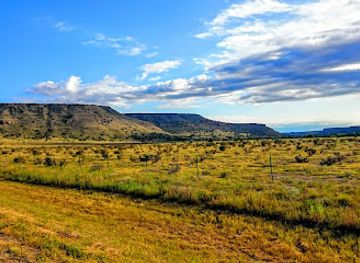
Explore Black Mesa State Park on the map
Plan your trip on one map. See where the top attractions, landmarks, restaurants and hotels are, and book hotels and experiences in a few clicks.
Best hotels in Black Mesa State Park
Best bars in Black Mesa State Park
Black Mesa State Park has no urban nightlife district and should be approached as a quiet, rural destination. Evening activity centres on the lake, campsite or cabin, conversation and the exceptionally open night sky rather than clubs or late-night entertainment. Traditional small-town hospitality and any available evening refreshments are more likely to be found in Boise City or other regional settlements than at the park or in Kenton, and visitors should check local arrangements rather than expect a broad choice of venues. The lack of artificial light is one of the area’s principal evening attractions, making stargazing an appropriate after-dark activity when skies are clear. Keep lighting subdued, respect other campers and observe all park rules concerning fires, quiet hours and shoreline access.
-
State park
Black Mesa State Park & Nature Preserve
Explore Black Mesa State Park & Nature Preserve, Oklahoma's highest point, where stunning landscapes and diverse wildlife await adventure seekers.
Best shops in Black Mesa State Park
Shopping opportunities around Black Mesa State Park are modest and practical. Kenton is the nearest community, but visitors should obtain groceries, fuel, outdoor supplies and other essentials in Boise City or another larger regional service centre before travelling towards the park. The area is not known for an extensive retail district, permanent craft market or concentration of specialist boutiques. Small-town and ranch-country products may appear through local businesses or regional events, but availability is variable and should not be assumed. Outdoor equipment, food for self-catering and provisions for a remote stay are more useful purchases than souvenirs. Visitors who want locally made art, regional gifts or additional retail choice may need to include a wider Panhandle road journey rather than expecting such facilities within the park itself.
-
State park
Black Mesa State Park & Nature Preserve
Explore Black Mesa State Park & Nature Preserve, a stunning destination in Oklahoma known for its breathtaking landscapes, diverse wildlife, and rich cultural history.
Get your free copy of our complete guide to Black Mesa State Park, delivered straight to you.
Everything on this page, from attractions and restaurants to essentials and local phrases, in one PDF you can read offline, print or share.
Already have an account? Sign in
Your Black Mesa State Park guide is ready.
We'll send it to · Not you? Sign out

Getting your guide ready…
We are putting together a fresh copy of the Black Mesa State Park guide. This can take up to a minute.
This can take a few moments. If your browser asks, choose Allow so the download can start. You'll find the guide in your Downloads folder.
Nothing happened? Download it again
Sorry, the guide is taking longer than usual. Please try again in a minute, or get it by email instead.
Black Mesa State Park essentials
Currency and Payment
Safety
Emergency Situations
Do's and Don'ts
Local Tips
From Eve
Local phrases worth knowing
You don't need to get them perfect. A few words go a long way, and locals appreciate the effort.
Basics
| English | Local | Say it |
|---|---|---|
| Hello | Howdy | [hah-dee] |
| Goodbye | See ya later | [see ya lay-ter] |
| Yes | Yep | [yep] |
| No | Nah | [nah] |
| Please/You're welcome | Please and thank ya | [pleez and thank ya] |
| Thank you | Much obliged | [muhch uh-blahy-d] |
| Excuse me/Sorry | Pardon me | [pahr-dn me] |
| How are you? | How y'all doin'? | [haw y'all doin'] |
| Fine. And you? | Fine too. How 'bout you? | [fahyn too. How 'bout yoo] |
| Do you speak English? | Ya speak English? | [ya speak ing-glish] |
| I don't understand | I ain't catchin' on | [ahy eent kach-in awn] |
Eating & Drinking
| English | Local | Say it |
|---|---|---|
| I'd like to see the menu, please | Can I take a gander at the grub list? | [kan eye tayk uh gand-er at the gruhb list] |
| I don't eat meat | I don't do meat | [ahy don't do meat] |
| Cheers! | Bottoms up! | [bah-tuhmz uhp] |
| I would like to pay, please | I reckon I'll settle up now, if'n ya don't mind | [ahy rek-uhn ayl set-uhl uhp now, if'n ya dohnt mynd] |
Emergencies
| English | Local | Say it |
|---|---|---|
| Help! | I need a hand! | [ahy need uh hand] |
| Go away! | Shoo! | [shoo] |
| Call the Police! | Ring up the Sheriff! | [ring uhp the sher-iff] |
| Call a doctor! | Get a sawbones over here! | [get uh saw-bohnz oh-ver heer] |
| I'm lost | Done lost my way | [duhn lost mah way] |
| I'm ill | Feelin' poorly | [feel-in' poor-lee] |
Shopping
| English | Local | Say it |
|---|---|---|
| I'd like to buy... | I'm fixin' to purchase... | [ahy'm fik-sin tuh pur-chuhs] |
| I'm just looking | I'm just browsin' | [ahy'm jehst brow-zin'] |
| How much is it? | How much fer that? | [haw much fur that] |
| That's too expensive | That's mighty pricey | [that's my-tee pry-see] |
| Can you lower the price? | Can ya drop the tag a bit? | [kan yuh drop the tag uh bit] |
Time & Numbers
| English | Local | Say it |
|---|---|---|
| What time is it? | What's the hour? | [whuts the ow-er] |
| It's one o'clock | It's one bells | [its wuhn belz] |
| Half past (10) | Half past ten | [haf past ten] |
| Morning | Mornin' | [mawrn-in] |
| Afternoon | Afternoon | [af-ter-noon] |
| Evening | Evenin' | [ee-vuh-nin] |
| Yesterday | Yest'day | [yes-t'day] |
| Today | Today | [toh-day] |
| Tomorrow | Tomorra | [tuh-mor-uh] |
| 1 | One | [wuhn] |
| 2 | Two | [too] |
| 3 | Three | [three] |
| 4 | Four | [four] |
| 5 | Five | [five] |
| 6 | Six | [six] |
| 7 | Seven | [sev-uhn] |
| 8 | Eight | [ayt] |
| 9 | Nine | [niyn] |
| 10 | Ten | [ten] |
Transport & Directions
| English | Local | Say it |
|---|---|---|
| Where's a/the...? | Where's the... | [wheres the] |
| What's the address? | What's the locashun? | [whuts the loh-ka-shun] |
| Can you show me (on the map)? | Kin ya pint it out? | [kin yuh pynt it out] |
| When's the next (bus)? | When's the next stagecoach? | [whens the next stayj-coach] |
| A ticket (to ....) | A pass (ta ....) | [uh pass ta] |
History of Black Mesa State Park
Geology of the High Plains
Black Mesa’s landscape reflects the geological history of the southern High Plains, where layers of sedimentary rock were shaped by erosion and the action of ancient rivers and changing climates. The mesa forms are remnants of more extensive surfaces that once covered parts of the region, while the Cimarron River drainage helped cut the surrounding country into valleys, escarpments and isolated uplands. The resulting terrain differs sharply from the flatter agricultural plains farther east and gives the Oklahoma Panhandle its distinctive mesa-and-grassland character.
Indigenous Landscapes and Early Travel
Long before the modern park existed, the Panhandle was traversed and occupied by Indigenous peoples whose lives were connected to the region’s grasslands, river corridors and seasonal water sources. Later, Hispanic, Mexican and American travellers crossed the wider Cimarron country along routes associated with trade, migration and westward movement. The scarcity of reliable water made springs, rivers and lakes especially important, and the broader landscape retains traces of the changing relationships between people, livestock, transport and the semi-arid environment.
Settlement in Cimarron County
Permanent settlement developed slowly in the far western Panhandle because of distance, limited rainfall and the challenges of farming and ranching on the open plains. Kenton became the area’s best-known local settlement, while Boise City developed farther east as the county seat and principal service centre. Ranching, small-scale agriculture and transport shaped the regional economy, but the population remained sparse. That limited development is central to the area’s present character, preserving long views and reducing artificial light across the mesa country.
Creation of the State Park
Black Mesa State Park grew around Lake Carl Etling, a constructed reservoir that provided a recreational focus in a remote part of Oklahoma. State-park development introduced facilities for camping, cabins and lakeside activities without changing the area’s fundamentally rural character. Visitors now use the park as a base for fishing, boating where permitted, scenery and night-sky observation, while the nearby Black Mesa Nature Preserve protects a separate landscape known for Oklahoma’s highest point. Conservation and recreation remain closely linked in this sparsely settled region.
Black Mesa State Park in Photos
Browse through our photo collection highlighting the charm and character of the destination.
Neighbouring destination travel guides
The closest destinations to Black Mesa State Park, if you have time for more than one.
-

-

-

-

-


Swipe for more destinations
Explore more

Explore more of Panhandle
Explore Oklahoma’s Panhandle for Black Mesa, dark skies, open High Plains, frontier history and wide-ranging outdoor scenery.
Explore Panhandle
Explore more of Oklahoma
Discover Oklahoma: Where the spirit of the Old West meets modern charm, offering a rich mix of history, nature, and vibrant culture in the heart of the United States.
Explore Oklahoma