

Old Town (Lucerne) Travel Guide - Free
Explore Old Town in Lucerne with Evendo's free guide. Find the best shops, historic streets, restaurants, and gems on web or mobile.


Old Town Lucerne reveals medieval squares, covered bridges, lake views, historic guild houses, Swiss dining and atmospheric walks beside the Reuss.
Medieval Streets beside the Reuss
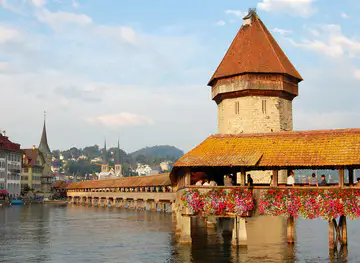
Lucerne’s Old Town, or Altstadt, occupies the historic centre on the north bank of the Reuss, facing the lake and linked to the modern city by the famous Chapel Bridge. Its compact streets unfold around squares such as Weinmarkt, Hirschenplatz and Kornmarkt, where painted façades, guild houses, fountains and restaurant terraces give the district much of its visual character. Although heavily visited, it remains a working urban quarter rather than an open-air museum, with residents, offices, cafés and small shops sharing the same medieval street plan.Read more about Old Town
Bridges, Churches and City Walls
Everyday Life and Visitor Culture
Explore Old Town on the map
A handpicked selection of must-see spots in Old Town, mapped for you.
Best hotels in Old Town
Old Town essentials
Getting There
Getting Around
Safety
Emergency Situations
Do's and Don'ts
Local Tips

From Eve
Local phrases worth knowing
You don't need to get them perfect. A few words go a long way, and locals appreciate the effort.
Basics
| English | Local | Say it |
|---|---|---|
| Hello | Grüezi | [grew-eh-tsee] |
| Goodbye | Uf Wiederluege | [oof vee-der-loo-geh] |
| Yes | Ja | [yah] |
| No | Nei | [n-eye] |
| Please/You're welcome | Bitte | [bit-teh] |
| Thank you | Merci | [mehr-see] |
| Excuse me/Sorry | Es tut mir leid | [ess toot meer lied] |
| How are you? | Wie goht's? | [vee gohts] |
| Fine. And you? | Guet. Und dir? | [gweet. oont deer] |
| Do you speak English? | Redsch Du Änglisch? | [redsh doo ang-leesh] |
| I don't understand | Ich verstand nid | [eech fer-shtahnt need] |
Eating & Drinking
| English | Local | Say it |
|---|---|---|
| I'd like to see the menu, please | Ich möcht d'Menu luege, bitte | [eech merkht dee-meh-noo loo-geh, bit-teh] |
| I don't eat meat | Ich esse kai Fleisch | [eech ess-eh kigh flysh] |
| Cheers! | Prost! | [prohst] |
| I would like to pay, please | Ich möchte zahle, bitte | [eech merkht-eh tsah-luh, bit-teh] |
Emergencies
| English | Local | Say it |
|---|---|---|
| Help! | Hilf! | [hilf] |
| Go away! | Gang weg! | [gahng vehg] |
| Call the Police! | Ruef d'Polizei! | [roof dee-poh-lee-tsey] |
| Call a doctor! | Ruef en Dokter! | [roof en dohk-ter] |
| I'm lost | Ich ha mich verlaufen | [eech hah meekh fer-lah-oof-ehn] |
| I'm ill | Ich bin krank | [eech been krah-nk] |
Shopping
| English | Local | Say it |
|---|---|---|
| I'd like to buy... | Ich möcht ... koufe | [eech merkht ... kow-fuh] |
| I'm just looking | Ich lueg nur | [eech loo-ehg noor] |
| How much is it? | Wieviel koschtet das? | [vee-vee-ehl kohshtet dahs] |
| That's too expensive | Das isch z' teuer | [dahs ish tsoo toy-er] |
| Can you lower the price? | Chasch Du de Priis reduziere? | [khasch doo duh prees reh-doo-tsee-eh-reh] |
Time & Numbers
| English | Local | Say it |
|---|---|---|
| What time is it? | Wieviel Uhr isch es? | [vee-vee-ehl oor ish es] |
| It's one o'clock | Es isch eis Uhr | [ess ish eyes oor] |
| Half past (10) | Halb nach (10) | [halb nahk (tsehn)] |
| Morning | Morge | [mohr-ge] |
| Afternoon | Namitag | [nah-mee-tahg] |
| Evening | Abig | [ah-beek] |
| Yesterday | Gester | [geh-stehr] |
| Today | Hüt | [hoot] |
| Tomorrow | Morn | [mohrn] |
| 1 | Eis | [eyes] |
| 2 | Zwei | [tsvey] |
| 3 | Drei | [drey] |
| 4 | Vier | [feer] |
| 5 | Fünf | [foonf] |
| 6 | Sechs | [zehks] |
| 7 | Sieben | [zee-ben] |
| 8 | Acht | [ahkt] |
| 9 | Neun | [noyn] |
| 10 | Zehn | [tsehn] |
Transport & Directions
| English | Local | Say it |
|---|---|---|
| Where's a/the...? | Wo isch ...? | [voh ish] |
| What's the address? | Was isch d'Adresse? | [vahs ish dah-dreh-ssuh] |
| Can you show me (on the map)? | Chasch Du mer (uf em Plan) zeige? | [khasch doo mehr (oof em plahn) tsigh-eh] |
| When's the next (bus)? | Wänn fahrt dr nächscht (Bus)? | [ven fairt dur nekh-sht (boos)] |
| A ticket (to ....) | E Billett (nach ...) | [eh bill-let (nahkh)] |
History of Old Town
Monastery Settlement and Early Lucerne
Lucerne developed around the monastery of St Leodegar im Hof, whose foundations lie just beyond the present Old Town core, and the settlement’s name is recorded in medieval forms including Luciaria. Its position at the northern end of Lake Lucerne made it a useful staging point between the lake routes and the roads across central Switzerland. As trade and transport increased, activity concentrated around the Reuss crossings and the growing market settlement on the river’s north bank, establishing the compact urban pattern that still defines the Altstadt.
The Gotthard Route and Urban Growth
The opening of the Gotthard route in the medieval period strengthened Lucerne’s role as a commercial and political centre. The town expanded its fortifications, including the Musegg Wall and towers, while bridges across the Reuss connected markets and neighbourhoods on both banks. Lucerne entered the Swiss Confederation in 1332, bringing the town more closely into the political network that controlled movement and trade through central Switzerland. The Old Town’s squares, guild houses and riverfront streets grew from this combination of commerce, civic government and defensive planning.
Guilds, Churches and Civic Architecture
During the early modern period, Lucerne’s prosperity and Catholic identity shaped the appearance of its historic centre. Merchant and craft guilds occupied prominent buildings around the market squares, while churches and religious institutions influenced the skyline and public life. The Jesuit Church, begun in the seventeenth century beside the Reuss, introduced a grand Baroque interior and façade to the medieval townscape. The Rathaus at Kornmarkt, with its Renaissance-influenced civic design and arcades, expressed the authority of the local government and remains one of the Old Town’s principal historic buildings.
Tourism, Preservation and Renewal
Nineteenth-century steam navigation on Lake Lucerne and the arrival of the railway in 1859 helped turn Lucerne into an international tourist centre, increasing attention to its bridges, waterfront and historic streets. The Old Town retained its medieval layout while adapting buildings for hotels, shops and restaurants. A major fire destroyed much of the Chapel Bridge roof in 1993, including most of its historic paintings; the bridge was subsequently rebuilt, with surviving and restored elements incorporated into the structure. Today, conservation and tourism continue alongside ordinary residential and commercial life.
Old Town in Photos
Browse through our photo collection highlighting the charm and character of the destination.
Neighbourhoods near Old Town
The closest neighbourhoods to Old Town, if you have time for more than one stop.
-

-
-


Swipe for more neighbourhoods
Explore more

Explore more of Lucerne
Lucerne pairs its covered wooden bridges and lake views with Swiss history, mountain excursions, museums and a beautifully preserved old town to explore.
Explore Lucerne