

Queen Victoria Statue, Aberdeen Travel Guide
Free Guide: Bronze tribute to a beloved monarch, marking Aberdeen's elegant West End and the city's royal heritage.


A brief summary of Queen Victoria Statue
Bronze tribute to a beloved monarch, marking Aberdeen's elegant West End and the city's royal heritage.
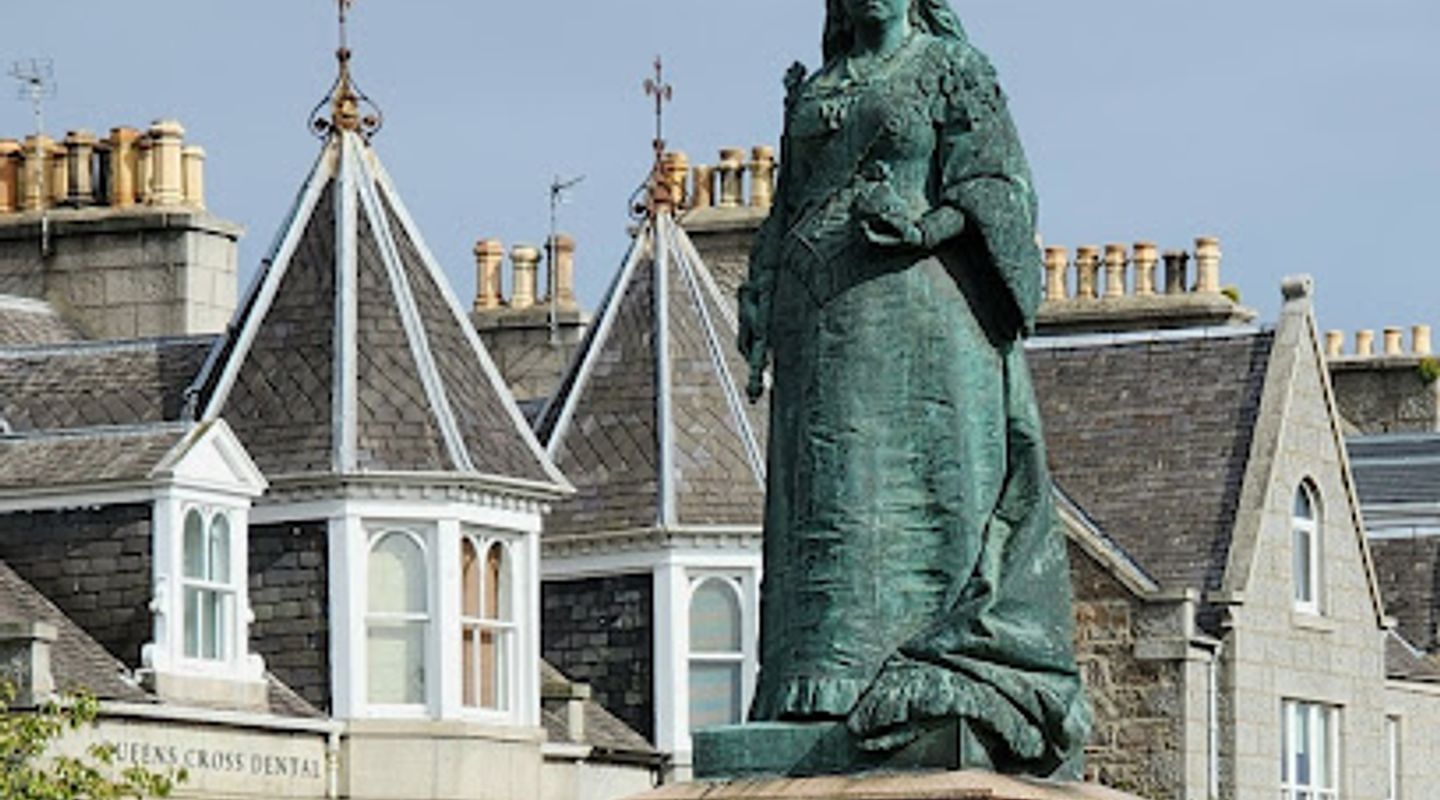
A striking bronze statue of Queen Victoria stands at the heart of Aberdeen's West End, marking the beginning of one of Scotland's most elegant neighborhoods. Originally sculpted in marble by Alexander Brodie in 1866, this iconic monument was replaced by Charles Birch's bronze version in 1964 and relocated to its present position at Queen's Cross roundabout. The statue faces west toward Balmoral, the Queen's Scottish residence, and remains a beloved landmark celebrating Aberdeen's deep historical connection to the British monarchy.
On-site amenities
 Restrooms
 Drink options
 Food options
 Seating areas
 Information boards
- Address
- Aberdeen AB15 4YD
- Website
Getting there
Bus
Walking
Taxi or Ride-Share
Bicycle
Discover more about Queen Victoria Statue
A Monument Born from Royal Controversy
The story of Queen Victoria's statue in Aberdeen begins with artistic disagreement. In 1863, sculptor Baron Carlo Marochetti unveiled a marble statue of Prince Albert at the corner of St. Nicholas Street, an event that marked Queen Victoria's first public appearance following her husband's death two years earlier. The installation sparked considerable local debate, prompting prominent citizens to propose an alternative memorial—this time honoring the Queen herself. At a public meeting, Alexander Donald of the Royal Tradesmen of Aberdeen proposed that "a colossal statue in marble, of Her Majesty, be erected at the corner of St. Nicholas Street." Public subscription funds were raised, and Scottish sculptor Alexander Brodie received the prestigious commission.
Royal Sittings and Scottish Symbolism
Brodie's work became his grandest achievement. The sculptor traveled to Balmoral Castle to conduct personal sittings with Queen Victoria, an extraordinary honor that allowed him to capture her likeness with intimate accuracy. The statue's most distinctive feature emerged by royal command: instead of court robes, the Queen wears a plaid of Royal Stewart tartan, a distinctly Scottish element that reflected the monarch's deep affection for the Highlands. Carved from Sicilian marble and standing 8 feet 6 inches tall on a plinth of pink Peterhead granite, the statue was unveiled on 20 September 1866 by Prince Albert Edward, the future King Edward VII, who praised Aberdeen's loyalty and the Queen's appreciation for the city's sympathy during her period of mourning.
Preservation and Relocation Through the Centuries
For over two decades, Brodie's marble masterpiece graced the junction of Union Street and Nicholas Street, becoming a cherished symbol of Aberdeen's connection to the royal family. However, Scotland's harsh weather posed a constant threat to the delicate marble. In 1888, the statue was moved indoors to the foyer of Aberdeen's Town House to protect it from the elements—a decision that preserved this irreplaceable artwork for future generations. Today, visitors can still view Brodie's original marble creation within the Town House, a testament to its enduring significance.
The Bronze Successor at Queen's Cross
When the original location required redevelopment for a new Marks and Spencer store in 1964, a replacement statue was commissioned. Sculptor Charles Birch, who had previously created marble statues of the Queen for royal patrons, was selected to produce a bronze version. This new statue was positioned at Queen's Cross, the prominent roundabout where Fountainhall Road, Queen's Road, St Swithin Street, Albyn Place, and Carden Place intersect. Unlike Brodie's youthful depiction, Birch's bronze portrays Victoria as a more mature, matronly figure—reflecting the Queen as she appeared in her later years. The statue was deliberately oriented to face west, gazing up Queen's Road toward Balmoral, symbolically acknowledging the Queen's beloved Scottish retreat.
A Landmark of the West End
Today, the bronze statue at Queen's Cross serves as the gateway to Aberdeen's prestigious West End, a neighborhood characterized by elegant Victorian architecture constructed from local gray granite. The roundabout itself has become a focal point of the district, surrounded by historic mansion houses that have been converted into exclusive restaurants, bars, and finance offices. The statue remains a powerful symbol of Aberdeen's Victorian heritage and the city's enduring ties to the British monarchy, drawing both locals and visitors who pause to appreciate this remarkable piece of Scottish sculptural history.
Evendo Review Centre
 Google
Guest reviews
Best time to go
Quietest: Jan, Feb & Nov · before 6am or at 10pm
Busy times are Evendo estimates for a typical year, to help you plan. Actual crowds vary with events, school holidays and the weather.
Explore Queen Victoria Statue on the map
A handpicked selection of must-see spots near Queen Victoria Statue, mapped for you.
Get your free copy of our complete guide to Queen Victoria Statue, delivered straight to you.
Everything on this page, from opening hours and how to get there to Eve’s tips and the best time to go, in one PDF you can read offline, print or share.
Already have an account? Sign in
Your Queen Victoria Statue guide is ready.
We'll send it to · Not you? Sign out

Getting your guide ready…
We are putting together a fresh copy of the Queen Victoria Statue guide. This can take up to a minute.
This can take a few moments. If your browser asks, choose Allow so the download can start. You'll find the guide in your Downloads folder.
Nothing happened? Download it again
Sorry, the guide is taking longer than usual. Please try again in a minute, or get it by email instead.
Other nearby places you may find interesting
The closest places of the same kind, if this one is not quite what you had in mind.
-
-
-
-
-


Swipe for more places
More to explore near Queen Victoria Statue

 Best experiences near Queen Victoria Statue
 Best hotels near Queen Victoria Statue
 Best landmarks near Queen Victoria Statue
 Best attractions near Queen Victoria Statue
 Best shops near Queen Victoria Statue
 Best restaurants near Queen Victoria Statue
 Best bars near Queen Victoria Statue
Do you manage this location?
Take control to get all the benefits, like improved information, better appearance, and stronger visibility across AI-powered discovery.
Explore more

Explore more of Aberdeen
Discover Aberdeen's sparkling granite architecture, rich maritime heritage, and scenic coastal beauty along Scotland's northeast coast.
Explore Aberdeen
Explore more of United Kingdom
Discover the United Kingdom: A blend of rich history, stunning landscapes, and vibrant cities, offering a unique travel experience for every visitor.
Explore United Kingdom
