Royal Border Bridge Travel Guide
Free Guide: Victorian engineering triumph spanning the River Tweed—still carrying trains 175 years after Queen Victoria's opening.


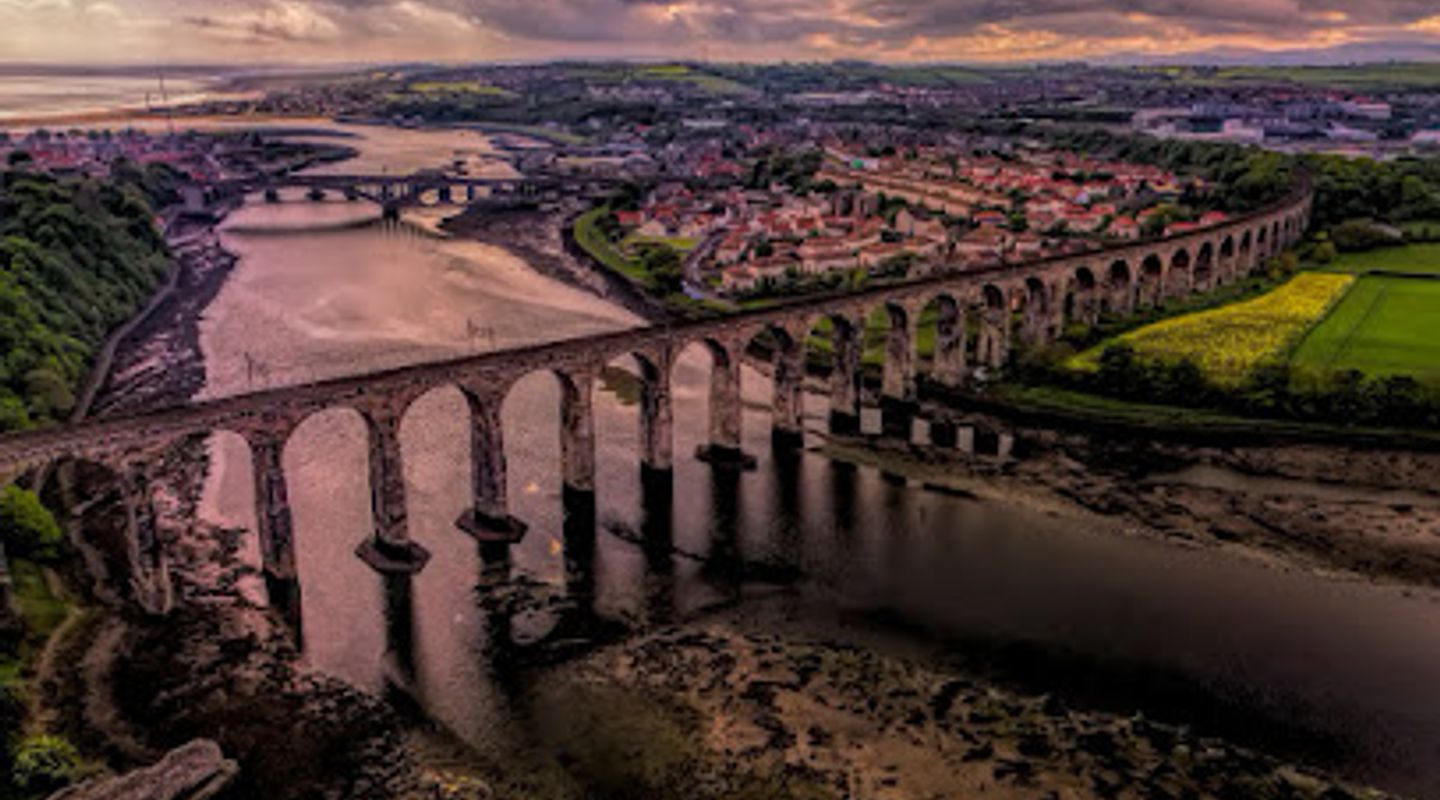
A brief summary of Royal Border Bridge
Victorian engineering triumph spanning the River Tweed—still carrying trains 175 years after Queen Victoria's opening.
An iconic Grade I listed railway viaduct spanning the River Tweed at Berwick-upon-Tweed, designed by Robert Stephenson and opened by Queen Victoria in 1850. This magnificent Victorian engineering feat features 28 stone arches and stands 37 metres above the river, carrying the East Coast Main Line between London and Edinburgh. Still in active use today, the bridge is one of the most recognisable landmarks in Northumberland and offers stunning views from the riverside walk below.
On-site amenities
 Restrooms
 Food options
 Drink options
 Information boards
 Seating areas
Opening hours
- Every dayOpen 24 hours
Opening hours as listed on the venue’s Google Business Profile. Hours can change for services and special events, so check with the venue before you go.
- Address
- River Tweed
- Website
Getting there
Train
Car
Bus
Walking
Discover more about Royal Border Bridge
A Victorian Masterpiece of Engineering
The Royal Border Bridge stands as one of the finest examples of 19th-century railway engineering. Designed by Robert Stephenson, the renowned son of railway pioneer George Stephenson, this Grade I listed viaduct was constructed between 1847 and 1850 to complete the vital rail link between London and Edinburgh. The bridge's foundation stone was laid on 15 May 1847, and after three years of intensive construction, Queen Victoria herself officially opened the bridge on 29 August 1850, granting her permission for it to bear the royal name.The structure's physical dimensions are genuinely impressive. Stretching 659 metres in length, the bridge comprises 28 elegant stone arches, each spanning 60 feet, and rises 37 metres above the River Tweed. The construction employed stone facing over brick soffits, creating a visually harmonious structure that draws inspiration from Roman viaducts. The bridge's 29 piers are ingeniously set into the riverbed and protected from the Tweed's strong tidal currents by cutwaters, demonstrating the meticulous engineering that ensures its longevity.
Strategic Importance and Economic Transformation
Beyond its architectural significance, the Royal Border Bridge proved transformative for Berwick-upon-Tweed itself. The town had languished economically following its decline as a border stronghold, but the bridge's completion provided a vital connection to the national railway network. This connection revitalised local trade and tourism, breathing new life into a community that had struggled for generations. The bridge became the final missing link in the continuous railway line connecting the two great cities of London and Edinburgh, making it strategically crucial to Britain's transport infrastructure.
Resilience Through War and Modernisation
During World War II, the Royal Border Bridge became a target of German bombing campaigns, yet it survived every attack and continued operating throughout the conflict. This resilience reflected both its robust construction and its critical importance to the war effort. In 1989, the bridge underwent electrification as part of the wider East Coast Main Line modernisation scheme, enabling faster and more efficient train services. Between 1993 and 1996, the structure underwent its first major restoration project in over a century, with work funded partly by English Heritage, strengthening it to accommodate heavier modern trains while preserving its historic character.
A Living Monument to Industrial Heritage
Today, the Royal Border Bridge remains fully operational, carrying thousands of passengers daily on the East Coast Main Line. Unlike many historic structures consigned to museums or monuments, this bridge continues its original purpose, making it a living testament to Victorian engineering excellence. The bridge cannot be crossed on foot—it is exclusively a railway structure—but visitors can experience its grandeur from multiple vantage points, particularly from the riverside walk that runs beneath its soaring arches, offering breathtaking perspectives of the stonework and engineering detail.
Visual Drama and Seasonal Splendour
The bridge's appearance transforms throughout the day and seasons. At sunset, the warm light catches the stone arches, creating particularly dramatic and photogenic conditions. From the riverside promenade and Castle Vale Park, visitors gain unobstructed views of the entire structure rising majestically above the water. The bridge is visible from numerous points around Berwick-upon-Tweed, including from the town's Elizabethan walls and from the Royal Tweed Bridge, where it frames the medieval character of the old town against the modern railway infrastructure.
Evendo Review Centre
 Google
Guest reviews
Best time to go
Quietest: Jan, Feb & Dec · before 6am or at 10pm
Busy times are Evendo estimates for a typical year, to help you plan. Actual crowds vary with events, school holidays and the weather.
Explore Royal Border Bridge on the map
A handpicked selection of must-see spots near Royal Border Bridge, mapped for you.
Get your free copy of our complete guide to Royal Border Bridge, delivered straight to you.
Everything on this page, from opening hours and how to get there to Eve’s tips and the best time to go, in one PDF you can read offline, print or share.
Already have an account? Sign in
Your Royal Border Bridge guide is ready.
We'll send it to · Not you? Sign out

Getting your guide ready…
We are putting together a fresh copy of the Royal Border Bridge guide. This can take up to a minute.
This can take a few moments. If your browser asks, choose Allow so the download can start. You'll find the guide in your Downloads folder.
Nothing happened? Download it again
Sorry, the guide is taking longer than usual. Please try again in a minute, or get it by email instead.
Other nearby places you may find interesting
The closest places of the same kind, if this one is not quite what you had in mind.
-
-
-
-
-


Swipe for more places
More to explore near Royal Border Bridge

 Best experiences near Royal Border Bridge
 Best hotels near Royal Border Bridge
 Best landmarks near Royal Border Bridge
 Best attractions near Royal Border Bridge
 Best shops near Royal Border Bridge
 Best restaurants near Royal Border Bridge
 Best bars near Royal Border Bridge
Do you manage this location?
Take control to get all the benefits, like improved information, better appearance, and stronger visibility across AI-powered discovery.
Explore more
Explore more of Berwickshire
Discover Berwickshire: A blend of coastal beauty, historic landmarks, and charming villages in Scotland's serene southeastern corner.
Explore Berwickshire
Explore more of United Kingdom
Discover the United Kingdom: A blend of rich history, stunning landscapes, and vibrant cities, offering a unique travel experience for every visitor.
Explore United Kingdom