Wren Library, Cambridge Travel Guide
Free Guide: Christopher Wren's 1695 library at Trinity College displays rare manuscripts and carved interiors within a working academic space open for limited weekday visits.


A brief summary of Wren Library
Christopher Wren's 1695 library at Trinity College displays rare manuscripts and carved interiors within a working academic space open for limited weekday visits.
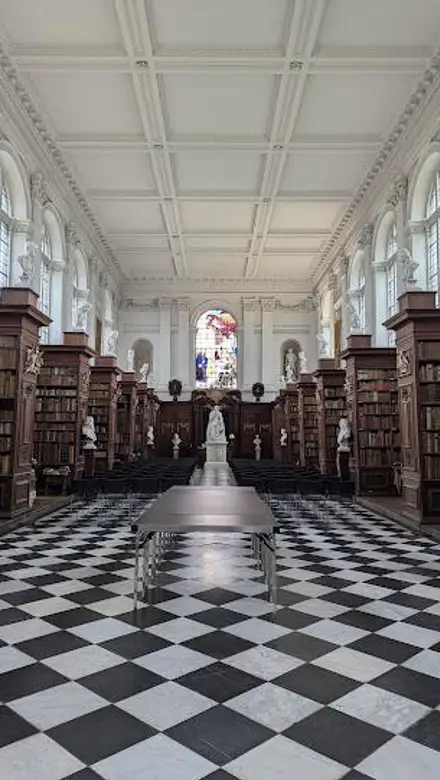
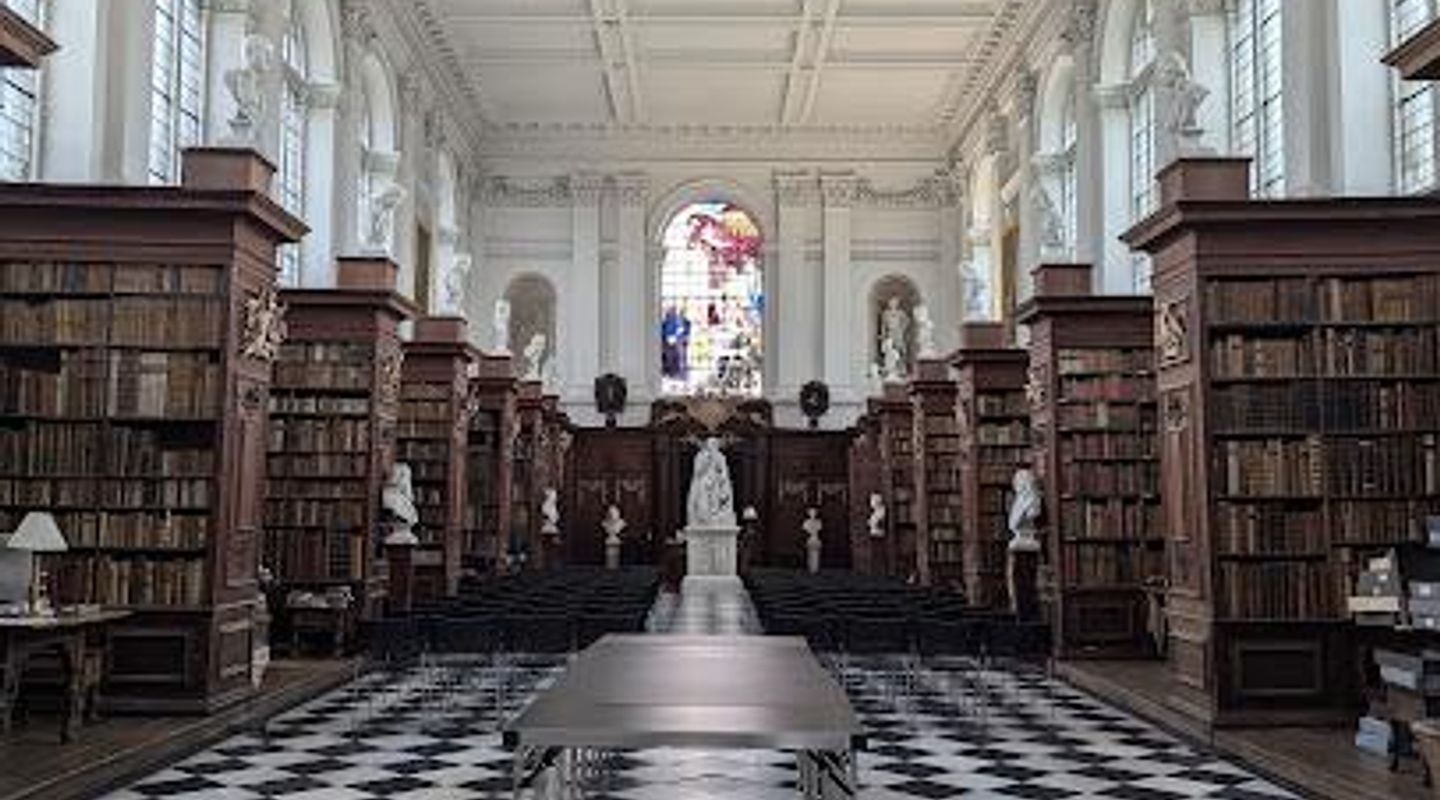
The Wren Library occupies the first floor of a Christopher Wren-designed building completed in 1695 within Trinity College. Visitors walk a long single room lined with perpendicular book stacks, limewood carvings by Grinling Gibbons, marble busts and a Thorvaldsen statue of Byron beneath large windows and a painted glass window. The space remains a working academic library with researchers present, so visits stay quiet and brief within the weekday 12:00-14:00 window.
Opening hours
- Mon12 pm–2 pm
- Tue12 pm–2 pm
- Wed12 pm–2 pm
- Thu12 pm–2 pm
- Fri12 pm–2 pm
- SatClosed
- SunClosed
Opening hours as listed on the venue’s Google Business Profile. Hours can change for services and special events, so check with the venue before you go.
- Address
- Trinity St Cambridge
- Phone
- Website
Getting there
Walk
Cycle
Bus
Park and Ride
Discover more about Wren Library
Architecture and interior
The library sits above an open colonnade in Nevile's Court. Its single long room features high windows that flood the space with light, marble flooring, limewood carvings and plaster busts along the walls. Perpendicular book stacks divide the length, creating bays that hold rare volumes and manuscripts. A painted glass window marks the south end while a marble sculpture of Byron stands near the centre.
Collections on view
Newton's annotated first-edition Principia Mathematica, medieval manuscripts including the Eadwine Psalter and Trinity Apocalypse, A.A. Milne's Winnie-the-Pooh papers, early Shakespeare and Caxton printings, Milton autographs and Wittgenstein notebooks appear among the holdings. Only a selection is displayed at any one time, yet the visible volumes convey the scale of the collection.
Visitor experience
Entry occurs through the Brewhouse Gate at the end of Garret Hostel Lane. Attendants supervise the short two-hour weekday slot. Visitors move slowly along the central aisle, pausing at display cases and carved details. Conversation stays minimal because researchers continue working at tables. The atmosphere remains scholarly and measured rather than theatrical.
Historical background
Trinity College dates to 1546. By the 1670s the existing library had become inadequate, prompting Master Isaac Barrow to commission Wren. Construction finished in 1695. The building has functioned continuously as both college library and public attraction since opening, linking seventeenth-century architecture with centuries of Cambridge scholarship.
Access and practical constraints
The site lies a few minutes' walk from Market Square along Trinity Street. Stairs provide the only route to the first floor; no lift exists. Larger bags are refused at the door. No toilets or refreshments are available for visitors. The visit suits adults with an interest in architecture or history; families with young children or wheelchair users face clear limitations.
Seasonal patterns
Opening remains limited to weekdays 12:00-14:00 year-round with occasional Saturday sessions in spring and winter. Exam periods in May and June increase student presence. Tourist numbers rise during university holidays, yet the two-hour window keeps crowds contained. Winter weekdays are typically the quietest times.
Evendo Review Centre
 Google
Guest reviews
Best time to go
Quietest: Jan, Aug & Dec · before 1pm or from 2pm
Busy times are Evendo estimates for a typical year, to help you plan. Actual crowds vary with events, school holidays and the weather.
Explore Wren Library on the map
A handpicked selection of must-see spots near Wren Library, mapped for you.
Get your free copy of our complete guide to Wren Library, delivered straight to you.
Everything on this page, from opening hours and how to get there to Eve’s tips and the best time to go, in one PDF you can read offline, print or share.
Already have an account? Sign in
Your Wren Library guide is ready.
We'll send it to · Not you? Sign out

Getting your guide ready…
We are putting together a fresh copy of the Wren Library guide. This can take up to a minute.
This can take a few moments. If your browser asks, choose Allow so the download can start. You'll find the guide in your Downloads folder.
Nothing happened? Download it again
Sorry, the guide is taking longer than usual. Please try again in a minute, or get it by email instead.
Unlock the best of Wren Library
Skip-the-line tickets, guided tours with entry, and walking tours of the area, booked in a few clicks.


Other nearby places you may find interesting
The closest places of the same kind, if this one is not quite what you had in mind.
-
-
-
-
-


Swipe for more places
More to explore near Wren Library

 Best experiences near Wren Library
 Best hotels near Wren Library
 Best landmarks near Wren Library
 Best attractions near Wren Library
 Best shops near Wren Library
 Best restaurants near Wren Library
 Best bars near Wren Library
Do you manage this location?
Take control to get all the benefits, like improved information, better appearance, and stronger visibility across AI-powered discovery.
Explore more

Explore more of Cambridge
Cambridge travel guide: explore historic colleges, the River Cam, museums, medieval chapels, riverside punting, independent shops and local culture.
Explore Cambridge
Explore more of United Kingdom
Discover the United Kingdom: A blend of rich history, stunning landscapes, and vibrant cities, offering a unique travel experience for every visitor.
Explore United Kingdom