Birnam Oak Travel Guide
Free Guide: An ancient oak on the banks of the River Tay, believed to be the last survivor of Shakespeare’s Birnam Wood – a living piece of Scottish and literary history.


A brief summary of Birnam Oak
An ancient oak on the banks of the River Tay, believed to be the last survivor of Shakespeare’s Birnam Wood – a living piece of Scottish and literary history.
Standing on the south bank of the River Tay near Dunkeld, the Birnam Oak is a majestic sessile oak believed to be the last survivor of the legendary Birnam Wood from Shakespeare’s Macbeth. Centuries old, with a hollow trunk and branches propped on wooden crutches, this ancient tree is a living link to Scotland’s natural and literary history. A short, scenic walk from Birnam village leads through riverside woodland to this iconic tree, often accompanied by the equally impressive Birnam Sycamore. It’s a peaceful, atmospheric spot where history, myth and nature converge.
On-site amenities
 Seating areas
 Information boards
 Trash bins
Opening hours
- Every dayOpen 24 hours
Opening hours as listed on the venue’s Google Business Profile. Hours can change for services and special events, so check with the venue before you go.
- Address
- Oak Rd, Dunkeld PH8 0BL
Getting there
On foot from Birnam
By train and bus
By car
Discover more about Birnam Oak
A Living Relic of Birnam Wood
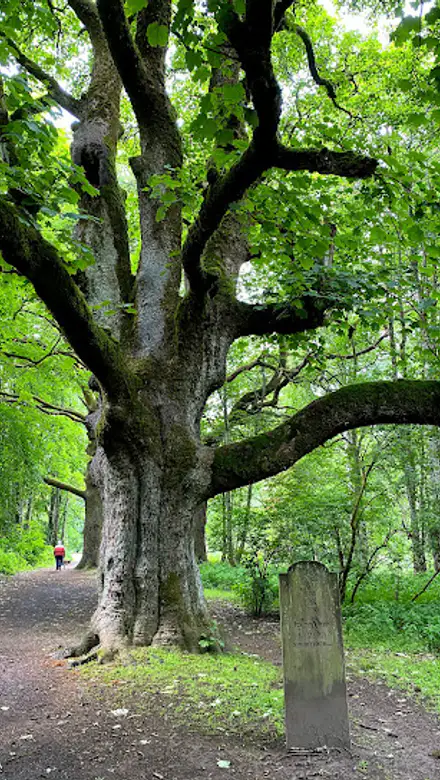
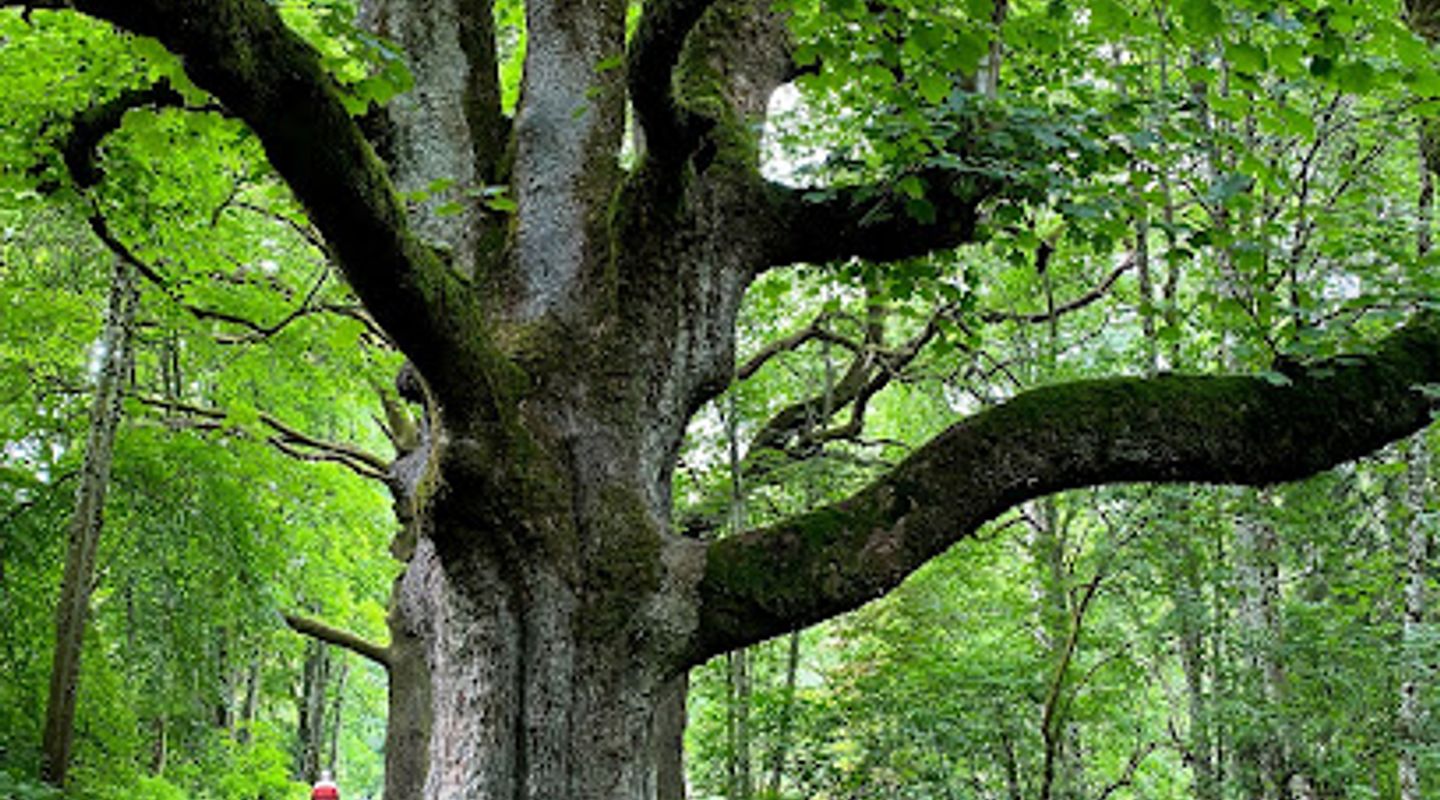
This enormous sessile oak, known as the Birnam Oak, stands in a strip of riverside woodland on the south bank of the River Tay, just below Dunkeld in Perthshire. With a girth of around seven metres and a height of roughly 27 metres, it is a veteran tree whose massive, spreading limbs are partly supported by wooden struts to keep them from collapsing. The lower part of the trunk is hollow, a result of age and past fires, yet the tree continues to thrive, putting on fresh leaves each spring. It is thought to be around 600 years old, meaning it was already a mature tree when Shakespeare is said to have visited Perthshire in the late 16th century.
Shakespeare’s Birnam Wood
In Macbeth, the witches prophesy that the king will fall only when Birnam Wood comes to Dunsinane Hill. In reality, this was a ruse: Malcolm’s army advanced camouflaged with branches cut from the great forest of Birnam. The Birnam Oak is now regarded as the last surviving representative of that once-vast woodland, lending it a powerful literary resonance. Whether Shakespeare actually saw this exact tree is uncertain, but the association has made it a pilgrimage site for lovers of the play. The tree’s gnarled, almost theatrical appearance – with its hollow trunk and crutch-supported limbs – feels like something out of a Shakespearean forest, adding to its mystique.
A Riverside Walk Through History
The oak lies at the end of a pleasant, waymarked path that begins in the village of Birnam and follows Oak Road down to the River Tay. Along the way, visitors pass other impressive trees and enjoy views of the wide, meandering Tay. Humorous signs along the path playfully warn that certain large trees are not the Birnam Oak, building anticipation before the real thing comes into view. Nearby stands the Birnam Sycamore, another heritage tree with massive buttress roots, creating a small grove of ancient giants. The riverside setting, with the sound of flowing water and birdsong, makes the walk as memorable as the destination.
More Than Just a Tree
Beyond its Shakespearean fame, the Birnam Oak has witnessed centuries of Scottish history: the Reformation, the Jacobite uprisings, the Union of the Crowns, and the industrial transformation of the Highlands. It has served as a local meeting place, attracted visitors like Queen Victoria and Beatrix Potter, and become a symbol of resilience in literature and environmental activism. Information boards at the site explain its natural history and cultural significance, helping visitors appreciate it not just as a curiosity, but as a living monument to time, nature and storytelling.
Evendo Review Centre
 Google
Guest reviews
Best time to go
Quietest: Jan, Feb & Dec · before 3am
Busy times are Evendo estimates for a typical year, to help you plan. Actual crowds vary with events, school holidays and the weather.
Explore Birnam Oak on the map
A handpicked selection of must-see spots near Birnam Oak, mapped for you.
Get your free copy of our complete guide to Birnam Oak, delivered straight to you.
Everything on this page, from opening hours and how to get there to Eve’s tips and the best time to go, in one PDF you can read offline, print or share.
Already have an account? Sign in
Your Birnam Oak guide is ready.
We'll send it to · Not you? Sign out

Getting your guide ready…
We are putting together a fresh copy of the Birnam Oak guide. This can take up to a minute.
This can take a few moments. If your browser asks, choose Allow so the download can start. You'll find the guide in your Downloads folder.
Nothing happened? Download it again
Sorry, the guide is taking longer than usual. Please try again in a minute, or get it by email instead.
Other nearby places you may find interesting
The closest places of the same kind, if this one is not quite what you had in mind.
-
-
-
-
-


Swipe for more places
More to explore near Birnam Oak

 Best experiences near Birnam Oak
 Best hotels near Birnam Oak
 Best landmarks near Birnam Oak
 Best attractions near Birnam Oak
 Best shops near Birnam Oak
 Best restaurants near Birnam Oak
 Best bars near Birnam Oak
Do you manage this location?
Take control to get all the benefits, like improved information, better appearance, and stronger visibility across AI-powered discovery.
Explore more
Explore more of Scotland
Discover the magic of Scotland: stunning landscapes, historic castles, vibrant cities, and world-famous whisky. An unforgettable journey awaits in this enchanting land.
Explore Scotland
Explore more of United Kingdom
Discover the United Kingdom: A blend of rich history, stunning landscapes, and vibrant cities, offering a unique travel experience for every visitor.
Explore United Kingdom