

Fyrish Monument Travel Guide
Free Guide: A striking 18th-century folly on a Highland hilltop, inspired by an Indian gateway and built to provide work for local tenants during a time of hardship.


A brief summary of Fyrish Monument
A striking 18th-century folly on a Highland hilltop, inspired by an Indian gateway and built to provide work for local tenants during a time of hardship.
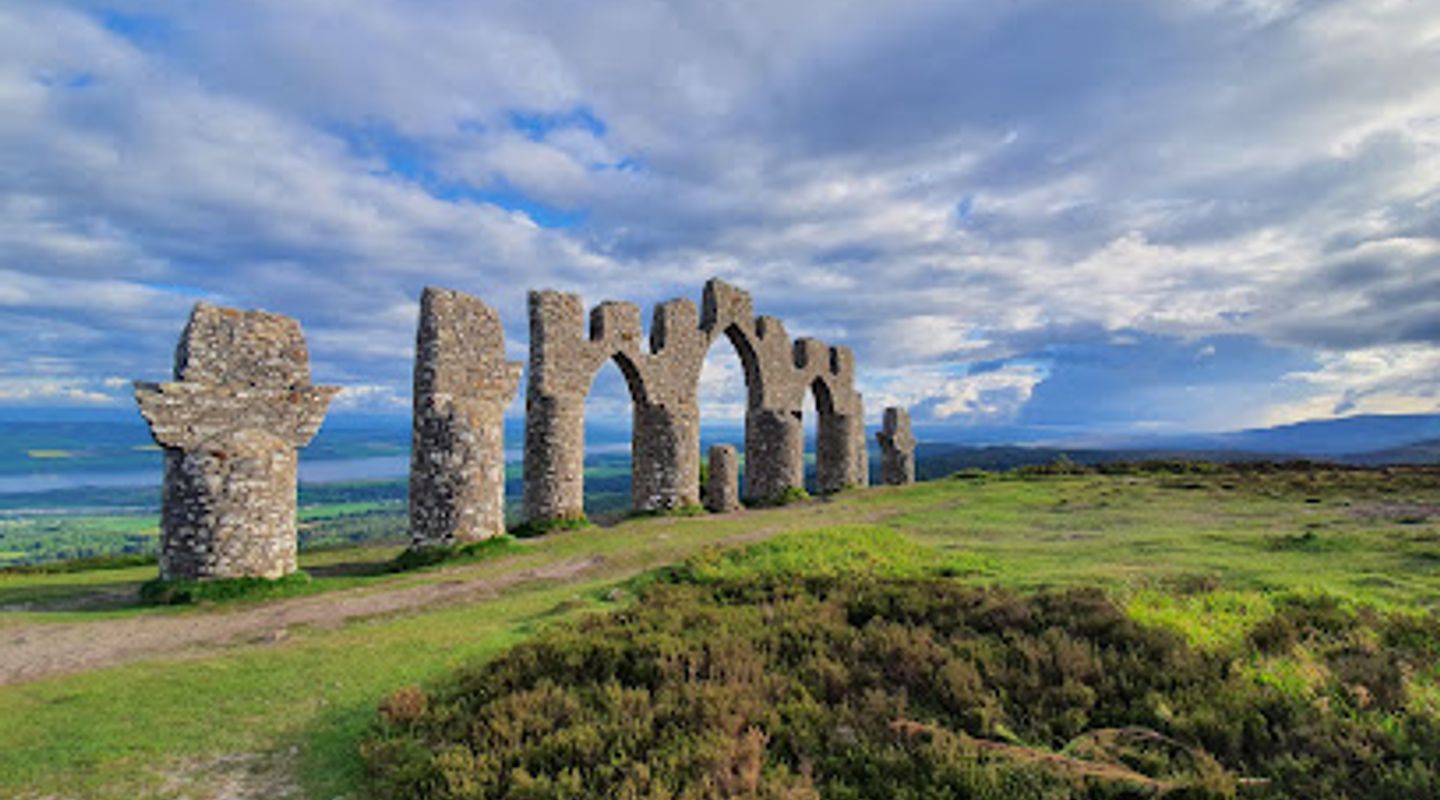
Perched high above the Cromarty Firth near Alness, the Fyrish Monument is a striking 18th-century folly built on Cnoc Fyrish (Fyrish Hill) in the Scottish Highlands. Commissioned by General Sir Hector Munro of Novar after his military campaigns in India, this unusual stone structure was inspired by the gates of Negapatam in Madras. Constructed between 1782 and 1785 by local Highland workers, it served both as a monument to Munro’s colonial victory and as a means of providing employment during a time of hardship. Today, it stands as a dramatic landmark offering panoramic views across the firth and towards Ben Wyvis, drawing hikers and history enthusiasts alike to its windswept hilltop.
On-site amenities
 Restrooms
 Drinking water
 Seating areas
 Sheltered areas
 Trash bins
 Information boards
Opening hours
- Every dayOpen 24 hours
Opening hours as listed on the venue’s Google Business Profile. Hours can change for services and special events, so check with the venue before you go.
- Address
- Alness IV16 9XL
- Website
Getting there
Car
Public Transport
Walking
Cycling
Discover more about Fyrish Monument
A Highland Folly with an Indian Inspiration
Rising from the summit of Cnoc Fyrish near Evanton, the Fyrish Monument is a curious and imposing structure that seems almost out of place on the Scottish landscape. Built between 1782 and 1785 on the orders of General Sir Hector Munro of Novar, the monument was modelled on the gates of Negapatam, a port in Madras (now Chennai), India, which Munro had captured for the British in 1781. This architectural homage reflects the global reach of the British Empire and the personal pride of a Highland laird who had made his name in distant colonial campaigns. The monument’s form—a cluster of arches and uneven stone pillars—echoes the style of Indian gateways, reinterpreted in local stone on a windswept Highland hill.
Work, Hardship and Highland History
The Fyrish Monument was more than just a vanity project; it was also a response to the social upheaval of its time. In the decades following the Jacobite defeat at Culloden and during the early stages of the Highland Clearances, many local tenants faced displacement and economic hardship. Munro’s decision to build the monument provided much-needed employment for the local population, who laboured for a penny a day to haul stones up the steep slopes of Fyrish Hill. Local legend holds that Munro would sometimes roll completed sections back down the hill, ensuring the work—and wages—continued for longer. This blend of colonial commemoration and practical relief for the community makes the monument a poignant symbol of a complex period in Highland history.
A Hilltop with Sweeping Vistas
From its position on the summit of Fyrish Hill, the monument commands extensive views across the Cromarty Firth and the surrounding countryside. To the north and east, the waters of the firth stretch towards the North Sea, while to the south the distant, often snow-capped peak of Ben Wyvis dominates the skyline. The site is a natural viewpoint, offering a sense of scale and isolation that is characteristic of the Highlands. On clear days, the panorama encompasses rolling farmland, coastal inlets, and distant mountains, making the climb worthwhile for anyone seeking expansive Highland scenery. The monument itself, weathered and slightly haphazard in appearance, adds a dramatic focal point to the open hilltop.
Walking to the Summit
The ascent to the Fyrish Monument is a popular hillwalk that begins from a car park on the northeastern side of the hill. The path winds through woodland and then emerges onto open hillside, with a steady but manageable gradient. The route is well-trodden and suitable for most walkers with a moderate level of fitness, though the final stretch can be steep and exposed in poor weather. Along the way, the surrounding forest and moorland provide a sense of immersion in the natural landscape, with glimpses of the firth appearing as the elevation increases. Reaching the summit, visitors are rewarded not only by the monument but by the sense of achievement that comes with a Highland hill climb.
A Living Landmark in the Landscape
Over two centuries after its construction, the Fyrish Monument remains a distinctive feature of the local skyline and a point of interest for both residents and visitors. It has become part of the area’s identity, appearing in local art, folklore, and community events. The monument’s prominent position also gave it strategic value during the 20th century, with beacons reportedly used nearby during wartime coastal defences. Today, it continues to serve as a destination for walks, photography, and quiet reflection, standing as a testament to Highland resilience, colonial ambition, and the enduring relationship between people and place in the Scottish Highlands.
Evendo Review Centre
 Google
Guest reviews
Best time to go
Quietest: Jan, Feb & Dec · before 8am or from 10pm
Busy times are Evendo estimates for a typical year, to help you plan. Actual crowds vary with events, school holidays and the weather.
Explore Fyrish Monument on the map
A handpicked selection of must-see spots near Fyrish Monument, mapped for you.
Get your free copy of our complete guide to Fyrish Monument, delivered straight to you.
Everything on this page, from opening hours and how to get there to Eve’s tips and the best time to go, in one PDF you can read offline, print or share.
Already have an account? Sign in
Your Fyrish Monument guide is ready.
We'll send it to · Not you? Sign out

Getting your guide ready…
We are putting together a fresh copy of the Fyrish Monument guide. This can take up to a minute.
This can take a few moments. If your browser asks, choose Allow so the download can start. You'll find the guide in your Downloads folder.
Nothing happened? Download it again
Sorry, the guide is taking longer than usual. Please try again in a minute, or get it by email instead.
Other nearby places you may find interesting
The closest places of the same kind, if this one is not quite what you had in mind.
-
-
-
-
-


Swipe for more places
More to explore near Fyrish Monument

 Best experiences near Fyrish Monument
 Best hotels near Fyrish Monument
 Best landmarks near Fyrish Monument
 Best attractions near Fyrish Monument
 Best shops near Fyrish Monument
 Best restaurants near Fyrish Monument
 Best bars near Fyrish Monument
Do you manage this location?
Take control to get all the benefits, like improved information, better appearance, and stronger visibility across AI-powered discovery.
Explore more

Explore more of Scottish Highlands
Discover the breathtaking beauty and rich history of the Scottish Highlands, where rugged landscapes, historic castles, and mysterious lochs await every adventurous traveler.
Explore Scottish Highlands
Explore more of United Kingdom
Discover the United Kingdom: A blend of rich history, stunning landscapes, and vibrant cities, offering a unique travel experience for every visitor.
Explore United Kingdom
