

Circus Lane, Stirling Travel Guide
Free Guide: A flower-draped Georgian mews lane where Edinburgh's elegant past meets contemporary charm.


A brief summary of Circus Lane
A flower-draped Georgian mews lane where Edinburgh's elegant past meets contemporary charm.
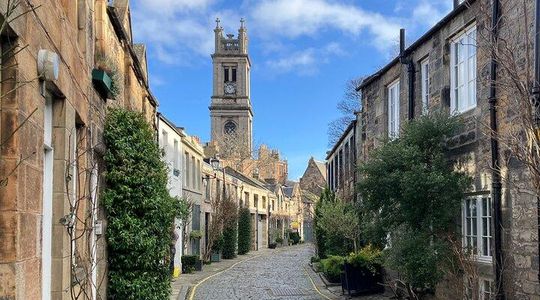
Circus Lane is a picturesque cobbled mews street in Edinburgh's Stockbridge neighbourhood, renowned for its charming flower-covered terraced houses and Instagram-worthy aesthetic. Built in the early 1800s as service quarters for wealthy New Town residents, the lane features converted stables-turned-garages, colourful hanging baskets, and Victorian street lamps. St Stephen's Church, an A-listed landmark with Europe's longest clock pendulum, anchors the street's northern end. The lane offers a quintessential Edinburgh experience combining Georgian heritage with contemporary appeal.
On-site amenities
 Food options
 Drink options
 Restrooms
 Information boards
- Address
- 29 Circus Ln, Edinburgh EH3 6SU
- Website
Getting there
Walking from Stockbridge
Public Transport via Bus
Walking from Edinburgh Waverley Station
Taxi or Ride-Share
Discover more about Circus Lane
A Georgian Service Lane Transformed
Circus Lane emerged during the second phase of Edinburgh's New Town expansion between 1800 and 1830, when the city's affluent residents sought to escape the crowded Old Town. The lane was deliberately constructed as a service street behind the grand Royal Circus, a sweeping Georgian circle of imposing four- to five-storey manor houses. Wealthy residents of Royal Circus required accommodation for their staff, horses, and carriages, and Circus Lane provided exactly that purpose. The colourful garages visible today are remnants of the original stables where horses were kept and coaches stored. This functional heritage remains visible in the lane's architecture and layout, offering visitors a tangible connection to Edinburgh's Georgian past.
Architectural Character and Visual Appeal
Today, Circus Lane's former service cottages have been converted into private residences of considerable charm. The street's defining aesthetic emerges from the interplay of several elements: cobblestone paving, terraced mews houses with distinctive front doors, abundant hanging baskets and window boxes overflowing with flowers and greenery, and Victorian street lamps casting warm light along the lane. The gentle curve of the street creates natural focal points for photography, with St Stephen's Church's 49-metre clocktower rising dramatically above the roofline at the lane's terminus. The combination of these elements—symmetry, colour, scale, and historical authenticity—has earned Circus Lane recognition as one of Britain's most visually pleasing streets, validated by eye-tracking technology studies.
St Stephen's Church: A Crowning Monument
At the northern end of Circus Lane stands St Stephen's Church, an A-listed masterpiece designed by renowned architect William Henry Playfair and completed in 1827–1828. The church's distinctive tower rises 49 metres and houses the longest clock pendulum in Europe, a remarkable engineering achievement that has become a defining feature of Edinburgh's skyline. The church no longer functions as a place of worship but has been repurposed as St Stephen's Theatre, a vibrant community arts venue and event space. It serves as home to the Edinburgh Festival Ballet and the MGA Academy, a Scottish theatre school, and hosts performances during the Edinburgh Festival Fringe. The building's transformation reflects Edinburgh's evolving cultural landscape while preserving its architectural significance.
A Photographer's Paradise and Living Community
Circus Lane has become one of Edinburgh's most photographed locations, attracting visitors from around the world seeking to capture its postcard-perfect scenes. The lane's popularity stems from its combination of authentic historical character and contemporary visual appeal. However, visitors should remember that Circus Lane remains a residential street where people live and work. Respectful behaviour is essential—keeping noise levels low, avoiding obstruction of residents' driveways, and being mindful of private property boundaries. The best photographic vantage points include the gentle bend where St Stephen's clocktower frames the composition, and angles that capture the interplay of flowers, cobbles, and terraced facades. Despite its fame, the lane retains an intimate, lived-in quality that distinguishes it from purely touristic attractions.
Exploring the Surrounding Neighbourhood
Circus Lane serves as an ideal starting point for exploring Stockbridge and its cultural offerings. The immediate vicinity contains numerous independent cafés, restaurants, and boutique shops reflecting Edinburgh's creative character. Nearby attractions include Dean Village, a historic milling settlement nestled along the Water of Leith with architecture dating to the 1600s, offering a contrasting landscape of green spaces and industrial heritage. The Scottish National Gallery of Modern Art is within reasonable walking distance, housed in two converted Georgian buildings set within a sculpture park. St Stephen Street, running parallel to Circus Lane, hosts an array of bars and dining establishments popular with locals and visitors alike. This concentration of cultural and culinary attractions makes Circus Lane a natural hub within a broader exploration of Edinburgh's north-central neighbourhoods.
Evendo Review Centre
 Google
Guest reviews
Best time to go
Quietest: Jan, Feb & Dec · before 6am or at 10pm
Busy times are Evendo estimates for a typical year, to help you plan. Actual crowds vary with events, school holidays and the weather.
Explore Circus Lane on the map
A handpicked selection of must-see spots near Circus Lane, mapped for you.
Get your free copy of our complete guide to Circus Lane, delivered straight to you.
Everything on this page, from opening hours and how to get there to Eve’s tips and the best time to go, in one PDF you can read offline, print or share.
Already have an account? Sign in
Your Circus Lane guide is ready.
We'll send it to · Not you? Sign out

Getting your guide ready…
We are putting together a fresh copy of the Circus Lane guide. This can take up to a minute.
This can take a few moments. If your browser asks, choose Allow so the download can start. You'll find the guide in your Downloads folder.
Nothing happened? Download it again
Sorry, the guide is taking longer than usual. Please try again in a minute, or get it by email instead.
Unlock the best of Circus Lane
Skip-the-line tickets, guided tours with entry, and walking tours of the area, booked in a few clicks.

Other nearby places you may find interesting
The closest places of the same kind, if this one is not quite what you had in mind.
-
-
-
-
-


Swipe for more places
More to explore near Circus Lane

 Best experiences near Circus Lane
 Best hotels near Circus Lane
 Best landmarks near Circus Lane
 Best attractions near Circus Lane
 Best shops near Circus Lane
 Best restaurants near Circus Lane
 Best bars near Circus Lane
Do you manage this location?
Take control to get all the benefits, like improved information, better appearance, and stronger visibility across AI-powered discovery.
Explore more

Explore more of Stirling
Discover Stirling: A city where history comes alive amidst stunning landscapes and cultural richness in the heart of Scotland.
Explore Stirling
Explore more of United Kingdom
Discover the United Kingdom: A blend of rich history, stunning landscapes, and vibrant cities, offering a unique travel experience for every visitor.
Explore United Kingdom
