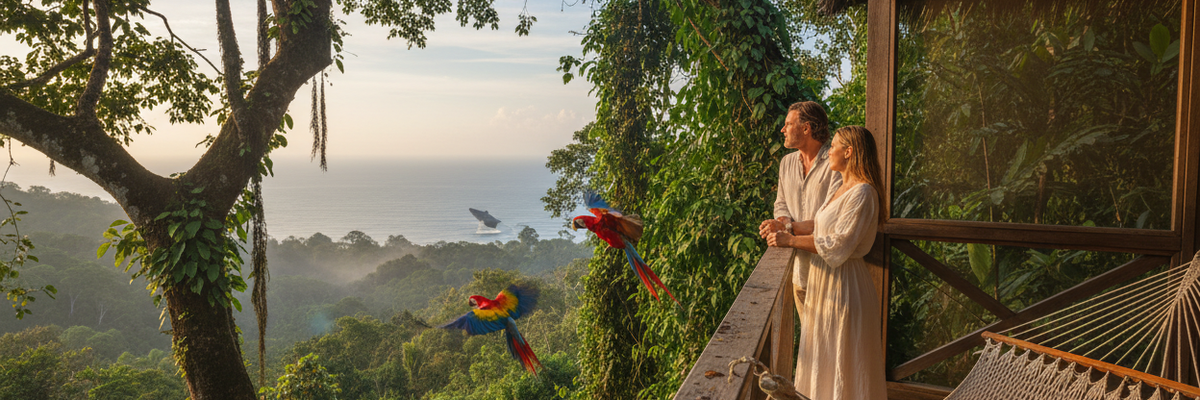
Some journeys are measured in miles, others in the quiet glances across a train compartment, the shared gasp at a breaching whale, the flour-dusted hands of a grandparent guiding a child in a foreign kitchen. Family travel, done with intention, becomes a moving tapestry where generations are stitched closer together by each new horizon.To travel as a family is to press pause on the everyday script and step together into an unscripted world. The destinations that shine brightest for multigenerational trips are not only beautiful; they are generous, offering different layers of experience for every age. Ancient cities become open-air classrooms; rainforests turn into living science labs; mountains and oceans invite both quiet contemplation and heart-pounding adventure. What follows is a curated journey through six remarkable destinations where toddlers and teenagers, parents and grandparents can all find their own rhythm, yet still move to the same collective beat.
Unveiling Italy’s Timeless Charms
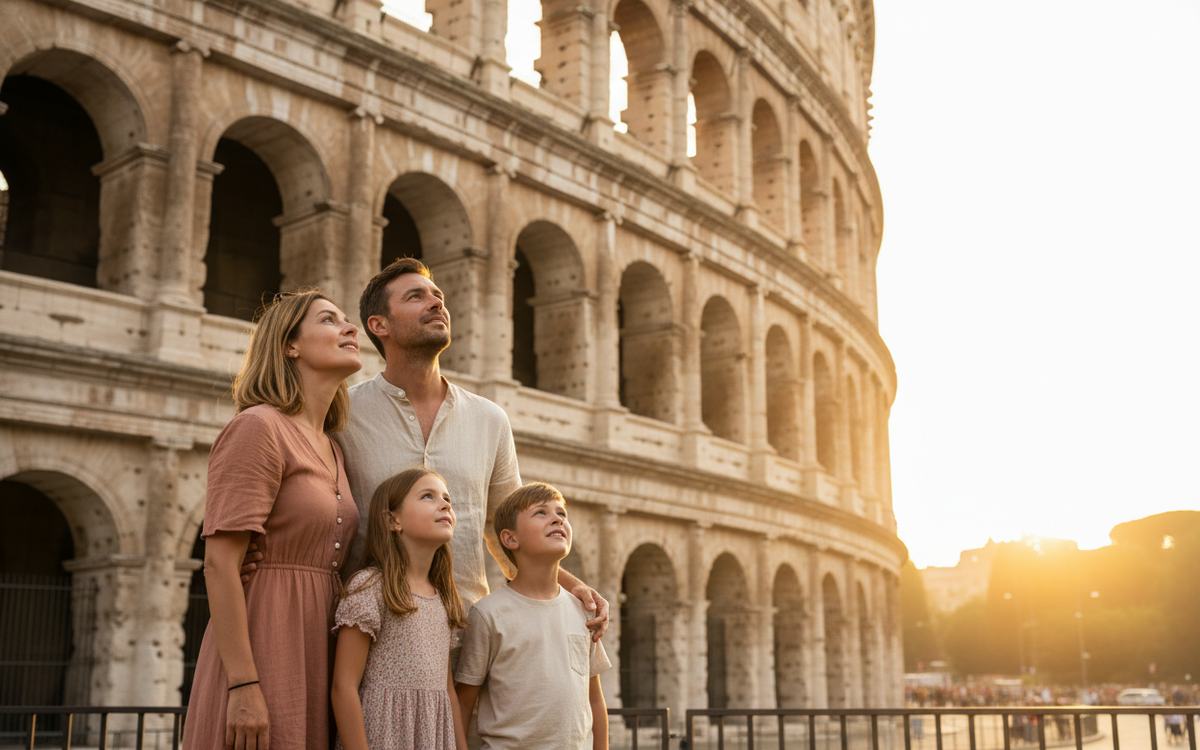
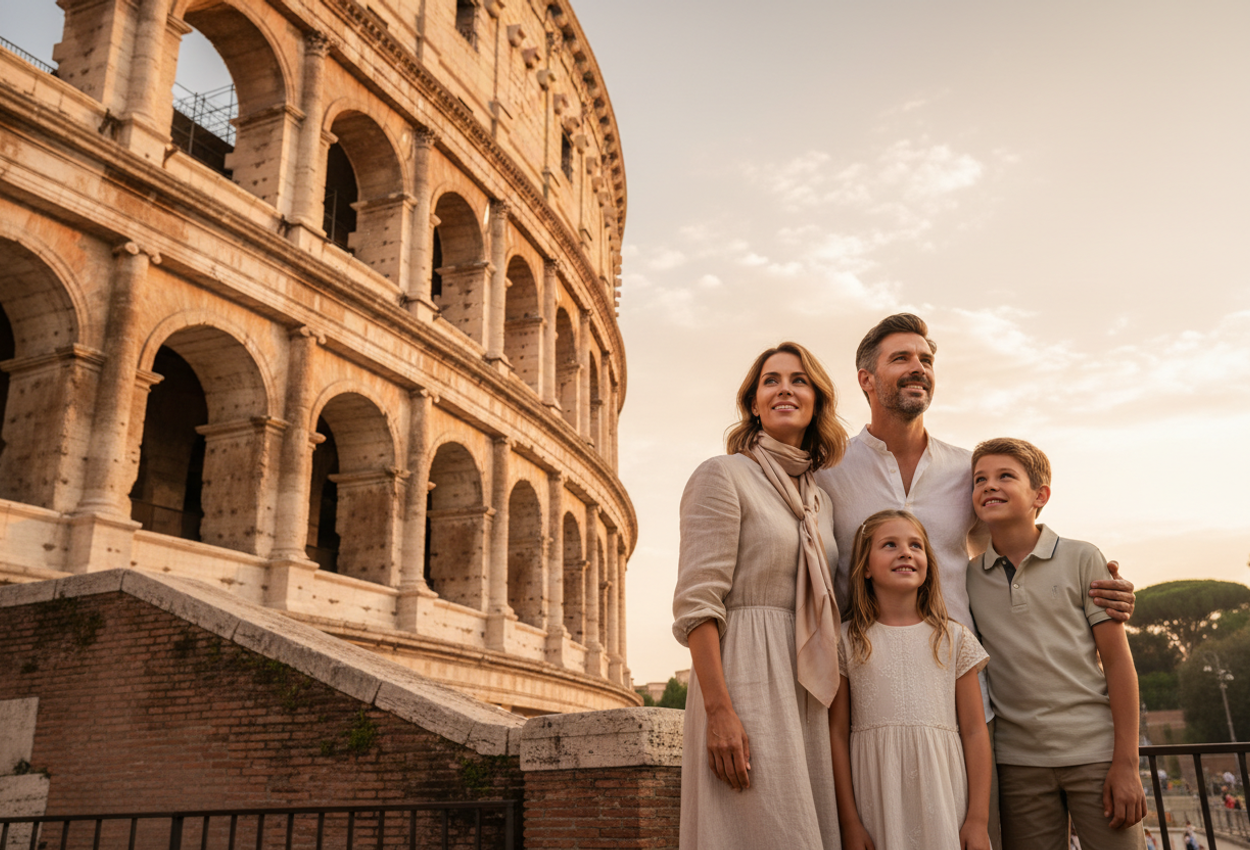
In Rome, history does not sit behind glass; it rises above cobblestone streets, worn smooth by centuries of footsteps. For a multigenerational family, the Eternal City unfolds like a storybook where each generation recognizes a different chapter. Standing before the Colosseum, even the most restless child quiets for a moment beneath its weathered arches. Grandparents recall long-ago films and Latin classes; teenagers think of gladiators and empires; younger children fixate on the sheer scale, their hands pressed against stone that has outlived entire civilizations.
A guided family tour through the Colosseum and the nearby Roman Forum turns a daunting tangle of ruins into an accessible narrative. Skilled guides pace the visit for mixed ages, weaving in anecdotes about roaring crowds, secret passageways, and senators plotting beneath the Mediterranean sun. As you walk along the Via Sacra, the family moves as a loose constellation: a grandparent lagging behind to study an inscription, a teenager striding ahead to frame the Arch of Titus in a phone camera, a child skipping between them all, absorbing without yet realizing it how deeply the past can inform the present.
Afternoons in Rome belong to appetite. Cross the Tiber into Trastevere, where laundry flutters from wrought-iron balconies and the smell of simmering tomatoes drifts from narrow kitchens. Tucked along a cobbled side street, a small family-run trattoria — its door framed by terracotta pots of basil and geraniums — becomes a second home by the end of your stay. Inside, nonna stirs a pot of slow-cooked ragu while her son works the dining room, greeting regulars with clasped hands and newcomers with a warmth that needs no translation.
Here, pasta is not simply ordered; it is discussed, considered, almost negotiated among the generations. A plate of cacio e pepe arrives, the peppery steam rising as a grandparent shares memories of their first trip to Europe. Children twirl strands of tonnarelli like golden ribbons, cheeks flushed from the house red diluted with sparkling water. The trattoria’s walls, cluttered with black-and-white family photos, mirror your own table: three generations leaning in, sharing stories over bowls that seem to refill themselves.
North in Florence, the Renaissance greets you at eye level. The city is compact enough for little legs, yet dense with masterpieces that can awe even museum-weary teens. A thoughtfully paced family visit to the Uffizi Gallery transforms names like Botticelli and Caravaggio into vivid encounters. Rather than marching room to room, a good guide chooses a handful of works, encouraging children to mimic poses in the paintings or hunt for hidden symbols, while adults indulge in the deeper art historical context. The gallery’s high windows pour light over the Arno, inviting quiet reflections between frames.
But it is in a tiny Florentine kitchen, far from the grand galleries, where many families find their most cherished memory. At a gelato-making class tucked behind an unassuming storefront near Piazza della Signoria, everyone dons aprons and hairnets, differences in age dissolving in the universal language of sugar and cream. A local maestro explains the importance of seasonal ingredients, passing around bowls of fragrant pistachios and bright raspberries. Children take turns pouring velvety mixtures into churns, while grandparents offer advice on patience as the gelato thickens. When the moment finally comes to taste, there is a hush, then laughter, as everyone compares flavors, tongues stained from pistachio green to deep chocolate.
The journey concludes in Venice, a city that seems designed to enchant all ages at once. There are no cars, only stone pathways, water, and sky, so even a simple walk becomes an adventure in navigation. Crossing each humpback bridge, you catch stolen vignettes of daily Venetian life: a boatman delivering crates of artichokes, schoolchildren in navy uniforms darting along the fondamenta, an elderly couple slowly closing green shutters against the late afternoon light. The soft slap of waves against centuries-old brick becomes the family’s shared soundtrack.
A gondola ride through the quiet back canals near Dorsoduro offers a rare moment of collective stillness. You settle into the curved, polished wood as the gondolier, balancing with impossible grace, pushes away from the dock. Grandparents lean back, hands entwined; parents share a low-voiced conversation across the boat; a child counts passing windows with window boxes spilling pink cyclamen. Overhead, laundry lines crisscross like bunting, and the late sun turns the canal into a ribbon of molten bronze. The gondolier points out minor palazzi and half-forgotten legends, each one another thread woven into the family’s growing tapestry of stories.
In a cool workshop near Campo Santa Margherita, the family trades gondola cushions for wooden stools during a mask-making session. Tables are laid with blank papier-mâché forms, trays of pigments, brushes of varying thickness, and small glittering containers of gold leaf. Children dive in gleefully, painting harlequin diamonds and swirling stars, while adults approach more hesitantly, then lose themselves in the quiet concentration of creation. A grandfather brushes on a delicate filigree of silver, sharing tales of Carnival he once read about; a teenager experiments with bold neon hues. By the time the masks are set to dry, each family member holds a physical symbol of the trip — their personalities captured not in photographs, but in paint, pattern, and flourish.
Italy’s genius for family travel lies not only in its history and food, but in its ability to invite every generation into the same experience at different depths. Whether you are deciphering a Roman inscription, comparing brushstrokes in the Uffizi, or licking a melting cone on a Venetian bridge, you are all, in your own way, discovering the simple, enduring joy of being together.
Costa Rica’s Eco‑Adventure Awaits
If Italy is a conversation with the past, Costa Rica is a plunge into the vivid present. Here, the air itself feels alive — warm, wet, and humming with possibility. From the moment the family steps off the plane, a chorus of cicadas, distant surf, and rustling palms announces that nature will be both playground and teacher.
Near the imposing silhouette of Arenal Volcano, the rainforest rises like a living cathedral. The family’s base, perhaps in the small town of La Fortuna, is ringed by greenery so lush it seems to glow. Morning mist clings to bromeliad-laden branches, and the distant volcanic cone peeks and disappears behind low-lying clouds. At breakfast on a terrace, grandparents cradle mugs of locally grown coffee, inhaling notes of chocolate and citrus, while children load up plates with sweet local pineapple and papaya, juice dripping from their fingers as they watch hummingbirds flash like jewels around scarlet hibiscus.
The day’s adventure begins with zip-lining through the rainforest canopy, a quintessential Costa Rican rite of passage that surprisingly suits all generations with the right outfitter. Harnessed and helmeted, everyone climbs to the first platform, the forest floor dropping away in a soft blur of green. Parents encourage children with quiet words; teenagers grin with bravado but grip the line a little tighter; a grandparent, perhaps skeptical at first, decides to join, nudged by the contagious excitement of younger family members.
When the first person steps off the platform, there is an instant of weightless silence, then the whir of the pulley as they glide above a sea of treetops. From this vantage point, the rainforest is a patchwork tapestry: glossy leaves, pendulous vines, flashes of toucans in impossible colors. Below, a distant river threads through the valley, catching the sunlight in shards. Between runs, guides point out the rattle of a hidden waterfall, the distant bark of a howler monkey, and the faint, sweet smell of orchids clinging to mossy trunks. Fear gives way to exhilaration and, finally, to an almost meditative appreciation as the family comes to trust both the equipment and their own courage.
Later, muscles pleasantly spent, the group soaks together in natural hot springs warmed by geothermal heat. The contrast between the cool evening air and the silky, mineral-rich water encourages drowsy conversation. A child floats between grandparents, listening half to their stories and half to the soft murmur of the jungle that never truly sleeps. Fireflies appear like wandering embers, and steam curls upwards to mingle with the stars.
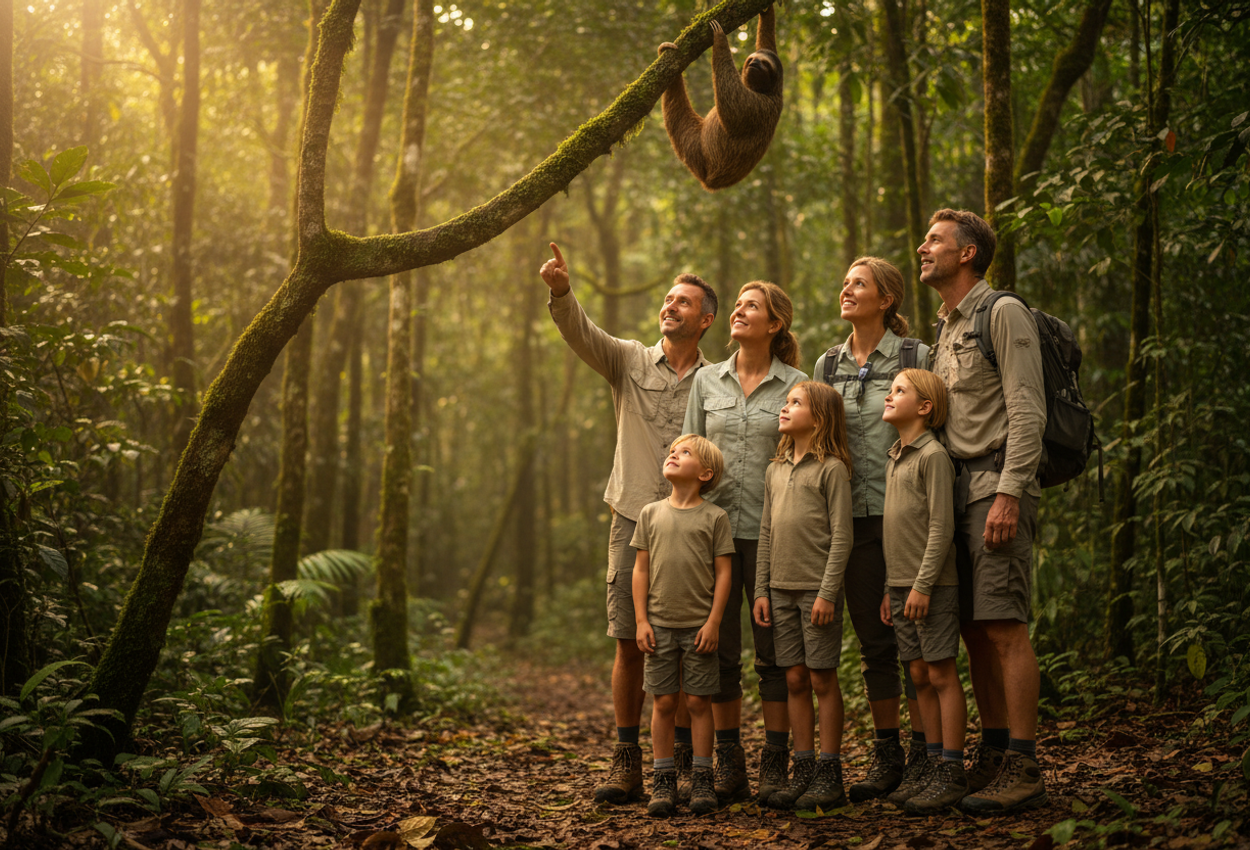
On the Pacific coast at Manuel Antonio National Park, the rainforest spills straight into pale-sand beaches, creating an accessible microcosm of Costa Rica’s famed biodiversity. With a naturalist guide leading the way, the family steps onto shaded trails, binoculars dangling from necks. The forest is dense, fragrant with damp earth, crushed leaves, and the faint sweetness of wild ginger. Every few meters, the guide stops, raising a hand. Above, a three-toed sloth curls in slow-motion serenity around a cecropia branch, its fur tinged green with algae. Children peer through spotting scopes, whispering in awe, while grandparents smile, marveling at such gentle resilience.
Deeper along the path, a capuchin monkey troop erupts overhead, leaping from branch to branch with acrobatic ease. Their chatter is punctuated by the distant roar of howler monkeys, a primeval sound that sends a little thrill through even the most stoic adults. Crabs in electric reds and blues skitter across roots, and tiny frogs flash luminous greens among the leaf litter. When the trail opens onto a crescent of beach, the family drops towels in shared relief. Warm Pacific waves lap at their ankles, and coconut-scented sunscreen competes with the briny tang of sea spray. Children race the surf; adults wade in slowly, then surrender to the buoyancy, rolling onto their backs to gaze at a canopy that seems to frame the very sky.
In the highlands, a visit to a sustainable coffee plantation offers a quieter but equally rich form of adventure. Walking between neat rows of glossy green coffee plants, the family learns how altitude, shade trees, and traditional methods work together to produce the beans that fuel so many mornings. Elder family members, who may have started countless days with coffee, are captivated by the origins of their ritual; younger ones delight in picking ripe red cherries, popping them open to discover the slippery beans inside. Inside a small processing shed, the smell of roasting beans envelops everyone — nutty, smoky, almost chocolaty — and there is a moment of communal silence as first sips are taken. Plain black for some, sweetened and softened with milk for others, but shared at the same wooden table.
As dusk deepens, a night hike offers one of Costa Rica’s most magical, and humbling, experiences. Armed with flashlights and guided by a local naturalist, the family steps back into the rainforest, now transformed. The frenetic daytime chorus has given way to a more mysterious soundtrack: the gentle drip of water from leaves, the rasp of insects, the surprising crack of a lizard darting over twigs. The air feels cooler yet somehow thicker, scented with damp bark and the faint musk of unseen animals.
Guided beams of light reveal the hidden universe of nocturnal life. A red-eyed tree frog clings to a leaf, its lime-green body and scarlet toes almost surreal against the darkness. Children hold their breath as a tarantula emerges cautiously from its burrow, while a grandparent, perhaps initially hesitant, now steps closer, curiosity overcoming old fears. The guide explains how each creature, from glistening beetles to delicate moths, plays a role in the complex web of the forest. Above, slivers of moonlight filter through leaves, casting shifting patterns on the path. By the time the group returns to their lodge, clothes lightly damp with rainforest humidity, they carry not just photos, but a deeper, shared understanding of the world’s fragile interconnectedness.
In Costa Rica, adrenaline and introspection coexist easily. The country’s commitment to conservation creates a natural classroom where every family member finds their own lesson — about courage, patience, or the simple miracle of a frog’s call in the dark. These memories, built on shared discovery rather than staged entertainment, linger long after the mud has been washed from sneakers.
Morocco’s Mystical Family Journey
Arriving in Marrakech is like stepping through a veil into a different sensory universe. The air is scented with orange blossom, grilled meats, and distant wood smoke. The ochre walls of the old city glow warmly beneath the North African sun, and the call to prayer washes over rooftops like a sonic tide. For a family traveling together, Morocco offers an immersion into a culture rich with stories, textures, and flavors that captivate from child to elder.
By late afternoon, Djemaa el-Fna square hums with anticipation. As the family approaches, the open space is a shifting mosaic of people and possibility. Storytellers gather small circles of listeners, their animated gestures visible even when the words remain foreign. Musicians coax hypnotic rhythms from hand drums and lutes, while the clink of tea glasses underscores every conversation. Children gaze wide-eyed at acrobats who twist and tumble, at henna artists drawing intricate designs on patient hands. Parents keep a gentle but firm hold, guiding younger ones through the crowd while allowing older kids the thrill of a little independence.
Just beyond the square, the souks spill out like a labyrinth of color and sound. Narrow alleys lead past stalls piled high with pyramids of cumin, paprika, and saffron, their scents swirling together into an intoxicating cloud. Light filters through slatted rooftops, catching on brass lanterns and hammered trays that hang like captured moons. Children run fingers over handwoven rugs, marveling at their softness, while grandparents examine carved wooden boxes, considering which piece might hold future letters or jewelry back home.
Bargaining becomes a family sport, a chance for teenagers to test their negotiation skills and younger kids to practice counting in another language. Vendors, many from families who have kept these stalls for generations, meet the family’s attempts with good humor. Everyone learns that the point is not just the discount, but the exchange itself — a fleeting relationship built on smiles, compliments, and a shared willingness to play the game.
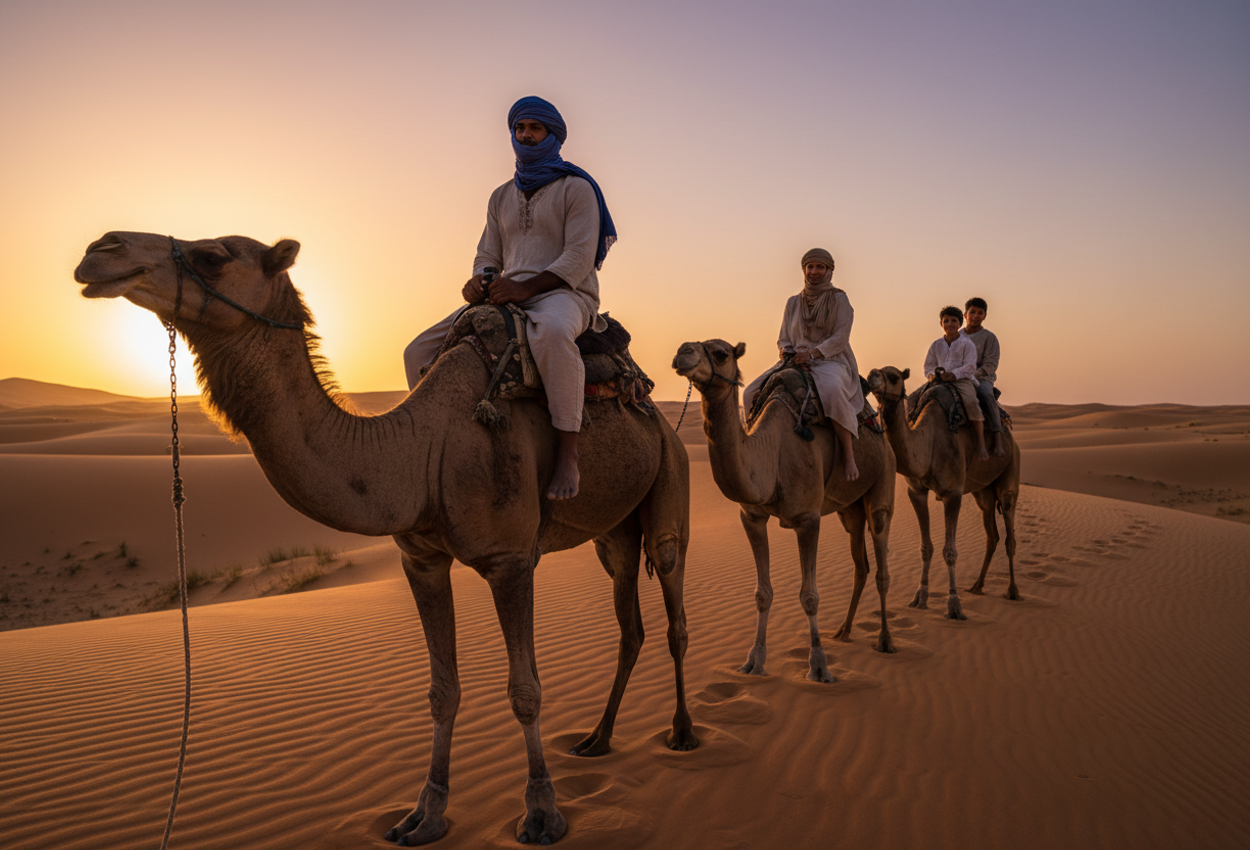
Leaving the city’s hum behind, the family sets out on a journey that will etch itself into memory: a camel trek into the Sahara Desert. The transition is gradual — first low hills, then wider plains, and finally the golden dunes rising like frozen waves at the edge of the sky. At the desert’s edge, camels kneel patiently, their padded feet perfectly adapted to the shifting sands. Guides help each family member mount, checking straps and offering reassurances. Grandparents may choose a shorter ride or a 4x4 transfer to the camp, while others embrace the gentle sway of the camel’s gait, laughing as they find their balance.
As the caravan moves into the dunes, the world narrows to sand and sky. Wind carves delicate ripples along dune ridges, and the sun bathes everything in a deepening amber. Conversations ebb as each rider slips into a private reverie, interrupted only by the creak of saddles and the occasional murmur from the guides. When the camels finally kneel again, the luxury desert camp feels almost mirage-like: white canvas tents arranged around low lanterns, carpets spread over the sand, and silver teapots catching the last rays of light.
Night in the Sahara unfolds slowly. As darkness thickens, the sky unfurls a riot of stars, more than most city-dwellers have ever imagined. The Milky Way appears as a luminous river overhead. Families huddle around a low table, sharing a fragrant tagine where preserved lemons and olives nestle among tender chicken, or perhaps a vegetarian stew perfumed with cinnamon and cumin. Couscous mounds are fluffed with care, and glasses of mint tea — sugared and steaming — are poured from heights that make children giggle.
After dinner, local musicians gather around a crackling fire. Drums and handclaps weave intricate rhythms, and guests are invited to join. Children learn simple patterns, their hands reddening with effort, while grandparents rock gently, the warmth of the fire on their faces and a cool breeze at their backs. In this circle of flickering light and ancient sand, generational boundaries soften. Stories are shared — of childhoods on different continents, of earlier travels, of dreams still to be realized — and above them, constellations march timelessly across the sky.
The next day, in the shadow of the Atlas Mountains, a different kind of intimacy awaits. Staying at a traditional Berber guesthouse in a small village, the family is welcomed not as clients but as temporary members of the community. The guesthouse, built of stone and earth, opens onto terraces where geraniums and potted herbs soak up the sun. From here, the mountains rise in layered shades of rust, green, and gray, their peaks sometimes dusted with snow even as valley fields burst with olive trees and barley.
A local guide leads a gentle walk through terraced fields, suitable for all ages, pausing to explain irrigation channels that have sustained these communities for centuries. Children watch as women in brightly patterned scarves tend to vegetable gardens, while elders in the family note familiar gestures and tools from their own rural roots, half a world away. At the village’s small school, if arranged in advance, the family might sit in on a brief lesson, exchanging shy smiles and a few shared words with local children who are just as curious about them.
Back at the guesthouse, a Berber cooking lesson brings everyone into the kitchen. Clay tagines are filled layer by layer: onions and tomatoes sizzle in olive oil; spices are measured by practiced hands; plump apricots and almonds are tucked among pieces of lamb or piles of carrots and zucchini. Younger children wash herbs in cool water, teens take charge of chopping under watchful eyes, and grandparents add a pinch of salt or suggestion remembered from their own family recipes. As the tagines simmer over coals, their aromas filling the courtyard, a shared understanding emerges — across cultures and generations, feeding one another is one of the purest forms of love.
For a restorative interlude, an insider experience awaits in a local hammam. Families book a private slot in a traditional bathhouse that welcomes multi-generational groups, allowing everyone to experience this cornerstone of Moroccan life with comfort. Steam wraps around the group as they sit together on warm stone benches, ladling hot water over shoulders and hair. Black olive soap is smoothed over skin, followed by gentle exfoliation that leaves everyone tingling and refreshed. Laughter echoes off tiled walls as children splash and grandparents relax, boundaries between spa treatment and simple family play blissfully blurred.
Morocco’s magic lies in its ability to feel both far from home and strangely familiar. The rituals of tea, shared meals, and storytelling echo family habits from around the world, while the setting — from Marrakech’s bazaars to the silent Sahara — casts them in entirely new light. In this interplay of the known and unknown, families rediscover not only a country, but each other.
Alaskan Cruise: Glaciers and Wildlife
Where Morocco dazzles with heat and color, Alaska invites families into a realm of ice and light. Boarding a luxurious cruise ship in early summer, you feel the subtle shift in atmosphere as the skyline of Seattle or Vancouver recedes and the sea opens ahead. Multigenerational groups gather along the railings, scarves pulled tight, faces turned towards the promise of fjords and forests. The ship becomes a floating village, a place where grandparents can rise early for quiet coffee on deck, parents find stolen moments in the spa, and children race to the bow in search of whales.
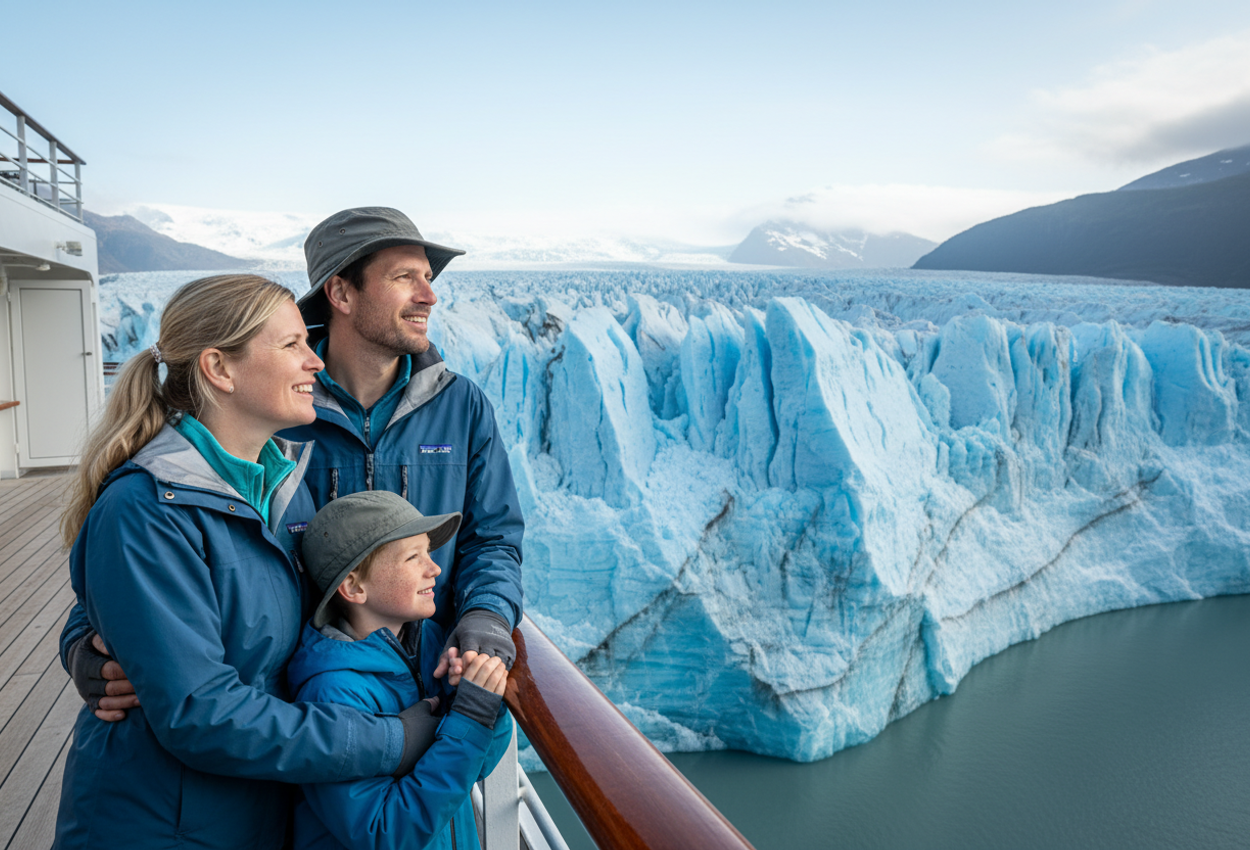
The first encounter with a glacier is often wordless. As the ship glides into Glacier Bay or another icy inlet, the air grows sharply colder, tinged with a metallic freshness that seems to come from another era. Walls of ice rise ahead, striated in blues that defy description — from pale aquamarine to an almost electric sapphire deep within crevasses. Families cluster on balconies and observation decks, swapping binoculars and steaming mugs of cocoa. A naturalist’s voice drifts over the loudspeakers, explaining how these ancient rivers of ice carved entire landscapes, while young children press gloved hands against the railing, simply mesmerized by the size of it all.
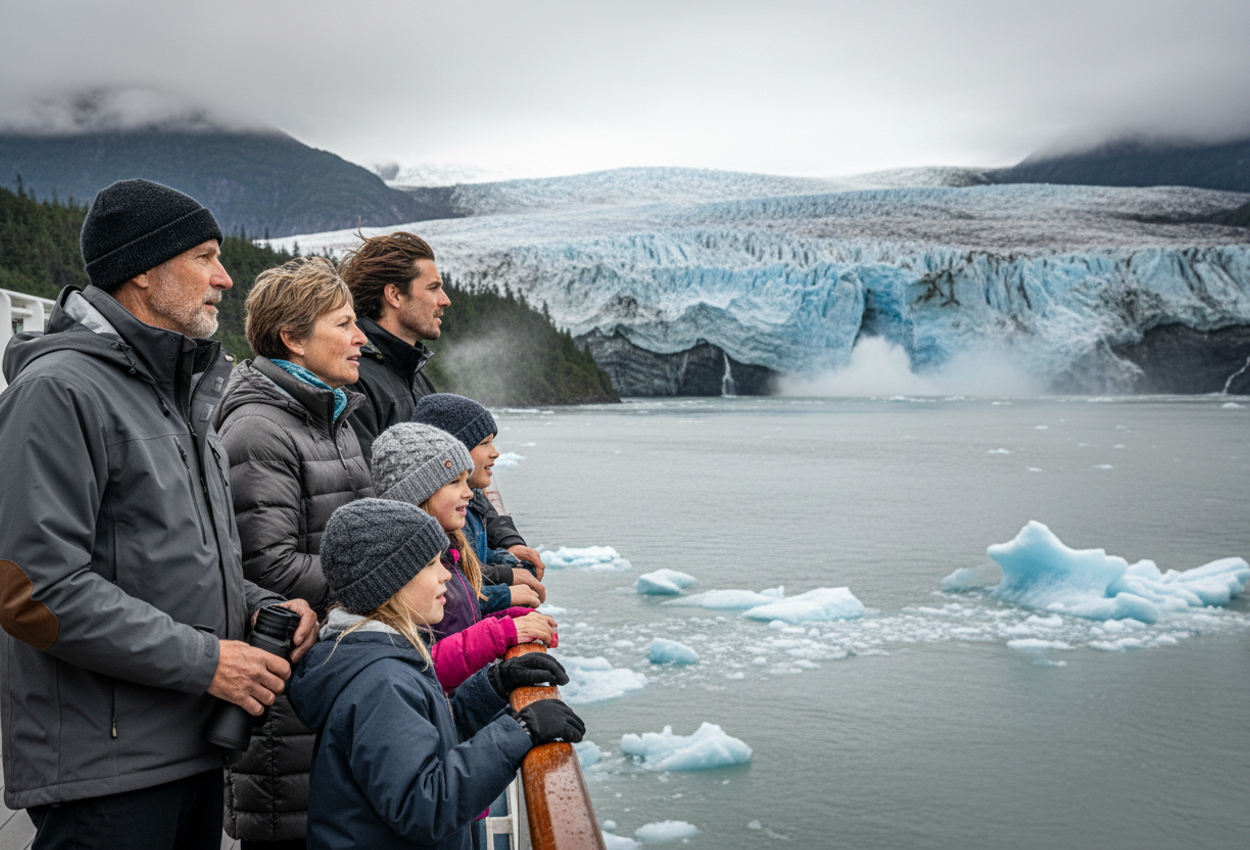
When a glacier calves, time briefly stops. There is a crack like thunder, then the slow-motion tumble of ice as a chunk separates and crashes into the slate-gray water below, sending up a plume of spray. The sound reaches the ship a heartbeat later, followed by an awed collective exhale from hundreds of witnesses. Grandparents recall news stories about melting ice caps; teenagers surreptitiously record the moment; younger kids, whose sense of time is shorter, understand only that they have seen something rare and powerful. In that shared silence, a sense of humility settles — a recognition of forces that existed long before any of us and will outlast our fleeting visit.
Wildlife keeps vigilance playful. One morning, word spreads that whales have been spotted off the starboard side. Families abandon card games and lectures alike, streaming to the railings. The sea, moments before an undisturbed gray plane, suddenly comes alive with plumes of mist as humpback whales surface to breathe. Their dark backs arc gracefully, occasionally followed by the flourish of a tail fluke as they dive. When a whale breaches — launching its massive body entirely out of the water — the ship erupts in gasps and shouts. Children jump up and down; grandparents wipe at unexpected tears; even the crew pauses to look.
In smaller excursion boats, the sense of intimacy intensifies. Seals haul out on floating ice like scattered commas, watching with indifferent curiosity. Bald eagles perch on high branches along the shore, their white heads stark against dark firs. A family might lean together over the side, the cold spray on their faces, as guidebooks and nature documentaries are replaced by the simple, astonishing reality of the moment.
Docking in Juneau, the state capital accessible only by sea and air, brings a different rhythm. Colorful wooden buildings line the waterfront, and hills rise steeply behind them, draped in dense forest. The family disperses for a while: some exploring shops selling local art and smoked salmon, others riding the aerial tramway for sweeping views over the Gastineau Channel. Yet it is a shared excursion to a glacier — perhaps Mendenhall Glacier — that becomes the day’s true anchor. Standing together on a viewpoint platform, the family traces the glacier’s retreat through interpretive markers, feeling the abstract concept of climate change become palpably, poignantly real.
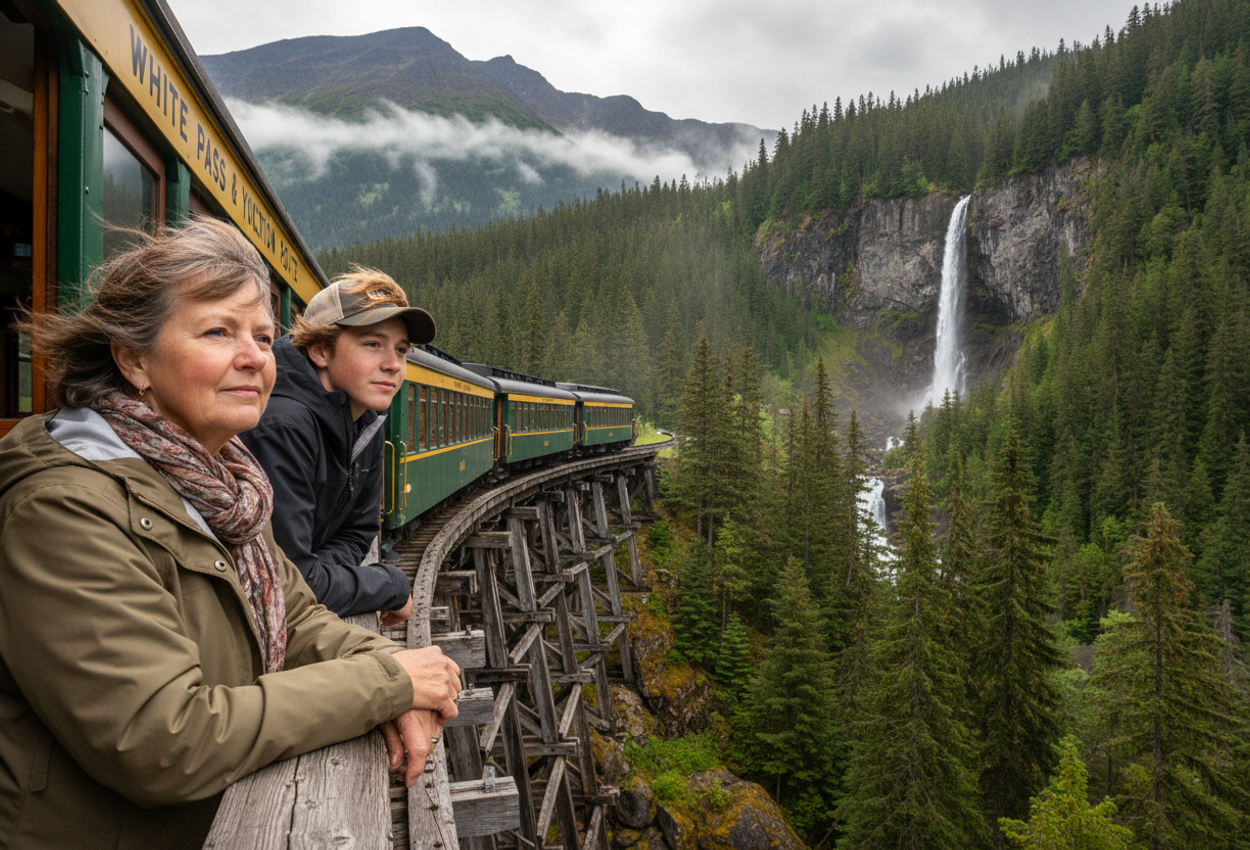
Further along the route in Skagway, history and adventure intertwine. Once a chaotic gateway for Klondike gold rush hopefuls, the town now welcomes travelers with wooden boardwalks and restored false-front buildings that stir the imagination. After a leisurely stroll past saloons and old-timey photo studios, the family boards the White Pass & Yukon Route railroad. This narrow-gauge train clings improbably to the mountainside, chugging past waterfalls, trestle bridges, and steep ravines. Children press their noses to the glass, counting tunnels; parents hold tight to railings on open platforms to drink in the crisp air; grandparents retell family stories of ancestors who once chased their own distant frontiers.
For many, Alaska’s most indelible memory comes from a dog sledding excursion on a glacier accessible only by helicopter. The adventure begins with the thunderous rush of rotors and the surreal feeling of rising above mountains glistening with snow. From the air, crevasses appear as inky-blue scars, and the world below seems vast and untouched. Landing on the glacier is like arriving on another planet — sunlight ricochets off the snow, and the air is so pure and cold it almost burns the lungs.
Waiting there, a team of lean, eager sled dogs yips in anticipation. Their excitement is infectious as guides introduce each dog by name and personality. Children linger to scratch behind ears, learning how these athletes live and train; older family members ask about the storied Iditarod and the human-canine partnerships it celebrates. When the sled finally lurches forward, there is a collective intake of breath. The only sounds are the scrape of runners on snow and the rhythmic panting of the dogs as they pull. Wind brushes faces, and for a few glorious minutes, the family flies over the glacier, bound together in shared exhilaration.
Back near sea level, a salmon bake in a forested clearing offers a distinctly Alaskan feast. Salmon grills over open flames, its smoky aroma curling through the trees. Picnic tables, worn smooth by countless gatherings, host platters of corn, potatoes, and fresh salads. Children roam between tables, returning with plates piled high; grandparents sit a bit longer, savoring each bite and the pleasure of watching the younger generation embrace new flavors. A nearby stream may hold its own quiet drama, with salmon pushing upstream, bodies flashing silver in the dappled light.
Onboard, evenings often bring cultural enrichment that deepens the journey. One night, the lounge quiets as a member of a local Tlingit community steps onto the small stage. Dressed in regalia accented with shells and beadwork, they share stories passed down through generations — of ravens and salmon, of clans and the deep relationship between people and land. Children listen, rapt, as drums and chanting weave an aural landscape as powerful as any glacier. Adults find themselves re-examining their own family narratives, sensing how place and ancestry shape identity. In this setting, surrounded by relatives and strangers alike, the lesson is clear: every coastline has its keepers, and every journey is richer when guided by those who have called it home for centuries.
An Alaskan cruise, with its blend of comfort and raw wilderness, becomes a floating framework for connection. There is space for everyone to move at their own pace, yet the shared encounters with ice, wildlife, and Indigenous culture draw the family back together again and again, reminding them how small and how lucky they are to explore the world side by side.
Sri Lanka: A Tapestry of Culture and Nature
In Sri Lanka, the very air seems woven from spice and sea salt, incense and jasmine. This teardrop-shaped island in the Indian Ocean offers an extraordinary concentration of experiences in a relatively small space, making it ideal for families hoping to balance exploration with ease. Here, ancient cities rise from the jungle, trains snake through emerald hills, and wild elephants roam within sight of the beach.
The journey into the island’s deep past begins in the ancient city of Anuradhapura, where stupas and stone pillars scatter across a vast, park-like landscape. Families move between sacred sites under the shade of towering trees, the heat softened by breezes that rustle palm fronds. At the heart of it all stands the Sri Maha Bodhi, a sacred fig tree believed to descend from the very tree under which the Buddha attained enlightenment. Grandparents, perhaps more attuned to the weight of such continuity, stand quietly beneath its branches, while children watch saffron-robed monks move like splashes of color among pilgrims.
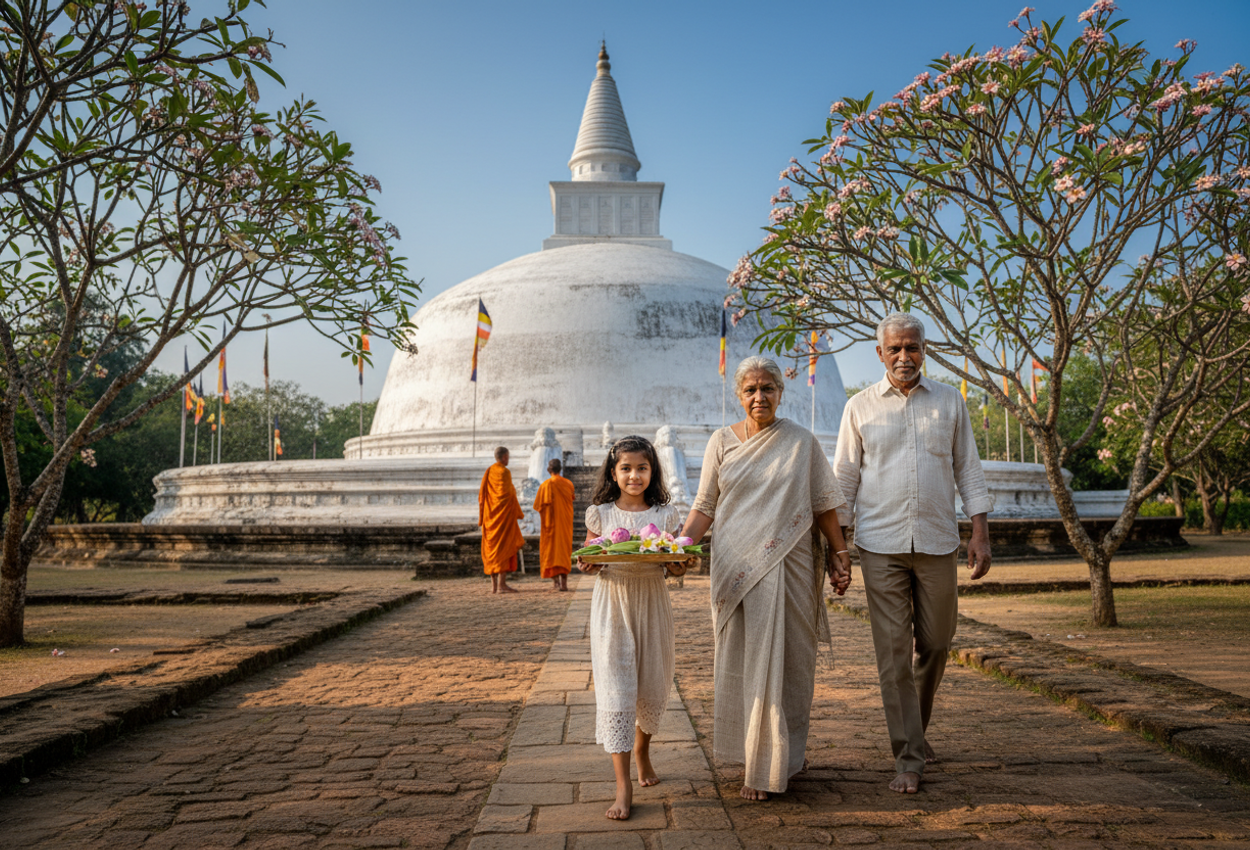
Nearby, the ruined monasteries and carved moonstones of Anuradhapura become stages for impromptu history lessons. Parents point out elephants and lotus flowers etched into stone, explaining their symbolic meanings; teens read from guidebooks, enjoying the role reversal of instructing older relatives. The low hum of cicadas underlines everything, and the smell of incense wafts from small shrines where devotees light oil lamps, leaving offerings of frangipani and marigold.
Further east in Polonnaruwa, the remnants of another former capital reveal a more compact but equally evocative vision of the past. Bicycles, rented from local vendors, make exploration playful and accessible for a wide range of ages. Children race gently along shaded paths while grandparents cruise at their own pace, regrouping at key sites: the rank of stone columns at the Royal Palace, the semicircular Vatadage with its guardian stones, the serene granite Buddhas of Gal Vihara. Time here feels generously elastic, allowing both deep contemplation and lighthearted movement.
From the cultural triangle, the family trades ruins for rolling hills, traveling by train into the highlands around Nuwara Eliya. The journey itself is a highlight — a slow, swaying passage past waterfalls, misty valleys, and villages clinging to steep slopes. Vendors hop on and off at stations, selling paper cones of spiced chickpeas and cut fruit sprinkled with chili salt, which children accept with delighted curiosity. Grandparents lean from open windows, the wind tugging at their hair as tea plantations sweep past in endless patterns of manicured green.
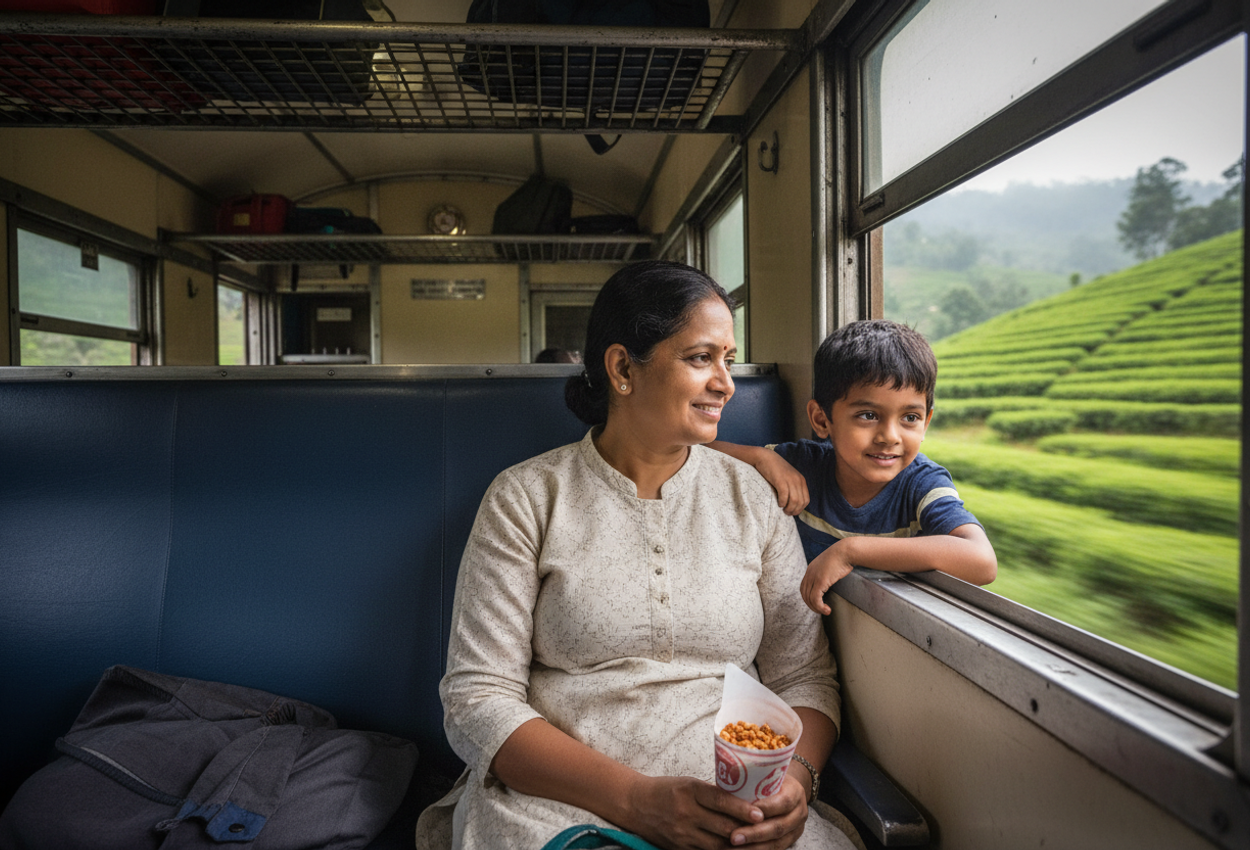
In the cool air of Nuwara Eliya, often nicknamed Little England for its colonial-era bungalows and manicured lawns, the family visits a working tea estate. Walking along tidy rows of waist-high bushes, they watch as skilled pluckers harvest only the youngest leaves, fingers moving with near-musical rhythm. A guide explains how altitude, weather, and soil combine to shape flavor. Inside the factory, the scent of oxidizing leaves is heady and comforting, like a cross between hay and honey. Tasting different brews — delicate, brisk, malty — becomes a small ceremony. A grandparent, perhaps long devoted to a particular morning blend, discovers new favorites; children, eyes widened by their first sips of strong black tea with milk and sugar, savor the feeling of being invited into an adult ritual.
On the island’s southeastern edge, the wild heart of Sri Lanka beats in Yala National Park. Here, dawn begins not with alarms but with birdsong and the soft clatter of jeeps being readied for safari. Wrapped in light jackets against the pre-sunrise chill, the family climbs into open vehicles, excitement sharpening every sense. The air smells of dust and distant salt; the eastern sky blushes pink as the convoy rolls past scrubland punctuated by gnarly trees and rock outcrops.
Wildlife sightings become a shared game of attention. Peacocks strut beside the track, their iridescent feathers catching the growing light. Spotted deer lift their heads in graceful unison, ears twitching. When the guide raises a hand for silence, everyone leans forward. A leopard has been spotted, draped in liquid elegance across a low branch, its coat a constellation of rosettes. Binoculars pass from hand to hand; children whisper in disbelief; grandparents, perhaps surprised by their own giddiness, feel time fall away as they lock eyes, however briefly, with this elusive cat.
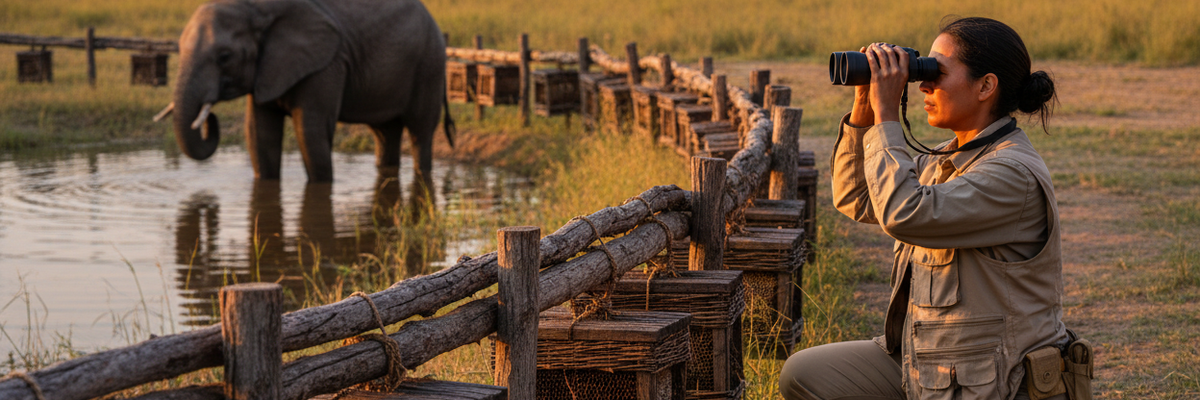
Elephants, too, appear in family groups mirroring the visitors. A matriarch leads her herd to a waterhole, calves jostling and splashing, older siblings nudging them into line. Watching them, human families fall naturally into reflections on care, protection, and the ways in which responsibility shifts across generations. Dust hangs in the air, golden in the slanting light, and for a while, the jeep is simply an extra cluster of quiet observers at the edge of a timeless scene.
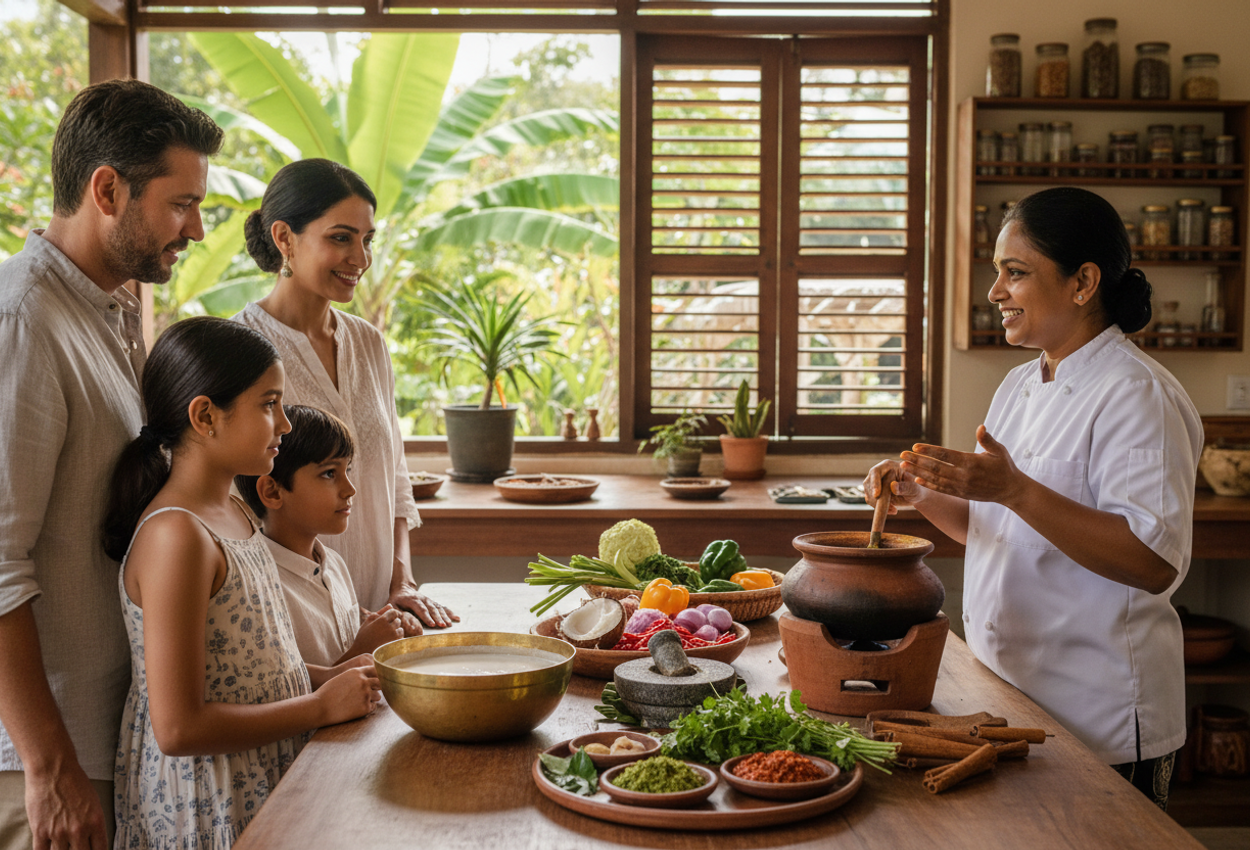
Back near the coast or in the central hills, a Sri Lankan cooking class offers a richly interactive way to draw the country’s flavors into the family’s own story. Hosted in a family home or small cooking school, the experience begins in a garden or at a local market, where ingredients are chosen by touch and scent: glossy eggplants, bundles of curry leaves, knobbly ginger, and bright bird’s-eye chilies. Children learn to identify pandan and lemongrass by aroma alone, while adults ask questions about sustainable sourcing and seasonal dishes.
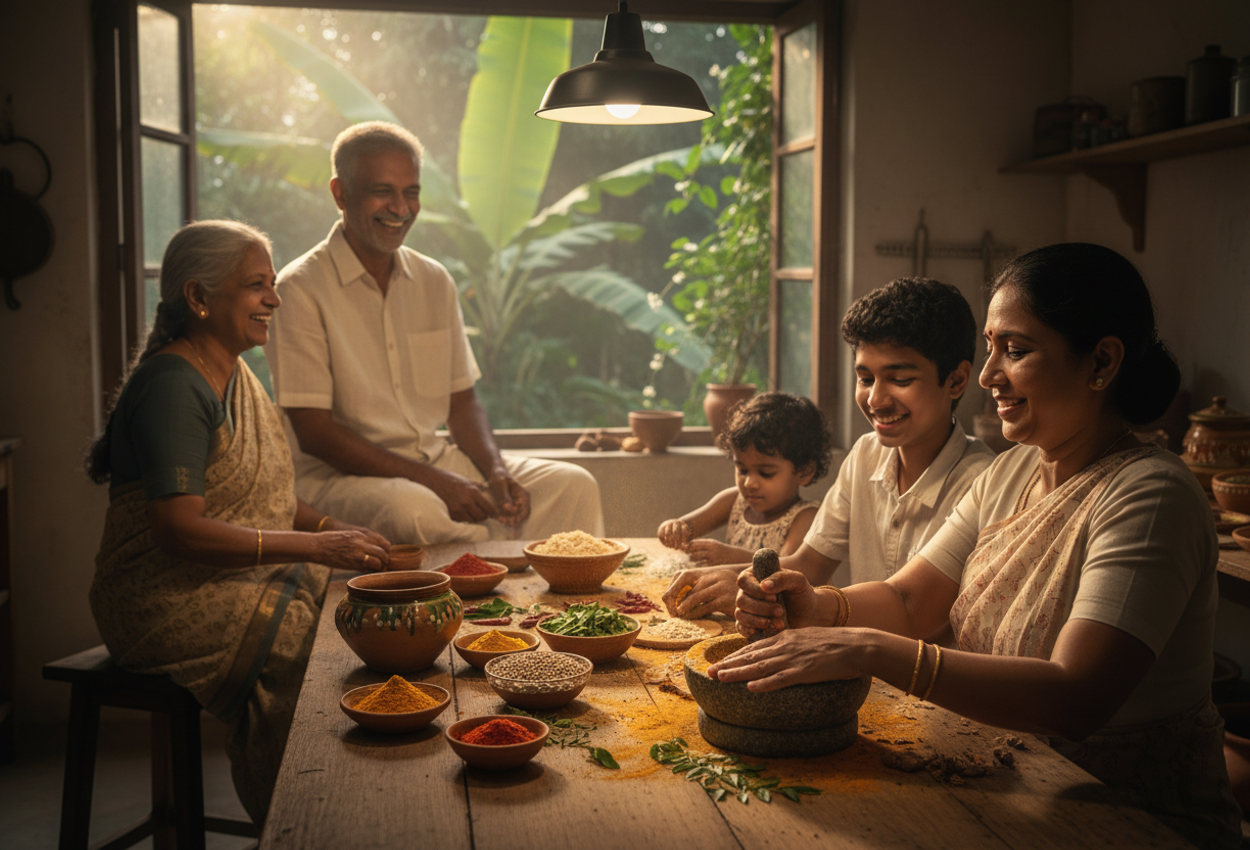
In the kitchen, clay pots line gas burners, and the rhythmic chopping of vegetables sets a soothing tempo. Under the guidance of a patient cook, the family grinds spices in a traditional stone mortar, the mix of coriander, cumin, fennel, and cardamom releasing an intoxicating perfume. Coconut milk is squeezed by hand from freshly grated flesh; batter for crisp-edged hoppers is whisked until it falls in silky ribbons. Grandparents sit comfortably at a table, shaping coconut sambal with their fingers, while teenagers experiment with balancing heat and tang in lentil dhal. Younger children take charge of garnish, sprinkling fresh herbs with solemn concentration.
When the meal is finally ready, it spreads across the table in a riot of color: golden curries, emerald sambals, pale hopper bowls with soft-centered eggs, fragrant rice speckled with toasted cashews and raisins. Eating with fingers, as is customary here, becomes a tactile lesson in etiquette and presence. Each bite is simultaneously a taste of Sri Lanka and a memory in the making — one that can be revisited long after the trip ends, every time a family member reaches for turmeric or coconut milk in their own kitchen.
Sri Lanka’s great gift to multigenerational travelers lies in its balance. Distances are manageable, yet the variety is immense; accommodations range from simple guesthouses to elegant boutique hotels, allowing families to tailor comfort levels. Most of all, the island invites a slower form of discovery, one in which elderly knees and toddler patience are both considered, and where the most lasting souvenirs are not just photos of ruins or leopards, but the quiet intimacy of shared cups of tea and communal meals.
Switzerland: Alpine Adventures for Everyone
In Switzerland, the landscape seems almost impossibly ordered: crystal lakes mirroring peaks, tidy villages with flower boxes bursting from wooden balconies, trains that glide with near-magical punctuality through mountains that elsewhere would be considered impenetrable. For multigenerational families, this consistency offers a gentle framework in which adventure feels secure, and even the most reluctant traveler can relax into the journey.
The iconic Glacier Express provides the perfect moving living room. Boarding in Zermatt or St. Moritz, the family settles into panoramic cars where floor-to-ceiling windows transform the alpine world into a private cinema. Luggage is stowed, jackets draped, and soon the click and sway of the train becomes a soothing heartbeat. Grandparents trace the route on printed maps, reading aloud about the engineering feats hidden beneath the passing scenery. Children press their faces to the glass, inventing stories for the tiny villages and solitary barns that flash by. Parents alternate between quietly catching up on reading and leaning over to point out glacial valleys or tumbling rivers.
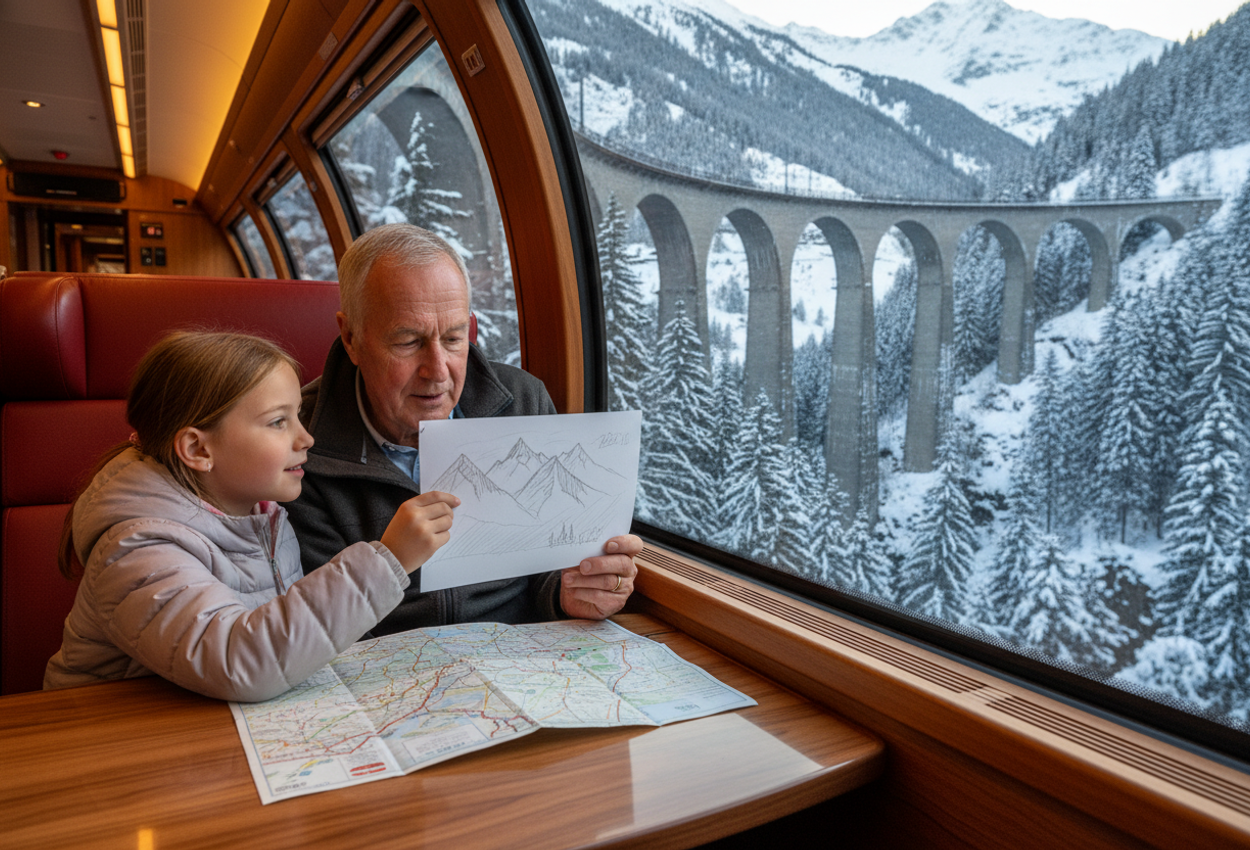
As the train winds over viaducts and dives through tunnels, the outside world changes with almost theatrical timing. Dense pine forests give way to high meadows dotted with cows, their bells chiming a gentle music that seeps even through closed windows. Snow-capped peaks appear and disappear as the train negotiates curves that feel too tight to be possible. Over a leisurely lunch served at your seat, the family toasts the day with mineral water from local springs or a glass of crisp Swiss white wine, clinking glasses softly so as not to disturb the neighboring table where another three-generation clan does much the same.
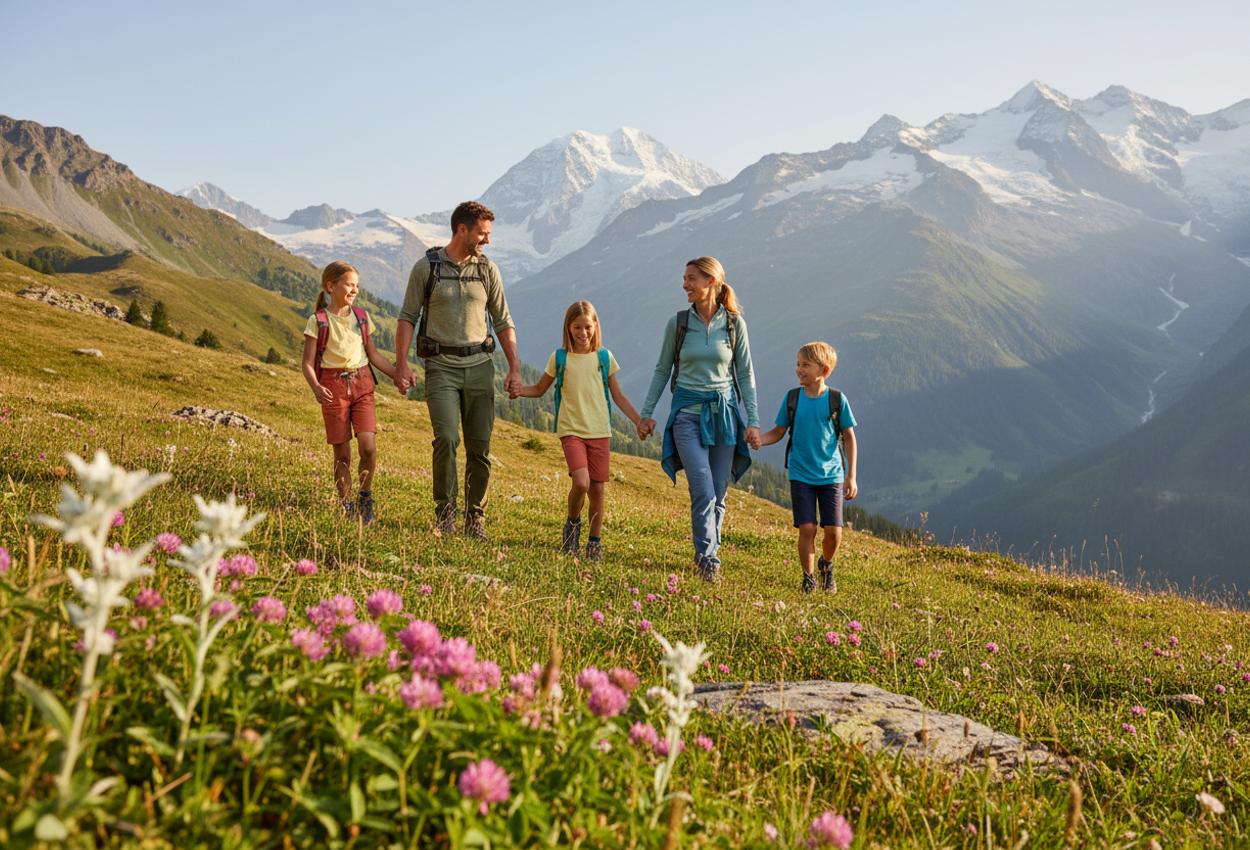
Off the train and into the heart of the Alps, hiking trails fan out from villages like Grindelwald, Wengen, or Zermatt, offering options for all abilities. A gentle, well-marked path might begin with a cable car ride, sparing older knees and smaller legs from steep ascents. Emerging at a high-altitude station, the family steps into air so clear it feels newly minted. The sun, stronger at elevation, warms faces even as a cool breeze carries the scent of wildflowers and pine resin.
The chosen trail follows a contour along the mountainside, with benches placed thoughtfully at regular intervals. Grandparents walk at a comfortable pace, pausing often to watch paragliders dance on thermals above. Children zigzag ahead, stopping to examine marmots that dart in and out of rocky burrows or to launch small sticks into mountain streams that race alongside the path. Parents mediate the distance between, snapping photos that capture both the sweeping grandeur of the peaks and the small details of a child’s hand reaching out to touch a cluster of alpine gentians.
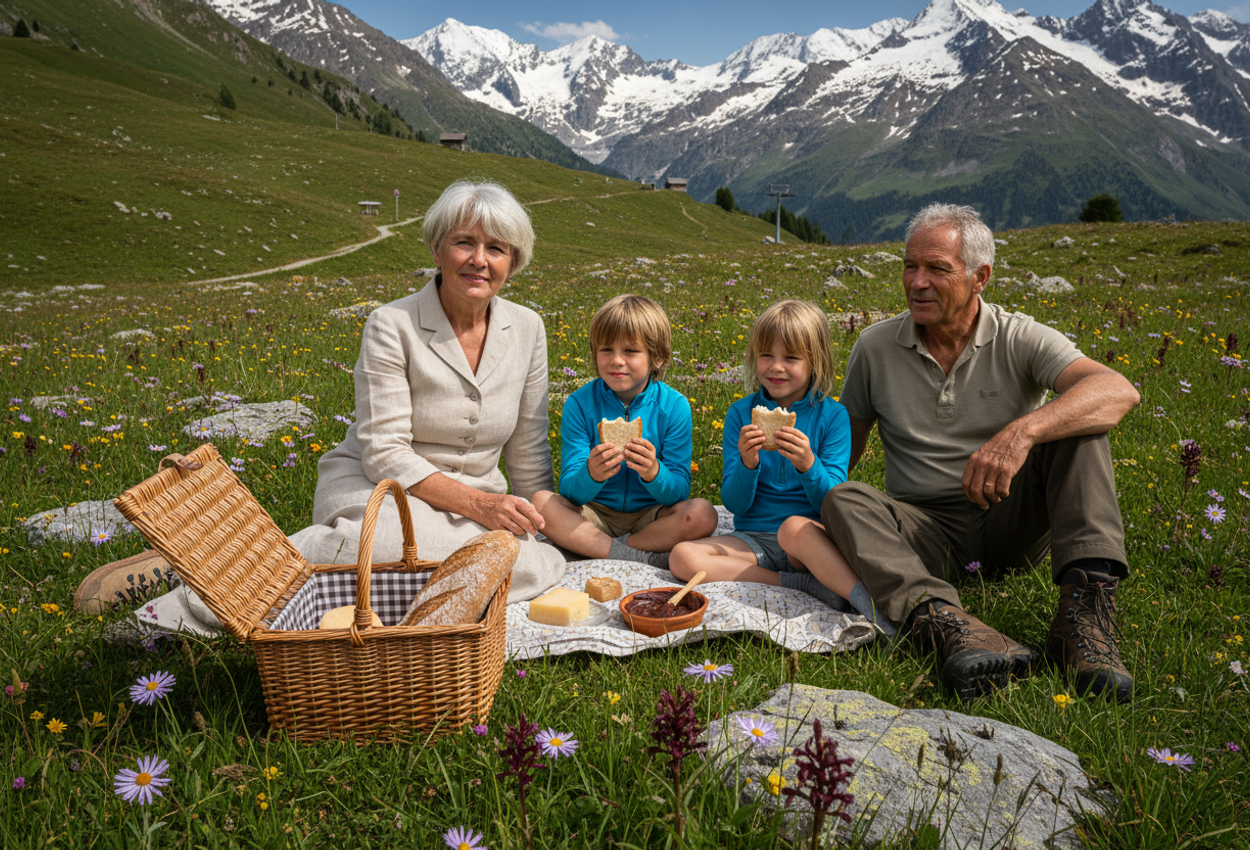
Picnic lunches on these trails become minor feasts. From backpacks emerge crusty loaves of bread, rounds of local cheese with nutty aromas, paper-wrapped slices of air-dried meat, and chocolate that somehow tastes even richer when eaten with slightly cold fingers. Everyone finds a comfortable rock or patch of grass, boots off, socks drying in the sun. Conversation flows easily, aided by the sense of accomplishment and the simple pleasure of hunger satisfied in stunning surroundings.
Back near the lakes and cities, a visit to the Lindt Home of Chocolate near Zurich delights all ages in different ways. The futuristic building, with its sweeping curves and airy atrium, houses a museum that traces the story of chocolate from ancient cacao rituals to modern confectionery. Interactive exhibits invite children to grind cocoa beans or design digital wrappers, while adults linger over displays explaining fair-trade sourcing and innovation. The showstopper is a towering chocolate fountain, its cascading ribbons of liquid sweetness entrancing to watch. Tasting sessions allow each family member to discover their favorite flavor profile — creamy milk, intense dark, or something studded with nuts and fruit.
Yet some of Switzerland’s most heartwarming experiences unfold far from glossy museums, in the quiet routines of rural life. A hidden gem for families is a stay or day visit at a traditional Swiss farm in the countryside near Lucerne or Appenzell. Reached by a short bus ride or a scenic hike, the farm sits amid rolling pastures where cows graze lazily, their bells chiming in polyphonic harmony. The farmhouse, sturdy and adorned with painted shutters, opens its doors with a smell of hay, warm milk, and baking bread.
Morning begins early here, but children often rise willingly when promised the chance to help with chores. Under the watchful eye of the farmer, they scatter feed for chickens, exclaiming as feathers tickle their hands. Teens assist with brushing the cows, learning how each animal has a name and temperament. Grandparents, perhaps reminded of their own rural childhoods or simply enjoying the vicarious nostalgia, watch from a bench, a mug of fresh milk or coffee warming their hands.
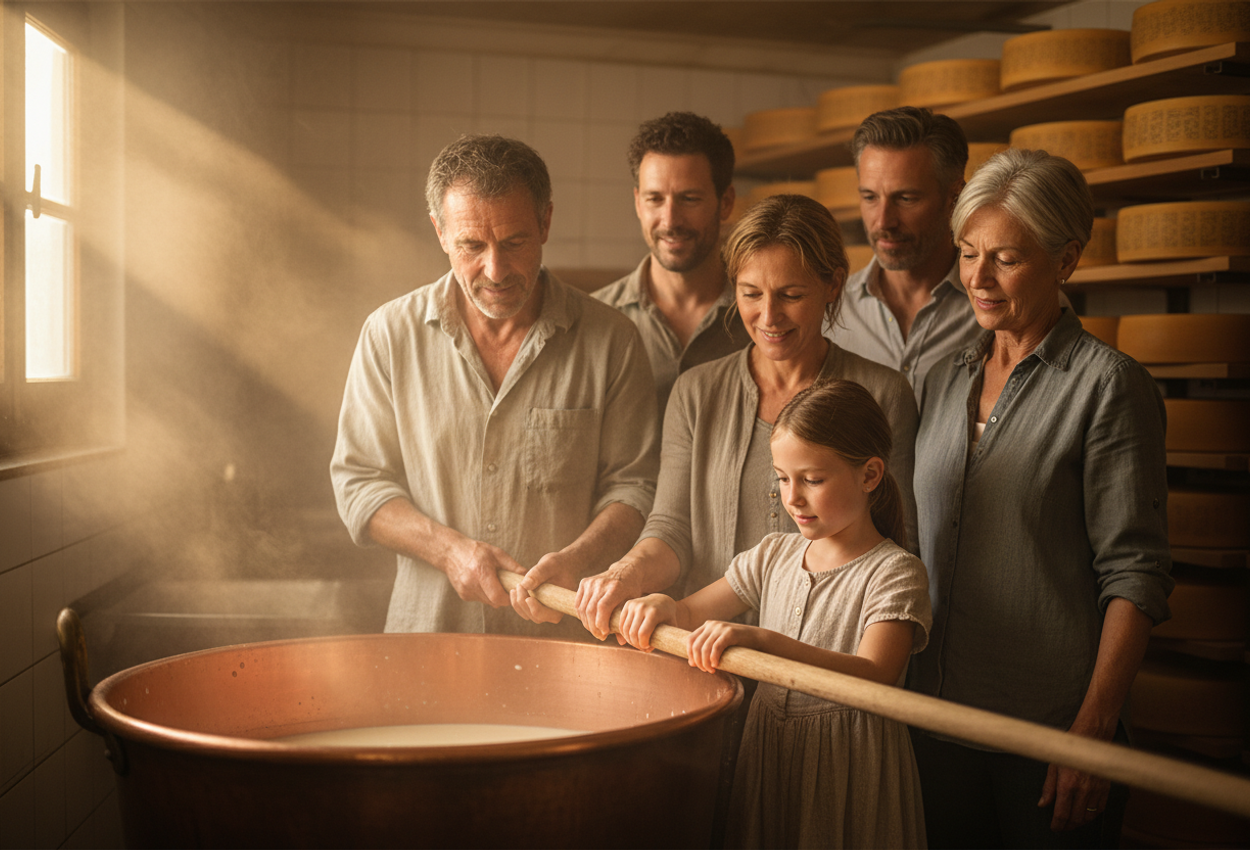
The highlight is cheese-making, an age-old craft that becomes a sensory masterclass. In a small, spotless dairy room, the family gathers around a copper cauldron where fresh milk gently warms. The farmer explains each step — the addition of rennet, the patient waiting for curds to form, the careful cutting and stirring. Children are invited to stir with a long wooden paddle, eyes widening as the liquid transforms into soft, cloudlike lumps. The smell is clean and slightly sweet, a promise of the flavors to come.
Later, as the curds are pressed into molds and stored to mature, the family samples cheeses at different ages. Young, springy wheels with subtle tang; older, firmer varieties with complex, nutty depths. They learn to pair bites with slices of apple or spoonfuls of homemade jam. Around the farmhouse table, daylight pouring in, stories flow — of life in the Alps through changing seasons, of transhumance traditions, of festivals where cows are adorned with flower crowns and paraded through villages. Children compare this rural rhythm with their own urban routines; grandparents share memories of simpler times. In the gentle cadence of shared discovery, the gap between city guest and mountain host narrows.
Switzerland’s talent for infrastructure — the punctual trains, the precise cable cars, the well-marked paths — quietly supports these layered experiences. Families can stretch into adventure knowing that, at the end of the day, a warm bed, a hot meal, and an easy way to tomorrow’s view await. In such an environment, generations can each find their own level of challenge and comfort, meeting again at dinner tables and train compartments to compare impressions and plan the next day’s collective chapter.
Across these journeys — from Italy’s sun-drenched piazzas and Costa Rica’s rainforests to Morocco’s deserts, Alaska’s fjords, Sri Lanka’s ruins, and Switzerland’s peaks — one truth emerges clearly. The most enduring souvenirs are not the handcrafted masks or chocolate bars, the rugs or bottles of olive oil, but the shared moments of awe, vulnerability, and joy. Family miles, whether flown, sailed, or walked, become the measure of an expanding heart, one that makes room not only for the world’s wonders, but for each other.