

Free Rila Travel Guide & Mobile App
Explore Rila with free travel guides. Discover regional history, expert tips, proposed trips, and audio guides on web or mobile app.


Explore Rila’s glacial lakes, Bulgaria’s highest peaks, forest trails, mountain resorts and the revered Rila Monastery.
Read more about Rila
When is the best time to visit Rila?
Best: June–August · 19–22°C| Month | High (°C) | Rainfall (mm) |
|---|---|---|
| January | 3 | 47 |
| February | 4 | 39 |
| March | 7 | 43 |
| April | 11 | 51 |
| May | 16 | 68 |
| June (best) | 19 | 73 |
| July (best) | 22 | 62 |
| August (best) | 21 | 58 |
| September | 17 | 52 |
| October | 12 | 51 |
| November | 7 | 63 |
| December | 4 | 56 |
Getting to and around Rila
How to get there
Transportation
Destinations in Rila
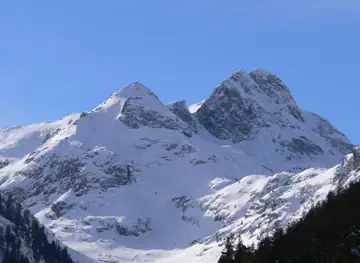
Resorts, valleys and scenic spots worth a trip of their own.
-

-

-
-

-
-


Swipe for more destinations
Best attractions in Rila
Rila’s attractions are shaped by the contrast between protected high mountain terrain and long-established religious and resort life. Rila National Park contains alpine grasslands, conifer forests, glacial valleys and lakes, with walking routes ranging from accessible forest paths to demanding ascents of Musala and other high summits. The Seven Rila Lakes are the region’s most visited natural sight, while the Malyovitsa valley offers a stronger mountaineering tradition and a quieter trail network. Borovets provides skiing in winter and lift-assisted access to summer routes, whereas Panichishte and Sapareva Banya combine mountain gateways with spa and leisure facilities. Rila Monastery adds an exceptional cultural dimension through its churches, murals, museum collections and wooded setting. Visitors can also explore mountain huts, village roads, bird-rich forests and pastoral landscapes, but facilities become sparse away from established resorts, making route planning particularly important.
-
Monastery
Troyan Monastery
Discover the tranquility and rich heritage of Troyan Monastery, a historic Bulgarian landmark set amidst breathtaking natural beauty.
-
Tourist attraction
Prohodna Cave
Explore Prohodna Cave, a stunning natural attraction in Bulgaria, known for its breathtaking formations and the iconic 'Eyes of God'.
-
Tourist attraction
Trigrad Gorge
Experience the stunning beauty of Trigrad Gorge, Bulgaria's natural gem, where majestic cliffs meet serene landscapes in the heart of the Rhodope Mountains.
-
Park
Rila park Dupnica
Explore Rila Park in Dupnica – a tranquil retreat with lush landscapes, diverse wildlife, and family-friendly activities for a perfect getaway.


Best landmarks in Rila
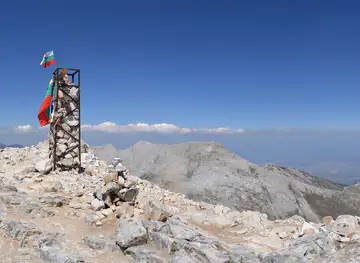
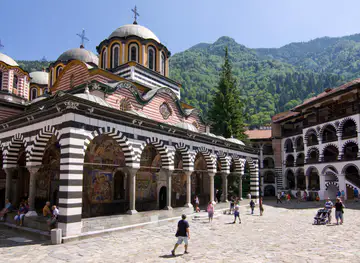
The most recognisable cultural landmark is Rila Monastery, whose enclosed stone-and-timber complex, striped katholikon, arcades and richly coloured frescoes represent the enduring importance of Bulgarian Orthodox architecture. Its mountain setting and connection with Saint Ivan of Rila give it significance beyond its visual appearance. In the natural landscape, Musala is the defining summit: at 2,925 metres it is Bulgaria’s highest point and the highest peak in the Balkans. The Seven Rila Lakes form another emblematic landmark, their successive glacial basins arranged beneath the surrounding ridges. The Malyovitsa peak and valley are closely associated with Bulgarian mountaineering, while the broad alpine slopes around Borovets reveal the mountain’s modern resort history. Several remote monasteries, chapels and mountain huts add local character, though their access and facilities are more limited than those at the principal sites.
-
 Monastery
Rila Monastery
Discover the breathtaking Rila Monastery, a UNESCO World Heritage site, nestled in Bulgaria's stunning Rila Mountains, rich in history and spiritual heritage.
-
Fortress
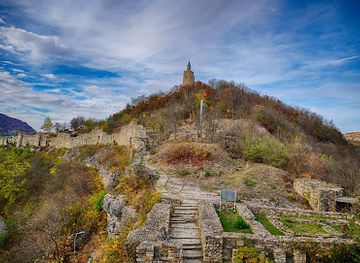
Tsarevets Fortress
Discover the historical grandeur of Tsarevets Fortress in Veliko Tarnovo, where Bulgaria's rich medieval past comes alive amidst stunning landscapes.
-
National park
Rila National Park
Explore Rila National Park: Bulgaria's largest national park, a UNESCO World Heritage site, known for its breathtaking landscapes and diverse hiking trails.
-
Park
Rila park Dupnica
Explore Rila Park Dupnica, a serene escape for nature lovers and families, offering stunning landscapes and recreational activities in Bulgaria.


Explore Rila on the map
Plan your trip on one map. See where the top cities, national parks and sights are, and book hotels and experiences in a few clicks.
Best hotels in Rila
Best restaurants in Rila
Food in Rila reflects the wider cuisine of south-western Bulgaria, with hearty dishes suited to a mountain climate. Resort restaurants and village inns commonly serve bean stews, grilled meats, shopska salad, stuffed peppers, fried or grilled trout where locally sourced, and pastries such as banitsa. Mountain huts provide simple soups, beans, bread, tea and filling cooked meals rather than elaborate dining. Around Sapareva Banya and the foothill settlements, look for home-style cooking, dairy products, jams and seasonal mushrooms when available. Restaurants in Borovets offer a broader choice, including Bulgarian specialities alongside international resort food. Rila Monastery has a small number of nearby eating places rather than a large dining quarter, so visitors should plan meals around opening arrangements and onward travel. Local fruit brandies and Bulgarian wine may appear on menus, while herbal teas are a natural choice after a high-altitude walk.
-
Restaurant
Restaurant "Seven Rila Lakes"
Experience authentic Bulgarian cuisine amidst stunning landscapes at the Seven Rila Lakes Restaurant in Sapareva Banya.
-
Restaurant
Rila fish
Discover fresh seafood delights at Rila Fish in Belitsa - where local flavors meet exceptional dining experiences.
-
Restaurant
Gorchim
Experience authentic Bulgarian cuisine at Gorchim - a hidden gem nestled in nature's beauty.
-
Restaurant
Tavern "Old Willow"
Discover authentic Bulgarian cuisine at Tavern 'Old Willow' in Dupnica – where tradition meets taste in a cozy setting.


Best bars in Rila
Rila’s evening life is concentrated in Borovets and the larger foothill settlements rather than spread across the mountain. Borovets has the widest choice of hotel bars, après-ski venues, pubs and occasional late-night entertainment, with activity generally strongest during the winter season and busier holiday periods. In Sapareva Banya, evenings are more likely to centre on restaurants, hotel lounges and relaxed conversations after spa visits. Malyovitsa and the villages have a quieter pattern based on guesthouse dining, mountain-hut sociability and early nights before walking or climbing. Small breweries, Bulgarian wine and rakia may be available, but drinking is not necessary to experience the region’s culture. Check local arrangements before travelling, as resort venues and seasonal businesses can change outside peak periods.
-
Bar
Raketa Rakia Bar
Discover the vibrant flavors of Bulgaria at Raketa Rakia Bar, Sofia’s go-to destination for traditional cuisine and delectable rakia.
-
Cocktail bar
Sputnik Cocktail Bar
Experience Sofia's nightlife at Sputnik Cocktail Bar, where expertly crafted cocktails and a vibrant atmosphere await every visitor.
-
Restaurant
Han Dyavolski Vodi
Experience the rustic charm and authentic flavors of Bulgaria at Han Dyavolski Vodi, a delightful restaurant and hotel in Pastra.
-
Bar
BeFree
Experience the vibrant nightlife of Blagoevgrad at BeFree, where delicious food and creative cocktails await in a trendy setting.


Best nightclubs in Rila
Rila’s evening life is concentrated in Borovets and the larger foothill settlements rather than spread across the mountain. Borovets has the widest choice of hotel bars, après-ski venues, pubs and occasional late-night entertainment, with activity generally strongest during the winter season and busier holiday periods. In Sapareva Banya, evenings are more likely to centre on restaurants, hotel lounges and relaxed conversations after spa visits. Malyovitsa and the villages have a quieter pattern based on guesthouse dining, mountain-hut sociability and early nights before walking or climbing. Small breweries, Bulgarian wine and rakia may be available, but drinking is not necessary to experience the region’s culture. Check local arrangements before travelling, as resort venues and seasonal businesses can change outside peak periods.
-
Bar
Cacao Beach Club
Experience the vibrant nightlife and stunning beachfront views at Cacao Beach Club in Sunny Beach, Bulgaria - the ultimate destination for fun and relaxation.
-
Night club
Carrusel Club
Immerse yourself in Sofia's vibrant nightlife at Carrusel Club – where unforgettable experiences and electrifying music come together.
-
Night club
EXE Club
Discover Sofia's nightlife at EXE Club, where vibrant beats and a stylish atmosphere create unforgettable nights in Bulgaria's capital.
-
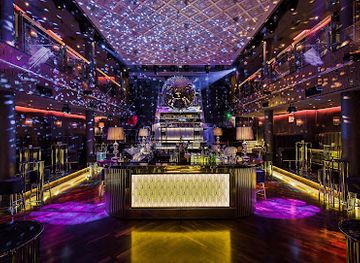
Disco club
Once Upon a Time Biblioteka
Discover Sofia's nightlife at Once Upon a Time Biblioteka, a lively disco club and restaurant offering delicious food and vibrant live music.



Best shops in Rila
Shopping in Rila is practical and regional rather than centred on large retail complexes. Borovets has the broadest resort selection, including outdoor equipment, winter clothing, souvenirs and small shops aimed at visitors, while Sapareva Banya and the foothill towns offer everyday provisions, pharmacies and local produce. Around Rila Monastery, stalls and shops sell religious objects, icons, books, postcards, honey, herbal products and packaged Bulgarian food; purchases should be made respectfully, particularly when they relate to Orthodox worship. Village shops and seasonal markets may offer cheese, jams, dried herbs, walnuts and fruit products from the surrounding countryside. Handmade textiles, carved items and ceramics can sometimes be found through local producers, although choice varies. For a more substantial supply of hiking equipment or specialist shopping, Sofia is outside Rila and is the most reliable nearby urban option.
-
Shopping mall
Serdika Center
Explore Serdika Center, Sofia's dynamic shopping mall offering a blend of local and international brands, delightful dining, and engaging entertainment.
-
Monastery
Rila Monastery
Discover the beauty and tranquility of Rila Monastery, a UNESCO World Heritage site nestled in Bulgaria's breathtaking mountains.
-
Shopping mall
The Mall
Explore Sofia's vibrant shopping scene at The Mall, featuring diverse stores, dining options, and entertainment for all ages.
-
Shopping mall
Mall of Sofia
Explore the Mall of Sofia, a premier shopping destination in Bulgaria's capital, blending modern retail with local charm and vibrant entertainment.


Get your free copy of our complete guide to Rila, delivered straight to you.
Everything on this page, from attractions and restaurants to essentials and local phrases, in one PDF you can read offline, print or share.
Already have an account? Sign in
Your Rila guide is ready.
We'll send it to · Not you? Sign out

Getting your guide ready…
We are putting together a fresh copy of the Rila guide. This can take up to a minute.
This can take a few moments. If your browser asks, choose Allow so the download can start. You'll find the guide in your Downloads folder.
Nothing happened? Download it again
Sorry, the guide is taking longer than usual. Please try again in a minute, or get it by email instead.
Rila essentials
Currency and Payment
Safety
Emergency Situations
Do's and Don'ts
Local Tips
From Eve
Local phrases worth knowing
You don't need to get them perfect. A few words go a long way, and locals appreciate the effort.
Basics
| English | Local | Say it |
|---|---|---|
| Hello | Howdy | [hau-dee] |
| Goodbye | See ya | [see ya] |
| Yes | Yep | [yehp] |
| No | Nope | [nohp] |
| Please/You're welcome | Sure thing | [shur thing] |
| Thank you | Thanks | [thangs] |
| Excuse me/Sorry | Sorry | [sor-ree] |
| How are you? | How's it going? | [how's it goin?] |
| Fine. And you? | Good. You? | [gud. yoo?] |
| Do you speak English? | Do ya speak English? | [do ya speek ing-glish?] |
| I don't understand | I don't get it | [I don't get it] |
Eating & Drinking
| English | Local | Say it |
|---|---|---|
| I'd like to see the menu, please | Can I see the menu, please? | [kan I see the men-yoo, pleez?] |
| I don't eat meat | I don't eat meat | [I don't eat meat] |
| Cheers! | Cheers! | [cheers!] |
| I would like to pay, please | Can I pay the bill, please? | [kan I pay the bil, pleez?] |
Emergencies
| English | Local | Say it |
|---|---|---|
| Help! | Help! | [help!] |
| Go away! | Leave me alone! | [leave me a-lone!] |
| Call the Police! | Call the cops! | [call the cops!] |
| Call a doctor! | Get a doctor! | [get a doc-tor!] |
| I'm lost | I'm lost | [I'm lost] |
| I'm ill | I'm not feeling well | [I'm not feel-ing well] |
Shopping
| English | Local | Say it |
|---|---|---|
| I'd like to buy... | I want to buy... | [I want to buy...] |
| I'm just looking | Just browsing | [just brows-ing] |
| How much is it? | How much does it cost? | [how much does it kost?] |
| That's too expensive | That's too pricey | [that's too pri-see] |
| Can you lower the price? | Can you make it cheaper? | [kan you make it chee-per?] |
Time & Numbers
| English | Local | Say it |
|---|---|---|
| What time is it? | What time is it? | [what time is it?] |
| It's one o'clock | It's one o'clock | [it's one o'clock] |
| Half past (10) | Half past ten | [half past ten] |
| Morning | Morning | [morning] |
| Afternoon | Afternoon | [afternoon] |
| Evening | Evening | [evening] |
| Yesterday | Yesterday | [yes-ter-day] |
| Today | Today | [to-day] |
| Tomorrow | Tomorrow | [to-mor-row] |
| 1 | 1 | [one] |
| 2 | 2 | [two] |
| 3 | 3 | [three] |
| 4 | 4 | [four] |
| 5 | 5 | [five] |
| 6 | 6 | [six] |
| 7 | 7 | [seven] |
| 8 | 8 | [eight] |
| 9 | 9 | [nine] |
| 10 | 10 | [ten] |
Transport & Directions
| English | Local | Say it |
|---|---|---|
| Where's a/the...? | Where's the...? | [where's the...?] |
| What's the address? | What's the address? | [what's the ad-dress?] |
| Can you show me (on the map)? | Can you point it out on the map? | [kan you point it out on the map?] |
| When's the next (bus)? | When's the next bus? | [when's the next bus?] |
| A ticket (to ....) | A ticket to ... | [a tik-it to ...] |
History of Rila
Ancient Mountain Passes and Thracian Settlement
Rila’s valleys and passes formed part of the wider network linking the interior Balkans with the Aegean and Thracian lowlands. Evidence from the surrounding region indicates human activity from prehistoric times, while Thracian communities used mountain resources, pasture and routes through south-western Bulgaria. Later Roman administration brought roads, settlements and changing patterns of trade to the broader area, although the high mountain remained more sparsely occupied than the foothills. The landscape’s importance has always rested on its resources, routes and defensive isolation as much as on permanent settlement.
Saint Ivan of Rila and the First Monastery
The central religious story of Rila begins with Ivan of Rila, a tenth-century hermit revered as Bulgaria’s principal saint. According to tradition, he lived in solitude in the mountain before attracting followers, and a monastic community developed around his spiritual legacy. The original foundation changed location and form over time, but its connection with the saint gave Rila exceptional significance in Bulgarian Orthodox culture. The monastery became a place of pilgrimage, learning and manuscript production, linking the mountain to the medieval Bulgarian literary tradition.
Medieval Bulgarian Monastic and Literary Centre
During the medieval Bulgarian period, the Rila Monastery grew into a major religious institution supported by rulers, nobles and pilgrims. Its influence extended beyond worship: monasteries preserved texts, trained clergy and maintained elements of Bulgarian language and cultural memory during periods of political instability. The surrounding valleys were also connected with routes across south-western Bulgaria, although access remained difficult. Rila’s importance therefore came from the combination of an enduring monastic tradition, a remote mountain setting and its role in sustaining Bulgarian identity through successive political changes.
Ottoman Rule and Reconstruction
After the Ottoman conquest of the Bulgarian lands in the late fourteenth century, Rila Monastery survived as an important Orthodox institution, though it experienced periods of difficulty, damage and rebuilding. The present complex largely reflects later reconstruction rather than a single medieval phase. Fires and other destruction led to repeated renewal, with craftsmen from across the region contributing to its churches, residential wings and decoration. Its survival allowed the monastery to remain a focal point for Bulgarian religious and cultural life during centuries when Bulgaria had no independent state.
The Bulgarian National Revival and the Modern Monastery
In the eighteenth and nineteenth centuries, the monastery became closely associated with the Bulgarian National Revival, a movement that strengthened education, religious culture and national consciousness under Ottoman rule. The main church, the katholikon of the Nativity of the Virgin, was completed in the nineteenth century and decorated with vivid frescoes and carved woodwork. The complex’s architecture expresses both monastic enclosure and public pilgrimage. Following the restoration of Bulgarian statehood in 1878, Rila Monastery continued to function as a religious centre and a symbol of national heritage.
Mountaineering, Resorts and Protected Landscapes
Organised mountaineering and mountain tourism expanded in the twentieth century, particularly around Borovets and Malyovitsa. Winter sports, climbing and hiking introduced new infrastructure while gradually bringing Rila into Bulgaria’s national tourism network. Protection of its forests, alpine habitats and waters led to the creation of Rila National Park in 1992, one of the country’s largest protected areas. Today the region balances pilgrimage, conservation, hiking and ski tourism, with management challenges arising from seasonal crowds, fragile trails and the need to protect high-altitude ecosystems.
Rila in Photos
Browse through our photo collection highlighting the charm and character of the destination.
Neighbouring regions of Rila
The closest regions to Rila, if you have time for more than one.
-

-
-

-

-


Swipe for more regions
Explore more

Explore more of Bulgaria
Explore Bulgaria: From Sofia's bustling streets to the serene mountains and stunning Black Sea beaches, discover the rich history, culture, and natural beauty of Bulgaria.
Explore Bulgaria