

Voderup Klint Travel Guide
Free Guide: Terraced coastal cliffs where Ice Age geology, open sea views and tranquil island farmland meet in one of Ærø’s most distinctive natural landscapes.


A brief summary of Voderup Klint
Terraced coastal cliffs where Ice Age geology, open sea views and tranquil island farmland meet in one of Ærø’s most distinctive natural landscapes.
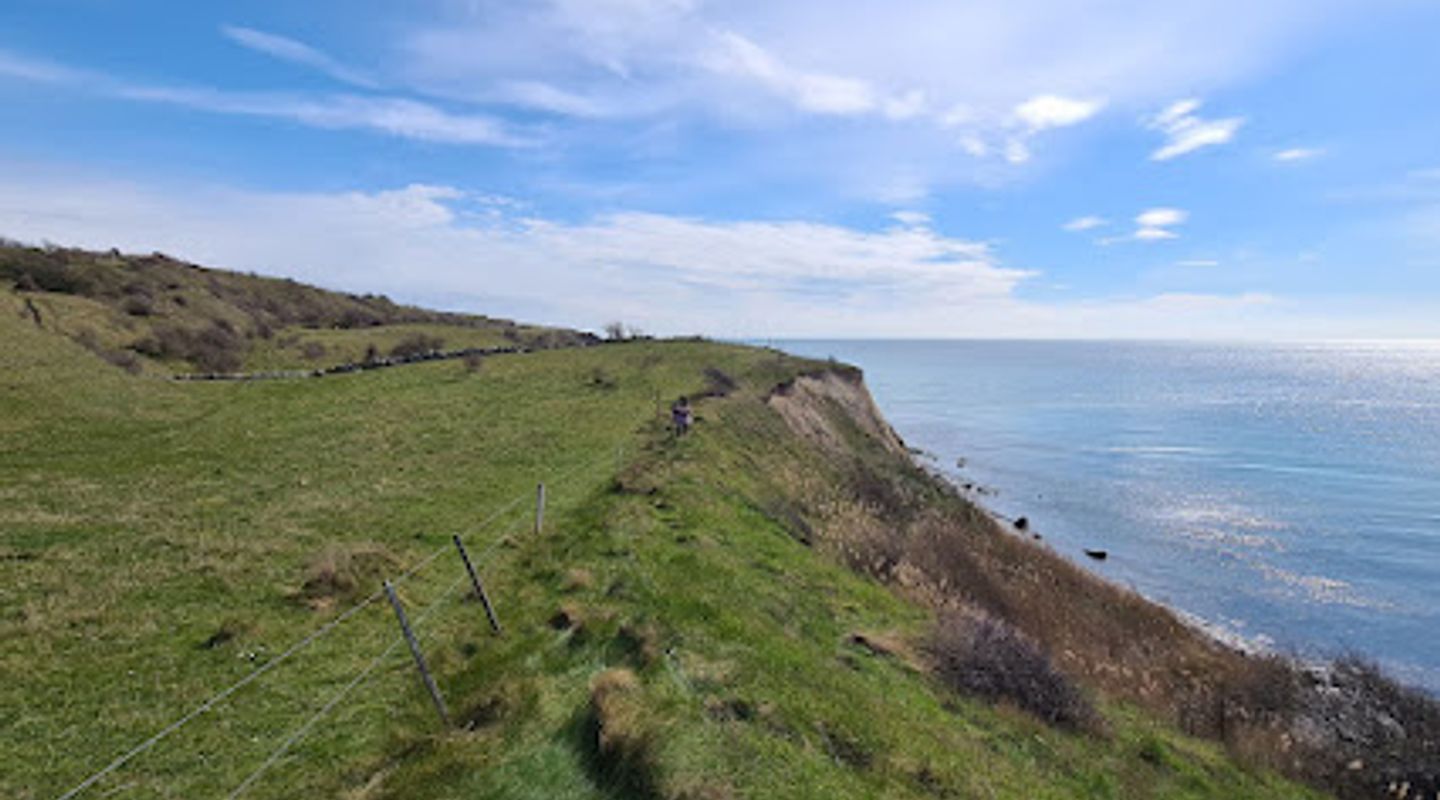
Voderup Klint is Ærø’s most dramatic stretch of coastline: a 3–3.5km-long, 25–33m-high stepped cliff dropping in giant green terraces towards the Baltic Sea. Shaped by landslides and the retreat of the Ice Age, this protected landscape pairs raw geology with soothing pastoral scenery. Grassy ledges, grazing cattle, and wide horizons make it ideal for unhurried walks, coastal photography, and lingering sunsets far from traffic and noise.
On-site amenities
 Trash bins
 Information boards
 Seating areas
Opening hours
- Every dayOpen 24 hours
Opening hours as listed on the venue’s Google Business Profile. Hours can change for services and special events, so check with the venue before you go.
- Address
- Mølledamsvej 1, 5970 Ærøskøbing
- Website
Getting there
Car from Ærøskøbing
Local bus from Ærøskøbing
Cycling from Ærøskøbing
Walking from nearby accommodation
Discover more about Voderup Klint
Terraced cliffs at the edge of Ærø
Voderup Klint unfolds as a sequence of broad, grassy steps cascading from farmland down to the Baltic Sea. Stretching roughly 3–3.5km along Ærø’s south coast and rising up to about 33m, the cliff forms one of the island’s most striking natural landmarks. From above, the land seems to break off in slow motion, terrace by terrace, until it meets the narrow belt of stony shore.Standing near the top, you look across patchwork fields before the ground suddenly falls away in green ledges and pale bands of clay. On clear days the views run unbroken over the Langeland Belt, with ships sliding quietly across the horizon and seabirds riding the breeze below you.
Ice Age story written in clay and landslides
The landscape here owes its unusual shape to the last Ice Age. Glacial deposits of clay and sand were later undercut by the sea and loosened by groundwater, causing large sections of the slope to slowly slide seaward. Over thousands of years these movements created the giant staircases you see today, a textbook example of a landslide-terraced coastline.Erosion still works at the base of the cliff, exposing soft layers in gentle pastel tones. After rain, the clay can gleam in muted greys and browns, while small springs seep from the slope and feed pockets of lush vegetation. The constant interplay between sea, gravity and soft sediments gives Voderup Klint its distinctive sculpted profile.
Protected coastal nature and quiet wildlife
Voderup Klint is part of a protected area recognized for both its geological and landscape value. The terraces are carpeted in grass and wildflowers, with patches of scrub that offer shelter to birds and insects. Skylarks rise from the fields in spring, and you may spot hares darting across the slopes or grazing cattle quietly maintaining the natural open character.Away from roads and buildings, the soundscape is dominated by wind, waves and bird calls. In summer the air is often full of buzzing insects and the scent of warm grass, while in autumn the sea can feel more powerful, sending a deeper roar up against the cliff foot.
Walking the steps between land and sea
A network of simple paths lets you explore the terraces at different levels. You can follow the upper edge for sweeping panoramas, wander down onto the broad ledges to feel surrounded by slopes on both sides, or continue towards the rocky beach for a low-angle view back up the cliff face. None of the routes are technically difficult, but the ground is uneven and can be muddy or slippery after rain.Benches and well-trodden spots invite you to pause and simply watch the sea. Many visitors bring a picnic to enjoy on the grass, using the terraces as natural amphitheatre seating with the Baltic as a live backdrop. As the day wears on, the light shifts across the stepped slopes, throwing long shadows that emphasise their sculpted forms.
Island light, changing seasons and long sunsets
The open setting on Ærø’s south coast gives Voderup Klint a particularly luminous quality. On bright days the contrast between deep blue water, green terraces and wide sky is intense, perfect for photography and contemplative walks. In spring and early summer, fresh foliage and wildflowers soften the clay bands; in winter, the structure of the landscape stands out more starkly against low sun and bare earth.Evenings are especially atmospheric. As the sun drops towards the western horizon, the terraces glow gold and the sea takes on bands of silver and pastel colour. It is the kind of place where time stretches, encouraging you to linger until the last light fades and the first lights of distant ships appear offshore.
Evendo Review Centre
 Google
Guest reviews
Best time to go
Quietest: Jan, Feb & Mar · before 6am or from 10pm
Busy times are Evendo estimates for a typical year, to help you plan. Actual crowds vary with events, school holidays and the weather.
Explore Voderup Klint on the map
A handpicked selection of must-see spots near Voderup Klint, mapped for you.
Get your free copy of our complete guide to Voderup Klint, delivered straight to you.
Everything on this page, from opening hours and how to get there to Eve’s tips and the best time to go, in one PDF you can read offline, print or share.
Already have an account? Sign in
Your Voderup Klint guide is ready.
We'll send it to · Not you? Sign out

Getting your guide ready…
We are putting together a fresh copy of the Voderup Klint guide. This can take up to a minute.
This can take a few moments. If your browser asks, choose Allow so the download can start. You'll find the guide in your Downloads folder.
Nothing happened? Download it again
Sorry, the guide is taking longer than usual. Please try again in a minute, or get it by email instead.
Other nearby places you may find interesting
The closest places of the same kind, if this one is not quite what you had in mind.
-
-
-
-
-


Swipe for more places
More to explore near Voderup Klint

 Best experiences near Voderup Klint
 Best hotels near Voderup Klint
 Best landmarks near Voderup Klint
 Best attractions near Voderup Klint
 Best shops near Voderup Klint
 Best restaurants near Voderup Klint
 Best bars near Voderup Klint
Do you manage this location?
Take control to get all the benefits, like improved information, better appearance, and stronger visibility across AI-powered discovery.
Explore more

Explore more of Ærø
Discover the enchanting island of Ærø in Denmark, where fairy-tale towns, scenic landscapes, and rich maritime history await to captivate your senses.
Explore Ærø
Explore more of Denmark
Discover Denmark: A perfect blend of history, modern design, and the cozy concept of hygge. Explore vibrant cities, serene landscapes, and world-class cuisine.
Explore Denmark
