

The Round Tower Travel Guide
Free Guide: A 17th‑century spiral ramp to the stars, the Round Tower blends royal history, sky‑gazing science and sweeping Copenhagen views in one compact city landmark.


A brief summary of The Round Tower
A 17th‑century spiral ramp to the stars, the Round Tower blends royal history, sky‑gazing science and sweeping Copenhagen views in one compact city landmark.
Rising above the old Latin Quarter, Copenhagen’s Round Tower (Rundetaarn) is a 17th‑century observatory, viewpoint and cultural venue in one. Built by King Christian IV in 1642, it is famed for its wide, whitewashed spiral ramp that winds gently to a rooftop platform with sweeping city views. Along the way you pass the former university Library Hall, now a bright gallery for changing exhibitions and concerts, and can peek into the historic observatory that still studies the Danish night sky.
On-site amenities
 Restrooms
 Drink options
 Food options
 Seating areas
 Trash bins
 Information boards
 Visitor centre
Opening hours
- Every day10 am–8 pm
Opening hours as listed on the venue’s Google Business Profile. Hours can change for services and special events, so check with the venue before you go.
- Address
- Købmagergade 52A, 1150 København
- Phone
- Website
Getting there
Metro and short walk from central Copenhagen
City bus to the Latin Quarter
Cycling through the city centre
Taxi or rideshare within Copenhagen
Discover more about The Round Tower
A royal tower at the heart of old Copenhagen
Completed in 1642 for King Christian IV, the Round Tower was conceived as a monument to learning, combining an astronomical observatory, a university library and a church within one ambitious complex. Rising above the narrow streets of the Latin Quarter, its brick cylinder quickly became a landmark on Copenhagen’s skyline, a role it has kept for nearly four centuries.The tower was the first part of the Trinitatis complex, designed so scholars could move from worship to books and on to the stars without leaving the building. Its position just off bustling Købmagergade still reflects that blend of everyday city life and lofty scientific purpose. From street level, the simple cylindrical form topped by a copper‑clad dome hints at the precision and curiosity that shaped it.
The famous spiral ramp and quiet alcoves
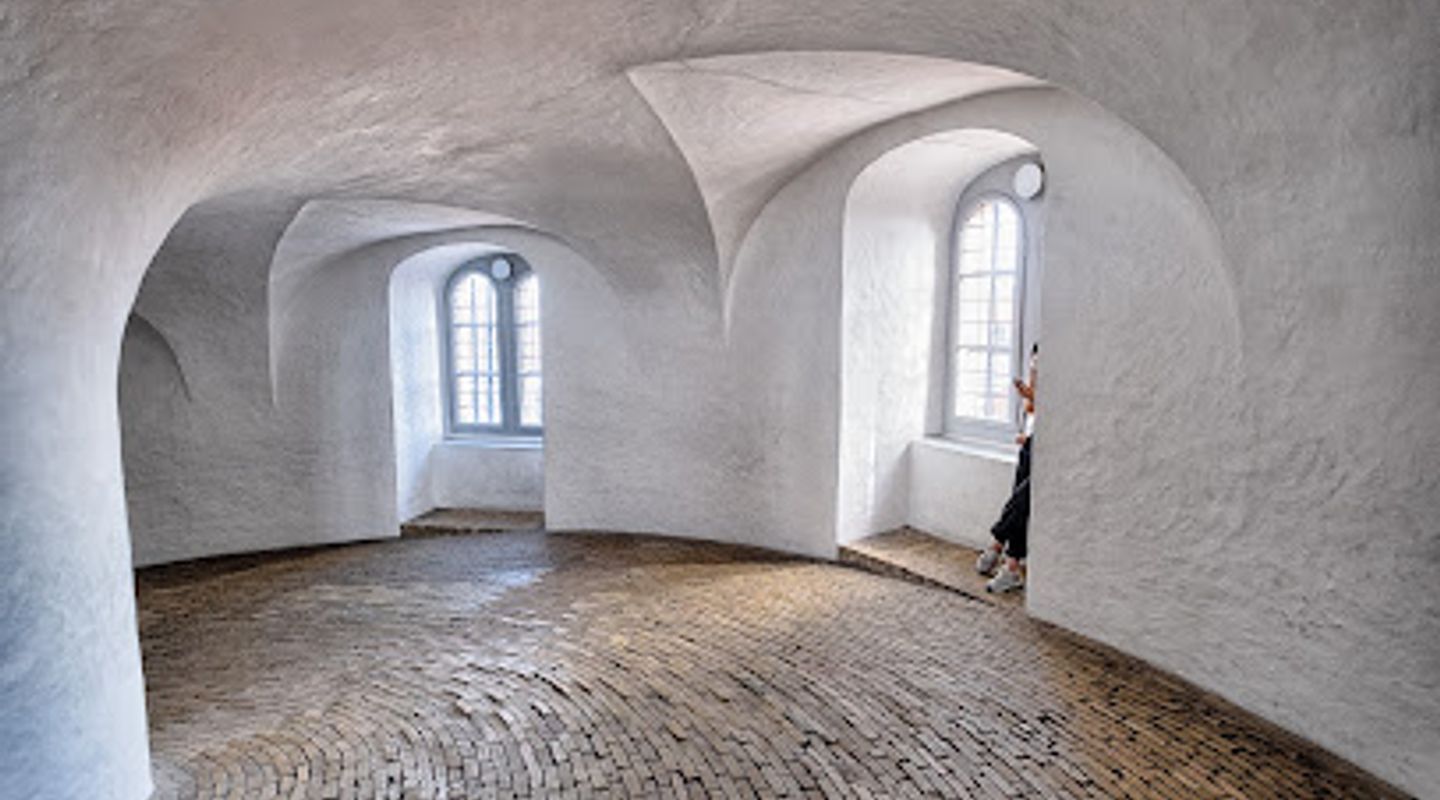
Instead of stairs, most of the ascent is via a broad spiral ramp that coils 7½ times around the hollow core. Originally wide and sturdy enough for horse‑drawn carts to carry heavy instruments and books, today it allows a gentle climb where people naturally fan out, pausing in shallow niches to catch their breath or look out of tall windows onto the rooftops below.The ramp’s whitewashed walls, worn brick floor and shifting daylight create a calm, almost meditative atmosphere despite the steady flow of visitors. Sound softens against the plaster, and each turn offers slightly different perspectives on the tower’s interior void. It is a rare example of early modern engineering that still feels surprisingly contemporary in its simplicity and accessibility.
The Library Hall: from books to culture
Roughly halfway up, the spiral opens into the Library Hall, once home to the entire book collection of the University of Copenhagen. Wooden floors, arched windows and exposed beams recall its scholarly past, when thousands of volumes lined the walls above the church below.Today the hall is a versatile cultural space hosting changing exhibitions, concerts, talks and seasonal events. Installations, photography, historical displays or design shows might occupy the room on any given visit. A small shop and café corner add to the sense of the tower as a living venue rather than a static monument, yet the proportions and patina of the hall keep its academic spirit intact.
Observatory dome and views across the city
Near the top, the route shifts from the ramp to a broad wooden staircase and a tighter stone stair that lead to the viewing platform and observatory. The open-air deck offers a 360‑degree panorama of Copenhagen: copper spires, church towers, the tiled roofs of the old town and, on clear days, a glimpse of the Øresund and Sweden beyond. Orientation tables help you pick out landmarks such as Rosenborg Castle and the Marble Church.Above the platform sits the historic observatory, one of the oldest functioning facilities of its kind in Europe. It has long served astronomers and enthusiasts, with telescopes used for public stargazing evenings in the darker months. Ongoing restoration work on the dome and interior aims to protect this scientific heritage while keeping the observatory active for future generations.
Experiences, seasons and ongoing restoration
The Round Tower is open most of the year, with longer evening hours in the lighter months and special night openings in winter for astronomy activities. Entry includes access to the ramp, Library Hall exhibitions when they are not being installed, and the viewing platform when weather and works allow. Temporary closures of the very top can occur during maintenance or the current refurbishment of the observatory dome.Despite its central location on a busy shopping street, the tower retains an intimate character inside. The slow spiral ascent, the changing cultural programme in the Library Hall and the chance to step into a working observatory make it more than just a viewpoint. It is a compact journey through Danish history, architecture and science, wrapped into a single, elegantly rounded structure in the heart of the city.
Evendo Review Centre
 Google
Guest reviews
Best time to go
Quietest: Jan, Feb & Mar · before 8am or from 10pm
Busy times are Evendo estimates for a typical year, to help you plan. Actual crowds vary with events, school holidays and the weather.
Explore The Round Tower on the map
A handpicked selection of must-see spots near The Round Tower, mapped for you.
Get your free copy of our complete guide to The Round Tower, delivered straight to you.
Everything on this page, from opening hours and how to get there to Eve’s tips and the best time to go, in one PDF you can read offline, print or share.
Already have an account? Sign in
Your The Round Tower guide is ready.
We'll send it to · Not you? Sign out

Getting your guide ready…
We are putting together a fresh copy of the The Round Tower guide. This can take up to a minute.
This can take a few moments. If your browser asks, choose Allow so the download can start. You'll find the guide in your Downloads folder.
Nothing happened? Download it again
Sorry, the guide is taking longer than usual. Please try again in a minute, or get it by email instead.
Unlock the best of The Round Tower
Skip-the-line tickets, guided tours with entry, and walking tours of the area, booked in a few clicks.
 Tour with entry
Self-Guided Tour In Copenhagen with 100 Captivating Audio Stories
from $3.19 Tour with entry
Copenhagen Exploration Game and City Tour on your Phone
from $8.52 Tour with entry
Half Day Self-Guided Audio Walking Private Tour in Copenhagen
from $14.07 Tour with entry
Life of H.C. Andersen - Half Day Self-Guided Audio Walking Tour
from $14.10
 Tour
TourA Self-Guided Nordic Exploration in Copenhagen's Hidden Hygge
from $1.06 Tour
TourCopenhagen Audio Guided Walking Tour 3h30 and 29 reviews
from $6.40 Tour
TourThe Philosopher's Last Walk: An audio tour on the life of Søren Kierkegaard
from $9.49 Tour
TourTOP Copenhagen : Private Guided Tour with your mobile
from $10.66
Other nearby places you may find interesting
The closest places of the same kind, if this one is not quite what you had in mind.
-
-
-
-
-


Swipe for more places
More to explore near The Round Tower

 Best experiences near The Round Tower
 Best hotels near The Round Tower
 Best landmarks near The Round Tower
 Best attractions near The Round Tower
 Best shops near The Round Tower
 Best restaurants near The Round Tower
 Best bars near The Round Tower
Do you manage this location?
Take control to get all the benefits, like improved information, better appearance, and stronger visibility across AI-powered discovery.
Explore more
Explore more of Copenhagen Region
Discover the Copenhagen Region: A perfect mix of historic charm and modern vibrancy, offering scenic beauty, cultural landmarks, and a high quality of life.
Explore Copenhagen Region
Explore more of Denmark
Discover Denmark: A perfect blend of history, modern design, and the cozy concept of hygge. Explore vibrant cities, serene landscapes, and world-class cuisine.
Explore Denmark
