Københavns Synagoge, Copenhagen Travel Guide
Free Guide: Discreetly tucked into Krystalgade, Copenhagen’s Great Synagogue blends neoclassical calm with Egyptian revival detail, embodying centuries of Jewish life in Denmark.


A brief summary of Københavns Synagoge
Discreetly tucked into Krystalgade, Copenhagen’s Great Synagogue blends neoclassical calm with Egyptian revival detail, embodying centuries of Jewish life in Denmark.
Set discreetly back from Krystalgade in Copenhagen’s old town, the Great Synagogue is the ceremonial and spiritual center of Denmark’s Jewish community. Completed in 1833 and designed by architect Gustav Friedrich Hetsch in a restrained neoclassical style with striking Egyptian revival details inside, it tells a layered story of emancipation, resilience and belonging. Behind its modest façade you find an ornate prayer hall with twelve symbolic columns, warm light, and a powerful sense of continuity from the 17th century to today.
On-site amenities
 Restrooms
 Information boards
Opening hours
- Mon10 am–2 pm
- Tue10 am–2 pm
- Wed10 am–2 pm
- Thu10 am–2 pm
- FriClosed
- SatClosed
- SunClosed
Opening hours as listed on the venue’s Google Business Profile. Hours can change for services and special events, so check with the venue before you go.
- Address
- Krystalgade, 12 København
- Phone
- Website
Getting there
Metro and short walk from central Copenhagen
City bus to Nørreport area
Bicycle within central Copenhagen
Taxi from inner-city hotels
Discover more about Københavns Synagoge
A discreet landmark in the heart of old Copenhagen
Completed in 1833 on Krystalgade, the Great Synagogue of Copenhagen is easy to miss at first glance. The façade is deliberately set back from the street line, a requirement when it was built at a time when Jewish institutions were not encouraged to be too conspicuous. Behind this modest frontage stands the main synagogue of Denmark’s Jewish community, tucked into a quiet stretch of the historic Indre By, a short walk from the city’s university quarter and major museums.The building was designed by architect Gustav Friedrich Hetsch, who created a dignified, neoclassical exterior in keeping with surrounding townhouses. Soft-toned masonry, clear geometric lines and a rhythm of tall windows give the synagogue an urban elegance that reveals its 19th‑century origins while blending naturally into the streetscape.
From early prayer houses to a unified congregation
Jewish life in Copenhagen dates back to the 17th century, when the first families were invited to settle and were only allowed to worship in private homes on upper floors away from the street. Over the next century, the community moved between small synagogues in the old town, including a main synagogue that was destroyed in the great fire of 1795. For decades, worship was dispersed across several modest prayer rooms.The dream of a single, representative synagogue on Krystalgade was delayed by internal disagreements over religious reform and by war and financial crisis. Only in the early 1830s did the project move ahead, symbolizing both the legal equality Jews had received in 1814 and a desire for a visible, though still discreet, place in Danish civic life. When the new synagogue was inaugurated, many of the smaller prayer houses closed and the community gathered here under one roof.
Egyptian details and symbolic space
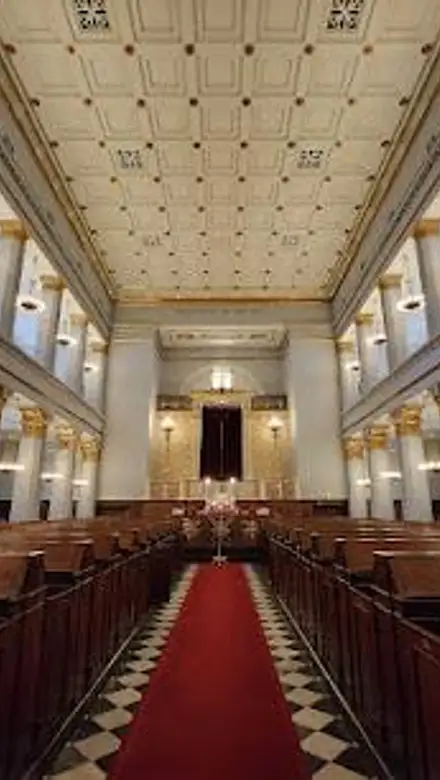
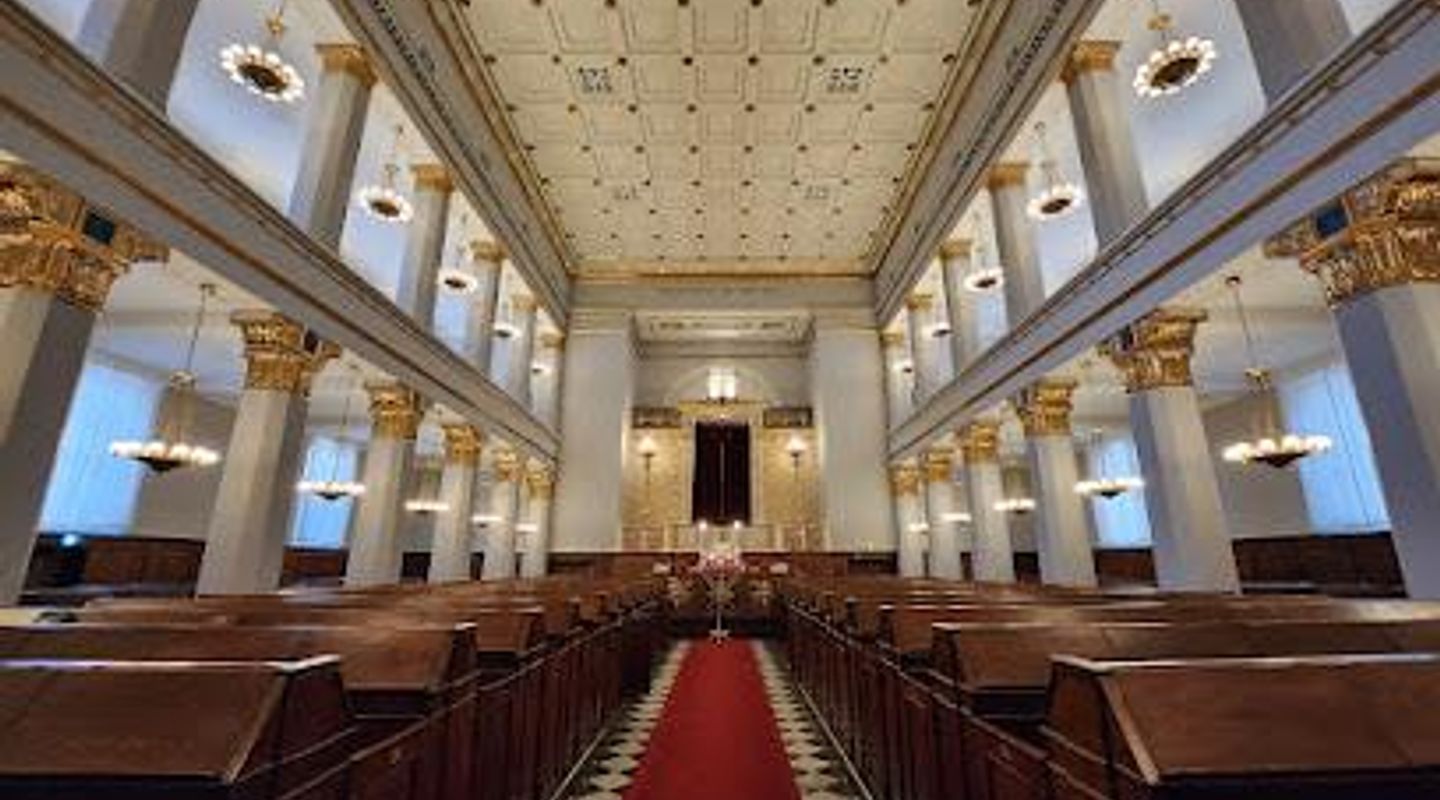
Hetsch’s interior design draws on the Egyptian Revival style that fascinated many 19th‑century architects. Inside the prayer hall, tall columns with stylized capitals, a richly patterned ceiling and the cornice above the ark all reference ancient forms while remaining firmly within a neoclassical framework. The effect is a space that feels both European and subtly oriental, echoing wider currents in synagogue architecture of the time.A defining feature is the row of twelve columns, understood as a reference to the twelve tribes of Israel. The hall is oriented toward the ark at the eastern end, with galleries above for additional seating. Light filters through high windows, catching gilded details and painted surfaces, creating a warm, ceremonial atmosphere that contrasts with the restrained exterior.
Resilience through crisis and remembrance
Over nearly two centuries, the synagogue has witnessed both prosperity and persecution. It has been the setting for festival services, life‑cycle ceremonies and community gatherings in quieter periods, and it has also stood through darker chapters, including the threats of the Second World War and later acts of terror in the city. Renovations, most recently in the 21st century, have carefully restored the original decorative program while upgrading the building for continued use.This continuity gives the synagogue a particular emotional weight. The benches, galleries and bimah have held generations of worshippers, and the walls themselves embody the long relationship between Danish society and its Jewish minority, from early restrictions to formal equality and modern-day recognition.
Visiting the synagogue today
Today, Københavns Synagoge still functions as an active Orthodox congregation as well as a key site for understanding Jewish Copenhagen. Access to the interior is typically structured and subject to security, reflecting contemporary realities, but guided visits are sometimes available. From the street you can appreciate how the set‑back façade, tall arched windows and understated portal hint at the rich ceremonial space inside.Even a short stop outside offers a chance to connect the surrounding university buildings, bookshops and churches with another, sometimes less visible, strand of the city’s history. Standing here, it is possible to imagine the long path from small hidden prayer rooms to this purpose‑built house of worship, still in use nearly two centuries after its dedication.
Evendo Review Centre
 Google
Guest reviews
Best time to go
Quietest: Jan, Feb & Mar · before 7am or from 8pm
Busy times are Evendo estimates for a typical year, to help you plan. Actual crowds vary with events, school holidays and the weather.
Explore Københavns Synagoge on the map
A handpicked selection of must-see spots near Københavns Synagoge, mapped for you.
Get your free copy of our complete guide to Københavns Synagoge, delivered straight to you.
Everything on this page, from opening hours and how to get there to Eve’s tips and the best time to go, in one PDF you can read offline, print or share.
Already have an account? Sign in
Your Københavns Synagoge guide is ready.
We'll send it to · Not you? Sign out

Getting your guide ready…
We are putting together a fresh copy of the Københavns Synagoge guide. This can take up to a minute.
This can take a few moments. If your browser asks, choose Allow so the download can start. You'll find the guide in your Downloads folder.
Nothing happened? Download it again
Sorry, the guide is taking longer than usual. Please try again in a minute, or get it by email instead.
Unlock the best of Københavns Synagoge
Skip-the-line tickets, guided tours with entry, and walking tours of the area, booked in a few clicks.


Other nearby places you may find interesting
The closest places of the same kind, if this one is not quite what you had in mind.
-
Copenhagen Zoo Explore 4,000+ animals across continents without leaving Copenhagen—year-round indoor and outdoor wildlife adventure.
-
 National Aquarium Denmark
Northern Europe’s largest aquarium, where striking whirlpool architecture, sharks, sea otters and a lush indoor rainforest bring the world’s oceans to Copenhagen’s shoreline.
National Aquarium Denmark
Northern Europe’s largest aquarium, where striking whirlpool architecture, sharks, sea otters and a lush indoor rainforest bring the world’s oceans to Copenhagen’s shoreline.
-
Magstræde One of Copenhagen’s oldest cobbled lanes, Magstræde is a colorful, time‑worn shortcut through the city’s medieval heart and everyday modern life.
-
Kastellet A perfectly preserved 17th‑century star fortress where red barracks, a windmill and grassy ramparts create a quiet green refuge beside Copenhagen’s harbour.
-
Rosenborg castle A compact Renaissance palace of kings, crowns and stories, Rosenborg Castle pairs glittering Crown Jewels with tranquil gardens in the very heart of Copenhagen.
Swipe for more places
More to explore near Københavns Synagoge

 Best experiences near Københavns Synagoge
 Best hotels near Københavns Synagoge
 Best landmarks near Københavns Synagoge
 Best attractions near Københavns Synagoge
 Best shops near Københavns Synagoge
 Best restaurants near Københavns Synagoge
 Best bars near Københavns Synagoge
Do you manage this location?
Take control to get all the benefits, like improved information, better appearance, and stronger visibility across AI-powered discovery.
Explore more

Explore more of Copenhagen
Discover Copenhagen: A perfect blend of history, modernity, and vibrant culture, where picturesque canals, stunning architecture, and world-class dining await you.
Explore Copenhagen
Explore more of Denmark
Discover Denmark: A perfect blend of history, modern design, and the cozy concept of hygge. Explore vibrant cities, serene landscapes, and world-class cuisine.
Explore Denmark