Helsingborg City Hall (Helsingborgs Rådhus)
A soaring neo-Gothic town hall on Helsingborg’s harbourfront, blending civic power, rich detailing and Öresund views into one unforgettable landmark.
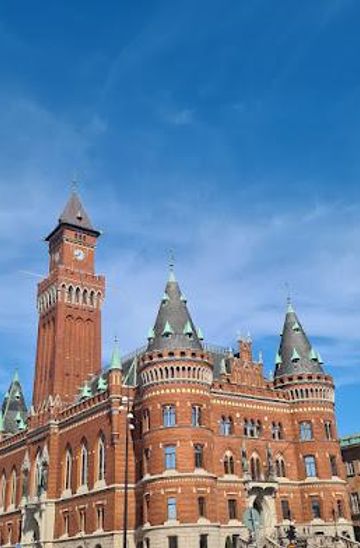
Helsingborg City Hall is a striking neo-Gothic landmark anchoring the heart of this Öresund port city. Completed in the late 19th century to designs by architect Alfred Hellerström, its soaring brick clocktower, turrets and ornate stonework echo medieval fortresses while symbolising modern civic pride. Inside, ceremonial halls, painted inscriptions and historic portraits reveal the city’s political and maritime heritage, while large windows frame glimpses of the harbour and across to Denmark.
A brief summary to Helsingborg City Hall
- Drottninggatan 2, Helsingborg, 252 21, SE
- Click to display
- Duration: 0.5 to 1.5 hours
- Free
-
 Mixed
Mixed
- Mobile reception: 5 out of 5

Know before you go
Hi, I'm Eve. Here are a few practical things to know before exploring Helsingborg City Hall.
- Aim to visit in daylight to appreciate the brickwork, stone details and tower silhouette against the Öresund, then return after dark to see the façades softly illuminated.
- Check in advance for open-house days or guided tours, which grant access to the ceremonial halls, historical interiors and exhibits usually closed to casual visitors.
- Bring a camera with a wide-angle lens to capture the full height of the tower from the square and to frame views along Drottninggatan with the city hall as a focal point.
- Allow time to walk around all sides of the building; the façades towards Drottninggatan and Stortorget reveal different arrangements of towers, portals and ornament.
- If you are sensitive to stories of ghosts or mysterious events, be prepared—local anecdotes about unexplained happenings inside the building are part of its lore.
Do you manage this location?
Take control to get all the benefits, like improved information, better appearance, and stronger visibility across AI-powered discovery. Learn more
Activate your presenceOther nearby places you may find interesting

Getting There
-
Train and short walk from Helsingborg C
From Helsingborg Central Station, reach the city hall on foot in about 8–12 minutes along central streets with mostly level, paved surfaces. The route is suitable for wheelchairs and strollers, though some cobblestones near the square can be uneven. Regional trains and Öresundståg services connect Helsingborg with cities such as Malmö and Lund in roughly 40–60 minutes, with standard second-class tickets typically costing around 120–220 SEK one way depending on distance and time of day.
-
Urban buses within Helsingborg
Several city bus lines stop within a 5–10 minute walk of the hall, serving neighbourhoods across Helsingborg. Typical journey times from residential districts range from 10 to 25 minutes. Single tickets bought via local transit apps or vending machines generally cost about 30–40 SEK and are valid for a set time window, allowing transfers. Buses run frequently during the day but less often in late evenings and on weekend mornings, and most are low-floor vehicles with ramp access.
-
Car or taxi from Helsingborg outskirts
Driving from outer districts or nearby suburbs usually takes 10–20 minutes, depending on traffic. Public parking garages and surface lots are available within walking distance of Drottninggatan and the central squares, usually charging hourly rates in the region of 15–35 SEK, with higher fees in the most central zones and time limits during weekdays. Streets immediately around the city hall can be busy at peak hours, and some spaces may have restricted durations, so always check local signs.
-
Ferry from Helsingør plus city walk
If you arrive by ferry from Helsingør, the crossing over the Öresund generally takes about 20 minutes and standard passenger fares commonly range from 60–120 SEK equivalent, depending on operator and ticket type. From the Helsingborg ferry terminal, the walk up to the city hall is around 10–15 minutes on gently rising, paved streets. The path is straightforward and suitable for most visitors, although those with limited mobility may prefer to use a short taxi ride from the terminal instead.
For the on-the-go comforts that matter to you
-
 Restrooms
-
 Seating Areas
-
 Information Boards
-
 Trash Bins
-
 Visitor Center
Discover more about Helsingborg City Hall
A red-brick beacon on the Öresund
Helsingborg City Hall dominates the southern end of Drottninggatan, its tall clocktower and cluster of turrets rising above the harbourfront. Built between the early 1890s and the late 1890s, it was conceived as a suitably monumental home for the expanding city government, replacing an older town hall that had outlived both its size and security needs. Today, the building still functions as the administrative heart of Helsingborg, but it also serves as one of the city’s most recognisable symbols.The setting is as strategic as it is scenic. From the steps and square outside, the streets fall gently towards the ferry terminal and the narrow strait separating Sweden from Denmark. On clear days, you can see ferries gliding back and forth and, beyond them, the outline of Helsingør, underlining the hall’s role as a ceremonial gateway to Sweden.Neo-Gothic drama with Nordic character
Architect Alfred Hellerström won the competition to design the new hall with a vision rooted in neo-Gothic style, adapted to local materials and Nordic light. Red brick walls are banded and framed with pale stone, giving the façades a strong rhythm. Pointed-arch windows, pinnacles and traceried details evoke medieval town halls and churches, while a crenellated base on the main tower hints at fortress architecture.The twin round corner turrets on the southern side soften the composition, topped with conical roofs and decorative corbel elements inspired by Renaissance and medieval fortifications. Facing both Drottninggatan and Stortorget, the building turns its most expressive entrances towards the principal urban spaces, with grand portals framed by carved stone, heraldic motifs and richly worked doors that clearly mark the official thresholds.Inside stories: courts, councils and quiet cells
The interior was designed to accommodate almost every civic function under one roof. Council chambers, offices, police facilities and even the city jail once shared this address, reflecting 19th-century ideals of a compact, ordered municipal centre. The cellar level formed a secure buffer beneath the detention cells on the main floor, an explicit response to past escape attempts in the old hall where prisoners had literally dug their way out.Ceremonial rooms on the upper levels are more lavish. High-ceilinged halls are lined with portraits of influential local figures and officials, while walls carry hand-painted sayings and decorative friezes that frame the proceedings of council meetings and civic ceremonies. Stained and leaded glass windows filter daylight into coloured patterns, and polished wood, stone floors and brass details amplify footsteps and voices.Civic symbol and protected monument
By the mid-20th century, Helsingborg City Hall had already been recognised for its architectural and historical value, becoming a listed building under national protection. This status safeguards its exterior character and key interiors, ensuring that any alterations respect the original design. Renovations over the years have threaded modern infrastructure and meeting facilities into the old shell, including new spaces in the attic level, while preserving the building’s distinctive outline on the skyline.The hall’s profile often appears alongside Kärnan tower and the harbour cranes in images of Helsingborg, forming a bridge between medieval heritage, 19th-century expansion and contemporary waterfront development. Its tower serves as a visual anchor when you move through the city, constantly reappearing at the end of streets and across open squares.Visiting the halls and hidden corners
On selected days, the city opens the building for public tours or special open-house events. These offer a chance to step through the heavy doors, explore the grand staircases and council chambers, and peer into spaces that are usually reserved for official business. Visitors can learn how the hall’s architecture reflects ideals of transparency, justice and civic pride, even as it concealed secure holding cells and administrative backrooms.Stories have also grown up around the building’s quieter corners. Staff and contractors have spoken of unexplained footsteps, lights switching on in empty rooms and tools moving overnight, giving rise to tales of resident ghosts linked to the building’s long history of trials and political debates. Whether you take these anecdotes as folklore or something more, they add an intriguing layer to a place already rich with symbolism, ceremony and everyday governance.Explore the best of what Helsingborg City Hall has to offer













More about Copenhagen Region
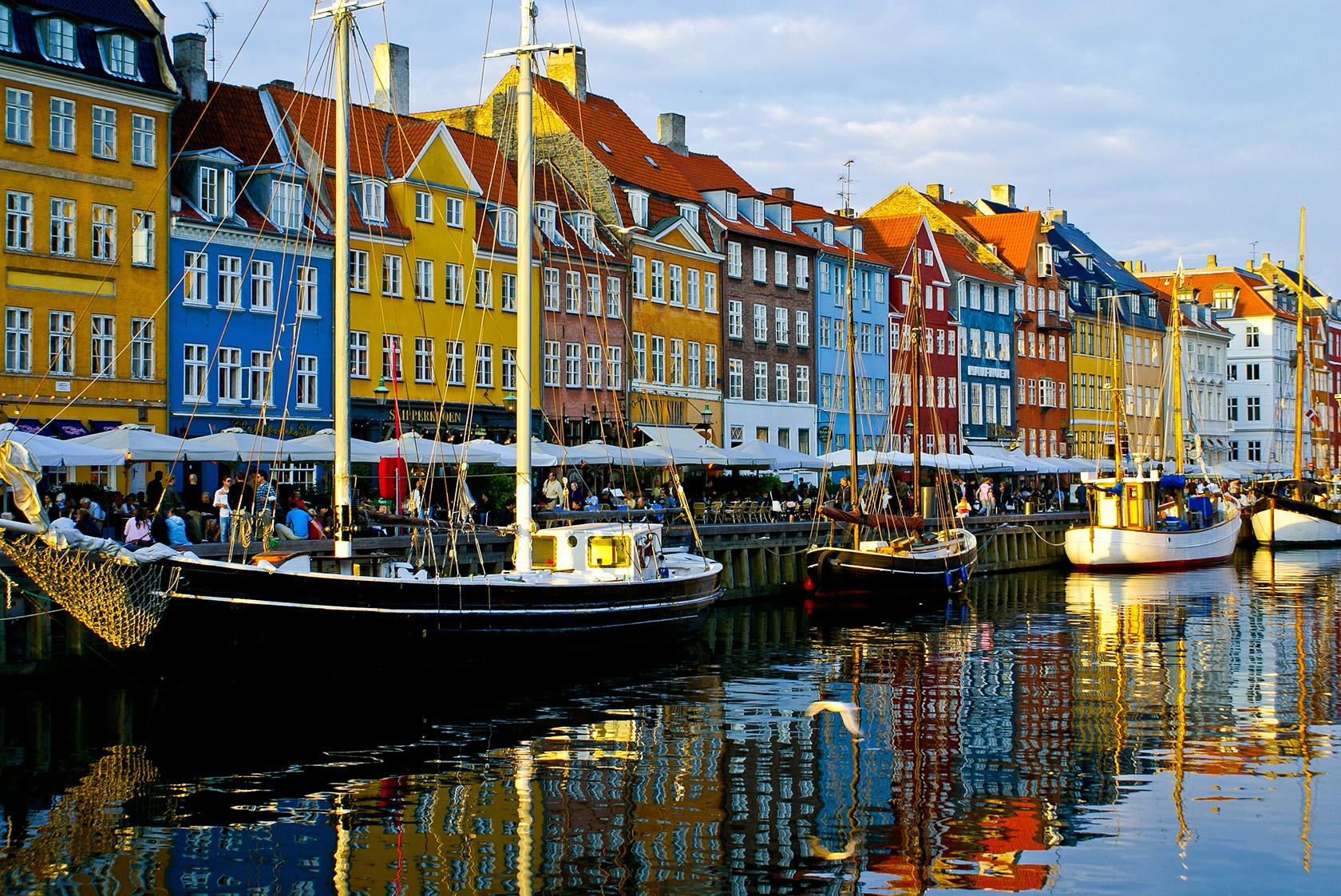
Discover the Copenhagen Region: A perfect mix of historic charm and modern vibrancy, offering scenic beauty, cultural landmarks, and a high quality of life.
Tell me more about Copenhagen Region