St. Mary Church, Helsingor Travel Guide
Free Guide: Medieval brick Gothic church in Helsingborg’s old town, where centuries of Danish and Swedish history meet in a serene, light-filled Lutheran parish interior.


A brief summary of St. Mary Church
Medieval brick Gothic church in Helsingborg’s old town, where centuries of Danish and Swedish history meet in a serene, light-filled Lutheran parish interior.
St. Mary’s Church, or Mariakyrkan, is Helsingborg’s oldest surviving church and a beautifully preserved example of red-brick Gothic architecture in the heart of the old town. Raised in the 14th and 15th centuries on the site of a 12th-century predecessor, it blends soaring brick vaults, medieval furnishings and soft Nordic light with the quiet rhythm of an active Lutheran parish. Moments from Kärnan and the town hall, it offers a peaceful counterpoint to the city streets, inviting unhurried contemplation, artful photography and a tangible sense of Helsingborg’s long coastal history.
On-site amenities
 Restrooms
 Seating areas
 Information boards
Opening hours
- Mon10 am–4 pm
- Tue10 am–7 pm
- Wed8 am–4 pm
- Thu10 am–4 pm
- Fri10 am–4 pm
- Sat10 am–5 pm
- Sun10 am–5 pm
Opening hours as listed on the venue’s Google Business Profile. Hours can change for services and special events, so check with the venue before you go.
- Address
- Mariagatan 8B, 252 23 Helsingborg
- Phone
- Website
Getting there
On foot from central Helsingborg
City bus within Helsingborg
From Helsingborg Central Station by public transport
By car or taxi within the city
Discover more about St. Mary Church
Gothic brick landmark in Helsingborg’s old heart
St. Mary’s Church rises in warm red brick just off Helsingborg’s central squares, its stepped gables and slender tower forming a familiar silhouette above the low roofs of the old town. Built as a three-aisled basilica in the Gothic style, it was begun in the early 1300s and essentially completed in the 15th century, when the city still belonged to Denmark. The church stands on the foundations of an earlier Romanesque stone church from the 1100s, its reused sandstone blocks and embedded grave slabs still visible in places if you look closely at the base of the walls.From the outside, the building is a textbook example of Baltic brick Gothic: pointed windows, buttresses, and the small square holes left by the original scaffolding, now like a faint construction diary written in clay. The setting is intimate rather than monumental; instead of a grand square, Mariakyrkan opens onto narrow streets and a human-scale churchyard, surrounded by historic townhouses and cafés that underline its role as a neighborhood church as much as a landmark.
A medieval interior layered with centuries of craftsmanship
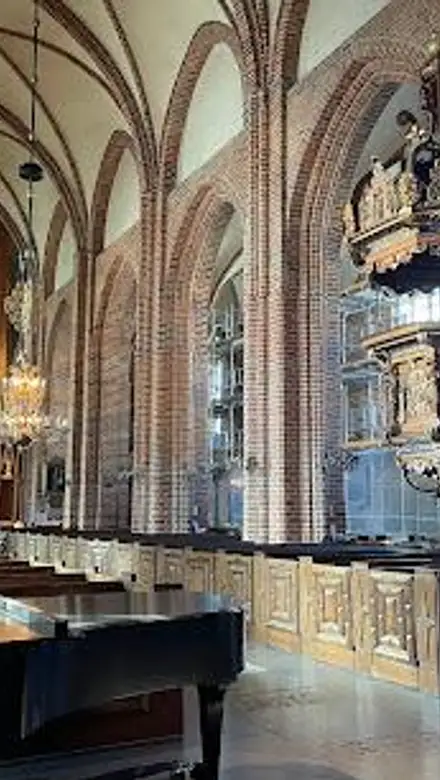
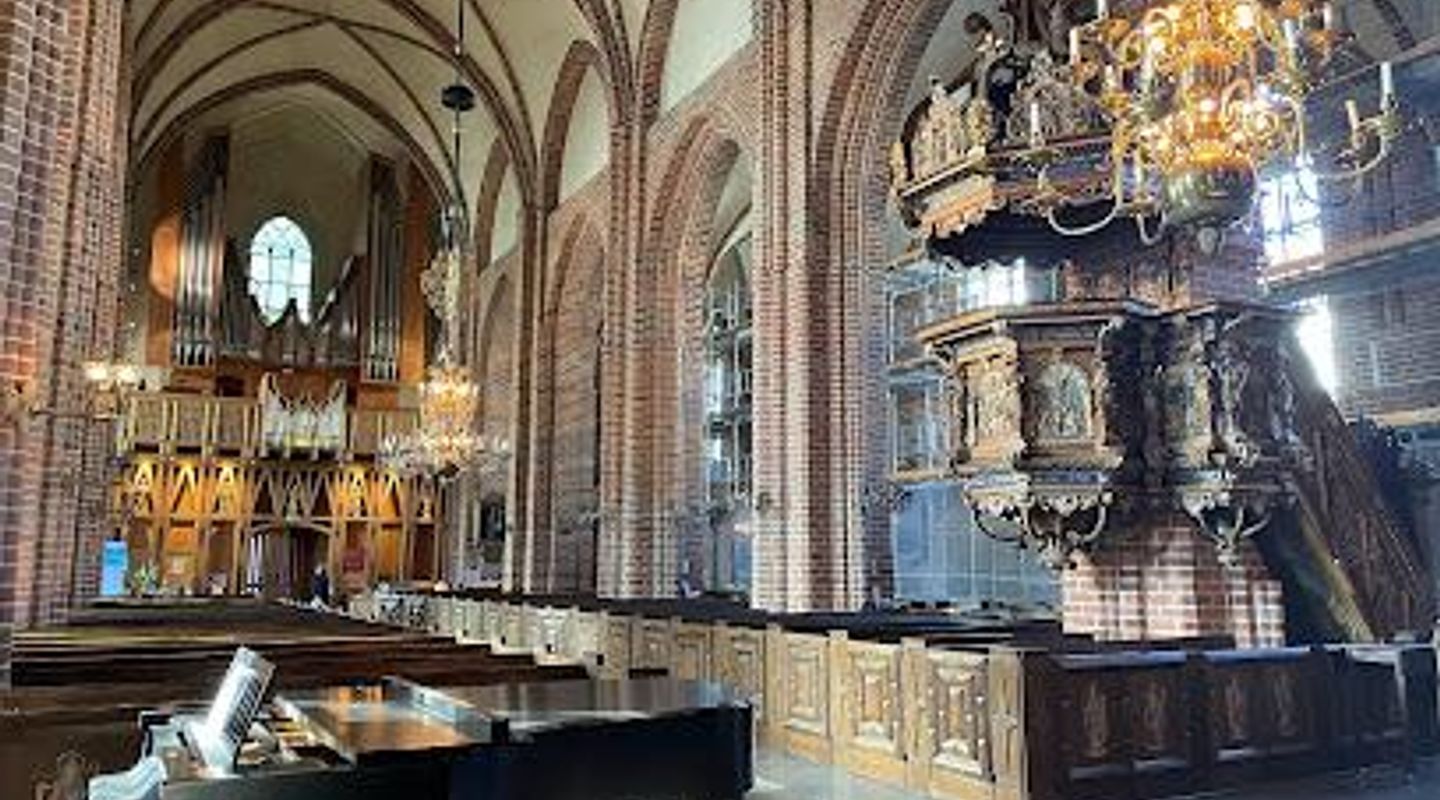
Step inside and the space suddenly lifts. Slender brick pillars carry ribbed vaults high overhead, and soft daylight filters through tall windows to pool on the worn stone floor. The atmosphere is one of calm continuity: this is a working parish church, but also a gallery of medieval craftsmanship. Among the most striking treasures is a richly carved 15th-century altarpiece, a painted triptych that once framed worship in Catholic times and still draws the eye to the eastern end of the nave.Look around the choir and side aisles and you’ll find finely worked wooden furnishings, including a later pulpit added after the Reformation, when sermons became central to Lutheran worship. Traces of older practices linger in the wall niches, once used as seating for elderly parishioners when most of the congregation stood. High on the gallery, the pipe organ continues a tradition that began here in the late 1500s, when one of the first organs was installed to accompany congregational song.
From Catholic Denmark to Lutheran Sweden
St. Mary’s began life as a Catholic parish church in a medieval port city firmly tied to Denmark. The bricks used for its construction are thought to have come from kilns at a nearby Dominican monastery, which also supplied materials for Kärnan, the fortress tower still overlooking the harbor. Over time, political borders and religious life shifted around the building. In the 1500s, as the Reformation reached Scandinavia, the congregation adopted Lutheranism, introducing pews, the prominent pulpit and a different rhythm of services.A century later, Helsingborg itself became Swedish, and the church’s identity gently pivoted with it. Structural changes continued into the modern era: earlier sacristies and porches were removed in the 19th century, necessitating iron anchors to stabilize the walls, while the present sacristy dates from the mid-20th century. Yet despite these adjustments, the essential medieval character of Mariakyrkan has remained remarkably intact.
Experiencing Mariakyrkan today
Today, St. Mary’s functions as both living parish and quiet refuge in the middle of the city. During opening hours, visitors can slip into a pew to rest, study the details of the altarpiece, or simply listen to the play of footsteps and the occasional murmur of preparation for a baptism, concert, or evening service. Candles, hymn books and simple floral arrangements give the interior a lived-in warmth that balances its historical weight.Outside, the compact churchyard and surrounding streets invite slow exploration with a camera, capturing brick patterns, sculpted portals and glimpses of the tower between rooftops. With major sights like Kärnan tower and the town hall only a short stroll away, St. Mary’s sits naturally within a wider wander through Helsingborg’s historic core, yet it easily rewards a dedicated, lingering visit of its own.
Details, symbols and quiet stories in the brickwork
For those who like to look closely, Mariakyrkan is full of quiet stories. The small holds in the exterior brickwork reveal where medieval scaffolding once clung to the walls, while the mix of stone and brick at the foundations hints at the vanished Romanesque church beneath your feet. Some older gravestones are built into the base, their inscriptions partly worn but still legible in raking light.Inside, carved figures on the altarpiece and pulpit embody the theological shifts that have shaped the church, while the play of light across bare brick surfaces changes subtly with every season. Even the relative modesty of the building, compared with grand cathedrals elsewhere, tells a story of a prosperous but human-scaled port city on the Öresund. For many visitors, it is this combination of craftsmanship, history and everyday spirituality that makes St. Mary’s an especially rewarding pause within Helsingborg’s busy center.
Evendo Review Centre
 Google
Guest reviews
Best time to go
Quietest: Jan, Feb & Mar · before 8am or at 8pm
Busy times are Evendo estimates for a typical year, to help you plan. Actual crowds vary with events, school holidays and the weather.
Explore St. Mary Church on the map
A handpicked selection of must-see spots near St. Mary Church, mapped for you.
Get your free copy of our complete guide to St. Mary Church, delivered straight to you.
Everything on this page, from opening hours and how to get there to Eve’s tips and the best time to go, in one PDF you can read offline, print or share.
Already have an account? Sign in
Your St. Mary Church guide is ready.
We'll send it to · Not you? Sign out

Getting your guide ready…
We are putting together a fresh copy of the St. Mary Church guide. This can take up to a minute.
This can take a few moments. If your browser asks, choose Allow so the download can start. You'll find the guide in your Downloads folder.
Nothing happened? Download it again
Sorry, the guide is taking longer than usual. Please try again in a minute, or get it by email instead.
Unlock the best of St. Mary Church
Skip-the-line tickets, guided tours with entry, and walking tours of the area, booked in a few clicks.

Other nearby places you may find interesting
The closest places of the same kind, if this one is not quite what you had in mind.
-
-
-
-
-


Swipe for more places
More to explore near St. Mary Church

 Best experiences near St. Mary Church
 Best hotels near St. Mary Church
 Best landmarks near St. Mary Church
 Best attractions near St. Mary Church
 Best shops near St. Mary Church
 Best restaurants near St. Mary Church
 Best bars near St. Mary Church
Do you manage this location?
Take control to get all the benefits, like improved information, better appearance, and stronger visibility across AI-powered discovery.
Explore more

Explore more of Helsingor
Discover Helsingør, Denmark's historic coastal city, home to Kronborg Castle and a vibrant cultural scene, offering a blend of history, scenic beauty, and local charm.
Explore Helsingor
Explore more of Denmark
Discover Denmark: A perfect blend of history, modern design, and the cozy concept of hygge. Explore vibrant cities, serene landscapes, and world-class cuisine.
Explore Denmark