Sankt Hans Torv
A gently undulating granite square where church spires, water sculpture and café terraces capture the everyday rhythm of Copenhagen’s Nørrebro district.
From Common Grazing Land to Nørrebro’s Neighborhood Square
Sankt Hans Torv sits where Copenhagen once ended and open grazing land began, on what used to be Blegedam Common outside the city’s fortifications. For centuries, cows from the surrounding commons were gathered and milked here before the area slowly filled with streets and tenement housing. In the 19th century the square took shape as a busy cattle market and junction, tied closely to the development of Nørrebro as a dense working-class district. As the city expanded, traffic gradually took over. By the mid‑20th century Sankt Hans Torv had become more of an oversized intersection than a welcoming place to linger. Yet its position where several important streets meet – including Blegdamsvej, Nørre Allé and Guldbergsgade – meant it never lost its role as a local focal point. The challenge became how to turn a road‑dominated space back into a civic square without erasing its function as a key urban crossroads.1990s Urban Renewal and the New Square Design
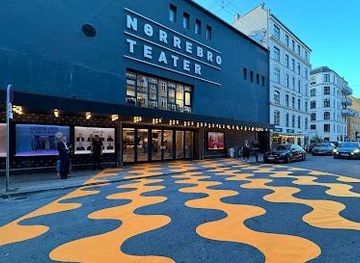
In 1993 a major redesign transformed Sankt Hans Torv from traffic island to urban living room. Landscape architects concentrated cars and buses along three edges, freeing the centre as a gently sloping granite plaza. The surface rises and falls in low, wave‑like undulations, softening the hard edges of the surrounding streets and inviting people to cross, sit and play. Materials were chosen to tie the new design to the historical streetscape: pale granite paving blends into the older cobblestones, while subtle level changes define areas for walking, café seating and informal gathering. A single tree anchors the middle of the square, adding a touch of shade and seasonality to what could otherwise feel like a purely stone environment. The result is a space that feels contemporary yet clearly rooted in Nørrebro’s existing fabric.The House that Rains and Everyday Art
At the heart of the square stands a striking granite sculpture and water feature by artist Jørgen Haugen Sørensen, often referred to as “The House that Rains.” It appears almost like a small, abstract building, with water occasionally trickling from hidden openings and jets in the surrounding paving. On quiet days the sound is barely more than a murmur; on busier afternoons it becomes an animated focal point for children and a subtle backdrop for conversations on the terraces. The sculpture underscores how art is woven into everyday life in Copenhagen. Rather than sitting behind a fence, it is integrated into the walking surface, to be explored, touched and even climbed around. Combined with the rhythmic movement of cyclists streaming past the square, it gives Sankt Hans Torv a dynamic quality that shifts between calm and energetic throughout the day.Church Spires, School Walls and Café Culture
Just east of the square rises St. John’s Church, Nørrebro’s oldest and largest church, whose tall spire is visible from many corners of the district. Its brick Gothic Revival architecture forms a dramatic backdrop and a reminder of the area’s 19th‑century growth. On another side stands the former Sankt Hans Gade School, one of the oldest buildings around the square, hinting at the educational and social history of the neighborhood. Along the edges of the plaza, ground‑floor cafés and bars spill out under awnings and umbrellas in good weather. Some, like French‑inspired Café Sebastopol, have become local institutions, while newer coffee bars and eateries reflect Nørrebro’s changing, diverse community. Terraces fill with students, families, freelancers and friends, creating a casual, lived‑in atmosphere that can feel bustling by late afternoon yet rarely rushed.A Local Living Room in Constant Motion
Today Sankt Hans Torv functions as an informal meeting point and pause space in a densely built district. The flow of buses, bikes and pedestrians around the perimeter keeps a sense of movement, but the interior feels surprisingly relaxed. People bring takeaway lunches, read on the steps, or simply sit and watch the world go by between errands on nearby Nørrebrogade or Elmegade. Because it is open and unfenced, the square is accessible at all hours and in all seasons. On bright winter days the low sun glints off the granite; in summer the terraces stay lively late into the evening. For visitors, spending time here offers a quick, authentic glimpse of everyday Copenhagen beyond the historic centre: multicultural, creative and shaped by thoughtful urban design.Exploring Nørrebro from the Square
Sankt Hans Torv makes a natural starting point for wandering Nørrebro. From here it is only a short stroll to the tranquil paths and famous graves of Assistens Cemetery, or to the independent shops, bars and eateries along Guldbergsgade and Elmegade. The nearby Lakes provide a greener waterside contrast, popular for runs, slow walks and sunset views. Although surrounded by activity, the square itself offers small moments of calm. Its gently sloping surfaces, low steps and scattered seating invite you to change pace and linger. Whether you come for a coffee, a short architectural detour, or simply to feel the rhythm of local life, Sankt Hans Torv rewards unhurried observation more than box‑ticking sightseeing.Local tips
- Visit in the late afternoon or early evening on a dry day to experience the cafés at their liveliest while the light still catches the granite paving and church spire.
- Combine your stop with a slow walk to Assistens Cemetery or along the nearby Lakes for a contrasting dose of greenery and quieter surroundings.
- If you enjoy photography, focus on the interplay between the undulating ground, the water sculpture and the backdrop of St. John’s Church and classic Nørrebro façades.
- Dress for changeable weather; the square is quite exposed, with limited shelter from wind, sun or showers unless you sit under a café awning.
A brief summary to Sankt Hans Torv
- Copenhagen, Nørrebro, 2200, DK
Getting There
-
Metro and walking
From central Copenhagen, take the M3 Cityringen metro to Nørrebros Runddel; trains run every few minutes and the journey from the city centre takes around 8–10 minutes. A standard adult ticket for this 2–3 zone trip typically costs about 20–25 DKK. From Nørrebros Runddel, allow 10–15 minutes on foot along main, well‑lit streets with some gentle inclines. Pavements are generally smooth and suitable for wheelchairs and strollers.
-
Bus from city centre
Several city bus lines connect the inner city with Nørrebro via Nørrebrogade or nearby routes, with travel times of about 10–20 minutes depending on traffic. Expect to pay roughly 20–25 DKK for a single adult ticket within the central zones. Buses run frequently during the day and early evening but less often late at night, and they can be crowded at rush hour. From the nearest stop, walking distances are short along busy urban streets.
-
Bicycle from inner Copenhagen
Cycling from the historic centre to Sankt Hans Torv usually takes 10–15 minutes along dedicated bike lanes for most of the way. You can use a city bike scheme or standard rental; typical prices range from about 75–150 DKK per day depending on provider and bike type. The route is mostly flat but involves navigating busy intersections, so it suits riders comfortable with urban cycling in mixed traffic and all‑weather conditions.
-
Taxi or ride-hail within Copenhagen
A taxi from central Copenhagen to Sankt Hans Torv normally takes 10–15 minutes outside peak hours, longer in heavy traffic. Fares usually fall in the 120–200 DKK range depending on distance, time of day and congestion. Vehicles can generally drop passengers close to the square, though kerb space can be busy in the evening. This option offers the most comfort and is convenient for travellers with luggage or limited mobility.