Background

Nørrebrogade

Copenhagen’s multicultural main street in Nørrebro, where bike lanes, shawarma bars, design shops and everyday life flow together from the lakes to Nørrebro Station.

The main spine of multicultural Nørrebro

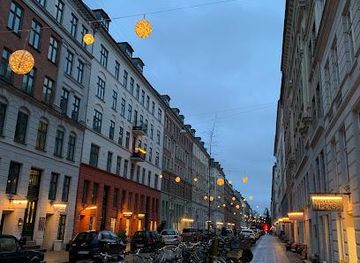
Nørrebrogade is the principal shopping and transport artery running through Nørrebro, one of Copenhagen’s most diverse and energetic districts. Starting by the city lakes and Queen Louise’s Bridge and continuing all the way to Nørrebro Station, the street forms a continuous ribbon of shops, eateries and everyday services, with dense apartment blocks rising above street level. From early morning delivery vans to the late-night hum of take-away counters, Nørrebrogade never really falls quiet. It is here that you feel Nørrebro’s multicultural character most strongly: Middle Eastern bakeries sit next to Danish chain stores, independent boutiques share the pavement with discount supermarkets, and conversations shift easily between Danish, English and a dozen other languages.

City history beneath the asphalt

Long before it became an urban high street, Nørrebrogade followed the route of the road leading to Copenhagen’s former Northern City Gate. For centuries, construction was limited outside the fortifications, and only scattered buildings lined the dusty track. As the city expanded in the 19th and early 20th centuries, the old restrictions disappeared and Nørrebro was rapidly built up with dense tenement housing, workshops and corner shops. Today’s Nørrebrogade still reflects that historic layering. Many façades retain their late 19th-century proportions, while ground floors have been refitted again and again as shops and services evolved. The street has also been central to debates about traffic and urban life: bus routes, protected bike lanes and pedestrian improvements have gradually reshaped it from a car-dominated thoroughfare into a more people-focused space without losing its role as a key route through the city.

Daily life, food and shopping along the strip

Walking Nørrebrogade offers an almost continuous sequence of places to eat, browse and people-watch. Greengrocers spill crates of fruit and vegetables onto the pavement, international supermarkets sit alongside organic specialists, and shawarma joints glow late into the evening. Side streets like Elmegade, Jægersborggade and Blågårdsgade branch off as quieter pockets rich in design stores, wine bars, cafés and small restaurants. Compared with central Copenhagen’s polished shopping streets, Nørrebrogade feels more local and workaday. You will find vintage clothing, budget fashion, barbers, phone shops and bakeries rather than rows of luxury brands. That mix makes the street interesting for travelers who want to see how Copenhageners actually live, shop and eat beyond the postcard-perfect canals.

Landmarks and green relief on the route

Despite its urban intensity, Nørrebrogade is punctuated by several important green and cultural spaces. One edge of the street runs along Assistens Cemetery, a walled park-like burial ground where notable Danes such as Hans Christian Andersen and Søren Kierkegaard are buried. Step through the gates and the traffic noise fades into an unexpectedly tranquil landscape of trees and winding paths. Farther northwest, Nørrebrogade passes Nørrebro Runddel and the entrance to Superkilen, a linear park celebrated for its bold design and international references. Local sports and community life gather around facilities like Nørrebrohallen, housed in a former tram depot close to the street. Together, these places break up the long corridor of shops and traffic with moments of culture, recreation and visual interest.

Experiencing the street on two feet or two wheels

To experience Nørrebrogade fully, it is best explored slowly. The continuous bike lanes make it one of the city’s classic cycling routes, while the sidewalks are wide enough in many stretches for strolling and impromptu café stops. The atmosphere shifts subtly along its length: closer to the lakes the street feels almost like an extension of the inner city, while farther north it becomes more residential and everyday. Because it is also a major bus corridor and an access route to the metro and S-train at Nørrebro Station, the street remains busy through much of the day. Yet even at peak times there are pockets where you can pause with a coffee, watch the stream of cyclists glide past and absorb the layered, lived-in character that makes Nørrebrogade such a distinctive part of Copenhagen.

Local tips

  • Walk at least one full stretch between the lakes and Nørrebro Runddel to sense how the vibe shifts from central-city edge to more local Nørrebro everyday life.
  • Combine the street with a detour into Assistens Cemetery for a quiet green break and to see the graves of famous Danes such as Hans Christian Andersen.
  • Venture down side streets like Jægersborggade, Elmegade and Blågårdsgade for specialty coffee, natural wine, design boutiques and a denser cluster of independent shops.
  • Time your visit for late afternoon or early evening to see the street at its liveliest, when commuters, locals shopping for dinner and diners all overlap.
  • Bring a contactless bank card; many small places are cashless, and paying by card or phone is the norm in Copenhagen.
widget icon

Buy tickets

    No tickets available

Book tours with entry

    No tours available

Book tours without entry

    No tours available

A brief summary to Nørrebrogade

  • Copenhagen, Nørrebro, 2200, DK

Getting There

  • Metro and bus from central Copenhagen

    From central Copenhagen, take the M3 Cityringen metro to Nørrebro Station, which usually takes about 10–15 minutes from the inner city. From the station, Nørrebrogade runs directly outside, and you can walk along the street in either direction. Standard single metro tickets in Copenhagen generally cost around 20–30 DKK within the central zones and can be bought from machines or via travel apps.

  • Bus along Nørrebrogade

    Frequent city buses, including line 5C, run the length of Nørrebrogade between the lakes and Nørrebro Station, with typical journey times of 10–25 minutes depending on traffic and where you board. Buses use the same integrated ticket system as the metro, so expect to pay roughly 20–30 DKK for a single ride within the city zones. Buses can be busy at peak commuting hours but offer an easy way to hop on and off at different parts of the street.

  • Cycling from the city center

    Copenhagen’s extensive bike lanes make cycling to Nørrebrogade straightforward from the inner city, typically taking 10–20 minutes from central neighborhoods such as Indre By or Vesterbro. Dedicated lanes run along most of the street, but traffic is dense at rush hour and may feel challenging for very inexperienced cyclists. You can use shared bikes or rental shops; prices vary, but expect roughly 80–150 DKK for a full day’s rental from typical city providers.

  • Walking from the lakes and inner city

    For a slower approach, many visitors walk from central Copenhagen across Queen Louise’s Bridge by the lakes, reaching the start of Nørrebrogade in about 15–25 minutes from the inner city. The route is flat and paved, suitable for most fitness levels and pushchairs. In wet or icy weather the pavements can be slippery, so sturdy footwear is useful, and strong winds across the bridge can make the walk feel colder than the temperature suggests.

Popular Experiences near Nørrebrogade

Popular Hotels near Nørrebrogade

Select Currency