

Enchanted Rock State Natural Area Travel Guide - Free Web & App
Your ultimate guide to Enchanted Rock State Natural Area. Discover top landmarks, proposed trips, and local tips. Free on the web or via the Evendo companion app.


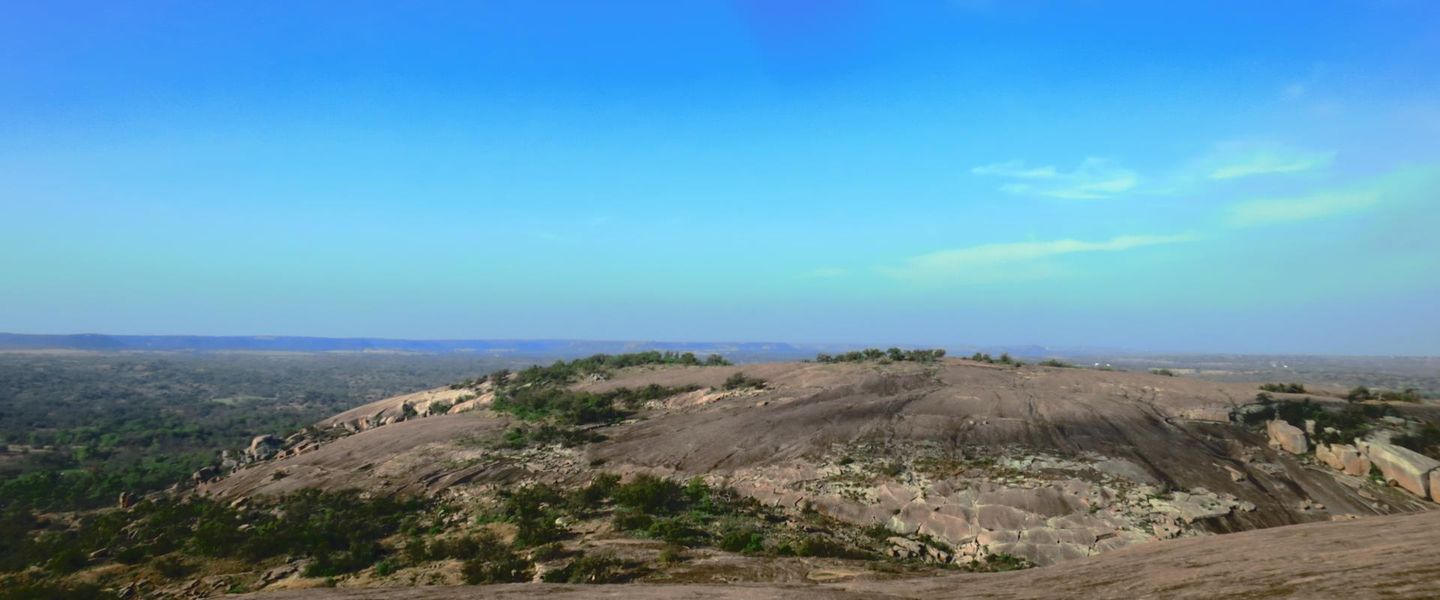


Enchanted Rock State Natural Area in Texas offers granite domes, Hill Country views, hiking, climbing, wildlife and distinctive Native heritage.
A Granite Landmark in the Hill Country
Enchanted Rock State Natural Area rises above the pink-granite landscapes of central Texas, roughly midway between Fredericksburg and Llano. Its defining feature is Enchanted Rock itself, a vast exfoliation dome formed from granite that cooled underground millions of years ago and was later exposed as surrounding rock eroded. The dome's smooth, gently curving surface catches the changing light, while smaller granite formations, caves and boulder-strewn slopes extend across the surrounding uplands.Read more about Enchanted Rock State Natural Area
Landscape, Wildlife and Outdoor Time
Stories Written in the Landscape
When is the best time to visit Enchanted Rock State Natural Area?
Best: March–April, October · 21–27°C| Month | High (°C) | Rainfall (mm) |
|---|---|---|
| January | 15 | 37 |
| February | 17 | 38 |
| March (best) | 21 | 52 |
| April (best) | 27 | 56 |
| May | 31 | 79 |
| June | 34 | 58 |
| July | 36 | 54 |
| August | 36 | 64 |
| September | 33 | 74 |
| October (best) | 26 | 75 |
| November | 21 | 48 |
| December | 16 | 41 |
Getting to and around Enchanted Rock State Natural Area
How to get there
Transportation
Best attractions in Enchanted Rock State Natural Area
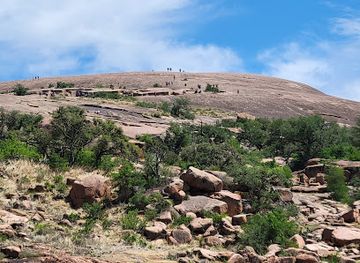
Enchanted Rock itself is the natural area's principal attraction, a broad pink-granite dome reached by the Summit Trail and surrounded by open Hill Country views. The Loop Trail provides a longer circuit through granite outcrops, oak and juniper woodland, grassland and boulder-strewn terrain, while the Base Trail offers a closer perspective on the dome without following the full summit route. Little Rock and Turkey Peak add variety to the geology, and the Enchanted Rock Fissure, reached by a more rugged route, reveals a dramatic split among the granite formations. Climbers use established routes on the domes, subject to park regulations and conditions. Seasonal pools and sheltered rock spaces support smaller plants and wildlife, while the nearby Llano River and communities of Fredericksburg and Llano offer additional regional experiences outside the natural area's boundaries.
-
Mountain peak
Enchanted Rock
Explore the breathtaking Enchanted Rock in Texas, a granite dome offering stunning views, hiking trails, and unique geological formations.
-
Visitor center
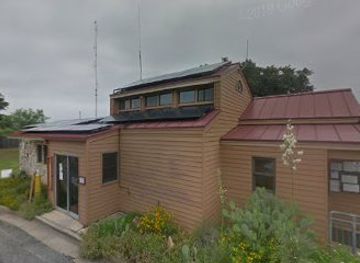
Enchanted Rock State Visitor Center
Explore the Enchanted Rock State Visitor Center: Your gateway to stunning trails, rich history, and breathtaking views in Texas Hill Country.
Explore Enchanted Rock State Natural Area on the map
Plan your trip on one map. See where the top attractions, landmarks, restaurants and hotels are, and book hotels and experiences in a few clicks.
Best hotels in Enchanted Rock State Natural Area
Best shops in Enchanted Rock State Natural Area
Shopping within Enchanted Rock State Natural Area is limited to practical visitor needs and interpretive or park-related items rather than a conventional retail scene. Fredericksburg is the main nearby place for provisions, outdoor essentials, regional food products, German-influenced specialities, art and locally made goods, while Llano provides a smaller selection of shops and supplies from the northern approach. Across the wider Hill Country, visitors may encounter farm shops, wineries, galleries, craft studios and producers whose goods reflect ranching, agriculture, German settlement and the area's distinctive landscapes. Product availability varies, particularly outside the gateway towns, so food, water, fuel and specialist walking equipment should be arranged before entering the rural area. Purchases from legitimate local businesses are preferable to removing rocks, plants or other natural material from the protected site.
-
State park
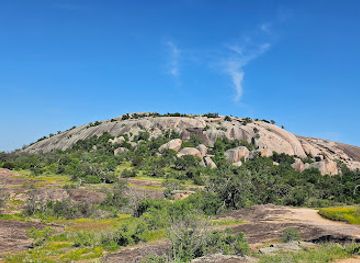
Enchanted Rock State Natural Area
Explore the stunning landscapes and outdoor adventures at Enchanted Rock State Natural Area, a must-visit destination in Texas.
Get your free copy of our complete guide to Enchanted Rock State Natural Area, delivered straight to you.
Everything on this page, from attractions and restaurants to essentials and local phrases, in one PDF you can read offline, print or share.
Already have an account? Sign in
Your Enchanted Rock State Natural Area guide is ready.
We'll send it to · Not you? Sign out

Getting your guide ready…
We are putting together a fresh copy of the Enchanted Rock State Natural Area guide. This can take up to a minute.
This can take a few moments. If your browser asks, choose Allow so the download can start. You'll find the guide in your Downloads folder.
Nothing happened? Download it again
Sorry, the guide is taking longer than usual. Please try again in a minute, or get it by email instead.
Enchanted Rock State Natural Area essentials
Currency and Payment
Safety
Emergency Situations
Do's and Don'ts
Local Tips
From Eve
Local phrases worth knowing
You don't need to get them perfect. A few words go a long way, and locals appreciate the effort.
Basics
| English | Local | Say it |
|---|---|---|
| Hello | Howdy | [hahy-dee] |
| Goodbye | See ya later | [see yuh ley-ter] |
| Yes | Yep | [yep] |
| No | Nope | [nohp] |
| Please/You're welcome | Please and thank you | [pleez and thangk yuh] |
| Thank you | Much obliged | [muhch uh-blahy-d] |
| Excuse me/Sorry | Pardon me | [pahr-dn mee] |
| How are you? | Howdy, y'all? | [hahy-dee, yawl?] |
| Fine. And you? | Fine as frog hair. You? | [fahyn az frog hair. yuh?] |
| Do you speak English? | Y'all speak English? | [yawl speek ing-glish?] |
| I don't understand | I ain't catchin' on | [ahynt kach-in awn] |
Eating & Drinking
| English | Local | Say it |
|---|---|---|
| I'd like to see the menu, please | Lemme see whatcha got to eat | [leh-mee see whatch-uh got tuh eet] |
| I don't eat meat | No meat for me | [noh meet fohr mee] |
| Cheers! | Bottoms up! | [bot-uhmz uhp] |
| I would like to pay, please | I reckon it's time to settle up | [ahy rehk-uhn its tahym tuh set-l uhp] |
Emergencies
| English | Local | Say it |
|---|---|---|
| Help! | SOS! | [es-oh-es] |
| Go away! | Git outta here! | [git aw-tuh heer!] |
| Call the Police! | Ring up the Sheriff! | [ring uhp thuh shehr-iff] |
| Call a doctor! | Get the doc on the line! | [get thuh dahk awn thuh leyen] |
| I'm lost | I'm all turned around | [ahym awl turnd uh-round] |
| I'm ill | I'm feelin' poorly | [ahym feel-in poor-lee] |
Shopping
| English | Local | Say it |
|---|---|---|
| I'd like to buy... | I'm fixin' to purchase... | [ahym fiks-in tuh pur-chuhs...] |
| I'm just looking | Just browsin' | [juhst brouz-in] |
| How much is it? | What's the damage? | [whahts thuh dam-ij] |
| That's too expensive | That's a little steep | [thats uh lih-tl steep] |
| Can you lower the price? | Can ya do any better on the price? | [kan yuh doh en-ee bet-er awn thuh prahys?] |
Time & Numbers
| English | Local | Say it |
|---|---|---|
| What time is it? | What's the time? | [whahts thuh tahym] |
| It's one o'clock | It's high noon | [its hahy noon] |
| Half past (10) | Ten-thirty | [ten-thur-tee] |
| Morning | Mornin' | [morn-in] |
| Afternoon | Afternoon | [af-ter-noon] |
| Evening | Evenin' | [ee-ven-in] |
| Yesterday | Yest'day | [yest-dey] |
| Today | Today | [tuh-day] |
| Tomorrow | Tomorrah | [tuh-mor-uh] |
| 1 | One | [wuhn] |
| 2 | Two | [too] |
| 3 | Three | [three] |
| 4 | Four | [for] |
| 5 | Five | [fahyv] |
| 6 | Six | [siks] |
| 7 | Seven | [sehv-uhn] |
| 8 | Eight | [eyt] |
| 9 | Nine | [nayn] |
| 10 | Ten | [ten] |
Transport & Directions
| English | Local | Say it |
|---|---|---|
| Where's a/the...? | Where's the... | [wheres thuh] |
| What's the address? | What's the addy? | [whats thuh add-ee] |
| Can you show me (on the map)? | Can ya point it out (on the map)? | [kan yuh point it awt (awn thuh map)] |
| When's the next (bus)? | When's the next one comin'? | [whens thuh nekst wuhn kum-in] |
| A ticket (to ....) | A pass (to ....) | [uh pass (tuh)] |
History of Enchanted Rock State Natural Area
Granite from Deep Geological Time
Enchanted Rock is part of the Llano Uplift, a region where ancient Precambrian rocks are exposed above the younger rocks of the surrounding Edwards Plateau and Texas Hill Country. The granite formed deep below the Earth's surface as molten rock cooled, then became visible over immense spans of time as erosion removed the material above it. The rounded domes and slabs seen today were shaped partly by exfoliation, a process in which outer layers of rock loosen and peel away as pressure changes and weathering act on the granite. This geological history explains the natural area's characteristic pink rock, boulder fields, shallow depressions and smooth summit surfaces.
Indigenous Connections and Oral Tradition
The granite domes and surrounding uplands have been used and travelled by Indigenous peoples for centuries. The Tonkawa and other Native communities maintained connections with the wider central Texas landscape, whose springs, plants, animals and travel routes supported seasonal life and exchange. Enchanted Rock's unusual appearance and reported sounds, including noises produced by temperature changes in the rock, contributed to stories that gave the dome a supernatural reputation among later communities. Such traditions are part of the site's cultural history, but they should not obscure the much older and continuing Indigenous presence in the region.
Ranching and Settlement in the Uplands
From the nineteenth century onwards, Euro-American settlement altered the Hill Country through ranching, farming, timber use and the growth of nearby communities. Fredericksburg, founded by German immigrants in 1846, became an important regional settlement, while Llano developed as a centre in the northern Hill Country. Around Enchanted Rock, the difficult terrain and thin soils limited intensive cultivation but did not prevent grazing and other rural uses. The wider landscape consequently became a meeting point between working ranch country and exposed geological formations that attracted increasing interest from travellers, naturalists and climbers.
Protection as a Natural Area
Growing recognition of Enchanted Rock's geological and scenic importance led to its protection by the State of Texas. The property became Enchanted Rock State Natural Area in 1978, preserving the principal dome and surrounding granite formations for public recreation and conservation. Management has had to balance hiking, rock climbing, camping and interpretation with the need to protect fragile soils, vegetation and rock surfaces. The natural area's designation reflects a broader change in the Hill Country, where distinctive landscapes once valued chiefly for ranching or extraction increasingly became important as public environmental and recreational assets.
A Modern Outdoor Destination
Today, Enchanted Rock is managed within the Texas state park system as a day-visit and camping destination centred on geology, walking and climbing. Its popularity has made advance planning increasingly significant, especially during weekends, holidays and periods of mild weather. Modern interpretation presents the dome as both a geological record and a culturally meaningful place, while visitor management seeks to reduce erosion and disturbance. The natural area remains closely linked to Fredericksburg, Llano and the wider Hill Country, yet its identity depends on retaining the open, rugged character of its granite landscape.
Enchanted Rock State Natural Area in Photos
Browse through our photo collection highlighting the charm and character of the destination.
Neighbouring destination travel guides
The closest destinations to Enchanted Rock State Natural Area, if you have time for more than one.
-

-

-

-
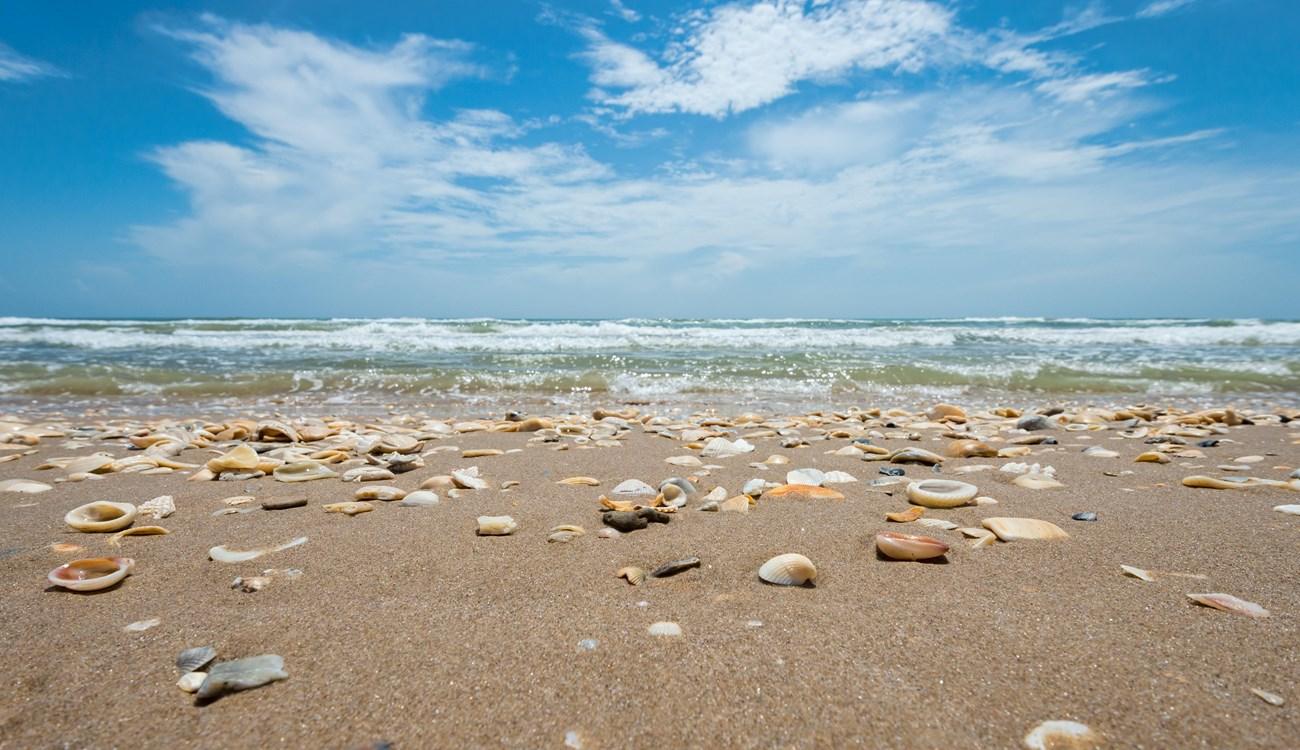 Padre Island National Seashore
, Texas: sea turtles, shorebirds, wild beaches, dunes, camping and quiet Gulf Coast adventure near Corpus Christi.
Padre Island National Seashore
Padre Island National Seashore, Texas: sea turtles, shorebirds, wild beaches, dunes, camping and quiet Gulf Coast adventure near Corpus Christi.
-


Swipe for more destinations
Explore more

Explore more of Hill Country
Explore Texas Hill Country for limestone landscapes, historic towns, swimming holes, vineyards, barbecue, hiking and wide-open Central Texas scenery.
Explore Hill Country
Explore more of Texas
Discover the diverse landscapes, rich history, vibrant cities, and culinary delights of Texas, the Lone Star State, where adventure and culture await at every turn.
Explore Texas