Ardvreck Castle Travel Guide
Free Guide: A haunted 15th-century ruin steeped in betrayal, legend, and Highland majesty on Loch Assynt.


A brief summary of Ardvreck Castle
A haunted 15th-century ruin steeped in betrayal, legend, and Highland majesty on Loch Assynt.
Ardvreck Castle stands as a haunting ruin on a rocky promontory jutting into Loch Assynt in the Scottish Highlands. Built around 1490 by the Macleods of Assynt, this 15th-century tower house witnessed one of Scotland's most infamous betrayals when Royalist leader the Marquis of Montrose sought refuge here in 1650, only to be handed over to his enemies. Today, the fragmentary remains reveal the castle's original three-storey design, while the surrounding landscape offers some of central Sutherland's most spectacular mountain vistas.
On-site amenities
 Information boards
 Parking areas
Opening hours
- Every dayOpen 24 hours
Opening hours as listed on the venue’s Google Business Profile. Hours can change for services and special events, so check with the venue before you go.
- Address
- Lairg IV27 4HL
- Website
Getting there
Car via A837
Walking from Inchnadamph
Guided tour or local taxi
Bicycle from Lochinver
Discover more about Ardvreck Castle
A Fortress Born from Highland Ambition
Ardvreck Castle emerged in the latter half of the 15th century as the stronghold of the Macleods of Assynt, a powerful Highland clan controlling these remote lands. Built by Angus Mor Macleod, the original structure was a simple rectangular tower of three or four storeys, designed to serve both as a residence and a defensive position. A century later, Donald Ban Macleod enhanced the fortress by adding a tower and vaulted cellars, transforming it into a more formidable structure. Even with these improvements, Ardvreck remained relatively compact, requiring additional buildings nearby to house kitchens, servants' quarters, and stables. The castle's strategic location on a rocky promontory projecting into Loch Assynt provided natural defensive advantages, while its thick stone walls, narrow window openings, and single defensible entrance reflected the constant threat of clan warfare that characterized Highland life.
The Infamous Betrayal of 1650
Ardvreck Castle's single moment of prominence in Scotland's national history came in 1650, when it became the stage for one of the most notorious betrayals in Highland tradition. After his defeat by the Covenanters at the Battle of Carbisdale, the Royalist commander James Graham, Marquis of Montrose, fled northward seeking sanctuary. Two days after his defeat, he arrived at Ardvreck Castle seeking refuge with Neil Macleod of Assynt. Finding Neil away, Montrose was received by his wife, Christine, who allegedly tricked him into the castle dungeon. She then summoned Government troops, delivering the fugitive into enemy hands. Montrose was transported to Edinburgh, where he was executed on 21 May 1650, his body subsequently dismembered and displayed in public. This act became legendary as a shocking violation of Highland hospitality and clan honour, forever staining the castle's reputation.
Decline and the Rise of Calda House
In 1672, the Macleods were forced to surrender their lands to the Mackenzies of Wester Ross following a 14-day siege. The Mackenzies found Ardvreck Castle inhospitable and commissioned the construction of Calda House, a more modern residence, around 1726. In a final irony, some of Ardvreck's stone was recycled into the new building. However, the Mackenzies' fortunes deteriorated rapidly. Calda House was plundered and burned in 1737, possibly deliberately by the family as they faced financial ruin. Following their support for the losing Jacobite cause in 1745, the Mackenzies were forfeited of their estates, which were seized by the Crown. Both Ardvreck Castle and Calda House were subsequently abandoned, their ruins left to the mercy of Highland weather and time.
The Haunted Ruins Today
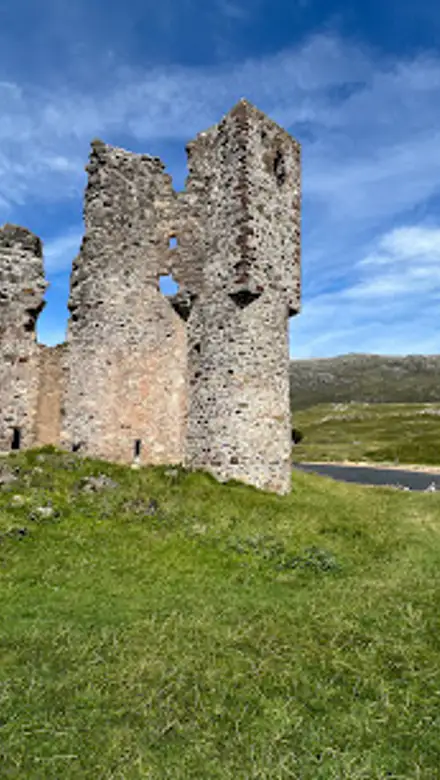
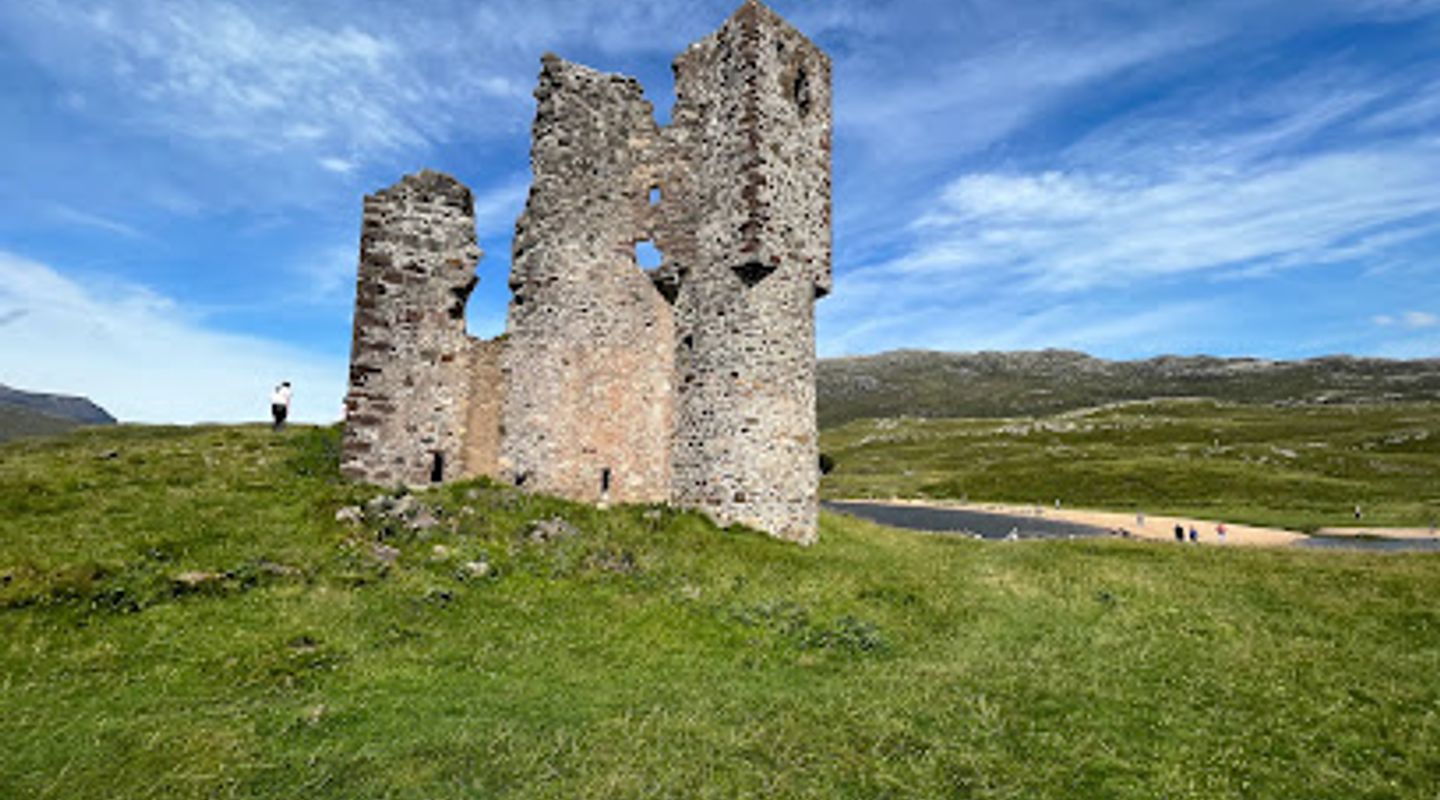
Today, Ardvreck Castle comprises little more than a finger of stone pointing skyward—a fragment of its former grandeur. Enough remains to identify its original three-storey tower-house design, including a corbelled section that once housed the main staircase and traces of the vaulted basement level. A dry stone wall marks the line of the old defensive wall across the narrow neck of the promontory, with visible traces of the original defensive ditch still apparent. The castle's remote setting and exposure to harsh Highland weather have accelerated its decay, yet this very desolation contributes to its atmospheric power. The walk to the castle along an improved path is genuinely enjoyable, culminating in views of breathtaking beauty across Loch Assynt toward the surrounding mountain landscapes of central Sutherland.
Legends and Ghostly Inhabitants
Ardvreck Castle has accumulated a rich folklore of supernatural tales. The most famous legend concerns a daughter of a Macleod chief who, according to one version, threw herself into Loch Assynt after being tricked by her father into marrying the Devil as a pact to save the castle. Another version claims she transformed into a mermaid or selkie, taking refuge in an underwater cave; when water levels rise, locals say the 'Mermaid of Assynt' sheds tears for the life she lost on land. Visitors have reported hearing the cries of a weeping woman echoing across the loch. A second ghostly presence is said to be a tall man clad in grey, while some accounts link supernatural disturbances to the castle's violent past—the sieges, betrayals, and bloodshed that marked its history. Whether these tales are born of Highland imagination or something more mysterious, they add an undeniable layer of intrigue to the ruins.
A Landscape of Singular Beauty
The true magic of Ardvreck lies not merely in its historical significance but in its setting. The castle stands on a near-island of rock surrounded by the dark waters of Loch Assynt, framed by some of the most dramatic mountain scenery in the Scottish Highlands. The surrounding peaks, glens, and moorland create a landscape of profound beauty and isolation. A modern parking area with excellent information boards provides convenient access, while the improved path to the castle makes it accessible to most visitors. Nearby stands the ruined shell of Calda House, a reminder of the Mackenzies' brief tenure and grander ambitions. Together, these two ruins tell the story of Highland power, ambition, betrayal, and decline—a narrative written in stone against one of Scotland's most magnificent natural backdrops.
Evendo Review Centre
 Google
Guest reviews
Best time to go
Quietest: Jan, Feb & Nov · before 7am or from 6pm
Busy times are Evendo estimates for a typical year, to help you plan. Actual crowds vary with events, school holidays and the weather.
Explore Ardvreck Castle on the map
A handpicked selection of must-see spots near Ardvreck Castle, mapped for you.
Get your free copy of our complete guide to Ardvreck Castle, delivered straight to you.
Everything on this page, from opening hours and how to get there to Eve’s tips and the best time to go, in one PDF you can read offline, print or share.
Already have an account? Sign in
Your Ardvreck Castle guide is ready.
We'll send it to · Not you? Sign out

Getting your guide ready…
We are putting together a fresh copy of the Ardvreck Castle guide. This can take up to a minute.
This can take a few moments. If your browser asks, choose Allow so the download can start. You'll find the guide in your Downloads folder.
Nothing happened? Download it again
Sorry, the guide is taking longer than usual. Please try again in a minute, or get it by email instead.
Unlock the best of Ardvreck Castle
Skip-the-line tickets, guided tours with entry, and walking tours of the area, booked in a few clicks.
 Tour with entry
Scottish Highlands Adventure Small Group Tour from Inverness
from $76.10 Tour with entry
Ullapool Port Ardvreck Castle and the Highlands of Assynt
from $163.83 Tour with entry
Ullapool Shore Excursion Ardvreck Castle & Achmelvich Beach
from $202.35 Tour with entry
3-Day North Coast 500 Small-Group Tour from Inverness
from $709.91
Other nearby places you may find interesting
The closest places of the same kind, if this one is not quite what you had in mind.
-
-
-
-
-


Swipe for more places
More to explore near Ardvreck Castle

 Best experiences near Ardvreck Castle
 Best hotels near Ardvreck Castle
 Best landmarks near Ardvreck Castle
 Best attractions near Ardvreck Castle
 Best shops near Ardvreck Castle
 Best restaurants near Ardvreck Castle
 Best bars near Ardvreck Castle
Do you manage this location?
Take control to get all the benefits, like improved information, better appearance, and stronger visibility across AI-powered discovery.
Explore more

Explore more of Scottish Highlands
Discover the breathtaking beauty and rich history of the Scottish Highlands, where rugged landscapes, historic castles, and mysterious lochs await every adventurous traveler.
Explore Scottish Highlands
Explore more of United Kingdom
Discover the United Kingdom: A blend of rich history, stunning landscapes, and vibrant cities, offering a unique travel experience for every visitor.
Explore United Kingdom