On a private island adrift in the Caribbean light, where scarlet heliconias bow toward turquoise water and wooden walkways hover just above the sea, Nayara Bocas del Toro feels less like a resort and more like a secret that couples whisper to one another in airport lounges and anniversary toasts.First Impressions: Paradise Found on Isla Frangipani
Romance at Nayara Bocas del Toro begins not at a lobby desk but at the edge of a wooden pier in Bocas Town, where the mainland feels already faint, as if remembered from another season of life. A discreet host lifts your bags into a sleek launch, offers chilled towels scented faintly with lime, and gestures toward the water taxi bench. As the engine hums awake, you leave behind the colorful clapboard houses and bobbing pangas of town, trading chatter and reggae beats for the low murmur of the motor and the soft slap of water against the hull.
The short ride to Isla Frangipani feels like an overture. The boat cuts a path through crystalline shallows, the sea changing shade by shade – pistachio near shore, then a glassy turquoise, then a deep, contemplative blue where the mangroves lean in as if inspecting your passage. Brown pelicans pirouette above the wake, occasionally folding their wings and plunging like smooth stones into the water. In the open stretches, the wind tunnels through your hair, salty and cool, a welcome contrast to the soft, velvety heat that hangs in the air of Bocas del Toro.
As you move farther from Isla Colón, human noise dissolves almost completely. The soundtrack narrows to the rustle of your lifejacket straps, the clink of ice in a glass of sparkling water, and pockets of birdsong filtering across the mangrove forest. The anticipation builds gradually, like a slow swell: this sense of slipping past regular life, of crossing into another tempo. Your captain points across a narrowing channel where a smear of rich, improbable green interrupts the horizon. There, he says, is Isla Frangipani.
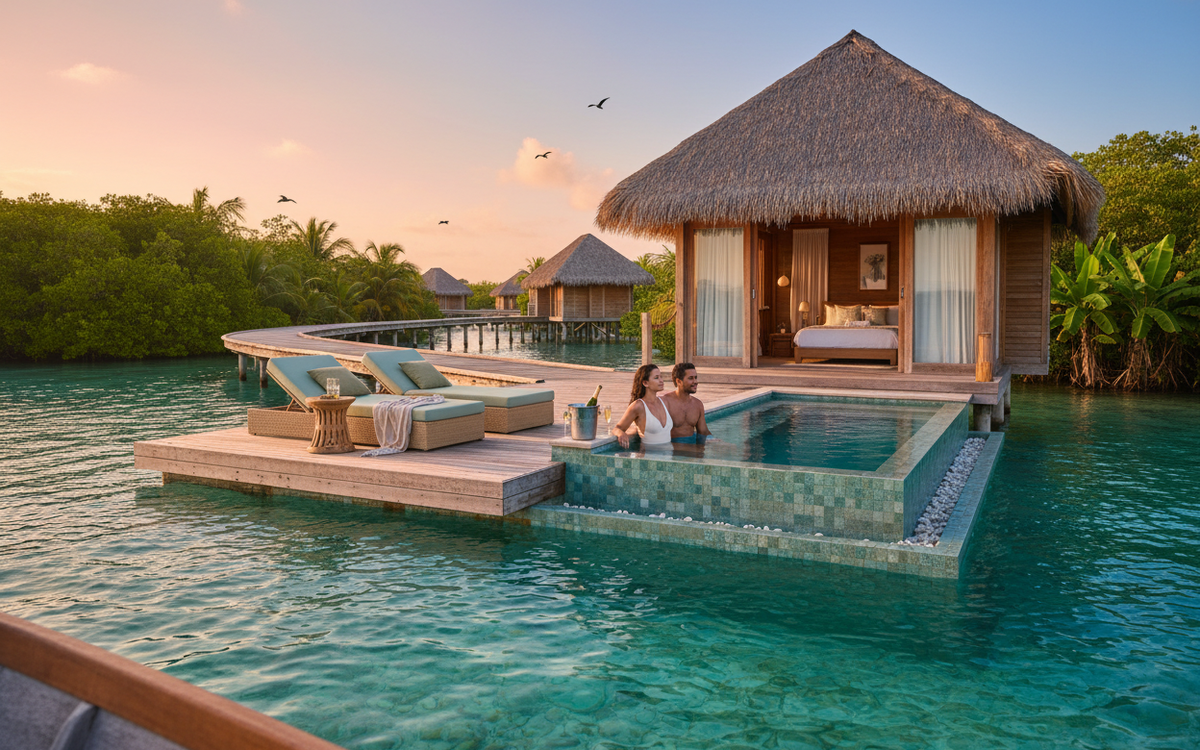
The island materializes not all at once, but in vignettes. First, a line of overwater villas stilted above the sea like finely carved totems, each crowned with thatched Balinese-style roofs and dark timber beams. Then the main boardwalk comes into view, a sinuous spine of polished wood curling over the water toward the heart of the property. Along the shoreline, mangroves tangle with fan palms and sea grapes, their roots sunk into clear shallows that reveal darting silver fish and the occasional shadowy stingray gliding along the sandy bottom.

The arrival dock is understated, almost shy, as if the island is testing whether you are the sort of guest who notices details. A carved Balinese door stands open at the end of the jetty, framing not marble or chandeliers but a slice of luminous lagoon and a wall of jungle beyond. Barefoot staff meet the boat with hibiscus-infused welcome drinks served in glass, not plastic, the condensation beading against your palm. You step onto the jetty and the wood is warm but not hot, as if it, too, is calibrated for comfort.
Check-in is less a transaction than a gentle ceremonial shedding of the outside world. There is no bustling front desk, no queue of weary travelers. Instead, you and your partner are guided along the boardwalk to a shaded lounge pavilion, open on all sides to the sea breeze. A ceiling fan turns lazily above handcrafted rattan chairs, and the scent of frangipani drifts in, sweet and almost creamy. The only paperwork is a brief conversation: dietary preferences, activity wishes, how strong you like your morning coffee. You are not given a map; you are invited on a walk.
The sense of seclusion is immediate and magnetic. Because Nayara Bocas del Toro occupies its own private island, there are no passing vendors, no beach clubs blaring music from neighboring properties. Villas are spaced generously, their pathways braided through lush gardens planted with ginger flowers, banana leaves, and sprays of red ixora. From almost any vantage point, you see water on at least two sides, an endless play of light on the sea that shifts with every passing cloud. You hear the occasional muffled laughter from another couple far down the boardwalk and the distant clink of glassware from the bar, but rarely anything more insistent than that.
By the time you reach your overwater villa, sandals in hand, skin beginning to glow with that slightly salted Caribbean sheen, the resort has worked a quiet transformation. The boat ride, the languid welcome, the deliberate privacy of the island – all conspire to create a feeling that you have not simply checked into a hotel, but been spirited away to a hideaway built almost exclusively for two.
Overwater Villa Dreams: A Romantic Haven
Slide back the heavy wooden door of your overwater villa and the first impression is of space and softness. Sunlight pours through wide glass sliders that open directly onto the deck, washing over smooth teak floors and up across high, vaulted ceilings where dark Balinese beams interlace in an intricate pattern. At the center of the room rises the star of the show: a towering Tumpang Sari canopy bed, its many-tiered crown carved in swirling motifs, wrapped in sheer white drapes that billow with every passing gust of sea breeze.
The design language here is a deft, seductive fusion. Ornately carved wooden panels from Bali meet the soft, sandy palette of the Panamanian Caribbean. Rattan pendant lamps cast honeyed light at dusk, while woven baskets hold plush rolled towels near the sliding doors. A deep, linen-upholstered sofa faces the water rather than a television; there is a screen, discreetly hidden, but the true entertainment lives just below your feet.
Set into the hardwood floor is a generous glass inlay that turns your villa into a private observatory. During the day, shafts of sunlight pierce the water and ignite clouds of tiny fish below; you watch as sergeant majors flicker in and out of view, their stripes sharp as brushstrokes, and needlefish glide like drawn silver lines across the sandy bottom. At night, the staff can switch on subtle underwater lighting that transforms the sea into an ink-dark theater, where rays ghost past on velvet wings and the faint shimmer of plankton sparkles like far galaxies.

The bathroom is its own sanctuary: double vanities hewn from smooth stone basins, mirrors framed in reclaimed wood, rainfall showers that feel as if a warm tropical downpour has been coaxed indoors. The amenities are generously sized and pleasantly un-branded in an ostentatious way, their labels quietly noting that they are reef-safe and botanically derived. Step outside and there is an outdoor shower as well, tucked between high wooden screens and a curtain of climbing jasmine, perfect for rinsing off the sea with the faint perfume of flowers all around.
But it is the deck that makes you gasp, every time. A wide sweep of timber unfurls from the villa, hovering above water as clear as melted glass. There is a private plunge pool at one end, its tiled edges catching the sunlight, its water just a degree or two cooler than the sea – bracing enough to refresh, but warm enough that you linger. Two oversized loungers, dressed in thick cushions the color of sea foam, are oriented toward the open horizon. Between them, an ice bucket waits, its cargo a bottle of chilled champagne or perhaps a crisp Panamanian rum punch prepared just the way you like it.
In the late afternoon, when the equatorial sun begins to soften and the heat loosens its grip, this deck becomes the stage for perhaps the most romantic ritual at Nayara Bocas del Toro. You slip into the plunge pool and feel the cool water rise around your shoulders, your partner’s knees brushing against yours as you both settle along the tiled edge. The sea around you responds to the changing light, deepening from turquoise to a burnished teal, while high above the silhouettes of frigatebirds trace slow arcs in the sky.
Staff arrive not with the intrusive clatter of a room-service cart but with a discreet knock and a wooden tray balanced effortlessly on one hand. Within moments, flutes are filled with champagne, beads of condensation racing down the glass. The first sip tastes like an exclamation point – bright, effervescent, sharpened by the faint salt on your lips from an earlier swim. Soft music, if you choose to play it from the villa’s sound system, mingles with the rustle of palm fronds and the occasional splash from some unseen fish below.
As the sun dips lower, the sky turns painterly. Hues of coral, rose, and molten gold bleed across the western horizon, reflecting in ripples on the water so that the entire seascape seems to glow from within. Your partner stretches out on the deck, droplets of pool water catching the colors and turning skin into a canvas of light. A warm breeze threads through the open doors, carrying with it the distant aromas of charcoal grills and citrus from the kitchens – a gentle reminder that dinner, and perhaps a long, slow walk to the restaurant, still lie ahead.
Back inside, the Tumpang Sari bed awaits, transformed by turndown. The drapes are drawn around it like a pavilion, a romantic cocoon lit by the softest of bedside lamps. A handwritten note rests on the pillow, maybe suggesting tomorrow’s tide times for snorkeling or recommending a tucked-away corner of the island where the sunrise is especially spectacular. Slipping between the crisp, cool sheets, you notice how the mattress seems to hold you just so – firm enough to support sun-tired muscles, plush enough to invite slow, sleepy conversations well past midnight.
In many overwater resorts, the novelty of sleeping above the sea can override all else. Here, that thrill is only the beginning. The villas at Nayara Bocas del Toro are designed for couples to sink into, both literally and metaphorically – spaces that invite afternoon naps under a lazily turning fan, long baths with the terrace doors flung wide open, and languorous mornings where the most urgent task is deciding whether to slip directly from bed into the sea or pause first for room-service coffee delivered in locally made ceramic cups.
Culinary Delights: A Taste of Bocas del Toro
For all its indulgent seclusion, Nayara Bocas del Toro refuses to let dining slide into an afterthought. The culinary experience is, in many ways, the heartbeat of the island – a nightly ritual that brings couples out of their private nests and into a shared, candlelit world suspended above the water.
The resort’s signature restaurant, Elephant House, is a marvel before you even sit down. Housed in a century-old Balinese structure painstakingly shipped to Panama, its dark wood bones and ornate carved panels rest on stilts directly over the sea. As you approach along the boardwalk, lanterns flicker in a gentle Caribbean breeze, casting lacework shadows across the planks. Stepping inside feels like entering a living piece of history – vaulted ceilings, polished floors that hold the faint scent of wood oil and sea air, and open sides that frame the lagoon like a series of slow-moving paintings.
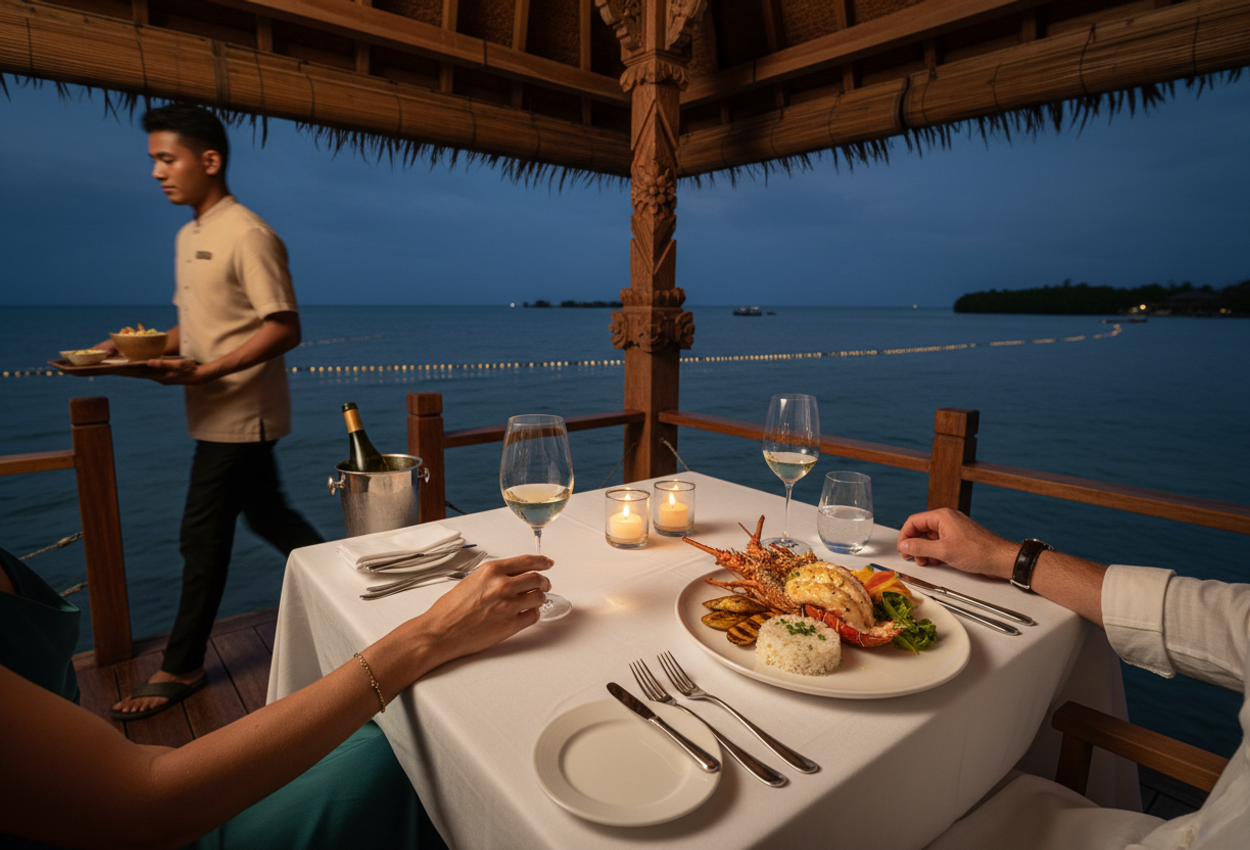
The farm-to-table ethos here is more than marketing language. Much of the produce comes from regional farms on the mainland and neighboring islands, while fishermen from local communities deliver their catches straight to the resort’s docks. The menu changes daily, dictated by the sea and the market: one evening might spotlight just-caught Caribbean lobster, another a delicate fillet of red snapper, another still a hearty coconut seafood stew dotted with plump shrimp and morsels of octopus.
On one particularly memorable night, dinner begins with a ceviche that tastes like the distilled essence of Bocas del Toro. Slivers of corvina are cured in lime and passion fruit juice, speckled with finely chopped culantro – the long-leafed cousin of cilantro so beloved in Panamanian kitchens – and topped with shards of green plantain tostadas for crunch. Each bite is electric, bright acidity washing over sweetness, the herbs grounding it all with a gentle bitterness.
The main course is a love letter to both land and sea: grilled Caribbean lobster, brushed with achiote butter, perched atop a creamy yuca purée scented with garlic and coconut milk. On the side, a tumble of sautéed baby okra and bell peppers, their edges just kissed by the pan’s heat, glisten beside a drizzle of reduced passion fruit that adds both tang and perfume. The lobster is impossibly tender, its natural sweetness coaxed forward rather than buried under heavy sauces. You can almost taste the journey from reef to plate in each forkful.
For dessert, the kitchen leans into the region’s tropical abundance. One evening, it might be a deconstructed tres leches cake infused with locally grown cacao, crowned by shards of dark chocolate and a scoop of guanabana sorbet whose flavor veers somewhere between pineapple and strawberry, impossibly refreshing in the warm night air. Another, perhaps a creamy flan perfumed with vanilla from Panama’s highlands, drizzled with a rum caramel that hums gently at the back of your throat.
The romance of Elephant House lies not only in the flavors but in the setting’s quiet drama. As you dine, the sea below whispers against the stilts, and if you lean over the railing between courses, you might glimpse a ray or small shark tracing slow circuits in the glow of the underwater lights. Overhead, the sky unfurls in an almost indecent sprawl of stars, unpolluted by city glare. Staff move with a practiced ease that feels neither obsequious nor aloof; they remember your favorite wine by the second night, suggest a particular rum from Panama’s interior that pairs beautifully with dessert, and offer to arrange breakfast in your villa if you confess to being “not morning people.”
By day, the culinary mood softens at Coral Café, the resort’s open-air bistro perched near the pool. Here, bare feet are welcome, and the menu leans light and sunny – think fluffy arepas topped with scrambled eggs and local cheese, or a bowl of tropical fruit where slices of mango, papaya, and pineapple tumble together beneath a snowfall of grated coconut. For lunch, a whole grilled red snapper arrives crisp-skinned and fragrant, nestled beside patacones – twice-fried green plantains – and a salad of cherry tomatoes and pickled onions that hums with lime.
What elevates the dining experience beyond simple indulgence is an almost palpable respect for place. That might mean using cacao nibs from Bocas del Toro’s own cacao farms in a bittersweet crumble over ice cream, or spotlighting a regional ingredient like pixbae – a local peach palm fruit that appears roasted and folded into a velvety risotto. It also shows in subtler ways: the gentle nudge from staff toward locally bottled craft beers, or the house-made hot sauce on the table that uses habaneros grown nearby, their heat softened by vinegar and a hint of tropical fruit.
For couples, meals become not just sustenance but punctuation marks in the day – a languid breakfast on your villa deck as hummingbirds hover at nearby blossoms, a lazy lunch between swims, a drawn-out dinner where the courses seem to stretch time. Because the menus shift each day, returning guests do not fall into culinary déjà vu. Instead, each evening feels like a fresh narrative, written in whatever is best from land and sea that day.
Sustainability in Style: Eco-Friendly Luxury
Many resorts describe themselves as eco-friendly; far fewer manage to weave environmental responsibility so deeply into the guest experience that it feels not like sacrifice, but like an added layer of luxury. Nayara Bocas del Toro is one of those rare few, operating entirely off-grid while maintaining the sort of seamless comfort that couples on a romantic escape quietly demand.
Behind the scenes, an intricate web of systems hums along. The island is powered primarily by solar energy, its panels positioned to drink in the Caribbean sun that blazes down most days of the year. During your stay, you never feel the flicker of a strained grid; lights are steady, air-conditioning runs efficiently when you need respite from the heat, and the plunge pools remain perfectly tempered. Yet there is a subtle nudge toward mindful use – key cards that cut power when you leave the villa, ceiling fans so well placed that you might choose them over air-conditioning at night, and an almost constant, gentle breeze that naturally cools the overwater structures.
Freshwater, that most crucial of island luxuries, is harvested through a sophisticated rainwater collection system. Sloping roofs feed into holding tanks, where the water is filtered and treated before flowing from your taps and into your shower. It is a quiet comfort to know that the rainfall drumming on your villa’s roof during a tropical squall will later reappear as the warm cascade of your morning rinse. In a region where freshwater can be precarious, this circularity feels not only responsible but poetic.
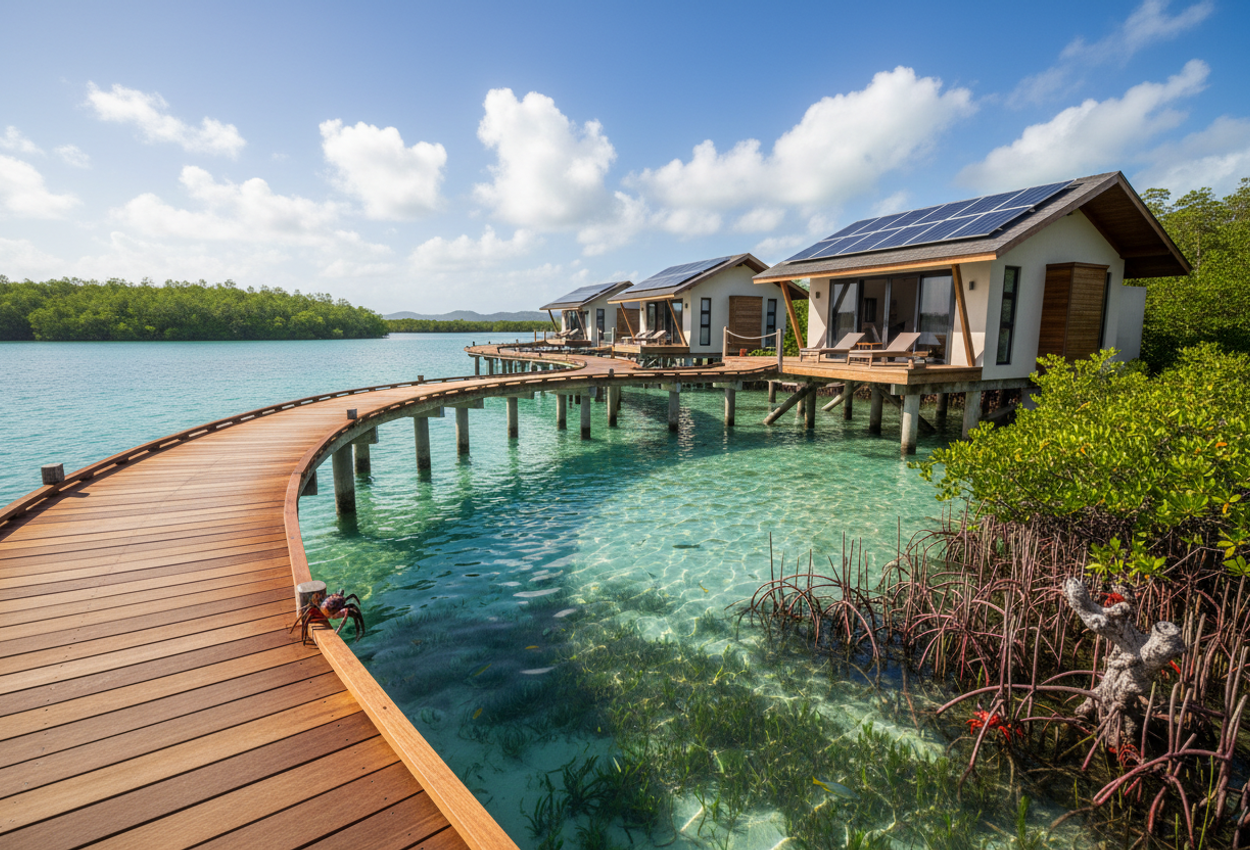
The resort’s relationship with its surrounding ecosystems – the mangroves and coral reefs that cradle Isla Frangipani – is even more striking. Rather than bulldozing or dredging, Nayara Bocas del Toro has worked around and within these natural systems. Boardwalks snake gently through mangrove stands, raised high enough to allow tides and marine life to move freely beneath. At low tide, you can peer down between the roots and spot schools of juvenile fish sheltering in the tangled underwater forest, their flashes of silver and yellow catching the filtered light.
Coral gardens near the island are treated with reverence. The resort partners with local conservation efforts to monitor reef health, and snorkeling routes are carefully marked to keep inexperienced swimmers from trampling delicate structures. On guided excursions, naturalist guides speak not in hushed, obligatory tones, but with genuine enthusiasm about parrotfish, damselfish, and the vital work of herbivores in a reef system. Guests are encouraged – firmly but kindly – to use the reef-safe sunscreen provided in their villas, its mineral formula kind to both coral and skin.
Plastic water bottles, that omnipresent scourge of tropical resorts, are entirely absent here. Instead, chilled filtered water is delivered in glass carafes, both in-villa and at dining venues, replenished as often as needed. The mini-bar eschews single-use plastics in favor of canned or glass-packaged beverages, and straws, when they appear, are sturdy and reusable or made from biodegradable materials. The effect is subtle but cumulative: over days, you become acutely aware of how little waste you are personally generating on the island.
In the bathrooms, amenities arrive in handsome, refillable dispensers rather than tiny disposable bottles. Labels note that the products are not only reef-safe, but also free from harsh sulfates and parabens. The shampoo carries a faint, herbal scent that hints at lemongrass and vetiver; the body wash smells of citrus and something gently floral. Using them, you feel less like a consumer and more like a participant in the property’s thoughtful, closed-loop systems.
Crucially, the commitment to sustainability extends beyond infrastructure into the social fabric of Bocas del Toro. Many staff members hail from nearby islands and communities, and the resort invests in training that enables them to rise through the ranks, from boat captains to sommeliers to spa therapists. In quiet moments, you might learn from a server about their upbringing on Isla Bastimentos or hear a groundskeeper talk about mangrove planting projects and how they protect shorelines from erosion.
The net effect is that sustainability at Nayara Bocas del Toro never feels like a badge or a burdensome lecture. It is instead a constant, reassuring presence – a sense that the pleasure you and your partner take in warm plunge pools and chilled wine, in reef swims and star-drenched dinners, is not coming at the expense of the island’s long-term wellbeing. For couples, particularly those attuned to the complexities of travel in a fragile world, that peace of mind is its own kind of luxury.
Secluded Activities: Exploring the Island Paradise
It would be entirely possible – deliciously so – to spend days at Nayara Bocas del Toro doing little more than oscillating between your Tumpang Sari bed, your plunge pool, and the dining table. Yet the island and its surroundings reward curiosity, offering experiences that deepen your relationship both with the place and with the person sharing it with you.
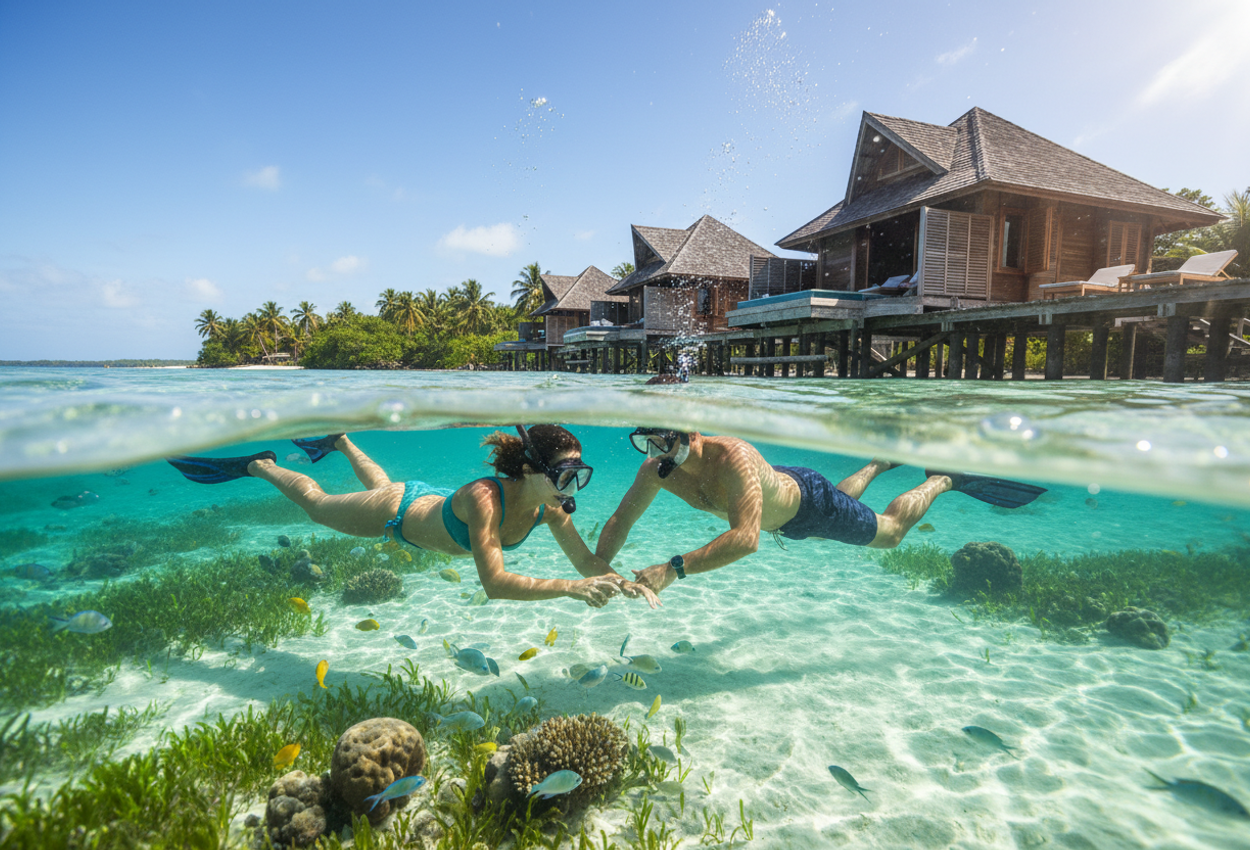
Snorkeling here feels like slipping into an alternate dimension. From your villa’s deck, a short ladder descends directly into the sea. One slow step at a time, the Caribbean closes around you – warm, silky, textured by tiny ripples. With a gentle push, you float out over underwater meadows of seagrass and clusters of coral heads, each hosting a teeming microcosm. Mask pressed to your face, you watch parrotfish grazing methodically, their beaks crunching on coral as flashes of turquoise and chartreuse shimmer along their flanks. Curious damselfish dart forward and back like tiny sentries, while shy angelfish peek from behind waving sea fans.
For couples who want a guided immersion, the resort arranges small-boat snorkel trips to nearby coral gardens and the protected waters around Isla Bastimentos National Marine Park. Glide over shallows that glow that improbable shade of swimming-pool blue, then roll backward from the side of the boat into water that muffles all sound except your own breathing. You and your partner can point excitedly when a ray ripples past below, or when a school of silvery baitfish briefly surrounds you like a living cloud, before pivoting away in perfect, synchronized formation.
Closer to shore, mangrove kayaking offers a different rhythm. Settled into a tandem kayak, paddles dipping quietly into the water, you trace narrow channels between stands of mangroves whose roots twist like sculptures into the sea. The air here is thicker, cooler in the shade, filled with the earthy tang of brackish water and the occasional burst of birdsong from a hidden kingfisher or heron. Sunlight filters through the canopy in dappled patches, illuminating small jellyfish drifting near the surface and the shadows of crabs clinging to the roots.
On land, a network of walking paths invites you into the island’s interior. Trails weave through pockets of secondary jungle where broad banana leaves glisten after a passing shower and lianas drape from trees like lazy vines. In the mornings, when the air is at its softest, couples set out hand-in-hand, coffee cups drained, listening for the throaty calls of distant howler monkeys or pausing to inspect a line of leafcutter ants hauling emerald shards along the forest floor. The resort’s guides, when requested, bring these walks alive with stories about medicinal plants, indigenous traditions, and the delicate balance of the archipelago’s ecosystems.
One of Isla Frangipani’s more surreal features is its so-called aerial beach – a sculpted slice of sand that seems to hover above the waterline, edged by a swooping wooden platform. From certain angles, especially when viewed from a kayak or paddleboard below, it appears as if a small crescent of white sand has simply levitated away from the sea, suspended in the air like an architectural mirage. For guests, it becomes a private stage for long, lazy sunbathing sessions or aperitifs at golden hour, the sea spread out like a painting below.
When wanderlust tugs you a bit farther afield, the resort can arrange a private boat tour to Starfish Beach on Isla Colón. The journey itself is a pleasure – a glide past mangrove islets and empty coves, your captain steering toward stretches where dolphins sometimes surface without warning, their fins knifing through the water before arcing gracefully away. As you approach Starfish Beach, the sea shallows to a pale, translucent jade and palm trees lean indulgently over the shoreline, their fronds fanning out above white sand.
Disembarking, you wade into water as calm and clear as a lagoon, grains of sand shifting silkily beneath your feet. Around you, the famous residents of the beach – cushion sea stars in shades of amber, rust, and ochre – rest on the bottom like scattered jewels. Guides gently remind visitors not to touch or disturb them, and there is a quiet thrill in simply hovering nearby with mask and snorkel, watching their tiny tube feet move in slow motion. Back on shore, rustic beach shacks serve grilled fish seasoned with lime and garlic, while the music of weekend crowds drifts softly along the sand.
Yet perhaps the greatest luxury of Nayara Bocas del Toro’s activities is how gently they fit into an overall rhythm of unrushed, unstructured days. There is no pressure to check boxes or accumulate Instagrammable moments. You might spend one afternoon supping on a paddleboard at the edge of the island, drifting without agenda, the next swinging in a hammock with a book you barely read because the horizon is too distracting.
As twilight falls, couples often reconvene at the pool or on hidden decks that jut out from the boardwalk. The sky bruises from pink to indigo, tree frogs begin their nightly chorus, and somewhere across the water, a boat’s lantern bobs, briefly visible, before vanishing as if swallowed by the night. In those in-between moments – toes damp from a final swim, hair salted and curling in the evening humidity, a final clink of glasses before dinner – the true magic of this secluded island reveals itself. It is not only in the polished wood and the solar panels, the glass floors and the gourmet menus, but in the rare, exquisite feeling that here, for a handful of days, the rest of the world has been placed on mute, leaving just the two of you and the sea.