The most meaningful love stories of our era are no longer confined to candlelit dinners for two. Increasingly, they are written in shared passport stamps, whispered confessions on overnight trains, and the easy laughter of old friends around distant tables.Beyond Coupledom: The Rise of Friendship Travel
For decades, travel marketing revolved around the couple. Honeymoons in overwater bungalows, anniversary escapes to quiet European towns, weekend breaks wrapped in the soft-focus language of romance. Yet on a recent overnight flight from New York to Rome, the row of seats that hummed with the most affectionate energy was not occupied by a couple at all but by four friends in their thirties. They passed noise-cancelling headphones down the line like gifts, compared playlists, and raised plastic cups of airline prosecco to the simple fact that they had managed to coordinate time off together. Their bond, woven from decade-long group chats and countless life milestones, felt every bit as intimate as any honeymoon in the cabin ahead.
This is the quiet revolution of our time: friendships stepping into the spotlight as central, enduring relationships and, increasingly, as the focus of big-ticket travel. Major booking platforms report steady growth in group reservations, particularly among millennial and Gen Z travelers who are more likely to be unmarried, more mobile in their careers, and more comfortable defining love on their own terms. Instead of saving the splurge for a traditional honeymoon that may or may not come, they are pooling resources with friends for elaborate journeys that feel like living, breathing love letters to their chosen families.
Behind the statistics is a shift in emotional priorities. After years marked by isolation, many of us crave the easy companionship of people who understand our histories without needing footnotes. Friend trips promise exactly that: emotional support built into the itinerary, a collective buffer against the fatigue of modern life. In long, unhurried hours on a train across Italy or a safari game drive in South Africa, conversations loosen and deepen. The white noise of daily obligations fades, leaving space for questions that rarely surface in text threads: Are you really happy at work. What do you want the next decade of your life to look like. How can I support you better.
Luxury travel companies have been quick to notice. At Black Tomato, bespoke itineraries once designed largely for couples are now increasingly tailored to friend groups: long weekends in Mexico City built around gallery hopping and mezcal tastings, or extended journeys across Japan that weave together neon nights and temple mornings. High-end operators such as Abercrombie & Kent offer private, fully staffed villas and lodges worldwide that allow groups of friends to essentially rent a bubble of time together, complete with guides, chefs, and drivers who adapt the day to the group’s shifting energy.
According to one recent study on travel behavior, a growing share of younger travelers say they would rather take a major trip with close friends than with a romantic partner, citing the safety and comfort of traveling with people who know them deeply. Long-standing friend groups, especially those scattered across multiple cities, increasingly use annual trips as anchor points, traditions that ground them even as careers, relationships, and addresses change.
Friendship researchers are not surprised. In a quiet café in London, psychologist and friendship specialist Dr. Maya Hollins describes what she calls the new romance of platonic bonds. She notes that friendships often outlast romantic relationships, yet we have historically starved them of ritual and investment. Travel, she argues, is helping to correct that imbalance.
When friends choose to travel together, they are essentially saying this relationship deserves ceremony and memory. They are elevating friendship from the background of life to center stage. That decision can be profoundly validating, especially for people who are single, queer, or simply not oriented around couplehood as the main story of their lives.
Group journeys also offer a different kind of vulnerability. Without the charged expectations that often trail romantic trips, there is space for the full, sometimes chaotic spectrum of self. You can admit that you are terrified of heights on a cliff-side hike in Bali, confess a career doubt in the shadow of Table Mountain, or cry over a long-held grief during a late-night soak in a Japanese onsen, and know that you are held by a web of people who have witnessed many versions of you.
In destination after destination, the itineraries that once belonged to couples are being gently rewritten. A farmhouse in Tuscany becomes a gathering place for university friends navigating their late thirties. A ryokan in rural Japan hosts a reunion of siblings and their chosen families. A safari lodge welcomes lifelong friends facing down midlife with curiosity instead of fear. These trips are not a rejection of romance but an expansion of it, acknowledging that love wears many faces, and that some of the deepest forms of intimacy are built not on candlelit declarations but on shared jet lag, inside jokes, and the knowledge that someone will always hand you the good pillow.
The evolution of romance is not about replacing partners with friends. It is about understanding that a life well loved is often one lived in concentric circles of connection. And if you follow that circle far enough, you might find yourself standing on a hilltop in Tuscany, or under the neon halo of Tokyo, or beside a crackling fire in the South African bush, looking around at the friends who made the journey with you and realizing that this, too, is love.

Tuscan Sunsets and Truffle Hunts: Italy Reimagined
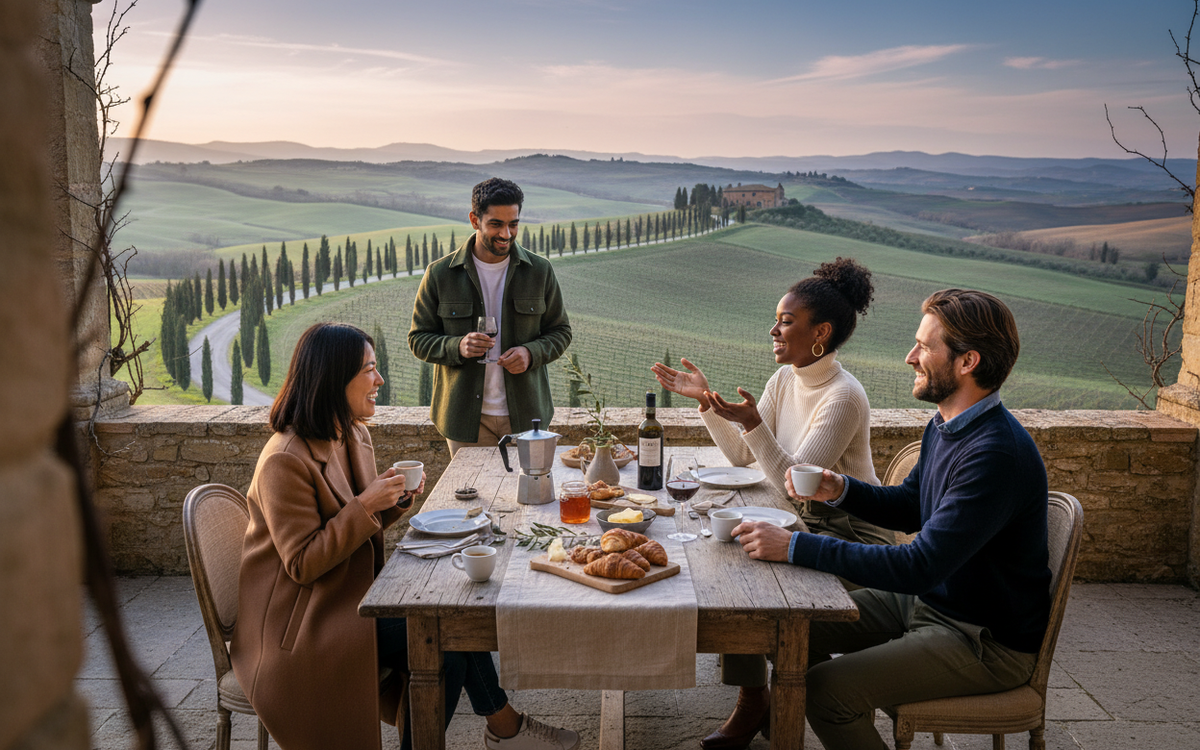
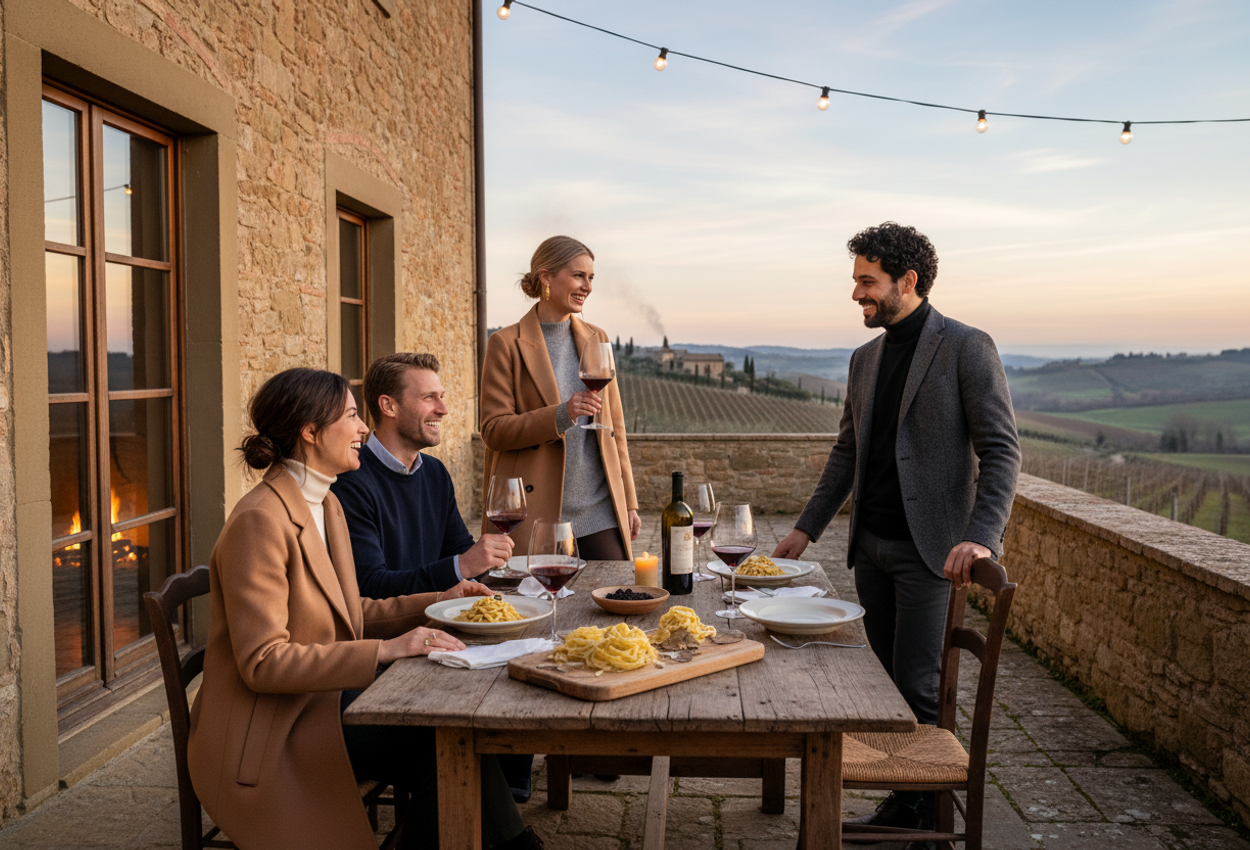
Dawn in Tuscany arrives like a whispered promise. The sky blushes from indigo to rose above the quilted hills of the Val d'Orcia, a landscape so archetypally Italian it feels almost imaginary. Inside a centuries-old stone villa on the sprawling estate of Castiglion del Bosco, A Rosewood Hotel, four friends wake slowly to the scent of freshly ground espresso and the distant chime of church bells from a hilltop village. Sunlight filters through linen curtains, casting dappled patterns across terracotta tiles that have absorbed generations of footsteps and stories.
Outside, the air is cool and damp, laced with the earthy perfume of cypress trees and dew-burnished grass. A staff member lays out breakfast beneath a pergola wrapped in dormant winter vines: flaky cornetti, still warm from the oven, local honey thick as amber, and pale slices of pecorino that smell faintly of hay. Someone presses the moka pot into a friend’s hands and insists they take the first pour. At the far edge of the estate, rows of vines contour the hillsides in disciplined lines, waiting for spring’s green flare. Here in early February, the colors are subtle and elegant: sage and stone, silver olive leaves, the soft beige of bare fields.
Traveling here with friends rather than a partner shifts the energy of the place. The villa’s multiple bedrooms mean there is no need to negotiate over who gets the better view; everyone wakes with their own little frame of Tuscany at the window. In the spacious living room, where a fire crackles beneath old wooden beams, a long farmhouse table becomes the stage for slow, meandering breakfasts and late-night card games. Laughter rises to meet the hanging copper pots, and even silence feels companionable, each person tucked into their own corner with a book or journal, united by the easy comfort of simply being together.
By mid-morning, the group climbs into a waiting Land Rover for one of the region’s most sensual rituals: truffle hunting. The car winds through the estate’s 5,000-acre expanse, past skeletal vines and stands of oak, until it reaches a pocket of woodland where the ground is a carpet of leaves. Here, a local truffle hunter greets them with a grin and a shaggy lagotto romagnolo who can barely contain its excitement. There are no other tourists in sight; only the scrape of boots on soil, the sharp, green scent of crushed herbs underfoot, and the occasional burst of birdsong.
As they follow dog and guide into the forest, small conversations bloom and overlap: one friend confesses a fear of changing careers, another admits to feeling unexpectedly lonely after moving in with a partner in a new city. The setting, with its filtered light and scent of damp earth, seems to invite honesty. When the dog suddenly begins to paw furiously at the ground, everyone huddles close, watching as the hunter gently parts soil to reveal a knobbly black truffle. It smells of musk and mystery, a concentrated essence of the forest itself. Passing it hand to hand, they marvel at how something so unassuming can hold so much flavor, much like the quiet but powerful bonds between them.
Later, in a sunlit kitchen that smells of garlic and toasted breadcrumbs, the group ties on matching aprons for a private cooking class. A local chef, flour dusting her forearms like chalk, guides them through the architecture of regional dishes. Together they knead dough for pici, the thick hand-rolled pasta of the region, laughing as some strands emerge alarmingly uneven. The truffles they unearthed that morning are shaved in delicate curls over creamy scrambled eggs and tossed with butter and sage through the steaming pasta. The flavors are at once simple and decadent: yolk-rich noodles with a pleasant chew, the truffle’s deep, foresty hum, the brightness of just-picked parsley. As they eat, cheeks flushed from the kitchen’s heat and a generous pour of Brunello, someone raises a glass to their younger selves, who once survived on takeaway pizza and cheap wine. This, they agree, is their grown-up version of romance.
Afternoons unwind slowly at Castiglion del Bosco. Some wander the restored borgo, pausing in the little church with its centuries-old fresco, where votive candles flicker in the dimness like quiet hopes. Others stroll along gravel paths lined with cypress trees, the air carrying faint notes of woodsmoke and rosemary from nearby kitchens. For those who wish, there is the estate’s private golf course, undulating across the hills like a green ribbon, or a wine tasting in vaulted cellars where Brunello di Montalcino slumbers in oak barrels, absorbing the character of both soil and time.
Evenings belong to the kind of connection that is rarely possible in the fractured hours of ordinary life. Back at the villa, the group gathers beneath a sky pricked with winter stars. A private chef plates delicate tortelli filled with ricotta and lemon, drizzled with browned butter and sage, followed by bistecca grilled over embers until its edges char and its center blushes ruby. The conversation flows as freely as the wine, circling past relationships, future dreams, and long-forgotten stories from their student days. When one friend admits to a lingering heartbreak, the others fall quiet, then offer not platitudes but presence: a hand on an arm, a silent shared understanding that love’s hardest chapters are easier when read aloud together.
This is Italy remade not as a backdrop for couples but as a canvas for collective memory. The villa’s long hallways hold the echo of their footsteps, the kitchen remembers their flour-dusted laughter, and the surrounding hills keep the imprint of their early-morning walks. When they finally leave, driving away along roads that twist between vineyards and umbrella pines, they carry with them not just photos of Tuscan sunsets but proof that romance can be a table filled with friends, a pot of espresso shared at dawn, and a forest floor disturbed by the joyful scramble of a truffle dog and four humans who traveled here to remind one another what home feels like.
Bali Bliss: Temples, Beaches, and Shared Spirituality
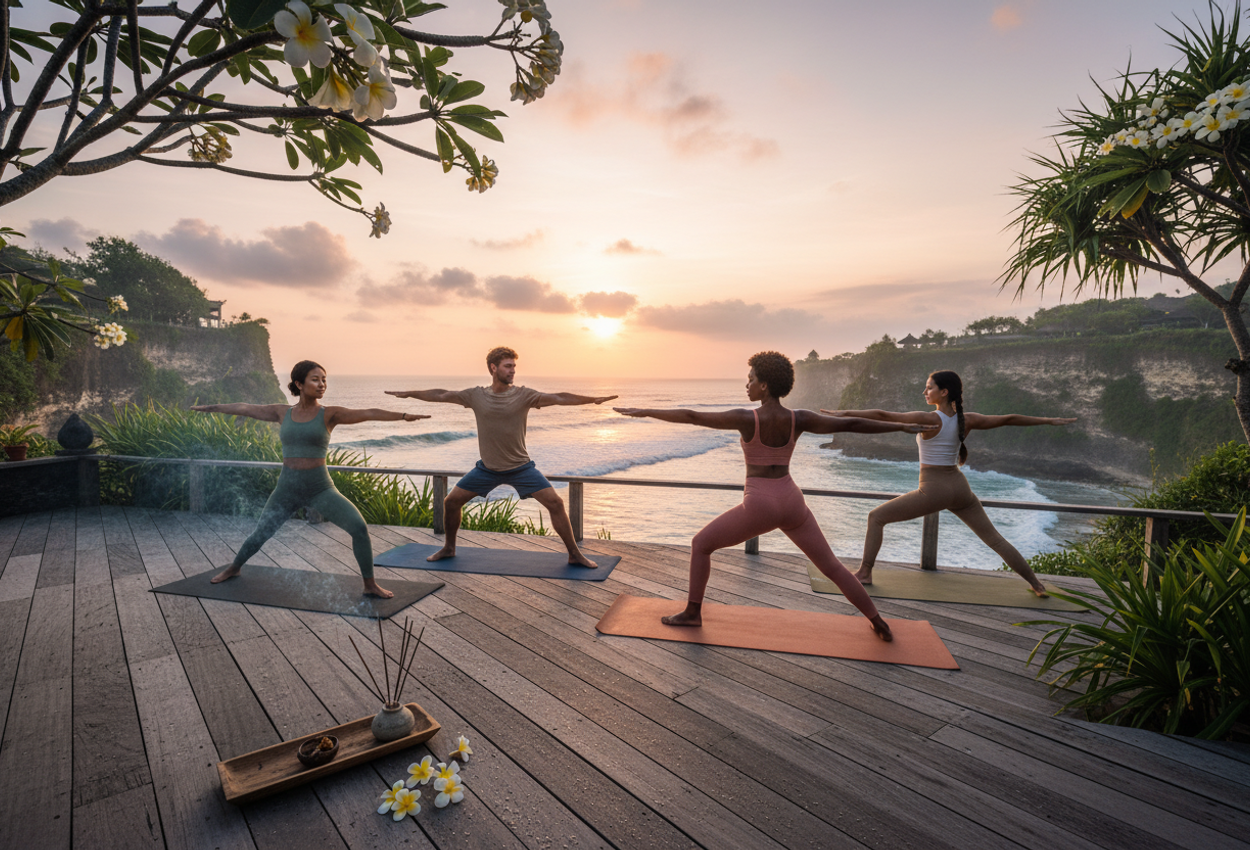
In the golden hour before sunrise, the cliffs of Uluwatu on the southern tip of Bali glow like embered stone. Far below, the Indian Ocean breathes in slow, powerful swells, its surface bruised purple and silver. On a wide wooden deck at Uluwatu Surf Villas, overlooking the break that surfers dream of, a small group of friends steps barefoot onto yoga mats still cool with night air. The shala is open to the elements: overhead, a thatched roof; around them, a tangle of palm fronds and frangipani trees; in front, nothing but air and ocean.
The instructor’s voice is soft but steady as the class moves through sun salutations. The scent of incense curls lazily through the salty air, mingling with the faint sweetness of blooming flowers. One friend, who arrived on the island feeling frayed at every edge, notices the moment their breath begins to synchronize with the group’s. Hands press into the grain of the wood, muscles heat gently, and a sense of shared presence settles over them like a warm shawl. When they rise into warrior pose, facing the horizon, the first gold line of sun splits the sea, and a murmur ripples through the class. It feels, in that suspended breath, like standing at the threshold of something quietly profound.
Days in Bali flow with a rhythm that encourages both exhilaration and introspection. After yoga, the group wanders up to breakfast at Mana, the on-site restaurant, where bowls of tropical fruit gleam like jewels: dragon fruit stained a shocking magenta, mango soft as custard, papaya perfumed and orange. There is thick Balinese coffee, its aroma deep and chocolatey, and plates of nasi goreng crowned with crispy shallots and a perfect fried egg. The friends linger over their meal, tracing the arc of the day ahead: a temple ceremony, a surf lesson, perhaps a visit to a rice terrace that has been dancing across their social feeds for years.
Mid-morning, they drive across the Bukit Peninsula to the famed Uluwatu Temple, perched on a cliff edge that seems to dissolve into sky. The air here is heavier with incense and the sharp tang of the sea. Monkeys scamper along the pathways, their quick hands reaching toward any unsecured bag or snack, while local guides keep a watchful eye. The group wraps sarongs around their waists, the fabric cool against sun-warmed skin, and follows a priest into a small courtyard where offerings of marigold and frangipani petals, nestled in palm-leaf baskets, are arranged with meticulous care. As they bow their heads to receive a splash of holy water and a few grains of rice pressed to their foreheads, a hush settles over them that has nothing to do with obligation and everything to do with awe.
From Uluwatu, the island’s spiritual pulse draws them inland to Ubud, where the air smells of rain-soaked earth and woodsmoke. Here, at the Sacred Monkey Forest Sanctuary, banyan trees drape their roots over moss-covered statues, and narrow stone bridges cross ravines lined with ferns. The chatter of macaques is constant, curious eyes peering from every branch. Walking the shaded paths, the friends find themselves speaking in quieter tones, as if the forest itself is listening. One admits to a long-held anxiety that has knotted their chest for years; another shares a new sense of peace they cannot yet fully explain. The monkeys, indifferent to human revelations, leap from trunk to trunk, but for the friends, the act of saying these things aloud in a place that feels both ancient and alive is its own kind of release.
Adventure here is never far from contemplation. One day is dedicated to white-water rafting on the Ayung River, where the water is the color of steeped tea and stone walls rise dramatically on either side. The raft bounces over rapids that send spray into their faces, shrieks of laughter ricocheting off rock. Between bursts of adrenaline, the river widens and stills, revealing carved reliefs in the rock faces and overhanging vines that trail their fingers in the current. In these quieter stretches, they drift side by side, paddles resting, watching kingfishers dart in electric flashes of blue, the air cool and damp against sunburned shoulders.
Nights in Bali are reserved for hedonistic softness. Back in Uluwatu, the group books a collective spa ritual: a series of massages and flower baths that begin with a foot scrub scented with lemongrass and lime. In dim treatment rooms, the hum of the ceiling fan mingles with gamelan music playing softly in the background. Skilled hands knead travel-tired muscles, tracing the map of each person’s stress. One friend, who has always found it difficult to accept touch without flinching, feels their body finally exhale. Later, submerged in tubs filled with warm water and an improbable number of rose and frangipani petals, they tilt their heads back and watch as steam clouds the air, petals sticking playfully to shoulders and hair. It is impossible to take oneself too seriously while wearing a crown of floating flowers, and that, they agree, is precisely the point.
Evenings bring the group to cliff-side bars and beach cafés where live bands play under strings of fairy lights. At Single Fin in Uluwatu, they sip cold Bintang beers and share plates of grilled fish slicked with sambal, the chili heat balanced by wedges of lime. Below, surfers carve lines into the last glassy waves of the day, their silhouettes backlit by a sun that melts orange and pink into the sea. The friends lean on the railing shoulder to shoulder, salt drying on their skin, muscles pleasantly heavy from yoga, surf, and river rapids. The conversation turns to what each has shed on this trip: old expectations, self-doubt, a lingering sense of being stuck. In their place, there is a new, quietly luminous sense of possibility.
On their final day, they drive north to the famed rice terraces of Tegallalang, a place that has graced countless screens but somehow still stuns in person. The terraces spill down the hillside in impossibly precise steps, each reflecting the sky in a thin meniscus of water. Farmers in wide-brimmed hats move slowly along the narrow paths, the rhythm of their work unchanged by the cameras pointed in their direction. The friends wander down into the terraces, sandals slipping in the mud, the air thick and warm against their skin. When they reach a spot where the view opens up in a staggering panorama of green, they sit together on a low wall and simply breathe.
Here, on a hillside carved by generations, they speak quietly about the future: about relationships they hope to nurture, boundaries they need to draw, ways they can carry the intentionality of this trip into the chaotic texture of everyday life. The wind lifts hair from damp foreheads, carrying the scent of wet earth and young rice. Somewhere nearby, a rooster crows, reminding them that for the people who live here, this is not a postcard but a daily reality. There is humility in that realization, and gratitude too, for the chance to have touched something so enduring with such tenderness.
When they finally leave Bali, boarding a red-eye at Ngurah Rai International Airport, their suitcases smell faintly of incense and frangipani oil, and their smartphones are heavy with photos. Yet what lingers most vividly are the moments with no cameras at all: the shared exhale in the yoga shala at sunrise, the quiet confession under banyan shade, the weightless laughter as their raft spun through rapids. In the island’s intricate dance of ritual and spontaneity, they have discovered a new kind of romance, one that has nothing to do with coupledom and everything to do with the sacredness of being fully seen by the people who know you best.
Japanese Journey: Tradition, Innovation, and Neon Nights
The first thing that strikes you about arriving in Tokyo with friends is not the neon. It is the sound. As the group steps out of Shibuya Station into the famous scramble crossing, they are swallowed by a living orchestra: the staccato click of shoes on asphalt, fragments of J-pop floating from storefronts, the melodic chirp of pedestrian signals, the murmur of thousands of conversations layered like a complex score. Above them, billboards flare to life in kaleidoscopic color, casting a soft glow over the river of people surging through the crossing from all directions.
Where romantic itineraries might favor quiet backstreets and candlelit restaurants, a friend-focused Tokyo adventure embraces the city’s full sensorial overload. The group begins its first night in Shinjuku, wandering narrow alleys of Omoide Yokocho where yakitori smoke hangs thick in the air and paper lanterns sway gently overhead. They squeeze onto stools in a tiny izakaya, knees brushing, as skewers of chicken thigh, shishito peppers, and shiitake mushrooms hiss on the grill inches from their faces. The chef, sleeves rolled to the elbow, calls out orders in a rhythmic chant while Asahi beers arrive beaded with condensation. They toast to surviving the flight, to finally making it to Japan together, to the invisible lines of fate that brought them all to the same table in this exact moment.
Later, they duck into a tucked-away sake bar, no larger than a generous walk-in closet, where shelves are lined with bottles from across the country. The owner, a quietly enthusiastic connoisseur, asks a few questions about their taste and mood before pouring small glasses of junmai daiginjo that smells faintly of melon and polished rice, then a richer yamahai with a nutty, almost savory depth. They pass each glass around the circle, comparing notes, the ritual of tasting becoming its own gentle game. Outside, the city hums, but inside this tiny room, the world contracts to the soft clink of ceramic cups and the particular pleasure of watching your friends fall in love with a flavor.
Morning brings a different Tokyo. The group rises early for a guided food walk through the area around the former inner market of Tsukiji, still very much alive with knife shops, small eateries, and stalls selling everything from dried seaweed to glossy, deep-red tuna. The air is cool and tinged with brine. They sample tamagoyaki, its layers sweet and silky; slurp miso soup flecked with clams; and stand shoulder to shoulder at a tiny sushi counter while a chef places perfect, glistening pieces of nigiri on a lacquered board in front of them. The tuna is buttery, the uni briny and almost custard-like, the rice warm and seasoned with such precision that they fall quiet without meaning to. One friend wipes away an unexpected tear, laughing as they do. There is something about sharing food this transcendent that feels almost vulnerable.
From the markets and back alleys of Tokyo, the group pivots toward the future at teamLab Borderless, the kind of digital art museum that seems designed precisely for friends to wander through together. Inside, walls dissolve into cascades of light, and floral projections bloom in response to movement. In one room, they wade ankle-deep through water while koi fish made of light dart around their feet. In another, they recline on a mirrored floor as stars swirl infinitely above and below. They reach for one another instinctively, hands tracing patterns in the air that ripple across projections. The experience feels simultaneously childlike and cosmic, a reminder that wonder is best amplified in the company of people who will not mock your gasp of delight.
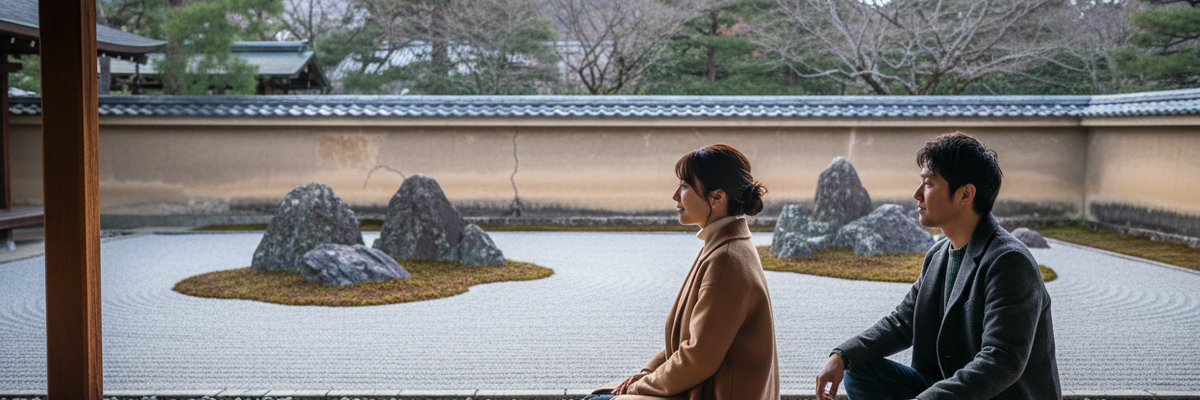
For all Tokyo’s futurism, the itinerary is laced with moments of stillness. One morning, the group travels to a quiet neighborhood for a traditional tea ceremony. They kneel on tatami mats in a room where every element, from the arrangement of a single flower to the curve of a ceramic bowl, has been considered. The tea master moves with practiced grace, cloth against porcelain whispering in the silence. As each friend receives a bowl of matcha, thick and jade green, they bow in gratitude, fingers brushing the warm clay. Drinking slowly, they feel time decelerate, anchored by the deliberate pace of the ritual. Later, outside beneath a stand of maple trees stripped bare by winter, they agree that this shared hush might be their favorite kind of intimacy.
The journey continues beyond Tokyo to Kyoto, where tradition is written into the very grain of the city. Here, narrow lanes in Gion are lined with wooden machiya houses, their latticed facades hinting at hidden worlds within. The friends stay in a ryokan where sliding shoji screens reveal tatami rooms and futons laid out with almost ceremonial precision. In the evening, they slip into yukata robes and pad softly to the communal bath. Steam curls up in opalescent swirls, bringing with it the mineral tang of the water. Lowering themselves into the onsen, they feel the day’s miles melt from their calves and shoulders. Conversation drifts from the trivial to the tender. Surrounded by strangers and yet wrapped in shared warmth, they speak about aging parents, shifting identities, the quiet fear of making the wrong choices. The water holds their confessions without judgment.
On another day, they rise before dawn to visit Fushimi Inari Taisha. The thousand vermilion torii gates flare vividly even in the soft, grey light, forming a tunnel that winds up the mountain. Early enough to beat most of the crowds, they walk in near-silence, the gravel crunching underfoot, the occasional crow cawing from the trees. Some sections of the path are steep, and they take turns setting the pace, pausing periodically to rest on stone steps cooled by the morning air. At a lookout point where the city spreads out below like a watercolor, they share thermos cups of convenience-store coffee and snacks, their breath small ghosts in the air. It is here, high above Kyoto, that one friend admits a profound doubt about the path they are on. There is no immediate solution, no neat answer, but there is a circle of people ready to sit with the discomfort, which is its own quiet form of solace.
Into this tapestry of tradition, the group threads moments that nod toward the future of travel itself. Drawing inspiration from the innovation swirling just across the water in places like Shenzhen, they seek out Tokyo’s high-tech quirks: a ramen restaurant where orders are placed via touchscreen and delivered with minimal human interaction; a café where drinks arrive courtesy of robot arms that glide along rails; an arcade in Akihabara where virtual reality headsets transport them into entirely invented worlds. In one particularly surreal evening, they book dinner at a restaurant famed for its robot performers and luminous, kinetic set pieces. The spectacle is outrageous, the food secondary, but what they remember later is how joyfully ridiculous they felt, shouting over the music, faces split with disbelieving grins.
Back in central Tokyo, a private shopping guide leads them through the gleaming boutiques of Ginza, where flagship stores stand like sculptural installations of glass and steel. They slip into quiet fitting rooms, trying on impeccably tailored coats and perfectly cut denim, emerging to the chorus of honest feedback that only old friends can provide. They discover small, independent shops tucked into side streets, where artisans sell hand-dyed scarves and delicate ceramics signed on the base. Each purchase becomes less about the item itself and more about the moment it marks: the afternoon light slanting down Ginza’s broad boulevards, the shared thrill of finding something that feels exactly like you.
On their final night, they return to the neon embrace of Tokyo, wandering once more through Shibuya. The crossing is a storm of motion, umbrellas blooming and closing, car lights streaking like ribbons. They find a small rooftop bar and step out into the chill air, city lights unfurling in every direction. As they clink glasses of highball whisky and grapefruit sours, they reflect on how this journey has reframed the idea of romance for them. There have been no couple’s photos under temple gates, no hearts carved into bamboo. Instead, there have been shared late-night convenience-store runs for onigiri and ice cream, communal jet lag in a tiny hotel room, and the quiet intimacy of learning how each friend moves through a foreign city: who charges ahead, who hangs back to read plaques, who always knows the way back to the train.
In a world that often equates romance with exclusivity, this trip has taught them that love can also be plural and expansive, painted in neon and traced in steam on ryokan windows. As they stand shoulder to shoulder above the city’s electric veins, they understand that the true souvenir they will carry home is not anything they bought or ate but the knowledge that, wherever they go next, they have found in each other the kind of enduring companionship that makes every journey feel like a love story.

South African Safari: Bonding in the Bush
From the moment the plane dips low over Cape Town, revealing the muscular silhouette of Table Mountain rising from the sea, it is clear that this trip will rearrange something fundamental. The city is a mosaic of color and texture: pastel houses stepping up the slopes of Bo-Kaap, the metallic glint of the V&A Waterfront, the white flare of waves collapsing against Camps Bay’s blonde sand. Arriving here as a group of friends feels like opening a book at the richest chapter, with everyone eager to underline different lines.
They begin in the city, taking the cable car up Table Mountain on a clear afternoon when the wind is brisk enough to sting cheeks. As the car glides upward, rotating slowly to offer 360-degree views, the city shrinks into a patchwork: glass towers clustered near the harbor, orderly rows of houses marching inland, the curve of the coastline roughened by surf. At the summit, the air is thinner and tinged with the faint, herbal scent of fynbos. The friends fan out along the pathways that snake over the plateau, pausing to photograph proteas blooming defiantly from rocky soil and to sit on stone outcrops where the world falls away beneath their feet. In the distance, the Atlantic gleams a deep, improbable blue. One friend, usually terrified of heights, confesses their fear as they inch toward the edge. The others flank them, a living guardrail, coaxing them forward with jokes and gentle encouragement until they are all standing together against the sky.
Back in the city, they wander through Bo-Kaap, where houses are painted in jubilant shades of turquoise, fuchsia, and lime. The air here smells of spice and laundry soap, and the cobblestone streets ring with the clatter of children playing soccer. A local guide leads them into a family kitchen where pots bubble with tomato-laced denningvleis and fragrant cape Malay curries. They chop onions, grind spices, and learn how recipes have been passed down through generations, surviving displacement and apartheid to become symbols of resilience. Around the table, as they tear into still-warm roti and spoon rich, aromatic sauce over rice, they listen to stories of the neighborhood’s history. The depth of what they are hearing presses in around the edges of their holiday glow, inviting them to bear witness rather than simply consume.
It is from this complex, beautiful city that they travel onward to the bush, boarding a small plane or driving hours inland to a private reserve where the air changes abruptly. Here, in the vastness of the South African wilderness, the sky feels closer, the horizon a clean line where earth and blue meet. Their lodge, booked through a specialist operator like Abercrombie & Kent, is both luxurious and intimately connected to its surroundings: thatched roofs that echo traditional architecture, decks that open onto sweeping views of savanna, plunge pools that seem to spill directly into the bush.
In the early morning, when the sky is still ink-dark and studded with stars, they wake to the gentle knock of a staff member bearing a tray of coffee and rusks. There is a chill in the air that bites at ankles and fingertips as they shrug into fleece jackets and climb into open safari vehicles, blankets pulled up to their chins. The engines purr to life, and they roll out into the pre-dawn hush, the headlights carving thin tunnels of light through tall grass. Slowly, the world begins to reveal itself: the silhouette of a giraffe stretched impossibly high against the paling sky, the quick flash of a jackal trotting through the brush, the liquid, descending notes of a nightjar’s call.
As the sun spills over the horizon, turning the grasses from slate to gold, they come upon a pride of lions sprawled in the road, their tawny bodies dusted with the day’s first light. The guide cuts the engine, and for a long moment, no one speaks. The lions yawn, baring teeth as white and sharp as polished bone, cubs batting lazily at one another’s tails. The only sounds are the click of camera shutters and the soft rustle of bodies shifting in the vehicle. One friend feels tears prick behind their eyes, overwhelmed by the proximity of such unfiltered life. A hand finds theirs in the half-light, squeezes once, then lets go, the quiet gesture saying more than any words could.
Mid-morning, they stop for coffee in a clearing where acacia trees throw spiky shadows on the ground. The ranger pours steaming coffee from a thermos and lays out a tray with rusks and amarula-laced hot chocolate. Standing there in the gentle warmth of the rising sun, mugs cupped in their hands, they exchange stories of what they have seen so far: the flash of a leopard’s tail disappearing into thicket, the improbable sight of a hippo trudging across open land, miles from any obvious water. The experience is both grounding and expansive, a reminder of how small they are and how intertwined all lives on this planet truly are.
Back at the lodge, afternoons are languid. They lounge on shaded decks as elephants shuffle past in small, deliberate herds, ears flapping slowly, trunks exploring the world with endless curiosity. Sometimes they gather at the edge of a waterhole, spraying themselves with muddy water while egrets hitch rides on their broad backs. The friends sit in respectful silence, the only sound the occasional clink of ice in a glass or the soft sigh of someone shifting in their chair. There is a profound comfort in simply watching life unfold at its own pace, free from human scheduling and screens.
As the heat begins to loosen its grip, they set out again for evening drives. The light at this hour is theatrical, slanting across the land in honeyed beams that pick out every blade of grass and twist of branch. They might find a rhino grazing, its prehistoric bulk outlined against the sky, or a dazzle of zebras standing so still they seem painted onto the landscape. At sunset, the guide chooses a lookout spot for sundowners, pouring gin and tonics over ice as the sky goes from gold to tangerine to indigo. The friends raise their glasses to the day, the quinine’s slight bitterness offset by the warm satisfaction of shared awe.
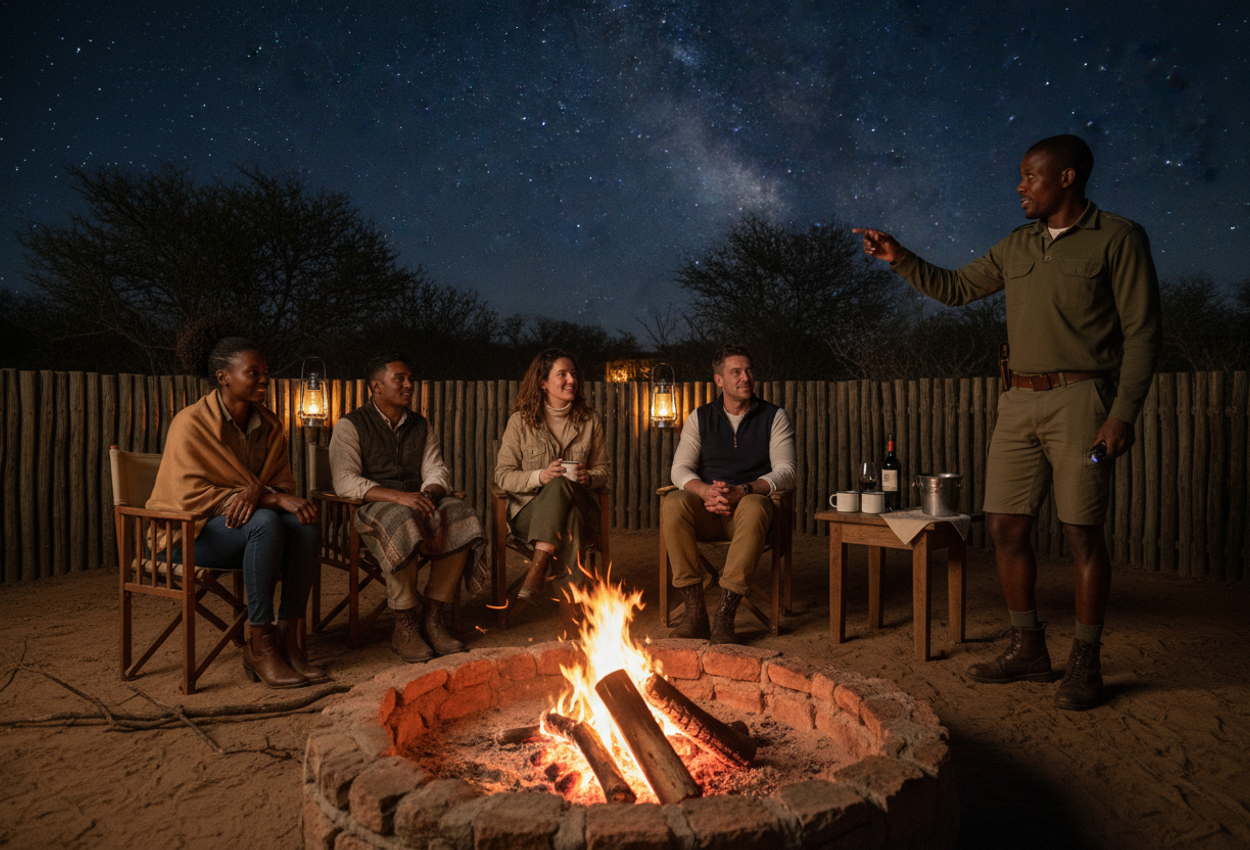
Evenings at the lodge revolve around the boma, a traditional circular enclosure where a fire burns steadily, sending sparks up to mingle with the stars. Lanterns cast a soft, flickering light over faces as they gather around low tables for dinner: grilled game meats scented with smoke, pap and chakalaka with a gentle burn of chili, salads bright with citrus and herbs. Between courses, they trade stories with guides and trackers, learning to identify constellations, animal tracks, and birds by call. It is here, under a sky so vividly crowded with stars it feels almost unreal, that conversations deepen in the way they so rarely do back home. One friend speaks haltingly about environmental grief; another shares the unexpected tenderness of watching their younger sibling become a parent. The fire cracks and pops; the night air cools against flushed cheeks. They feel, collectively, the fragile gift of being alive together in this exact place, on this exact night.
What elevates this journey from spectacle to something more meaningful is the chance to connect with the communities working to protect these landscapes. Through a visit arranged with A&K Philanthropy, the social impact arm of Abercrombie & Kent, the group spends an afternoon at a local conservation or education project. They might meet schoolchildren at a program that teaches environmental stewardship or visit a clinic supported by safari tourism funds. Listening to community leaders speak about the delicate balance between conservation and livelihood, the friends are confronted with the reality that the wild beauty they have been admiring is not an untouched Eden but a landscape shaped by history, politics, and human choices.
For one friend, who has long wrestled with questions about the ethics of long-haul travel, this visit is both uncomfortable and clarifying. Seeing concrete examples of tourism revenue funding education and healthcare does not erase the complexities, but it offers a model for what responsible, community-first travel can look like. On the drive back to the lodge, dust puffing up behind the vehicle in soft clouds, they speak about how they can better align their future trips with organizations that prioritize local voices.
On their final night, the lodge arranges a private dinner set slightly apart from the main boma. A long table is laid beneath a leadwood tree, lanterns hanging from its branches like captured stars. The tablecloth is crisp, the place settings gleaming, yet the soundtrack is pure wilderness: crickets, distant hyena whoops, the occasional low rumble that might be thunder or a lion far off in the dark. Between courses, the generator hums to a stop, and the world is briefly swallowed by darkness. In that pause, the friends sit in complete quiet, listening to the night enfold them. Someone reaches across the table, searching for another’s hand. When the lights flicker back on, there is a collective exhale, a small laugh, the spell softened but not entirely broken.
As they pack to leave the next morning, folding dust-stained clothes and tucking away memory cards full of images, they realize that the most indelible imprints of the trip are not the big-ticket wildlife sightings but the quieter, human moments: a shared blanket on a cold dawn drive, a whispered joke beside the fire, the way someone absentmindedly brushed a beetle off a friend’s shoulder without interrupting their sentence. In the wild expanse of the South African bush, they have discovered a kind of romance that feels less like escape and more like return—a coming home to themselves and to the people who have chosen, again and again, to walk beside them.