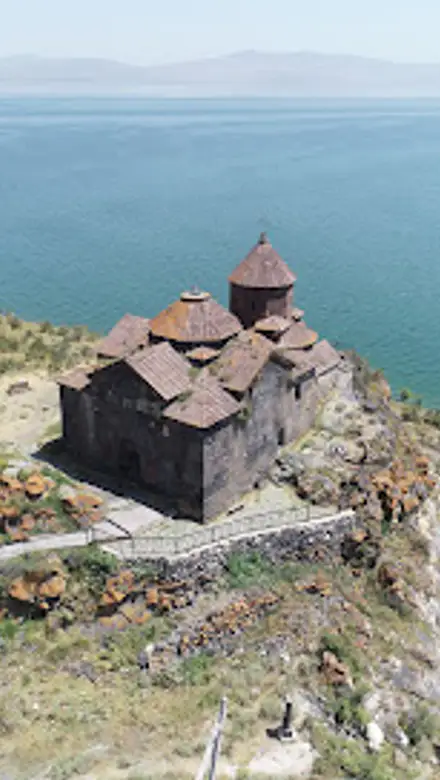
Hayravank Monastery Travel Guide
Free Guide: Discover Hayravank Monastery: A historic Armenian treasure on Lake Sevan's shore, offering stunning views and a glimpse into medieval architecture.


A brief summary of Hayravank Monastery
Discover Hayravank Monastery: A historic Armenian treasure on Lake Sevan's shore, offering stunning views and a glimpse into medieval architecture.
Hayravank Monastery, dating back to the 9th-12th centuries, sits on the southwestern shores of Lake Sevan in Armenia. This historic complex, comprised of a church, chapel, and gavit, offers visitors a glimpse into Armenia's rich religious and architectural past, complete with stunning views of the expansive lake.
- Address
- C4M5+36M, Hayravank
Getting there
Car
Public Transport
Walking
Discover more about Hayravank Monastery
Overview
Perched on a rocky promontory along the southwestern shores of Lake Sevan, Hayravank Monastery is a testament to Armenia's enduring spiritual and architectural heritage. Dating back to the 9th to 12th centuries, this monastic complex offers a serene escape with panoramic views of Lake Sevan, one of the largest high-altitude lakes in the world. The monastery complex includes the St. Stepanos Church, a chapel, and a gavit (a type of narthex), showcasing distinctive Armenian architecture. The oldest structure, St. Stepanos Church, features a unique quatrefoil cruciform design with a square-based central dome, constructed from black limestone in the late 9th century. A small chapel was added in the 10th century, followed by the addition of the gavit in the 12th century, distinguished by its two thick columns and an octagonal domed cupola. The use of local basalt stone gives the structures a dark hue that contrasts beautifully with the azure waters of Lake Sevan.Surrounding the monastery are numerous khachkars (traditional Armenian cross-stones) and gravestones, remnants of a small cemetery. Archaeological excavations in the area have unearthed artifacts from the Bronze and Iron Ages, indicating a settlement existed here long before the monastery. According to legend, Hayravank was once connected to Spitak Berd Castle by underground tunnels. Another legend tells the story of a monk named Hovhan who, during an invasion by Tamerlane's troops in the 14th century, miraculously walked across the lake, convincing Tamerlane to spare those who could fit within the monastery walls.While monastic life ceased in the 19th century, the monastery was renovated in the 1980s and opened to the public. Today, visitors can explore the ancient prayer halls, examine intricate stone carvings, and soak in the peaceful atmosphere.
Evendo Review Centre
 Google
Guest reviews
Explore Hayravank Monastery on the map
A handpicked selection of must-see spots near Hayravank Monastery, mapped for you.
Get your free copy of our complete guide to Hayravank Monastery, delivered straight to you.
Everything on this page, from opening hours and how to get there to Eve’s tips and the best time to go, in one PDF you can read offline, print or share.
Already have an account? Sign in
Your Hayravank Monastery guide is ready.
We'll send it to · Not you? Sign out

Getting your guide ready…
We are putting together a fresh copy of the Hayravank Monastery guide. This can take up to a minute.
This can take a few moments. If your browser asks, choose Allow so the download can start. You'll find the guide in your Downloads folder.
Nothing happened? Download it again
Sorry, the guide is taking longer than usual. Please try again in a minute, or get it by email instead.
Unlock the best of Hayravank Monastery
Skip-the-line tickets, guided tours with entry, and walking tours of the area, booked in a few clicks.
 Tour with entry
Group Tour: Lake Sevan, Hayravank, Noratus, Jermuk, winery
from $48.45 Tour with entry
Private tour to Lake Sevan, Noratous, Hayravank, Sevanavank
from $114.00 Tour with entry
Holy Places of Highland Sevan
from $133.00 Tour with entry
Lake Sevan, Hayravank, Noratus, Selim Pass, Jermuk, Areni
from $166.25
Other nearby places you may find interesting
The closest places of the same kind, if this one is not quite what you had in mind.
-
-
-
-
-


Swipe for more places
More to explore near Hayravank Monastery

 Best experiences near Hayravank Monastery
 Best hotels near Hayravank Monastery
 Best landmarks near Hayravank Monastery
 Best attractions near Hayravank Monastery
 Best shops near Hayravank Monastery
 Best restaurants near Hayravank Monastery
 Best bars near Hayravank Monastery
Do you manage this location?
Take control to get all the benefits, like improved information, better appearance, and stronger visibility across AI-powered discovery.
Explore more

Explore more of Lake Sevan
Discover the natural beauty of Lake Sevan, Armenia's largest lake, surrounded by mountains, ancient monasteries, and offering a variety of water sports and cultural experiences.
Explore Lake Sevan
Explore more of Armenia
Explore Armenia's ancient wonders, vibrant cities, and breathtaking landscapes. From historic monasteries to delicious cuisine, there's something for every traveler.
Explore Armenia