Voderup Klint Travel Guide
Free Guide: Terraced sea cliffs, quiet pastures and sweeping Baltic views make Voderup Klint one of Ærø’s most striking natural landscapes for walks, picnics and sunsets.


A brief summary of Voderup Klint
Terraced sea cliffs, quiet pastures and sweeping Baltic views make Voderup Klint one of Ærø’s most striking natural landscapes for walks, picnics and sunsets.
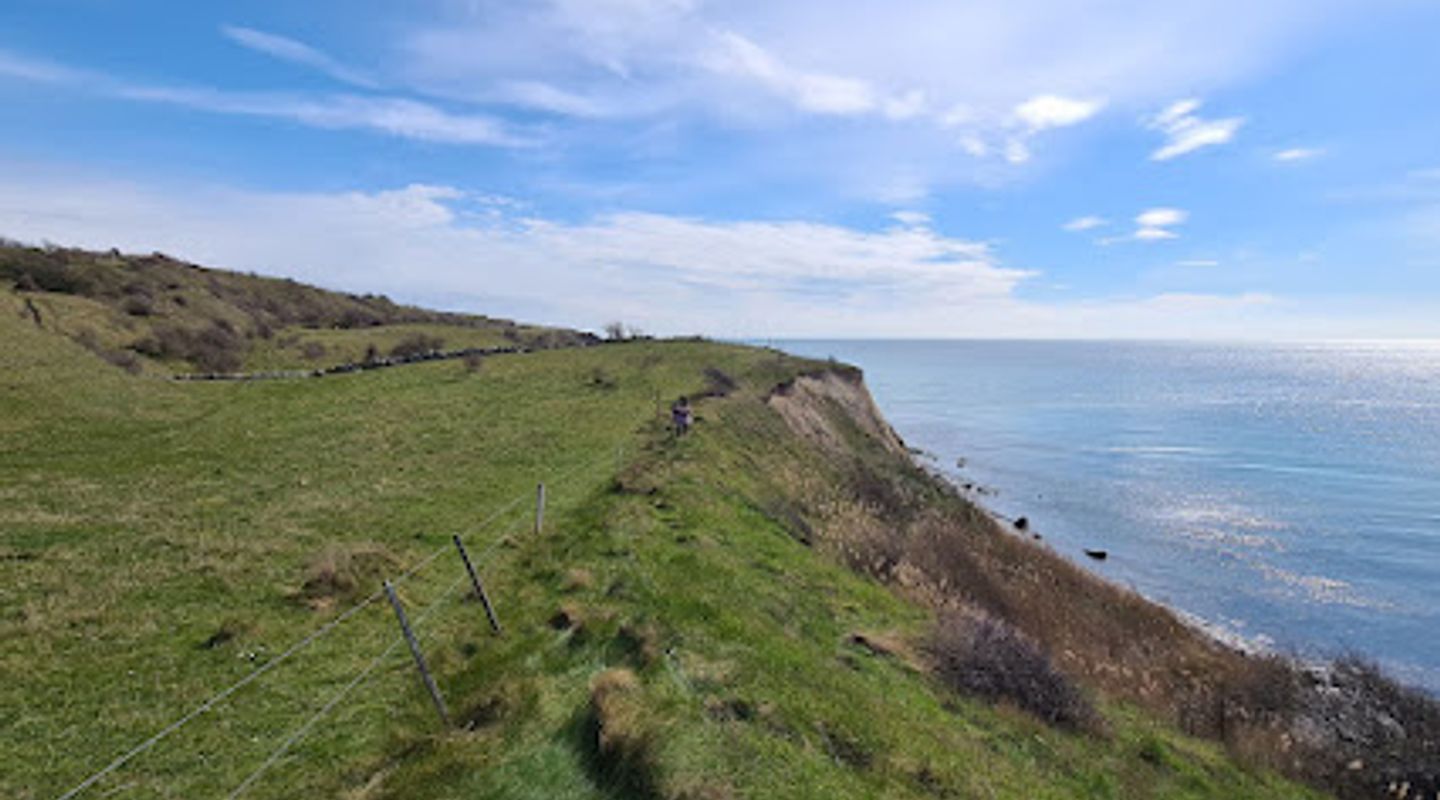
Voderup Klint is a dramatic 3–3.5 km stretch of stepped sea cliffs on the south coast of Ærø, rising up to around 30–33 m above the Baltic. Terraced clay slopes, green pastures and grazing cattle create a striking, almost amphitheatre-like landscape where land seems to tumble slowly into the sea. Protected for its special geology and sweeping archipelago views, it’s one of Ærø’s signature spots for coastal walks, photography, picnics and sunset watching in quiet, wide‑open surroundings.
On-site amenities
 Trash bins
 Information boards
 Seating areas
Opening hours
- Every dayOpen 24 hours
Opening hours as listed on the venue’s Google Business Profile. Hours can change for services and special events, so check with the venue before you go.
- Address
- Mølledamsvej 1, 5970 Ærøskøbing
- Website
Getting there
Car from Ærøskøbing
Bicycle from Ærøskøbing
Bus and short walk on Ærø
Discover more about Voderup Klint
Stepped cliffs on Ærø’s wild south coast
Voderup Klint forms one of the island’s most memorable landscapes: a band of clay cliffs stretching roughly 3–3.5 km along Ærø’s southern shore and rising to about 30–33 m above sea level. Here the coast appears to descend in huge natural terraces, with broad grassy ledges breaking up the drop towards the water. From the top edge of the klint the Baltic Sea opens wide, dotted with small islands of the South Funen Archipelago on clear days.Despite its scale, Voderup Klint feels intimate and pastoral. Sheep and cattle often graze the slopes, keeping the grass cropped and emphasising the step-like form. Narrow paths lead down through the meadows, giving you the sensation of slowly walking through layers of the landscape rather than simply descending a cliff.
Geological story written in clay and ice
The unusual terraces at Voderup Klint are the result of the last Ice Age and the slow movements of clay-rich ground afterwards. Layers of glacial deposits were pushed and folded by advancing ice, then later slipped seaward as the coastline adjusted to rising sea levels. The result is this giant natural staircase, where bands of clay and sediment are clearly visible in the exposed faces.The area is protected both for its geology and for the way it illustrates the "drowned" Ice Age landscape that characterises the South Funen Archipelago. Standing on one of the middle terraces, you can trace the lines of former shorelines and picture how the island once extended further before the sea flooded low-lying areas. In winter and after rain, the clay can become slick and sticky, a reminder that these cliffs are still slowly evolving.
Walking routes and coastal viewpoints
Voderup Klint is best experienced on foot. Simple farm tracks and footpaths run along the upper edge, connecting gates that lead down across the stepped slopes. From the top, viewpoints open west and east along the coast, making it easy to find quiet spots to sit in the grass and watch the changing colour of the sea and sky.A signed local walking route links the cliff with surrounding fields and small lanes, allowing circular hikes of 3–8 km depending on how far you wander. Down on the lower terraces you feel close to the surf, with waves rolling in just below. Higher up, skylarks and seabirds provide most of the soundtrack, broken only by distant tractor noise from inland farms.
Atmosphere of open skies and quiet pastures
The setting at Voderup Klint is distinctly rural. Approaches pass hedgerows, wind-bent trees and scattered farmsteads before the land suddenly breaks away to reveal the sea. On sunny days the terraces glow green against deep blue water; in mist or low cloud the cliffs take on a softer, moody character, with the steps fading into grey.Because the coastline faces broadly south, the area can feel pleasantly warm and sheltered on calm days, with sunlight lingering long into the evening in summer. Sunsets can be particularly impressive, with the low light carving strong shadows across each terrace. Even in windier weather there is usually a ledge or hollowness where you can tuck in behind an old earth bank or grazing fence.
Planning your visit on Ærø
Voderup Klint is free to access and open at all hours, making it easy to combine with other explorations of Ærø’s villages and beaches. There are no built-up facilities directly at the cliff, so visitors should come prepared with water, snacks and appropriate footwear for grassy, sometimes muddy slopes. Simple benches or rocks offer natural resting points, and several spots on the upper edge work well for a picnic blanket.The terrain is gently to moderately steep rather than extreme, but the ground can be uneven and the descent to the lower terraces is not suitable for all mobility levels. Families with children can still enjoy the upper viewpoints, while more active walkers can continue down to explore the full "staircase" of the klint and follow the coast for as long as they wish.
Evendo Review Centre
 Google
Guest reviews
Best time to go
Quietest: Jan, Feb & Dec · before 8am or from 10pm
Busy times are Evendo estimates for a typical year, to help you plan. Actual crowds vary with events, school holidays and the weather.
Explore Voderup Klint on the map
A handpicked selection of must-see spots near Voderup Klint, mapped for you.
Get your free copy of our complete guide to Voderup Klint, delivered straight to you.
Everything on this page, from opening hours and how to get there to Eve’s tips and the best time to go, in one PDF you can read offline, print or share.
Already have an account? Sign in
Your Voderup Klint guide is ready.
We'll send it to · Not you? Sign out

Getting your guide ready…
We are putting together a fresh copy of the Voderup Klint guide. This can take up to a minute.
This can take a few moments. If your browser asks, choose Allow so the download can start. You'll find the guide in your Downloads folder.
Nothing happened? Download it again
Sorry, the guide is taking longer than usual. Please try again in a minute, or get it by email instead.
Other nearby places you may find interesting
The closest places of the same kind, if this one is not quite what you had in mind.
-
-
-
-
-


Swipe for more places
More to explore near Voderup Klint

 Best experiences near Voderup Klint
 Best hotels near Voderup Klint
 Best landmarks near Voderup Klint
 Best attractions near Voderup Klint
 Best shops near Voderup Klint
 Best restaurants near Voderup Klint
 Best bars near Voderup Klint
Do you manage this location?
Take control to get all the benefits, like improved information, better appearance, and stronger visibility across AI-powered discovery.
Explore more

Explore more of Langeland
Discover Langeland: Denmark's idyllic island retreat with scenic landscapes, rich history, and vibrant culture. Perfect for nature lovers, history buffs, and festival goers.
Explore Langeland
Explore more of Denmark
Discover Denmark: A perfect blend of history, modern design, and the cozy concept of hygge. Explore vibrant cities, serene landscapes, and world-class cuisine.
Explore Denmark