

Halsted Priory Travel Guide
Free Guide: A serene former Benedictine priory turned manor estate, where church, park and farmland quietly reveal centuries of Danish religious and aristocratic history.


A brief summary of Halsted Priory
A serene former Benedictine priory turned manor estate, where church, park and farmland quietly reveal centuries of Danish religious and aristocratic history.
Halsted Priory, just outside Nakskov on the Danish island of Lolland, is a historic manor estate with roots in a 12th‑century Benedictine monastery. Today the whitewashed main house, medieval church and landscaped park form a tranquil rural ensemble overlooking fields and the nearby fjord. While the manor buildings remain private, visitors can wander the public churchyard and surrounding grounds, piecing together a thousand years of religious, royal and aristocratic history in a quietly atmospheric corner of southern Denmark.
On-site amenities
 Restrooms
 Seating areas
 Trash bins
 Information boards
- Address
- 4900 Nakskov
- Phone
- Website
Getting there
Car from Nakskov town centre
Bicycle from Nakskov and western Lolland
Regional bus within Lolland
Discover more about Halsted Priory
Monastic beginnings on the edge of Lolland
Halsted Priory, or Halsted Kloster, began life in the Middle Ages as a small Benedictine house close to the shores of Nakskov Fjord. From the late 12th and 13th centuries, monks cultivated the fertile Lolland soil, managed farmland and offered spiritual care to the surrounding community. The location was strategic as well as peaceful: near trading routes across the Baltic but sheltered in a rural pocket of woodland, fields and wetlands.The priory’s early wealth and influence came from royal patronage. For centuries the estate was part of the Danish Crown’s holdings, reflecting the close ties between church and monarchy. Traces of this first religious phase survive mainly in the relationship between the estate and nearby Halsted Church, whose Romanesque core dates from the same period and hints at the original stone architecture that once dominated this landscape.
Fire, reformation and the rise of a manor
In the early 1500s Halsted’s peaceful rhythm was abruptly broken. During a raid in 1510, forces from the Hanseatic League attacked Nakskov and then moved up the fjord, burning parts of the priory and damaging its ranges. The violence foreshadowed the upheavals of the Reformation, which reached Denmark in the 1530s and brought monastic life here to a definitive close.After the Reformation the Crown took full control and gradually transformed Halsted from religious house to secular manor. Buildings were adapted for noble residence, agricultural management and storage rather than communal monastic life. Over succeeding centuries, noble families reshaped the complex, adding new wings, rebuilding in changing styles and laying out gardens that still define the estate’s character today.
Architecture framed by parkland and church
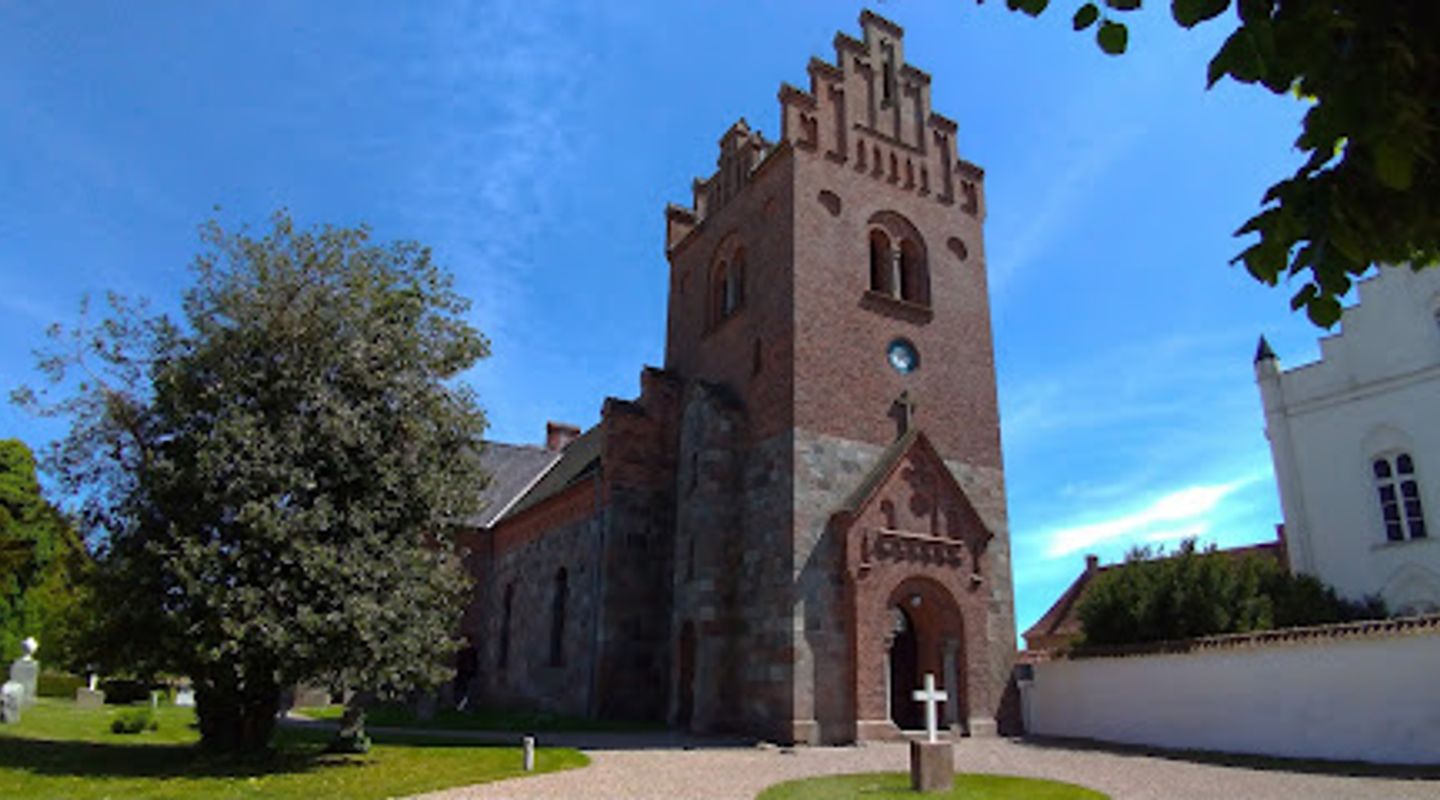
The present main house reflects this layered history. A dignified, whitewashed manor with historicist touches, it blends older structural cores with later 18th and 19th‑century alterations. Rather than a single showpiece facade, the impression is of a lived‑in country seat, with courtyards, service buildings and barns hinting at the estate’s working agricultural role.Set slightly apart, Halsted Church forms an essential part of the ensemble. Its Romanesque nave and chancel in granite, a later burial chapel from the 1600s and a 19th‑century tower together trace six hundred years of Danish church architecture. The churchyard, with family graves and mature trees, overlooks fields that once belonged entirely to the priory, reinforcing the sense of continuity between medieval spirituality and manor‑house piety.
A quiet landscape of paths, lawns and water
Much of the appeal for visitors lies outdoors. The estate is wrapped in a landscape of lawns, old trees and gently undulating farmland typical of western Lolland. From the park you sense the proximity of Nakskov Fjord and the wider Baltic, even when the water itself remains out of sight behind hedgerows and fields. In spring and summer, birdsong, flowering borders and the rustle of leaves dominate the soundscape.Public access focuses on the church, churchyard and surrounding parkland, offering a chance to stroll, sit on a bench and absorb the atmosphere of a long‑established estate. Without large interpretive installations, it is a place that rewards a slower pace: you imagine monks crossing these grounds, later estate workers heading to the fields, and carriages arriving for manor gatherings under the same canopy of trees.
Experiencing Halsted today
Halsted Priory remains a private manor, and the main residential buildings are not open for interior visits. This limited access shapes the experience; it feels more like encountering a living historic estate than touring a museum. Visitors typically combine a walk here with time in Nakskov or along the fjord, using the priory as a peaceful cultural stop in a wider exploration of Lolland.The mood is contemplative rather than dramatic. There are no grand ticket halls or crowds, just a sense of layered history anchored by the church and the dignified manor silhouette. For travelers interested in Danish religious heritage, rural architecture and quiet landscapes, Halsted Priory offers a gentle but evocative window into how monasteries evolved into manorial estates and how that story still shapes the countryside of southern Denmark.
Evendo Review Centre
 Google
Guest reviews
Best time to go
Quietest: Jan, Feb & Mar · before 8am or at 7pm
Busy times are Evendo estimates for a typical year, to help you plan. Actual crowds vary with events, school holidays and the weather.
Explore Halsted Priory on the map
A handpicked selection of must-see spots near Halsted Priory, mapped for you.
Get your free copy of our complete guide to Halsted Priory, delivered straight to you.
Everything on this page, from opening hours and how to get there to Eve’s tips and the best time to go, in one PDF you can read offline, print or share.
Already have an account? Sign in
Your Halsted Priory guide is ready.
We'll send it to · Not you? Sign out

Getting your guide ready…
We are putting together a fresh copy of the Halsted Priory guide. This can take up to a minute.
This can take a few moments. If your browser asks, choose Allow so the download can start. You'll find the guide in your Downloads folder.
Nothing happened? Download it again
Sorry, the guide is taking longer than usual. Please try again in a minute, or get it by email instead.
Other nearby places you may find interesting
The closest places of the same kind, if this one is not quite what you had in mind.
-
Labyrint Lolland-Falster Lose yourself in a leafy forest maze where quiz clues, gentle trails and fresh Lolland-Falster air turn getting lost into an easygoing family adventure.
-
Evolution Museet World-class real dinosaur fossils and a 300-million-year journey through evolution, set inside Denmark’s Knuthenborg Safaripark on the island of Lolland.
-
Lupinmark A seasonal sea of lupins turning the Lolland farmland into a vivid carpet of color, perfect for a peaceful countryside pause and striking photographs.
-
Skelsnæs-pavillionen A restored 1822 forest pavilion on a lakeside promontory in Naturpark Maribosøerne, offering peaceful picnic shelter amid historic woods and bird‑rich waters.
-
Relic of the Castle Revshale Subtle grassy earthworks on Borgø Island where a forgotten royal fortress, fierce 13th‑century battles and the serene Maribo Lakes Nature Park meet.
Swipe for more places
More to explore near Halsted Priory

 Best experiences near Halsted Priory
 Best hotels near Halsted Priory
 Best landmarks near Halsted Priory
 Best attractions near Halsted Priory
 Best shops near Halsted Priory
 Best restaurants near Halsted Priory
 Best bars near Halsted Priory
Do you manage this location?
Take control to get all the benefits, like improved information, better appearance, and stronger visibility across AI-powered discovery.
Explore more
Explore more of Lolland
Discover Lolland, Denmark's tranquil island retreat, offering lush landscapes, historic sites, and delightful local cuisine for an unforgettable escape.
Explore Lolland
Explore more of Denmark
Discover Denmark: A perfect blend of history, modern design, and the cozy concept of hygge. Explore vibrant cities, serene landscapes, and world-class cuisine.
Explore Denmark
