

Fredericia Vold Travel Guide
Free Guide: Northern Europe's best-preserved fortress ramparts, where 370 years of Danish military history meets urban parkland.


A brief summary of Fredericia Vold
Northern Europe's best-preserved fortress ramparts, where 370 years of Danish military history meets urban parkland.
Fredericia Ramparts is one of northern Europe's best-preserved fortress fortifications, encircling the historic city center with earthen ramparts, bastions, and defensive structures built between 1650–1660. Originally commissioned by King Frederik III as a strategic military stronghold, the ramparts now form one of Denmark's largest urban parks, offering scenic walking trails, historical monuments, cannons, and panoramic views of the Little Belt. The site blends military heritage with peaceful green spaces, making it both a historical landmark and a relaxing recreational destination.
On-site amenities
 Restrooms
 Drink options
 Food options
 Seating areas
 Picnic areas
 Trash bins
 Information boards
Opening hours
- Every dayOpen 24 hours
Opening hours as listed on the venue’s Google Business Profile. Hours can change for services and special events, so check with the venue before you go.
- Address
- Nørre Voldgade 18, 7000 Fredericia
- Website
Getting there
Train
Car
Bus
Cruise Ship
Discover more about Fredericia Vold
A Fortress Born from War and Royal Vision
Fredericia Ramparts stand as a testament to 17th-century military strategy and royal ambition. King Frederik III commissioned their construction in 1650 following the devastation of the Thirty Years' War, which had left Jutland largely unfortified and vulnerable to invasion. The fortress was strategically positioned on the narrow Bers Odde peninsula, jutting into the Little Belt between Jutland and Funen. This location offered multiple defensive advantages: the superior Danish fleet could protect the fortress from the sea, the short distance to Funen allowed rapid troop transfers between the two regions, and the peninsula's natural geography made it easier to defend against land-based attacks. The ramparts themselves, built between 1650 and 1660, form a distinctive half-circle of earth fortifications and bastions surrounding the city center, with the water of the Little Belt providing additional protection along the remaining perimeter.
A Fortress That Required Inhabitants
Unlike traditional military strongholds, Frederik III envisioned Fredericia as a living, functioning town. The fortress needed commerce, crafts, farmers, and residents to sustain itself—yet the site began as bare, uninhabited land. To populate the new settlement, the king issued a decree forcing approximately 40 families from nearby villages to relocate within the ramparts, a decision that likely met with considerable resistance. To attract skilled craftsmen and merchants, the crown granted Fredericia extraordinary privileges, including religious freedom—a revolutionary concept in 17th-century Europe. Jews, Catholics, and Reformed Christians were welcomed, making Fredericia Denmark's first free town and a haven for those seeking refuge from religious persecution. This unique policy created a diverse, cosmopolitan population of peasants, soldiers, merchants, craftsmen, and fortune-seekers from across Europe, though the plan achieved only partial success in attracting the wealthy merchants the king had hoped for.
Witness to Denmark's Greatest Military Victory
The ramparts' most famous moment came on 6 July 1849, during the First War of Schleswig, when Danish forces achieved a decisive victory against Schleswig-Holstein rebels who had laid siege to the fortress for two months. The attacking army, numbering approximately 14,000 soldiers, had entrenched themselves in trenches and earthen ramparts facing the city. The Danish victory at Fredericia became a defining moment in Danish national identity and is commemorated annually with a festival on 6 July. The iconic bronze statue Landsoldaten (The Foot Soldier), unveiled in 1858 at the main entrance to the city, honors this battle and is said to be the world's oldest monument celebrating the unknown soldier. The ramparts themselves were officially protected as a historical monument in 1917, ensuring their preservation for future generations.
From Military Stronghold to Urban Oasis
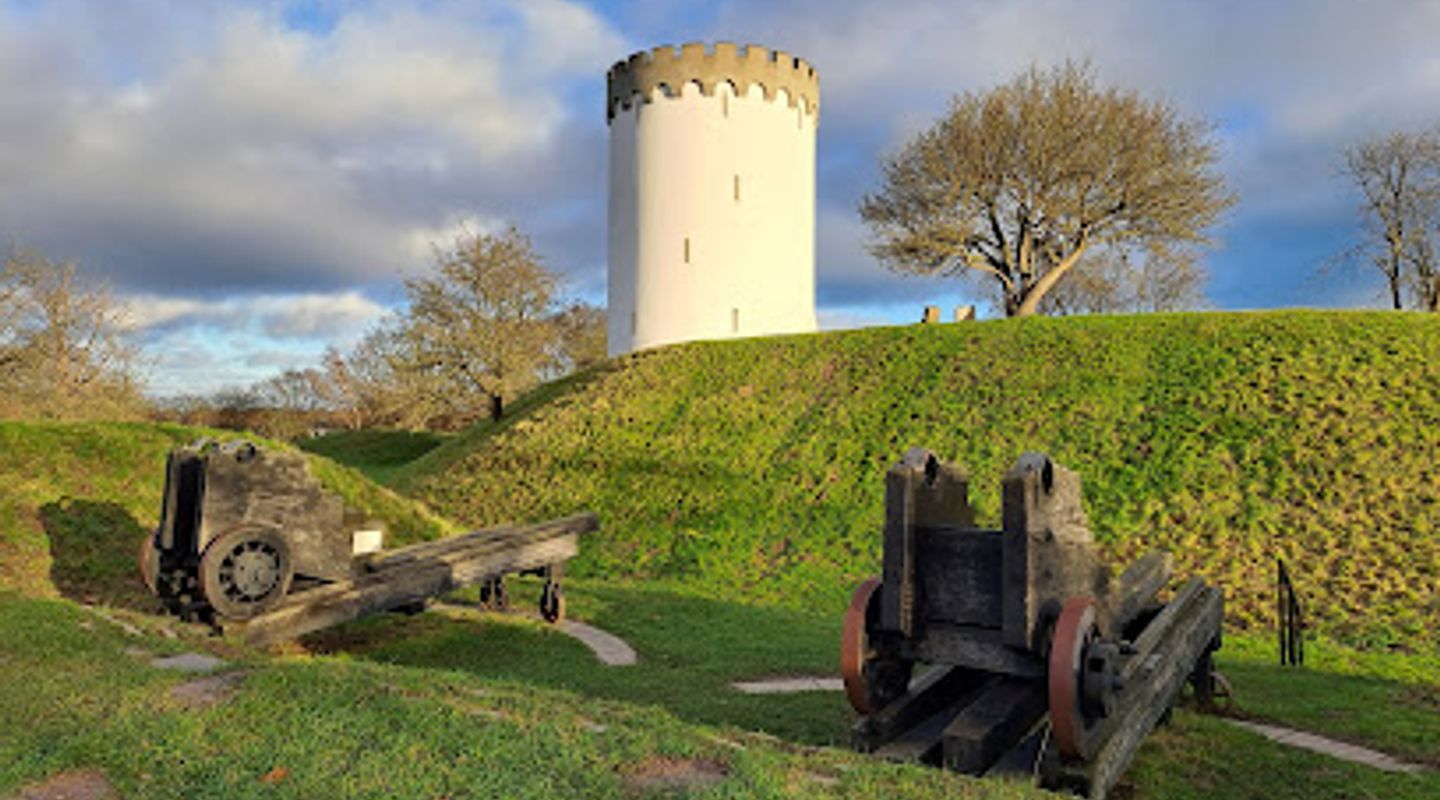
Once the fortress lost its military significance after 1864, the ramparts underwent a remarkable transformation. Today, they comprise one of Denmark's largest urban parks, seamlessly blending historical preservation with recreational green space. The earthen bastions and fortifications remain largely intact, scattered with original cannons and old town gates that tell the story of the fortress's defensive purpose. A scenic walking route, approximately one hour in duration, encircles the ramparts, passing historical statues, information boards, and viewpoints that explain the various gates, bastions, and buildings. The White Water Tower, perched atop the fortifications, offers panoramic views of the city and the Little Belt beyond. The moat that once served as a defensive barrier now creates a picturesque waterway that enhances the park's tranquil atmosphere, particularly beautiful during spring and summer when vegetation flourishes.
A Living History Preserved in Stone and Earth
The Gunpowder Tower (Krudttårnet), built in 1675 on the Lolland Bastion, stands as the oldest military building in Fredericia and overlooks the sea from its strategic position opposite the Citadel. The ramparts' design reflects the military engineering principles of the era, with carefully calculated angles and bastions designed to provide overlapping fields of fire. Walking the ramparts today, visitors encounter layers of history: the original fortifications, monuments to fallen soldiers, cannons positioned as they were centuries ago, and the gates through which soldiers, merchants, and refugees once passed. The site's protected status ensures that this remarkable example of 17th-century fortress architecture remains accessible to future generations, serving as both an educational resource and a peaceful retreat within the modern city.
Evendo Review Centre
 Google
Guest reviews
Best time to go
Quietest: Jan, Feb & Dec · before 6am or at 10pm
Busy times are Evendo estimates for a typical year, to help you plan. Actual crowds vary with events, school holidays and the weather.
Explore Fredericia Vold on the map
A handpicked selection of must-see spots near Fredericia Vold, mapped for you.
Get your free copy of our complete guide to Fredericia Vold, delivered straight to you.
Everything on this page, from opening hours and how to get there to Eve’s tips and the best time to go, in one PDF you can read offline, print or share.
Already have an account? Sign in
Your Fredericia Vold guide is ready.
We'll send it to · Not you? Sign out

Getting your guide ready…
We are putting together a fresh copy of the Fredericia Vold guide. This can take up to a minute.
This can take a few moments. If your browser asks, choose Allow so the download can start. You'll find the guide in your Downloads folder.
Nothing happened? Download it again
Sorry, the guide is taking longer than usual. Please try again in a minute, or get it by email instead.
Other nearby places you may find interesting
The closest places of the same kind, if this one is not quite what you had in mind.
-
-
-

-
-


Swipe for more places
More to explore near Fredericia Vold

 Best experiences near Fredericia Vold
 Best hotels near Fredericia Vold
 Best landmarks near Fredericia Vold
 Best attractions near Fredericia Vold
 Best shops near Fredericia Vold
 Best restaurants near Fredericia Vold
 Best bars near Fredericia Vold
Do you manage this location?
Take control to get all the benefits, like improved information, better appearance, and stronger visibility across AI-powered discovery.
Explore more
Explore more of Sønderjylland
Sønderjylland: A Journey Through Denmark's Scenic Landscapes, Rich History, and Vibrant Traditions.
Explore Sønderjylland
Explore more of Denmark
Discover Denmark: A perfect blend of history, modern design, and the cozy concept of hygge. Explore vibrant cities, serene landscapes, and world-class cuisine.
Explore Denmark
