

Table Rock State Park Travel Guide - Free Web & App
Your ultimate guide to Table Rock State Park. Discover top landmarks, proposed trips, and local tips. Free on the web or via the Evendo companion app.


Table Rock State Park in South Carolina combines Blue Ridge hiking, mountain lakes, CCC heritage, camping and scenic trails near Pickens and Greenville.
Mountain Landscape
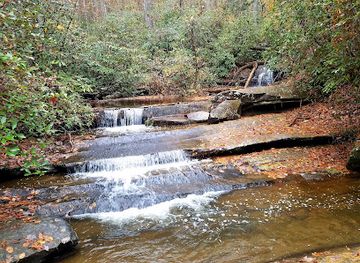
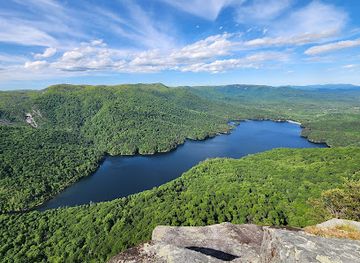
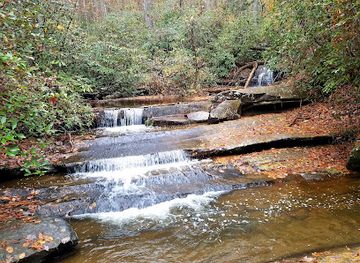
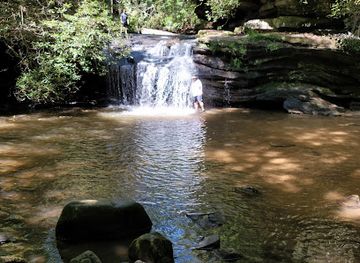
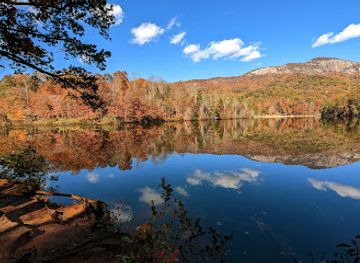
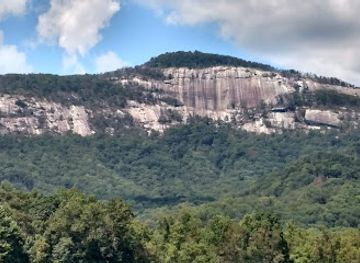
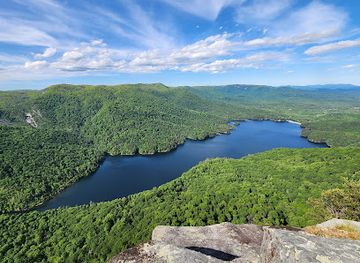
Table Rock State Park occupies more than 3,000 acres in the north-western corner of South Carolina, where the foothills rise towards the Blue Ridge Escarpment. Its defining landmark is Table Rock Mountain, a broad granite mass whose distinctive profile dominates the surrounding countryside. Pinnacle Mountain, wooded ridges and steep-sided valleys add further character, while Carrick Creek runs through the park and feeds the clear waters of Lake Oolenoy and Pinnacle Lake. The landscape is heavily forested, with hardwoods, rhododendron and mountain laurel creating changing colour and texture through the seasons.Read more about Table Rock State Park
Trails, Lakes and Outdoor Life
Heritage and Gateway Communities
When is the best time to visit Table Rock State Park?
Best: April–May, October · 21–26°C| Month | High (°C) | Rainfall (mm) |
|---|---|---|
| January | 10 | 102 |
| February | 12 | 102 |
| March | 17 | 127 |
| April (best) | 22 | 102 |
| May (best) | 26 | 127 |
| June | 30 | 152 |
| July | 32 | 152 |
| August | 31 | 152 |
| September | 27 | 127 |
| October (best) | 21 | 102 |
| November | 15 | 102 |
| December | 10 | 102 |
Getting to and around Table Rock State Park
How to get there
Transportation
Best attractions in Table Rock State Park
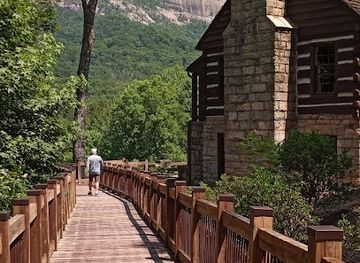
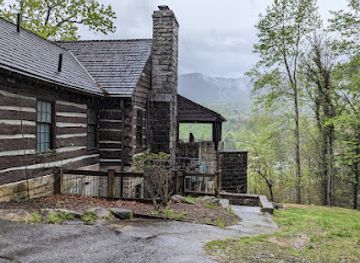
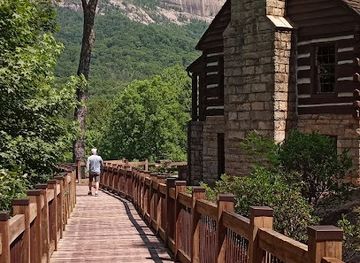
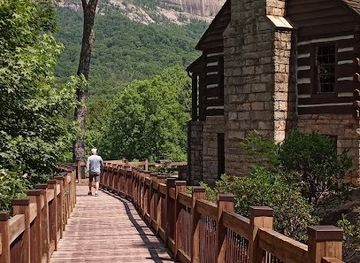
Table Rock Mountain is the park's principal attraction, rising above forested valleys and rewarding determined walkers with broad views across the South Carolina foothills. Pinnacle Mountain provides another demanding mountain objective, while the Foothills Trail links the park with a wider long-distance route through the Blue Ridge landscape. At lower elevations, Carrick Creek Nature Trail offers a gentler introduction to the woodland and stream environment. Lake Oolenoy and Pinnacle Lake bring a different rhythm to the visit, with shorelines, picnic areas and seasonal water-based recreation where authorised. The historic Table Rock Lodge and surrounding Civilian Conservation Corps structures add architectural and social history to the natural setting. Campgrounds, cabins and day-use areas make the park suitable for extended exploration, while the nearby Oolenoy Valley and roads towards Pickens reveal the rural foothill character beyond the core park facilities.
-
Visitor center
Table Rock Nature Center
Explore the beauty of the outdoors at Table Rock Nature Center, your gateway to hiking, wildlife, and breathtaking views in South Carolina.
-
Tourist attraction
Table Rock Summit Trailhead
Discover breathtaking views and exhilarating hikes at Table Rock Summit Trailhead in South Carolina's stunning Table Rock State Park.
-
Campground
Table Rock State Park Campground Loop A
Discover the tranquility and natural beauty of Table Rock State Park Campground Loop A in Pickens, SC. Perfect for camping, hiking, and wildlife watching.
-
Park
The Gaines Lodge
Explore the beauty of Table Rock State Park from The Gaines Lodge, your serene retreat for adventure and relaxation in South Carolina.
Explore Table Rock State Park on the map
Plan your trip on one map. See where the top attractions, landmarks, restaurants and hotels are, and book hotels and experiences in a few clicks.
Best hotels in Table Rock State Park
Best restaurants in Table Rock State Park
Table Rock State Park itself is primarily a recreational landscape rather than a dining destination, so visitors should plan to bring suitable food for picnics or use the nearest communities for substantial meals. Pickens is the closest practical service centre, with additional restaurants, cafés and takeaway options in Easley and along the wider Greenville area. The regional food culture reflects the Upstate's South Carolina setting, where barbecue, fried chicken, biscuits, country-style vegetables and sweet tea are familiar staples, alongside everyday American diners and independent family restaurants. Farm stands and seasonal producers may appear in the surrounding countryside, although availability varies. Visitors staying in cabins or self-catering accommodation can shop for supplies in the larger nearby towns, while those using campsites should check current rules governing food storage, cooking and fires rather than assuming all facilities provide dining services.
-
Restaurant
Aunt Sue's Country Corner
Discover Southern hospitality at Aunt Sue's Country Corner in Pickens – where comfort food meets community spirit.
-
Visitor center
Table Rock Nature Center
Explore nature's wonders at Table Rock Nature Center - your gateway to outdoor adventures in South Carolina.
-
Hiking area
Table Rock Summit Trailhead
Discover stunning views and invigorating hikes at Table Rock Summit Trailhead in South Carolina's breathtaking landscapes.
-
Campground
Table Rock State Park Campground Loop A
Experience the serene beauty of Table Rock State Park Campground Loop A—an ideal escape into nature with breathtaking views and endless outdoor activities.
Best bars in Table Rock State Park
Evening entertainment around Table Rock State Park is quiet and closely tied to rural community life rather than a dedicated nightlife scene. The park's accommodation and camping areas offer evenings shaped by lakeside surroundings, conversation and, where authorised, carefully managed camp activities, but visitors should follow current quiet-hour and fire rules. Traditional restaurants, casual bars and community venues are more likely to be found in Pickens and Easley than within the park itself. Greenville, farther away, provides the Upstate's broadest choice of breweries, music venues, theatres and late-evening restaurants for those willing to make a longer journey. Travellers should plan transport before drinking, as rural roads are winding and public transport options around the park are limited.
-
State park
Table Rock State Park
Discover the breathtaking beauty of Table Rock State Park, where adventure meets tranquility in South Carolina's stunning landscapes.
-
Campground
Table Rock State Park Campground Loop A
Experience the breathtaking beauty and outdoor adventures at Table Rock State Park Campground Loop A in South Carolina.
-
Visitor center
Table Rock State Park Visitors Center
Discover the beauty of the Blue Ridge Mountains at Table Rock State Park Visitors Center – your gateway to outdoor adventures and natural wonders.
-
 Hotel
HotelTable Rock Inn
Experience the serene beauty of Table Rock Inn, your ideal retreat near Table Rock State Park in South Carolina.
Best nightclubs in Table Rock State Park
Evening entertainment around Table Rock State Park is quiet and closely tied to rural community life rather than a dedicated nightlife scene. The park's accommodation and camping areas offer evenings shaped by lakeside surroundings, conversation and, where authorised, carefully managed camp activities, but visitors should follow current quiet-hour and fire rules. Traditional restaurants, casual bars and community venues are more likely to be found in Pickens and Easley than within the park itself. Greenville, farther away, provides the Upstate's broadest choice of breweries, music venues, theatres and late-evening restaurants for those willing to make a longer journey. Travellers should plan transport before drinking, as rural roads are winding and public transport options around the park are limited.
-
State park
Table Rock State Park
Explore Table Rock State Park, a stunning natural oasis in South Carolina's Blue Ridge Mountains, perfect for outdoor adventures and breathtaking views.
-
Hotel
Table Rock Inn
Experience the serene beauty of Table Rock Inn, where comfort meets nature in the heart of South Carolina's stunning landscapes.
Best shops in Table Rock State Park
Shopping within Table Rock State Park is limited and focused on visitor necessities rather than a retail district. Pickens is the nearest useful town for groceries, outdoor supplies and everyday services, while Easley and Greenville offer a wider selection of shops, specialist equipment retailers, regional food producers and independent businesses. In the surrounding Upstate, visitors may encounter farm stands, roadside produce sellers, local art and craft businesses, and shops connected with South Carolina food traditions, although these are dispersed and seasonal rather than concentrated in a single market. Pack trail essentials before entering the park, particularly if planning a long hike or camping stay. Local products such as preserves, baked goods and regional foods can make practical provisions, but availability varies by settlement, season and opening arrangements.
-
Restaurant
Aunt Sue's Country Corner
Experience Southern charm and delicious comfort food at Aunt Sue's Country Corner, a favorite spot for travelers in Pickens, SC.
-
Visitor center
Table Rock Nature Center
Explore Table Rock Nature Center for breathtaking views, engaging exhibits, and a gateway to outdoor adventures in South Carolina's natural beauty.
-
Hiking area
Table Rock Summit Trailhead
Discover the breathtaking views and vibrant wildlife at Table Rock Summit Trailhead, a must-visit hiking destination in South Carolina.
-
Campground
Table Rock State Park Campground Loop A
Experience the breathtaking beauty of Table Rock State Park Campground Loop A, where adventure meets tranquility in the heart of South Carolina's outdoors.
Get your free copy of our complete guide to Table Rock State Park, delivered straight to you.
Everything on this page, from attractions and restaurants to essentials and local phrases, in one PDF you can read offline, print or share.
Already have an account? Sign in
Your Table Rock State Park guide is ready.
We'll send it to · Not you? Sign out

Getting your guide ready…
We are putting together a fresh copy of the Table Rock State Park guide. This can take up to a minute.
This can take a few moments. If your browser asks, choose Allow so the download can start. You'll find the guide in your Downloads folder.
Nothing happened? Download it again
Sorry, the guide is taking longer than usual. Please try again in a minute, or get it by email instead.
Table Rock State Park essentials
Currency and Payment
Safety
Emergency Situations
Do's and Don'ts
Local Tips
From Eve
Local phrases worth knowing
You don't need to get them perfect. A few words go a long way, and locals appreciate the effort.
Basics
| English | Local | Say it |
|---|---|---|
| Hello | Howdy | [hah-DEE] |
| Goodbye | See ya | [SEE yuh] |
| Yes | Yup | [YUHP] |
| No | Nah | [NAH] |
| Please/You're welcome | Please/No problem | [PLEEZ / NOH proh-bluhm] |
| Thank you | Thanks a lot | [THANKS uh lot] |
| Excuse me/Sorry | Pardon me/My bad | [PAHR-dun me / mah BAD] |
| How are you? | How y'all doin'? | [hao yal DOO-in?] |
| Fine. And you? | I'm doin' good. How 'bout y'all? | [ahm DOO-in gud. hao 'bout yal?] |
| Do you speak English? | Y'all speak English? | [yal speak ING-lish?] |
| I don't understand | I ain't gettin' ya | [ahnt GET-tin ya] |
Eating & Drinking
| English | Local | Say it |
|---|---|---|
| I'd like to see the menu, please | Can I check out the menu, please | [kan ah chek out the MEH-nyoo, please] |
| I don't eat meat | I don't eat no meat | [ah doo-nt eat noh meet] |
| Cheers! | Cheers! | [CHEERS!] |
| I would like to pay, please | I reckon I'll pay now, please | [ah REK-uhn ayl pay now, please] |
Emergencies
| English | Local | Say it |
|---|---|---|
| Help! | Help! | [HELP!] |
| Go away! | Git away! | [git uh-WAY!] |
| Call the Police! | Call the Sheriff! | [call the SHER-iff!] |
| Call a doctor! | Call the doc! | [call the dok!] |
| I'm lost | I'm plumb lost | [ahm PLUM lost] |
| I'm ill | I feel poorly | [ah feel POR-lee] |
Shopping
| English | Local | Say it |
|---|---|---|
| I'd like to buy... | I'm fixin' to buy... | [ahm FIX-in tuh buy...] |
| I'm just looking | I'm just browsin' | [ahm JUST BROW-zin] |
| How much is it? | How much fer it? | [hao much fur it?] |
| That's too expensive | That's a mite pricey | [thats uh MYT PRY-see] |
| Can you lower the price? | Kin ya drop the price? | [kin ya DROP the price?] |
Time & Numbers
| English | Local | Say it |
|---|---|---|
| What time is it? | What time is it? | [wut tahm iz it?] |
| It's one o'clock | It's one o'clock | [its wun uh-KLOCK] |
| Half past (10) | Half past ten | [haf past ten] |
| Morning | Mornin' | [MORN-in] |
| Afternoon | Afternoon | [AF-ter-NOON] |
| Evening | Evenin' | [EVE-nin] |
| Yesterday | Yestidy | [YES-ti-dee] |
| Today | Today | [to-DAY] |
| Tomorrow | Tomorry | [tom-OR-ee] |
| 1 | One | [wun] |
| 2 | Two | [too] |
| 3 | Three | [three] |
| 4 | Four | [for] |
| 5 | Five | [fahv] |
| 6 | Six | [siks] |
| 7 | Seven | [SEV-en] |
| 8 | Eight | [ayt] |
| 9 | Nine | [nine] |
| 10 | Ten | [ten] |
Transport & Directions
| English | Local | Say it |
|---|---|---|
| Where's a/the...? | Where's the...? | [wheres the...?] |
| What's the address? | Where's it located? | [wheres it loh-KAY-ted?] |
| Can you show me (on the map)? | Can ya show me (on the map)? | [kan ya show me (on the map)?] |
| When's the next (bus)? | When's the next (bus)? | [whens the next (bus)?] |
| A ticket (to ....) | A ticket (to ....) | [uh TICK-it (to ....)] |
History of Table Rock State Park
A Blue Ridge Escarpment Landscape
The mountains around Table Rock State Park belong to the ancient Blue Ridge province of the Appalachian region. Weathering, erosion and long geological change shaped the hard rock ridges and prominent outcrops that now define Table Rock and Pinnacle mountains. The park sits near the dramatic transition between the South Carolina foothills and higher terrain leading towards the North Carolina line, a setting that explains its steep valleys, fast-running streams and elevated viewpoints. Although geological processes long predate human history, they remain fundamental to understanding the park's trails, forests and distinctive mountain profile.
Indigenous and Early Settlement Landscapes
The wider north-western South Carolina foothills formed part of the homeland and travelling landscape of Indigenous peoples, including the Cherokee, before intensified colonial settlement. During the eighteenth and nineteenth centuries, roads, farms and small communities developed around the valleys and streams, while the mountains remained more lightly settled than the lower country. Farming and woodland use altered parts of the landscape, but the steepest ridges retained extensive forest cover. Modern visitors encounter a natural setting shaped not only by geology, but also by centuries of movement, cultivation and changing relationships with the land.
The Civilian Conservation Corps Era
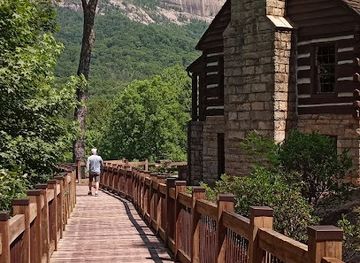
Table Rock became one of South Carolina's early state parks during the New Deal period, with major development undertaken in the 1930s by the Civilian Conservation Corps. Young workers built roads, trails, lake facilities, stone structures and the park lodge, using local materials and designs intended to harmonise with the mountain setting. This work established much of the park's enduring recreational character and formed part of a wider national effort to create public landscapes and employment during the Great Depression. Surviving structures and masonry provide a visible connection with that formative period of American park history.
State Park Recreation and Conservation
Following its early development, Table Rock evolved into a year-round public recreation area combining swimming and boating waters, camping, picnicking and mountain trails. Its proximity to the growing communities of South Carolina's Upstate increased its importance as an accessible escape into the foothills, while the surrounding forests remained valuable for habitat and watershed protection. The park's inclusion on the Foothills Trail further connected it with a larger network of conservation landscapes across the Blue Ridge. Management today balances public access with protection of woodland, streams, lakes and heavily used mountain routes.
Table Rock State Park in Photos
Browse through our photo collection highlighting the charm and character of the destination.
Neighbouring destination travel guides
The closest destinations to Table Rock State Park, if you have time for more than one.
-

-

-

-
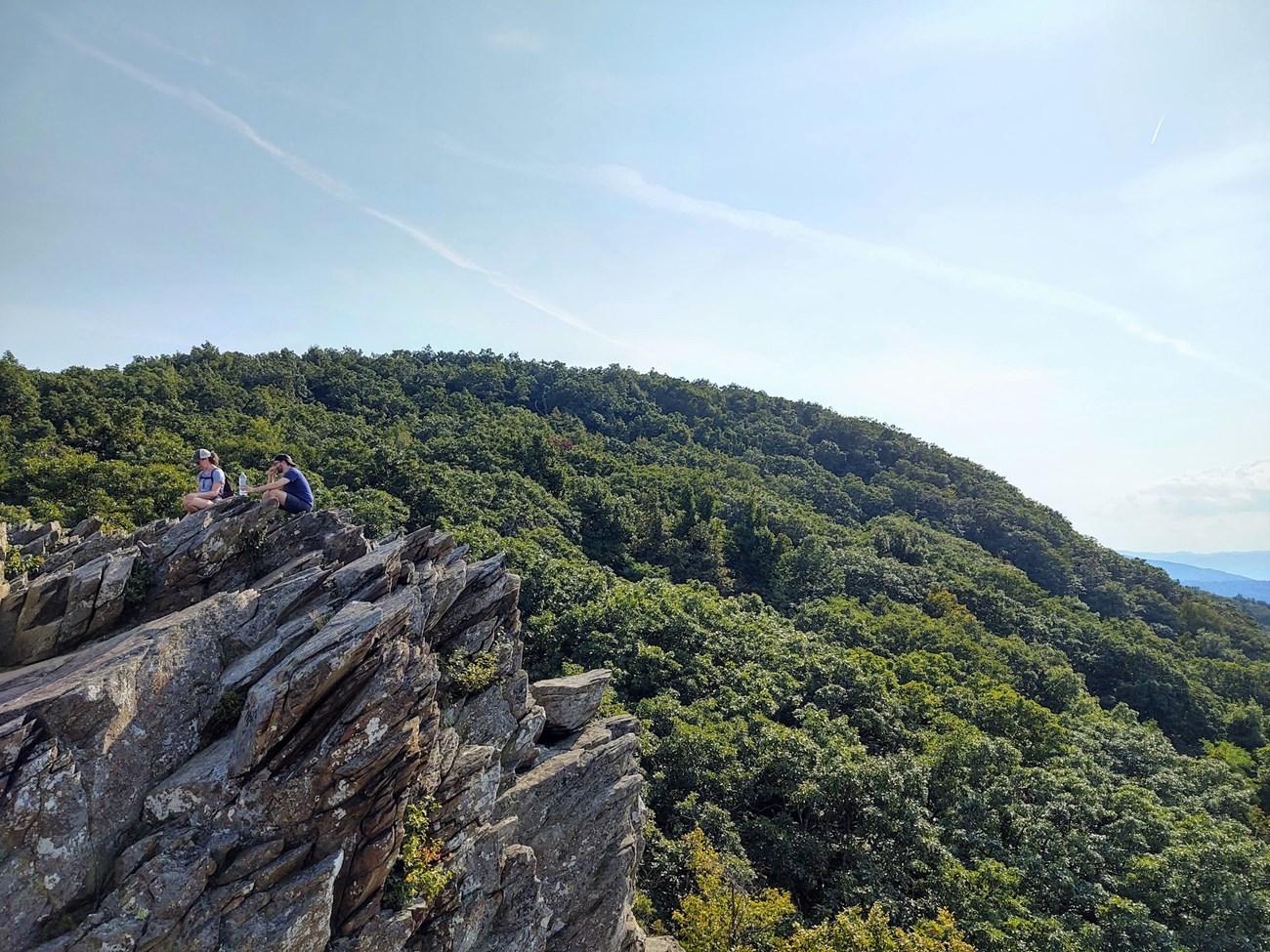 Blue Ridge Parkway
 in Virginia links mountain overlooks, historic farms, forest trails and gateway towns, revealing Appalachian landscapes and heritage.
Blue Ridge Parkway
Blue Ridge Parkway in Virginia links mountain overlooks, historic farms, forest trails and gateway towns, revealing Appalachian landscapes and heritage.
-


Swipe for more destinations
Explore more

Explore more of Blue Ridge Mountains
Explore South Carolina’s Blue Ridge Mountains for waterfalls, forest trails, lakes, Cherokee heritage, mountain towns and Appalachian scenery.
Explore Blue Ridge Mountains
Explore more of South Carolina
Explore South Carolina: A blend of historic charm, natural beauty, and southern hospitality. From Charleston's cobblestone streets to Myrtle Beach's sandy shores, adventure awaits.
Explore South Carolina