Background

The Corpus Clock: Cambridge’s Mesmerizing Time-Eating Sculpture

A captivating golden clock with a mechanical grasshopper that ‘devours’ time, blending art, science, and philosophy in the heart of Cambridge.

4.6

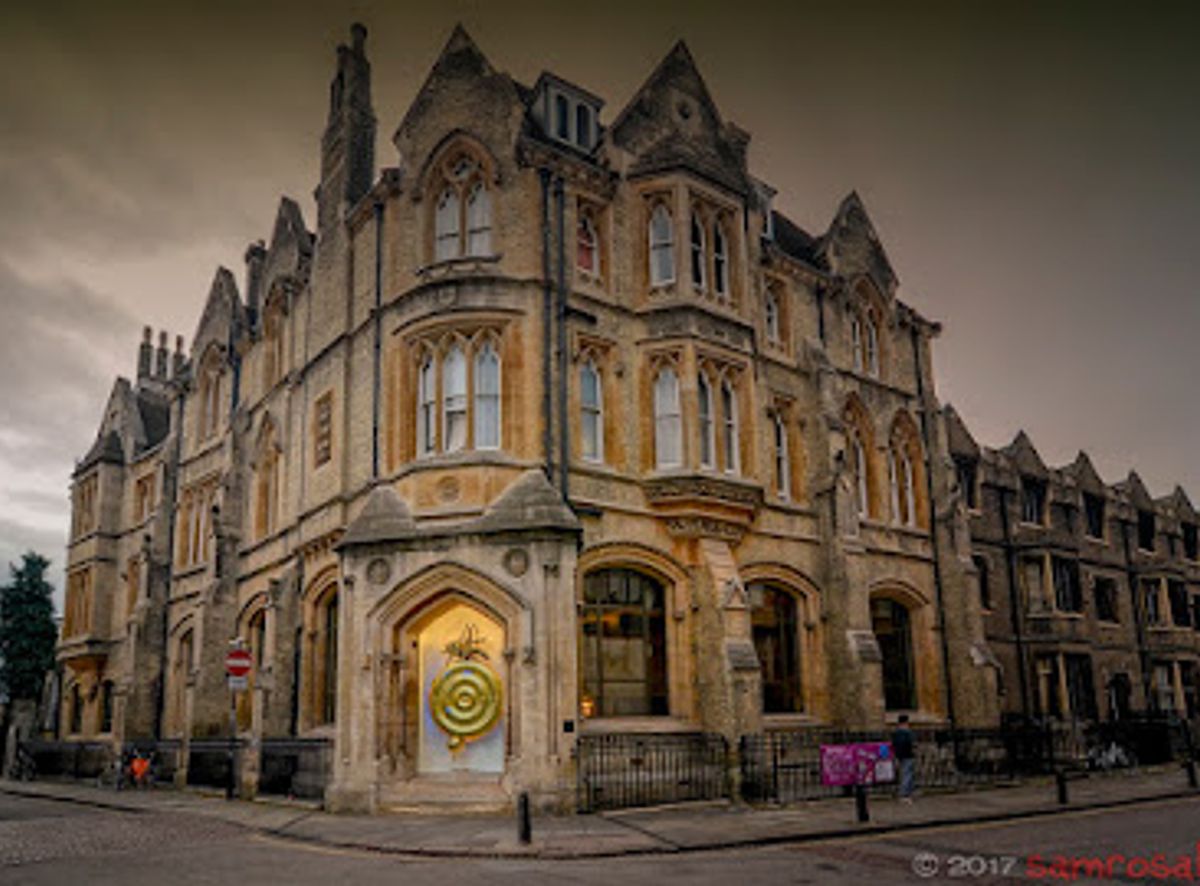
The Corpus Clock, located on Trumpington Street outside the Taylor Library at Corpus Christi College, Cambridge, is a striking 24-carat gold-plated sculptural clock unveiled in 2008 by Stephen Hawking. Known for its unique ‘Chronophage’ or ‘time-eater’—a mechanical grasshopper perched atop that appears to devour time—the clock displays time via three rings of blue LED lights instead of hands, symbolizing the elusive and uneven passage of time.

A brief summary to The Corpus Clock

  • 58 Trumpington St, Cambridge, CB2 1RH, GB
  • +441223338000
  • Duration: 0.25 to 1 hours
  • Free
  • Environment icon Outdoor
  • Mobile reception: 5 out of 5
  • Monday 12 am-12 am
  • Tuesday 12 am-12 am
  • Wednesday 12 am-12 am
  • Thursday 12 am-12 am
  • Friday 12 am-12 am
  • Saturday 12 am-12 am
  • Sunday 12 am-12 am

Local tips

  • Visit during daylight for clear views of the gold-plated clock face and the intricate Chronophage sculpture.
  • Evening visits reveal the mesmerizing blue LED lights that illuminate the time rings vividly.
  • Combine your visit with a walking tour of nearby Cambridge University colleges and King’s Parade.
  • Be prepared for crowds at the busy street junction, especially during peak tourist seasons.
widget icon

Getting There

  • Walking

    From Cambridge Train Station, it is a 20-25 minute walk through the city center on mostly flat terrain, suitable for most visitors and providing scenic views of Cambridge’s historic streets.

  • Bus

    Local buses such as Citi 1 and Citi 3 serve the city center with stops near King’s Parade; travel times range from 10-20 minutes from Cambridge Train Station. Services run frequently during the day but may be limited in the evening. Single fares cost approximately £2-£3.

  • Taxi

    Taxis from Cambridge Train Station to the Corpus Clock take about 5-10 minutes depending on traffic, offering convenient door-to-door service. Typical fares range from £7 to £12.

The Corpus Clock location weather suitability

  • Weather icon Any Weather
  • Weather icon Clear Skies
  • Weather icon Rain / Wet Weather

Unlock the Best of The Corpus Clock

Buy tickets

    No tickets available

Book tours with entry

    No tours available

Book tours without entry

    No tours available

Discover more about The Corpus Clock

A Modern Marvel at the Heart of Cambridge

The Corpus Clock stands prominently at street level on the exterior of the Taylor Library, overlooking the historic King’s Parade. Conceived and funded by Dr John C. Taylor, a Cambridge alumnus and inventor, this clock was unveiled in 2008 by the renowned physicist Stephen Hawking. It commemorates the 500th anniversary of Corpus Christi College and represents a fusion of art, science, and philosophy. The clock’s 1.5-meter diameter face is plated in pure 24-carat gold, featuring undulating ripples that evoke the Big Bang, symbolizing the universe’s origins and the flow of time.

The Enigmatic Chronophage: Time’s Devouring Creature

Crowning the clock is the Chronophage, a menacing mechanical grasshopper whose name means “time-eater” in Greek. This intricately crafted creature’s mouth opens and closes as it seemingly consumes each passing second, its spiky legs crawling around the clock face in a hypnotic, unsettling dance. The Chronophage embodies the relentless and inevitable passage of time, reminding viewers of mortality and the fleeting nature of existence. This deliberate design choice lends the clock a haunting, philosophical presence uncommon in public monuments.

Innovative Time Display and Mechanical Brilliance

Unlike traditional clocks, the Corpus Clock has no hands or digital numerals. Instead, it uses three concentric rings of blue LED lights behind slits in the gold face to indicate hours, minutes, and seconds. The clock’s movement is intentionally irregular, sometimes speeding up or slowing down before resetting, reflecting the uneven experience of time in human life. It performs over 50 programmed ‘tricks,’ including reversing time and special displays on notable dates such as the birthdays of John Taylor and John Harrison, New Year’s Day, and Corpus Christi Day. Despite its complexity, the clock is mechanical with minimal electrical input, powered mainly by a small motor for the LEDs.

Symbolism and Cultural Impact

The Corpus Clock is more than a timepiece; it is a public artwork that challenges perceptions of time and existence. An inscription below the clock quotes the Vulgate Bible: “Mundus transit et concupiscentia eius” (“The world passeth away, and the lust thereof”), reinforcing its meditation on impermanence. The clock’s design deliberately unsettles, prompting reflection on how time is consumed relentlessly. It has become an iconic symbol in Cambridge, bridging the city’s rich academic heritage with contemporary creativity and engineering excellence.

Visitor Experience and Surroundings

Situated at a busy junction, the clock attracts steady attention from passersby and tourists alike. Its street-level placement allows close-up viewing, though the bustling location means photos often capture crowds. The surrounding area is steeped in history, with the medieval architecture of Corpus Christi College and the vibrant life of King’s Parade nearby. The clock’s golden glow and the rhythmic movement of the Chronophage create a mesmerizing spectacle, especially in the evening when the blue LEDs shine vividly.

Engineering Feat and Legacy

The Corpus Clock took seven years and approximately £1 million to build, involving around 200 specialists, including work at a secret Dutch military research institute. It was hailed as one of Time magazine’s Best Inventions of 2008. The clock’s creator, John C. Taylor OBE, personally funded the project, embedding his name and the year of creation on the clock face in Latin. This masterpiece stands as a testament to human ingenuity, blending horology, sculpture, and philosophy into a timeless landmark.

Busiest months of the year

Busiest hours of the day

Popular Experiences near The Corpus Clock

Popular Hotels near The Corpus Clock

Select Currency