

Devils Tower National Monument Travel Guide - Free Web & App
Your ultimate guide to Devils Tower National Monument. Discover top landmarks, proposed trips, and local tips. Free on the web or via the Evendo companion app.


Devils Tower National Monument in Wyoming features iconic rock columns, Indigenous heritage, wildlife, hiking, climbing and Black Hills scenery near Hulett.
A Landmark Above the Black Hills
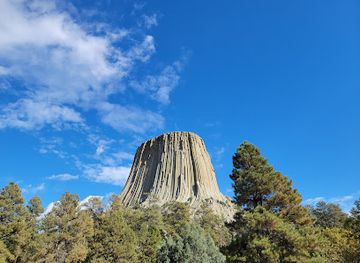
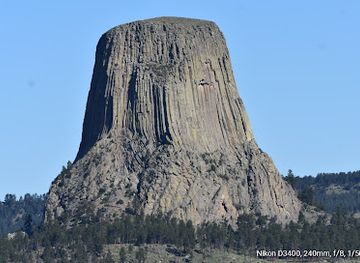
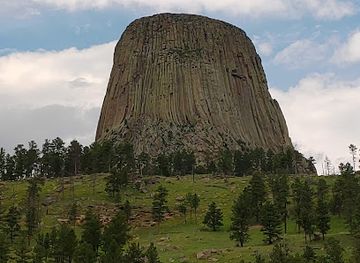
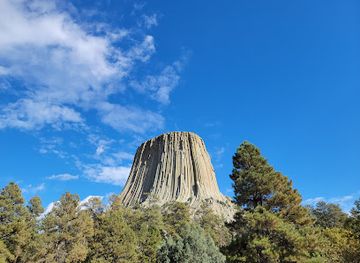
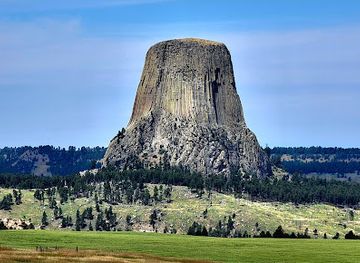
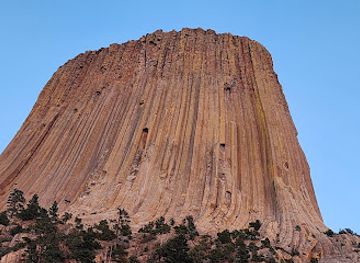
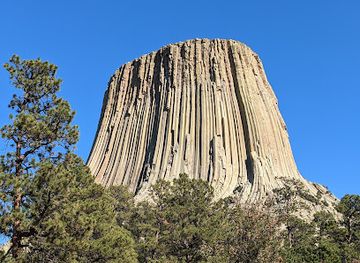
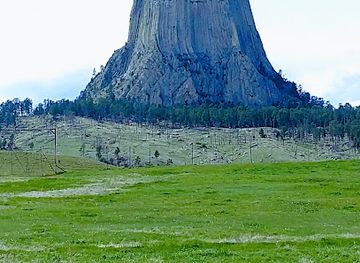
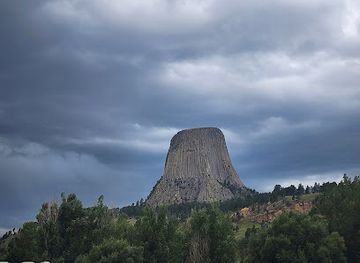
Devils Tower National Monument rises dramatically from the grasslands of north-eastern Wyoming, close to the Black Hills and within reach of the small communities of Hulett, Sundance and Moorcroft. Its great pale formation, composed of closely packed polygonal columns, stands 867 feet above the surrounding Belle Fourche River landscape. Seen from the monument road, prairie trails or distant viewpoints, the tower has an unmistakable vertical presence that defines this corner of the state.Read more about Devils Tower National Monument
Geology, Wildlife and Open Country
A Place of Continuing Cultural Importance
When is the best time to visit Devils Tower National Monument?
Best: June–August · 24–27°C| Month | High (°C) | Rainfall (mm) |
|---|---|---|
| January | -1 | 15 |
| February | 1 | 17 |
| March | 8 | 25 |
| April | 13 | 40 |
| May | 18 | 60 |
| June (best) | 24 | 70 |
| July (best) | 27 | 50 |
| August (best) | 26 | 40 |
| September | 20 | 30 |
| October | 14 | 25 |
| November | 6 | 17 |
| December | 0 | 15 |
Getting to and around Devils Tower National Monument
How to get there
Transportation
Best attractions in Devils Tower National Monument
The central attraction is Devils Tower itself, viewed most closely along the paved Tower Trail that circles its forested base. The route presents changing perspectives of the columns, surrounding meadows and climbers on the rock when conditions and regulations permit. Joyner Ridge Trail provides a quieter walk through mixed grassland and woodland with broader views towards the formation. The Belle Fourche River, which flows near the monument, supports a greener corridor through the prairie and offers opportunities for wildlife observation. Prairie dog colonies near the monument provide a chance to watch these sociable burrowing animals, while deer and birds are often associated with the wider landscape. The visitor centre introduces the geology, cultural significance and climbing history of the site. Beyond the monument, the roads towards Hulett and Sundance pass through the open ranch country and forested margins of the Black Hills, but these nearby communities should be treated as gateways rather than attractions within the national monument.
-
Visitor center
Devils Tower Visitor Center
Explore the iconic Devils Tower Visitor Center, your gateway to Wyoming's breathtaking natural wonder and rich cultural history.
-
Museum
Devils Tower Information Marker (northbound)
Experience the awe-inspiring Devils Tower, America's first national monument, and delve into its history, geology, and breathtaking scenery.
-
Campground
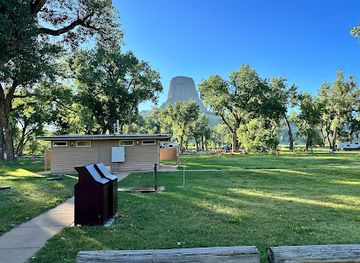
Belle Fourche River Campground
Discover the tranquil beauty of Belle Fourche River Campground, where adventure and relaxation meet in the heart of Wyoming's stunning landscapes.
-
Tourist attraction
Prairie Dog Town
Explore Prairie Dog Town in Wyoming, a lively wildlife attraction showcasing playful prairie dogs amidst stunning landscapes near Devils Tower.
Best landmarks in Devils Tower National Monument
Devils Tower is the defining natural landmark: a steep-sided igneous formation whose closely spaced columns rise above the Belle Fourche River valley and the surrounding grasslands. Its vertical profile and unusual geology made it an early focus of federal landscape protection when it became the United States’ first national monument in 1906. The formation is also a cultural landmark known by Indigenous names including Bear Lodge and remains associated with prayer and ceremony for several American Indian nations. The Belle Fourche River provides an ecological counterpoint to the dry uplands, while the forested base and nearby prairie dog towns reveal the variety of habitats within the monument. The surrounding valley, ridges and open ranch country are important parts of the landmark’s setting, showing why Devils Tower is experienced not simply as an isolated rock but as a prominent feature within a wider northern Great Plains landscape.
-
Visitor center
Devils Tower Visitor Center
Experience the breathtaking beauty and rich history at the Devils Tower Visitor Center, your gateway to exploring Wyoming's iconic natural landmark.
-
Museum
Devils Tower Information Marker (northbound)
Explore the iconic Devils Tower Information Marker, a historic site that blends stunning natural beauty with rich cultural heritage in Wyoming.
-
Historical landmark
Devil’s Tower
Experience the breathtaking beauty of Devil's Tower, a historical landmark offering stunning vistas and rich cultural significance in Wyoming.
-
Hiking area
Red Beds Trailhead
Discover breathtaking landscapes and hiking trails at the Red Beds Trailhead, a highlight of Devils Tower National Monument in Wyoming.
Explore Devils Tower National Monument on the map
Plan your trip on one map. See where the top attractions, landmarks, restaurants and hotels are, and book hotels and experiences in a few clicks.
Best hotels in Devils Tower National Monument
Best restaurants in Devils Tower National Monument
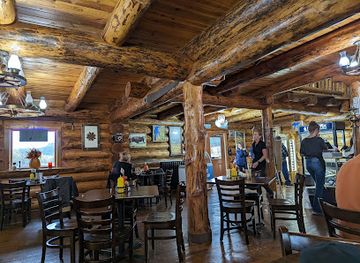
Dining within Devils Tower National Monument is limited, so visitors generally plan meals around their accommodation, picnic supplies or nearby gateway communities. Picnic areas provide a practical option for a daytime stop, while Hulett has the closest concentration of casual restaurants, cafés and seasonal visitor-oriented food businesses. Sundance, farther away on Interstate 90, offers a broader choice of places to eat and is useful for travellers approaching from the east or west. The regional food character reflects north-eastern Wyoming’s ranching landscape, with straightforward American meals, beef, burgers, sandwiches and locally familiar comfort food more typical than a specialised destination cuisine. Shops and markets in the surrounding towns can help visitors assemble provisions for a day outdoors, but opening patterns may be seasonal or limited, particularly outside the main travel period.
-
Restaurant
The Diamond Bar at Devils Tower
Experience local flavors and stunning views at The Diamond Bar at Devils Tower – where great food meets breathtaking scenery.
-
Cafe
Campstool Cafe
Discover Campstool Cafe: A cozy dining spot near Devils Tower serving delightful meals in Wyoming's breathtaking landscapes.
Best bars in Devils Tower National Monument
Devils Tower is a quiet natural monument rather than a nightlife destination, and there are no nightclubs or entertainment districts within the protected area. Evenings usually centre on campgrounds, accommodation, stargazing and the sounds of the surrounding countryside. Traditional bars and casual evening venues are more likely to be found in Hulett or Sundance, where local residents, travellers and motorcyclists may gather during the warmer months. The atmosphere is informal and rural rather than late-night or highly organised, with availability varying by season and day. Visitors staying at a remote lodge, ranch or campground should not assume that food, drinks or entertainment will be available after dark, and should make arrangements before leaving larger settlements.
-
Bar
The Diamond Bar at Devils Tower
Discover the perfect blend of local flavors and breathtaking views at The Diamond Bar, your ideal stop near Devils Tower.
-
Gift shop
Devils Tower Trading Post
Explore the charming Devils Tower Trading Post for unique souvenirs, delicious snacks, and a taste of local craftsmanship near the iconic Devils Tower.
-
 Bed & breakfast
Devils Tower Lodge
Discover the charm of Devils Tower Lodge, where comfort meets the breathtaking beauty of Wyoming's iconic landscapes.
-
Family-friendly
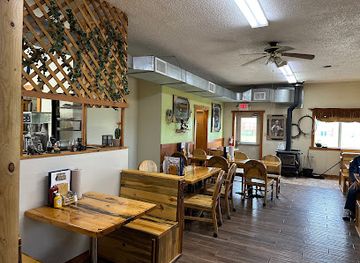
Devils Tower View Cafe
Enjoy delightful meals and breathtaking views at Devils Tower View Cafe, a family-friendly spot near the iconic national monument.
Best shops in Devils Tower National Monument
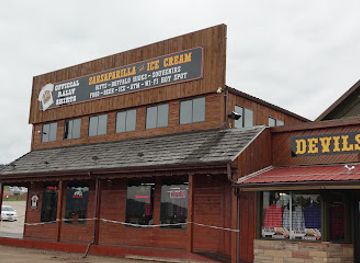
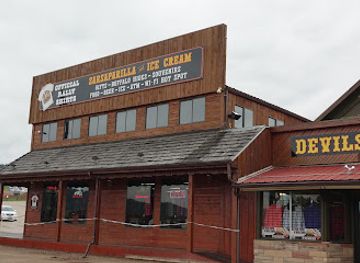
Shopping at Devils Tower is modest and focused on visitor essentials, books and souvenirs rather than extensive retail. The monument’s visitor centre area is the natural place to look for interpretive material and keepsakes associated with the formation, geology and national monument. Hulett provides the closest small-town shopping, including provisions, practical supplies and locally oriented gift items, while Sundance offers a wider range of everyday services and traveller purchases. In the surrounding region, visitors may encounter western clothing, Native-inspired artwork, locally made crafts and food products, but provenance and cultural representation should be considered carefully. Larger shopping centres are not part of the monument experience, so outdoor equipment, medication and specialist supplies are best obtained before arriving from a bigger regional town.
-
Gift shop
Devils Tower Trading Post
Explore unique gifts and delicious treats at Devils Tower Trading Post, your one-stop shop near the iconic Devils Tower in Wyoming.
Get your free copy of our complete guide to Devils Tower National Monument, delivered straight to you.
Everything on this page, from attractions and restaurants to essentials and local phrases, in one PDF you can read offline, print or share.
Already have an account? Sign in
Your Devils Tower National Monument guide is ready.
We'll send it to · Not you? Sign out

Getting your guide ready…
We are putting together a fresh copy of the Devils Tower National Monument guide. This can take up to a minute.
This can take a few moments. If your browser asks, choose Allow so the download can start. You'll find the guide in your Downloads folder.
Nothing happened? Download it again
Sorry, the guide is taking longer than usual. Please try again in a minute, or get it by email instead.
Devils Tower National Monument essentials
Currency and Payment
Safety
Emergency Situations
Do's and Don'ts
Local Tips
From Eve
Local phrases worth knowing
You don't need to get them perfect. A few words go a long way, and locals appreciate the effort.
Basics
| English | Local | Say it |
|---|---|---|
| Hello | Howdy | [houd-ee] |
| Goodbye | See ya | [see yah] |
| Yes | Yep | [yep] |
| No | Nah | [nah] |
| Please/You're welcome | Please/No problem | [pleez/no prob-lem] |
| Thank you | Thanks | [thanks] |
| Excuse me/Sorry | Pardon me/My bad | [par-dun me/my bad] |
| How are you? | Howdy | [houd-ee] |
| Fine. And you? | Good. How 'bout you? | [good. how 'bout yah] |
| Do you speak English? | Ya speak English? | [yah speak ing-glish] |
| I don't understand | I'm lost | [im lost] |
Eating & Drinking
| English | Local | Say it |
|---|---|---|
| I'd like to see the menu, please | Show me what y'all got to eat | [show mee what y'all got to eat] |
| I don't eat meat | I'm a vegetarian | [im a ve-ji-tear-ee-an] |
| Cheers! | Cheers! | [cheers] |
| I would like to pay, please | Check, please | [check, please] |
Emergencies
| English | Local | Say it |
|---|---|---|
| Help! | I need a hand! | [i need a hand] |
| Go away! | Get lost! | [get lost] |
| Call the Police! | Ring up the Sheriff! | [ring up the sher-iff] |
| Call a doctor! | Call the doc! | [call the doc] |
| I'm lost | I'm turned around | [im turned a-round] |
| I'm ill | I'm feelin' poorly | [im feelin' poor-lee] |
Shopping
| English | Local | Say it |
|---|---|---|
| I'd like to buy... | I'm interested in... | [im in-tres-ted in] |
| I'm just looking | Just browsing | [just brows-ing] |
| How much is it? | How much does it run? | [how much duz it run] |
| That's too expensive | That's a bit steep | [thats a bit steep] |
| Can you lower the price? | Can ya do any better? | [can yah do any bet-ter] |
Time & Numbers
| English | Local | Say it |
|---|---|---|
| What time is it? | What's the time? | [whats the time] |
| It's one o'clock | It's one | [its one] |
| Half past (10) | Ten thirty | [ten thirty] |
| Morning | Mornin' | [mornin'] |
| Afternoon | Afternoon | [after-noon] |
| Evening | Evenin' | [evenin'] |
| Yesterday | Yest'day | [yest'day] |
| Today | Today | [to-day] |
| Tomorrow | Tomorruh | [tom-or-ruh] |
| 1 | One | [one] |
| 2 | Two | [two] |
| 3 | Three | [three] |
| 4 | Four | [four] |
| 5 | Five | [five] |
| 6 | Six | [six] |
| 7 | Seven | [seven] |
| 8 | Eight | [eight] |
| 9 | Nine | [nine] |
| 10 | Ten | [ten] |
Transport & Directions
| English | Local | Say it |
|---|---|---|
| Where's a/the...? | Where's the... | [wheres the] |
| What's the address? | Where's it located? | [wheres it lo-cated] |
| Can you show me (on the map)? | Can ya point it out? | [can yah point it out] |
| When's the next (bus)? | When's the next ride? | [whens the next ride] |
| A ticket (to ....) | A ticket (to ...) | [a ticket (to)] |
History of Devils Tower National Monument
An Ancient Igneous Formation
Devils Tower formed from molten rock that solidified below the surface during the geological history of the Black Hills region. Over immense periods, erosion removed the softer sedimentary rocks around it and exposed the more resistant igneous core. The tower’s distinctive columns developed as the rock cooled and contracted, although the precise nature of the original intrusion remains a subject of geological interpretation. The surrounding Belle Fourche River landscape records a much longer sequence of deposited rocks, uplift and erosion than the relatively young human history of the monument.
Indigenous Names and Traditions
Devils Tower lies within a landscape with longstanding connections to American Indian nations, including the Lakota, Cheyenne, Kiowa and other peoples. Bear Lodge is among the traditional names associated with the formation, which continues to hold religious and cultural importance. Oral traditions explain the tower through stories of bears, prayer and protection, with versions differing between communities. The trees around the formation may carry prayer bundles and cloth offerings, reminders that this is not solely a geological attraction but an active sacred place.
Exploration and Monument Status
Euro-American awareness of the formation increased during nineteenth-century exploration and settlement in the northern Great Plains, when it was recorded on maps and encountered by expeditions. In 1906, President Theodore Roosevelt proclaimed Devils Tower the first United States national monument under the Antiquities Act. The designation recognised the formation’s scientific and scenic importance and placed it within the developing national system for protecting significant public landscapes. Indigenous cultural associations, however, extend far beyond the federal monument’s administrative history.
Climbing, Conservation and Public Use
Climbing Devils Tower became an established recreational pursuit during the twentieth century, adding a new chapter to the monument’s visitor history. At the same time, Indigenous communities raised concerns about climbing on a sacred formation and about the impact of ropes, chalk and foot traffic. The National Park Service now asks climbers to honour a voluntary closure during June, while monitoring visitor use, wildlife habitat and cultural resources. Today the monument balances public access with the protection of a place whose spiritual significance remains central to many communities.
Devils Tower National Monument in Photos
Browse through our photo collection highlighting the charm and character of the destination.
Neighbouring destination travel guides
The closest destinations to Devils Tower National Monument, if you have time for more than one.
-

-

-

-

-


Swipe for more destinations
Explore more

Explore more of Black Hills
Explore Wyoming’s Black Hills around Devils Tower, Sundance and Bear Lodge, with geological landmarks, ranch country, dark skies and open-road scenery.
Explore Black Hills
Explore more of Wyoming
Discover Wyoming: A Land of Unspoiled Beauty, Rich History, and Boundless Outdoor Adventures in the Heart of the American West.
Explore Wyoming