On a quiet winter evening in Charleston, when the air along the cobblestones turns crisp and the harbor wind carries a faint scent of salt and jasmine vines at rest, there is a doorway that seems to glow a little warmer than the rest. Step through it and the city’s storied romance concentrates into a single dining room, where gaslight softens every edge and dinner feels less like a meal than a quiet vow.Setting the Stage: Ambiance and First Impressions
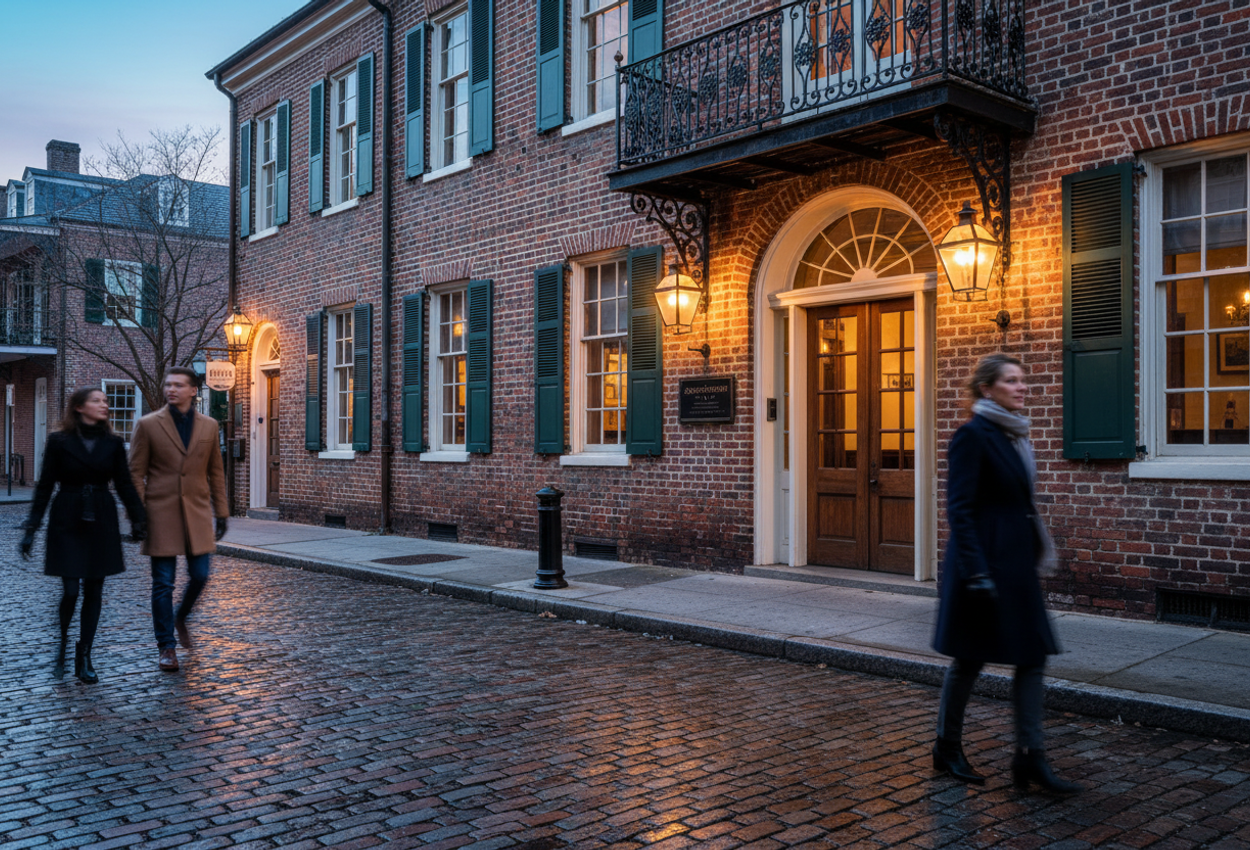
In the historic heart of downtown Charleston, where 18th- and 19th-century facades line narrow streets and wrought-iron balconies lace the skyline, [Restaurant Name] occupies a lovingly restored brick building that has watched the city evolve around it. Approaching along a cobbled lane, you first notice the balcony: a sweep of black ironwork curling into floral motifs, its railings glowing under the amber halo of traditional gas lamps. Their steady hiss and soft flame cast a flickering light across the old brickwork, picking up the faint sheen of years of sea air and evening fog. It feels less like arriving at a restaurant and more like being invited to a private home that has quietly hosted romantic encounters for generations.
The doorway is recessed behind a graceful iron gate, its scrolls twined with seasonal greenery. In early February, when Charleston is between the deep chill of winter and the first flush of spring, the arrangement is subtle: eucalyptus, olive branches, and pale cream roses whose petals catch the lamplight. As you step inside, the city’s cool night air yields to a gentle warmth carrying the aromas of butter, seared seafood, and something floral—perhaps the delicate perfume of the fresh flowers that dot the room.
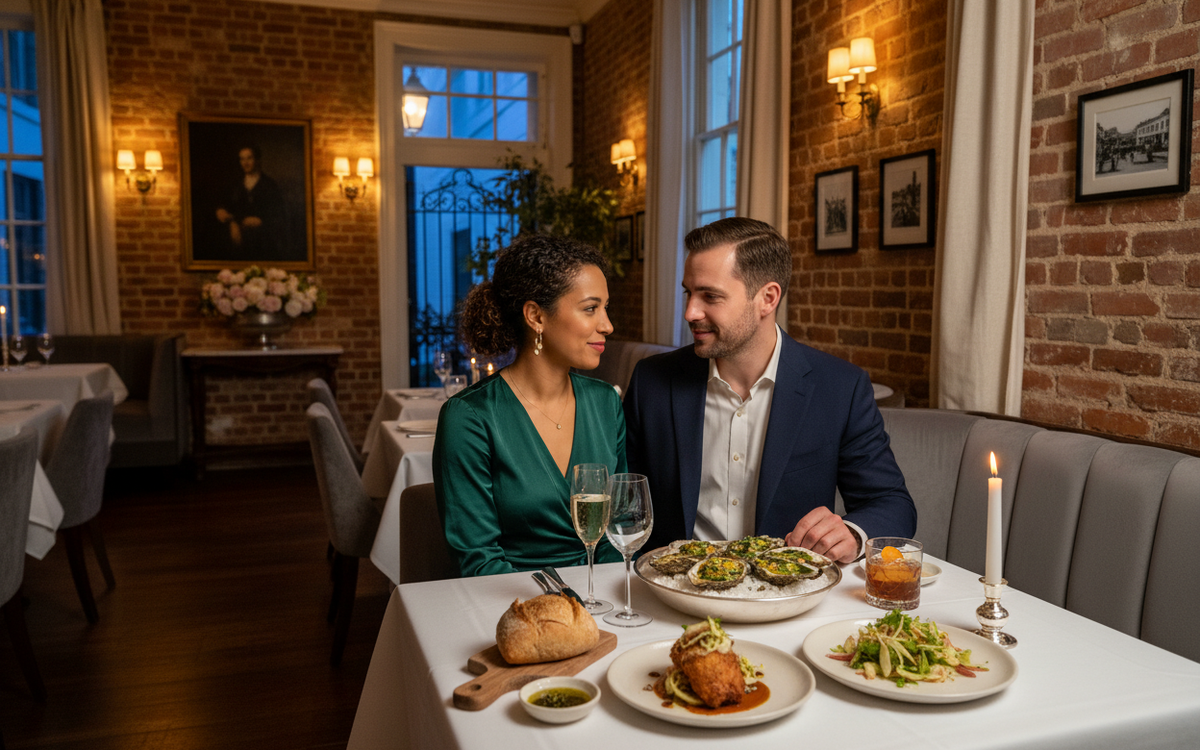
The interior of [Restaurant Name] is a study in thoughtful restraint. Exposed brick walls, burnished to a soft matte sheen, rise around the space like an embrace. Their clay-red tones are deepened by the low, golden light from sconces designed to mimic old carriage lamps. Each table is dressed in crisp white linen that glows almost pearlescent against the darker backdrop, set with heavy crystal stemware and slender, tapered candles whose flames dance with the faintest shift of air. The effect is intimate without being precious: a room designed not to impress you into silence, but to coax you into conversation.
Soft jazz, barely above a murmur, threads through the space. Think brushed cymbals, a lazy trumpet line, a piano that sounds like it might be played in the next room rather than piped in from a playlist. The soundtrack lands squarely in that sweet spot where it creates atmosphere but never competes with the words being spoken across the table. Every so often, there’s a subtle swell as classics drift in—melodies that feel familiar even if you can’t immediately name them—which only deepens the sense of timelessness.
The layout favors romance over spectacle. Tables for two line the brick walls, some tucked into shallow arches that feel like miniature alcoves, others positioned near tall paned windows framed by gauzy curtains. From certain seats, you can glimpse the balcony’s ironwork or the ghostly glow of the gas lamps outside, a constant reminder that beyond the glass lies a city that has long understood the art of lingering. Banquettes upholstered in dove-gray velvet soften the lines of the room, their textures inviting an absentminded hand to trace them while you talk and sip and wait for the evening to unfurl.
Details abound for the observant. A curated collection of black-and-white photographs lines one wall—vintage street scenes of Charleston, couples strolling along the Battery, a lone carriage rolling past Colonial facades—each in a simple dark frame. In the back of the dining room, a single large oil painting anchors the space: a moody, impressionistic rendering of the harbor at twilight, its brushstrokes echoing the flame-shaped flicker of the candles below. Nearby, a small marble-topped pedestal holds a silver bowl overflowing with seasonal blooms; tonight, pale pink camellias and creamy ranunculus spill over the edges, their faint perfume mingling with the scent of wax and wine.
The acoustics, often the undoing of would-be romantic dining rooms, are carefully considered here. Brick, wood, and fabric combine to diffuse sound so that conversations at neighboring tables melt into a gentle hum. You catch impressions—a laugh here, a murmured toast there—but never enough to intrude. This is a room that seems to lean in toward each couple, absorbing their secrets and sending them back only the quiet reassurance that they are, for a few hours, in their own world.
There is a sense of occasion woven into every gesture from the moment you arrive. Coats are whisked away with the ease of a practiced ballet, and on more than one visit, I watched as staff discreetly helped guests tuck small gifts or bouquets beneath tables, ready for perfectly timed proposals or anniversaries. Candles are lit and relit without drama, chairs held without fanfare. The atmosphere at [Restaurant Name] does not shout special; it simply assumes that love, in all its quiet forms, is the default setting here.
A Culinary Overture: Appetizers and Drinks
The romance at [Restaurant Name] deepens the moment the first glasses arrive. The bar, visible from parts of the dining room, gleams like a small stage: cut-crystal decanters catching the light, bottles arranged in precise tiers, citrus peels coiled in glass jars. The cocktail list leans into the classics with a sly Southern wink, and nothing encapsulates this better than their take on a French 75, the house favorite that introduces many couples to the evening.
Served in a slender flute chilled to a delicate frost, the Ironwork 75 pairs local gin infused with jasmine blossoms and Meyer lemon with a top note of icy Champagne. Tiny bubbles rise in a steady ribbon, carrying a scent that is equal parts citrus and garden at dusk. The first sip is bright and refreshing, the lemon zest playing against the gentle floral whisper of jasmine, before the wine’s yeastiness steps in to ground it. It is the sort of drink that encourages you to slow down, to clink glasses softly and let the evening’s pace be dictated not by hunger, but by pleasure.
If your inclination leans toward something bolder, the bar’s signature smoked rye cocktail—served beneath a small glass cloche filled with fragrant applewood smoke—provides theater without feeling gimmicky. As the server lifts the lid, a tendril of aromatic smoke coils into the air, carrying with it hints of campfire and toasted spice that briefly perfume the table. On the palate, the drink is deep and complex: rye’s peppery warmth cushioned by a house-made demerara syrup and a dash of black walnut bitters, finished with a flamed orange peel that leaves a faint caramelized citrus aroma on your fingertips.
The wine list is quietly excellent, curated with an eye toward both romance and food pairing. Old World bottles dominate, but there are thoughtful inclusions from small American producers, including expressive pinot noirs and textured chardonnays that flirt with the restaurant’s seafood-leaning menu. The sommelier, when summoned, has that rare gift of engaging without ever condescending. Ask for a pairing to suit a proposal, an anniversary, or a first date, and you’ll receive recommendations that feel as personal as they are precise—often accompanied by a brief story about the producer or a suggestion to revisit the bottle’s aroma after the main course arrives.
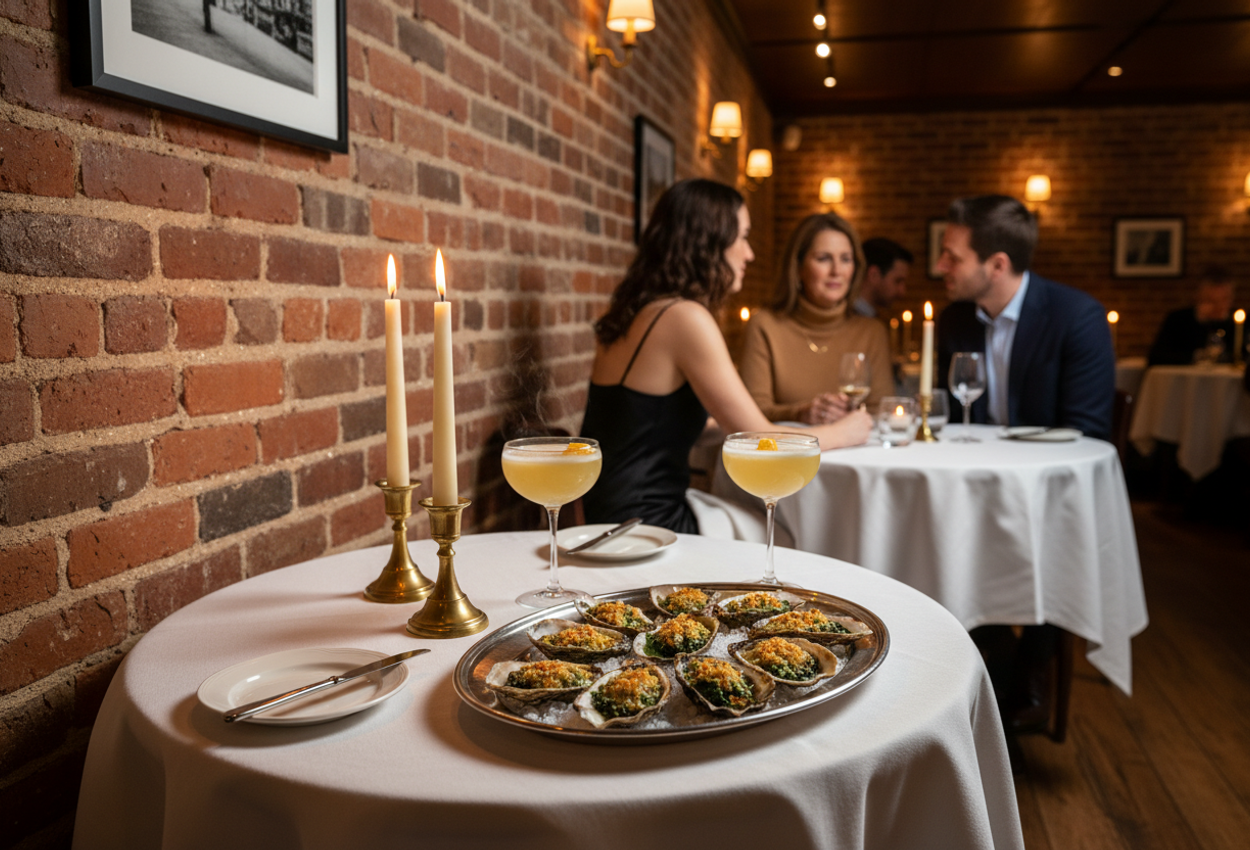
The appetizer menu reads like a love letter to the coastal larder, and nowhere is this clearer than in the Oysters Rockefeller that anchor the opening section. At first glance, they appear as a classic: a half-dozen local oysters, their deep cupped shells nestled into a bed of coarse salt on a heavy silver platter, each crowned with a verdant blanket of spinach and herbs under a gently bronzed crust. But this version reveals its modernity in the details. Instead of the heavier cream base one might expect, the kitchen employs a lighter, herb-forward sabayon, aerated and scented with a whisper of Pernod. The breadcrumbs are flecked with preserved lemon and grated bottarga, giving each bite a subtle saline kick that echoes the brininess of the oyster beneath.
As you lift the shell, the aroma is intoxicating: warm anise, toasted crumbs, the mineral scent of the sea rising in a soft wave. On the tongue, the oyster is still very much alive in flavor—plump, just set, and softly saline—while the topping provides a velvety counterpoint, brightened by the citrus and a barely-there heat from a pinch of Espelette pepper. Paired with the Ironwork 75, the dish becomes a study in contrasts: rich and delicate, oceanic and airy, each sip of the cocktail cutting through the sabayon and setting you up for another slow, appreciative bite.
Another standout for sharing is the buttermilk-fried quail, presented on a hand-thrown ceramic plate whose muted earth tones echo the exposed brick around you. The quail arrives carved into manageable pieces, its mahogany skin freckled with flecks of sea salt and cracked pepper. The crust is a marvel—shatteringly crisp but impossibly thin—encasing tender meat that tastes of juniper and thyme from a long, fragrant brine. It rests atop a puddle of sorghum and bourbon glaze, dark and glossy, its sweetness tempered by a vinegary backbone. A scattering of pickled mustard seeds pops delicately under the teeth, offering welcome brightness, while a small nest of shaved fennel and apple provides a cool, anise-scented crunch.
The interplay of textures and temperatures is where the appetizer course truly sings. Warm, crunchy, silken, and cool elements move across the palate like variations on a theme, each designed less to dazzle in isolation than to invite shared bites, exchanged forks, and the quiet intimacy of tasting from the same plate. Even something as simple as the house bread service—a small loaf of crusty sourdough baked with Carolina Gold rice flour, served with whipped sea-salt butter and a drizzle of herb-infused local olive oil—feels like an invitation to linger, to tear and dip and talk until the candles burn a little lower.
The Main Event: Entrees That Ignite Passion
By the time the main courses arrive, the room has deepened into its own second act. Candle flames burn lower, jazz standards have slipped into bluesier territory, and the clink of cutlery has softened as everyone settles into that unhurried middle stretch of the evening. At [Restaurant Name], the entrees are not merely sustenance; they are the narrative climax, where the kitchen’s technique and the region’s ingredients intersect to create dishes that feel at once luxurious and deeply rooted in place.
The star of the menu is the pan-seared scallops with saffron risotto and grilled asparagus, a dish that captures the essence of Charleston’s coastal abundance. Three plump sea scallops, their surfaces seared to a burnished, caramel-colored crust, are arranged in a deliberate arc atop a pool of golden risotto that glows almost amber in the candlelight. The scallops themselves are textbook perfect: their exterior delicately crisp, giving way to interiors that remain translucent at the very center—sweet, tender, and imbued with the faint brininess of the Atlantic. When your knife glides through each one, there is no resistance, only the clean, satisfying give of precisely timed heat.
The risotto beneath them is made with Arborio rice but accented with a stock brewed from local shrimp shells and aromatics, lending it a whisper of coastal salinity. Threads of Spanish saffron streak the grains with sunny color and a warm, hay-like aroma that rises in gentle curls of steam as the plate is set down. Each spoonful is luxuriously creamy yet retains that essential al dente bite, a reminder that the kitchen understands the balance between comfort and rigor. Slivers of preserved lemon punctuate the richness, their bright acidity slicing through the butter and cheese, while a final drizzle of herb oil infuses each mouthful with the green freshness of parsley and chive.
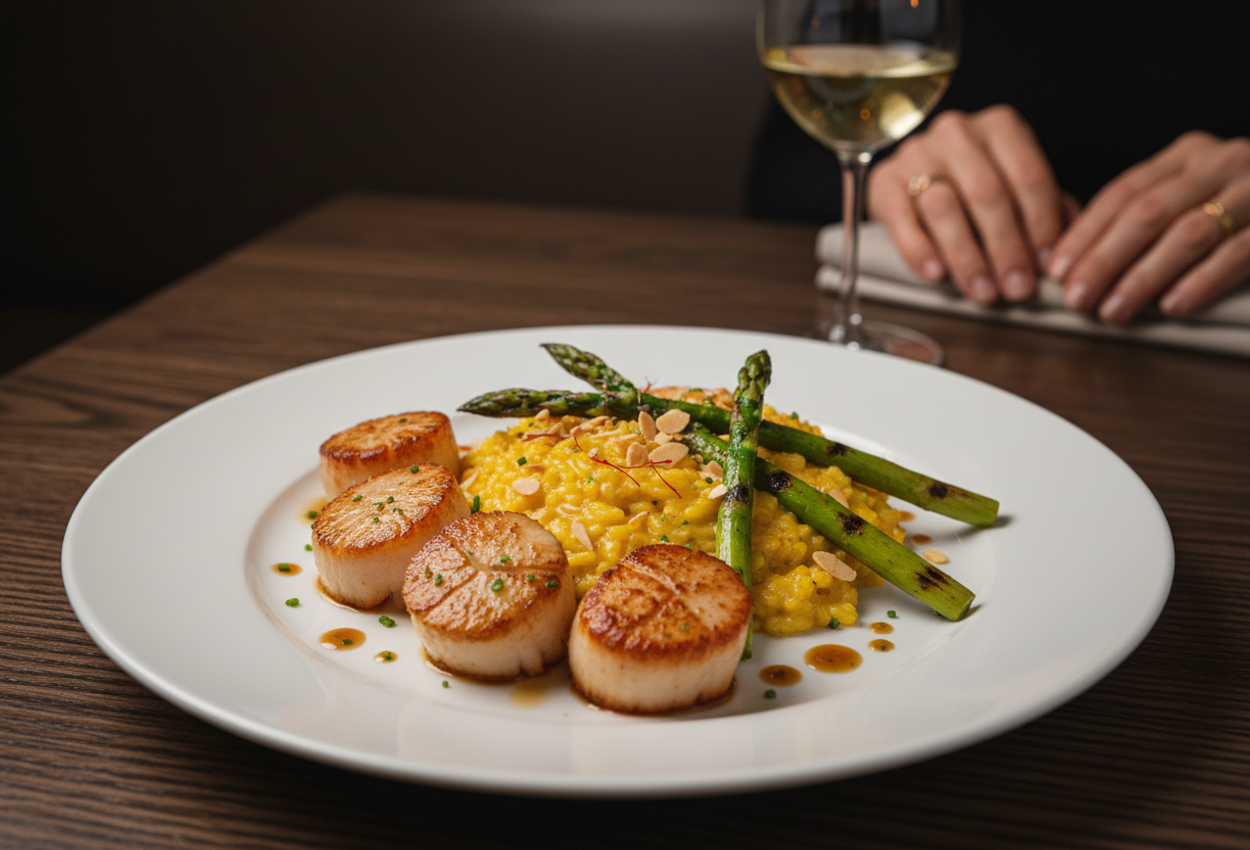
Alongside, slender spears of asparagus, charred just enough to leave inky grill marks, provide a pleasing counterpoint. Their tips are tender but still resilient, offering a faint snap that plays beautifully against the softness of the risotto. A scatter of toasted almonds adds texture and a gentle nuttiness, while a delicate foam of shellfish stock and white wine—more a whisper than a sauce—lingers at the edges of the plate, begging to be chased with a final piece of bread. Paired with a lightly oaked chardonnay suggested by the sommelier, the dish becomes a masterclass in layered flavors: sea and citrus, cream and char, nuttiness and floral warmth.
For those drawn to heartier fare, the herb-crusted lamb loin is a quietly dramatic alternative. Presented as thick, blushing-pink medallions fanned across a bed of roasted root vegetables, it arrives with the subtle scent of rosemary, thyme, and garlic announcing its presence before the plate even hits the linen. The lamb is sourced from a small regional farm, and its quality is instantly apparent: the meat is tender, its flavor pronounced but never gamey, wrapped in a crust of fine breadcrumbs, Dijon, and fresh herbs that shatter gently under the knife.
Beneath the lamb, a mosaic of caramelized carrots, parsnips, and baby turnips glows in shades of orange and pale gold, their edges just shy of char, their interiors honeyed and soft. They rest in a silky jus—an elixir of lamb stock reduced slowly with red wine and a hint of balsamic—whose glossy sheen invites repeated forays of fork and knife. A final flourish of pomegranate arils adds both visual sparkle and a bright, juicy burst that keeps the dish from ever feeling heavy, even as it comfortably anchors a winter’s night.
Vegetarians are not consigned to afterthought here. A roasted cauliflower steak, thick-cut and deeply burnished, is served over a bed of lentils braised in vegetable stock, white wine, and caramelized onions. The cauliflower’s florets char at the edges into tiny petals of concentrated sweetness, while the stalk retains a tender, almost nutty core. Fragrant with cumin, coriander, and smoked paprika, the dish is finished with a swirl of tangy tahini yogurt and a shower of fresh herbs. It is the sort of plate that invites sharing, even for those who may have chosen meat: a quiet argument for the sensual possibilities of vegetables when treated with care.
Across all of these entrees, there is a through line of attentiveness to sourcing that feels authentic rather than performative. Servers speak easily of nearby farms and fisheries, of seasonal shifts that might mean the scallops yield to grouper or that winter root vegetables make way for spring peas and young carrots. The effect is to ground the evening’s romance not in abstraction, but in the tangible reality of land and sea, of local producers whose work underpins every morsel. Your meal feels, in this sense, like a collaborative love story: between chef and purveyor, between diner and city, between two people sharing the sort of food that invites eye contact and unhurried conversation.
Sweet Endings: Desserts to Share and Savor
At [Restaurant Name], dessert is not an afterthought; it is a carefully orchestrated final movement designed with couples in mind. By the time menus reappear, the candles on your table have burned low enough to cast more shadow than light, and the jazz has softened into something almost lullaby-like. The room feels cocooned, the world outside receding behind the mullioned windows as the promise of something sweet—and perhaps a final glass of wine—draws the evening toward its close.
The undeniable centerpiece of the dessert menu is the chocolate lava cake with raspberry coulis and vanilla bean ice cream, a confection so unabashedly romantic it might veer into cliché in lesser hands. Here, however, it is executed with such precision and restraint that it feels instead like an essential ritual. Served in a petite, heart-shaped porcelain ramekin, the cake arrives dusted with a breath of cocoa and confectioners’ sugar, its surface just cracked enough to suggest the molten richness within. A pool of ruby-red raspberry coulis arcs gracefully around one side, its surface glossy and smooth, while a single quenelle of vanilla bean ice cream rests on a handmade cocoa nib tuile, specks of real vanilla seed visible like tiny constellations.
As you cut into the cake with your spoon, the center yields in a slow, luxurious spill of glossy chocolate, thickened just enough to cling to the edges yet fluid enough to pool against the coulis. The aroma rising from the fracture is heady—dark cocoa, warm butter, a hint of espresso folded into the batter to deepen its flavor. On the tongue, the chocolate is indulgent but not cloying, balanced by a measured sweetness and a whisper of salt. Dip your spoon through the molten center and into the raspberry, and the pairing comes alive: the berries’ bright tartness slicing through the richness, their acidity awakening the palate just when it might otherwise tire.
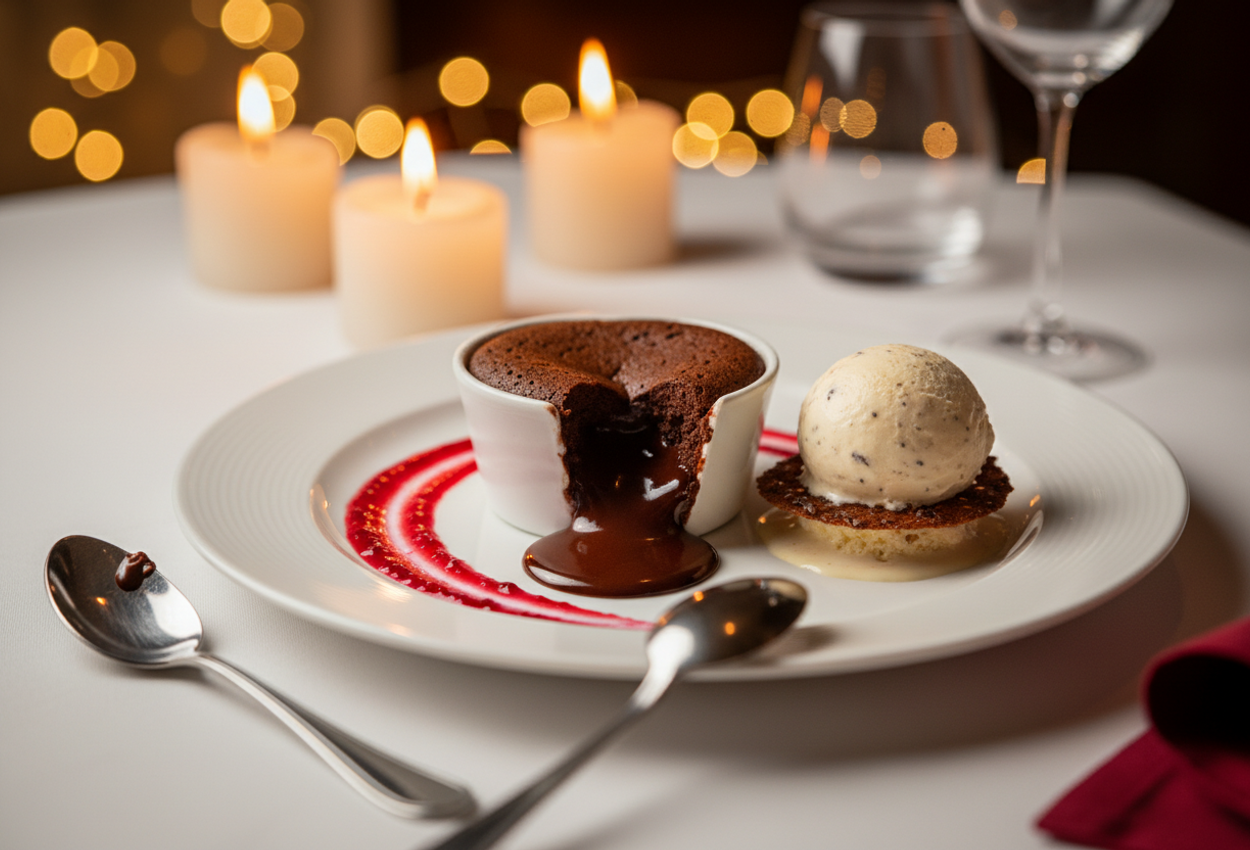
The ice cream, made in-house, is a lesson in the power of simplicity. Its texture is silken, with no hint of ice crystals, the custard base churned to a point just shy of firmness so that it begins to soften the instant it meets the warm edges of the cake. As it melts, it creates rivulets of sweet cream that swirl together with chocolate and raspberry in painterly streaks across the plate—an edible reminder that the best romantic gestures are often the least complicated, provided they are executed with care.
For couples seeking something a little less overtly decadent, the citrus and mascarpone pavlova offers an airier alternative. A crisp meringue shell, its surface glossy and faintly crackled, gives way under the spoon to reveal a marshmallow-soft interior. It cradles a cloud of lightly sweetened mascarpone, scented with orange blossom water, and is crowned with segments of ruby grapefruit, Cara Cara orange, and blood orange that glisten like gemstones. A drizzle of local honey and a scattering of candied pistachios add florality and crunch, while a final zesting of lime over the table releases a mist of perfume that seems to briefly reset the senses.
To drink, the dessert wine and digestif offerings are quietly impressive. A late-harvest Riesling, with its notes of apricot and honey, finds an easy partner in the lava cake, while a nutty tawny port seems made for long, reflective sips between bites of pavlova. There is also a small but thoughtful selection of amari and after-dinner cocktails—a silky espresso martini for those who wish to prolong the evening, or a simple pour of aged rum that carries whispers of molasses and oak, perfect for cradling between both hands as candles burn down to their final centimeters.
Perhaps the greatest triumph of the dessert course is how naturally it lends itself to sharing. Portions are generous without being overwhelming, and plates are designed for two spoons rather than one. Watching couples around the room, you notice the small gestures that mark the success of a romantic dinner: a spoon offered, a bite insisted upon, a quick, conspiratorial grin when someone goes back for just one more taste. At [Restaurant Name], sweet endings are not about spectacle or excess; they are about creating a final, lingering moment where everything else—time, obligations, the outside world—falls gently away.
Service with a Smile: Attentiveness and Hospitality
Even in a city known for its graciousness, the service at [Restaurant Name] stands out for the way it balances professionalism with genuine warmth. From the moment you step through the door, there is an almost uncanny sense that the staff has been expecting you—not in a performative way, but with the quiet familiarity of hosts welcoming guests into their home. Names are learned quickly and used sparingly, eye contact is steady but never intrusive, and every movement seems choreographed to support the restaurant’s central mission: to give couples space to connect while ensuring they never once have to ask twice for anything they need.
On arrival, hosts greet you with a softness that immediately lowers the shoulders. If there is a special occasion noted in your reservation—a birthday, an anniversary, a proposal in the works—it is acknowledged with understated delight rather than fanfare. On one visit, I watched as a nervous guest slipped a small ring box to the maître d’ with a barely perceptible gesture. Over the course of the evening, the staff orchestrated the moment with near-invisible precision: timing the arrival of the lava cake, dimming the nearby lights by a single notch, and ensuring a discreetly chilled half-bottle of Champagne materialized within seconds of the partner’s joyful nod.
Servers move through the dining room with a pace that feels unhurried yet never lax. They materialize at your elbow just as a question forms—about the provenance of the scallops, the exact blend in the cocktail you’ve fallen in love with, or the best way to share three courses between two people without feeling overburdened. Answers come with the ease of experience, peppered with personal preferences and honest guidance. If a dish you are considering is particularly rich, they will say so; if the chef has a favorite preparation that evening, they will mention it. There is no upselling, only matchmaking between diner and plate.
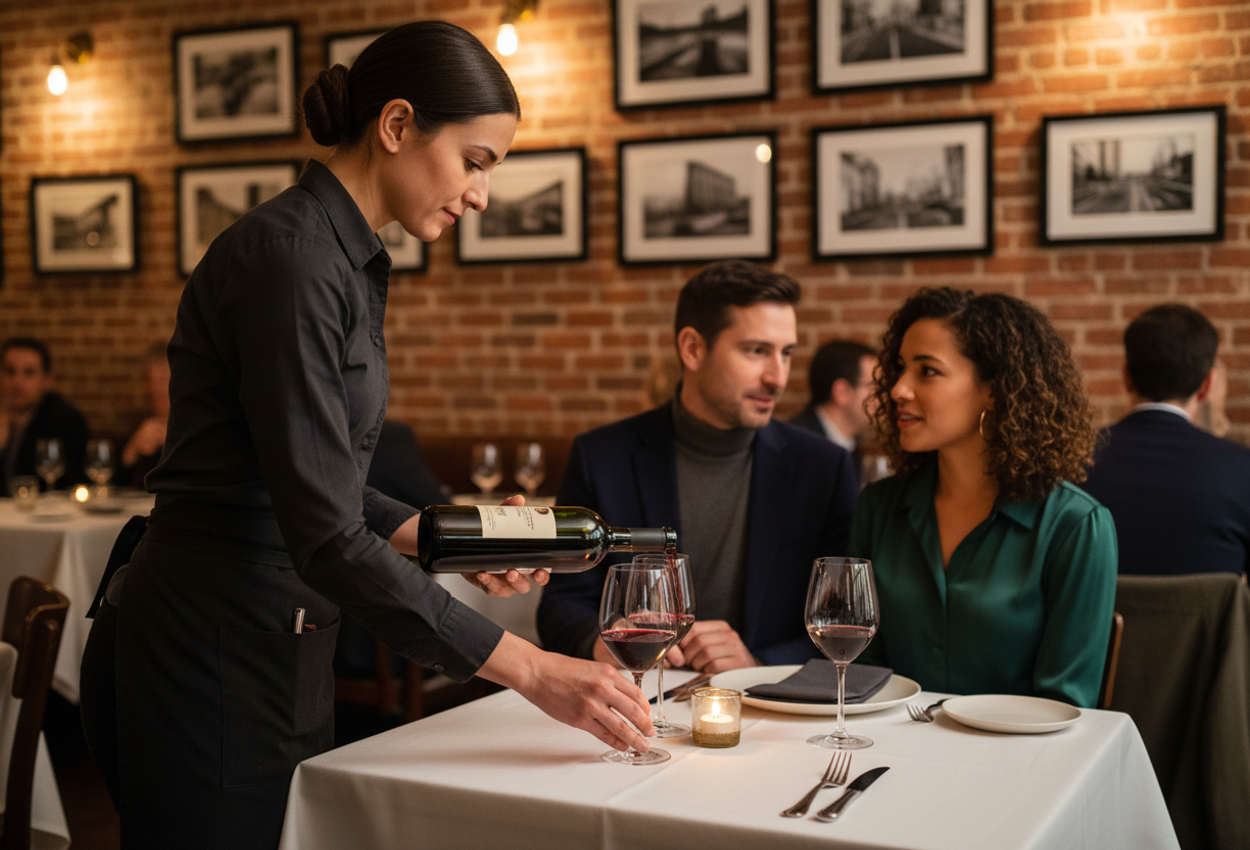
Attention to detail is where the hospitality truly glows. Water glasses are refreshed with a near-magical efficiency; napkins, refolded when a guest slips away from the table, are never fussed over in a way that might break the conversational spell. Dietary restrictions are handled not as inconveniences but as invitations. Mention a gluten intolerance or a dairy sensitivity, and you will see a brief, thoughtful pause followed by concrete suggestions and, when necessary, quiet consultation with the kitchen. On one evening, a neighboring table celebrating an anniversary included someone who could not eat chocolate. Without prompting, the pastry chef adapted the pavlova to feature more seasonal fruit and a dairy-free sorbet, presenting it with the same elegance as any other dessert on the menu.
The sommelier and bar team, too, exhibit a gracious intuition that feels central to the restaurant’s romantic identity. They learn quickly whether you prefer to be guided or left to explore, whether you light up at the mention of something obscure and natural, or relax into the familiarity of a classic Burgundy. Bottles are presented with care but without ceremony so elaborate it might interrupt the intimacy at the table. When a glass is refilled, it is done with a light touch, as if by a benevolent spirit rather than a person bending between you and your conversation.
Perhaps the most telling measure of hospitality at [Restaurant Name] is what happens as the evening winds down. There is no sense of being hurried out, even on busy nights. Checks appear only when requested, and lingering is not simply tolerated but quietly accommodated: a fresh candle here, a final pour of water there, the staff’s energy gently dialed back to create space for couples who are not quite ready to step back into the Charleston night. When you finally do rise to leave, coats reappear as if conjured, doors are held open, and you are sent back into the glow of the gas lamps with the feeling that your time inside was not just observed, but quietly, respectfully cherished.
In the end, what sets [Restaurant Name] apart as the ultimate romantic dining experience is not any single element—the wrought-iron balconies, the perfectly seared scallops, the molten heart of the lava cake—but the way all of these pieces interlock to create an evening that feels seamlessly, almost inevitably, special. It is a place where love, in all its forms, is taken seriously, and where hospitality is practiced not as a profession but as an art. In a city as storied and seductive as Charleston, that is no small achievement.