Charleston is a city that does not rush you into romance; it coaxes you toward it, one cobblestone, sea breeze, and live oak shadow at a time.In Charleston, South Carolina, love is stitched into the brickwork and laced through the salt air blowing off the harbor. This is a city where centuries-old church bells still keep time, where magnolia blossoms lean over iron balconies, and where every slow turn of a carriage wheel seems to echo with stories. For couples, Charleston is not just a destination; it is a setting, a ready-made backdrop for stolen glances, lingering dinners, and unhurried wanderings under gas lamps that never quite surrendered to electricity’s glare.
This romantic guide leads you through the city’s most evocative experiences: dawn strolls past pastel facades, sunset sails on a tall ship, intimate French suppers hidden on side streets, and moonlit adventures down narrow alleys once haunted by duelists and whispered legends. Woven through it all are the textures of Charleston’s history and culture, the resilience of a place that has rebuilt itself after fire, earthquakes, and war, and the warmth of Southern hospitality that makes visitors feel, just for a while, like locals in on a secret.
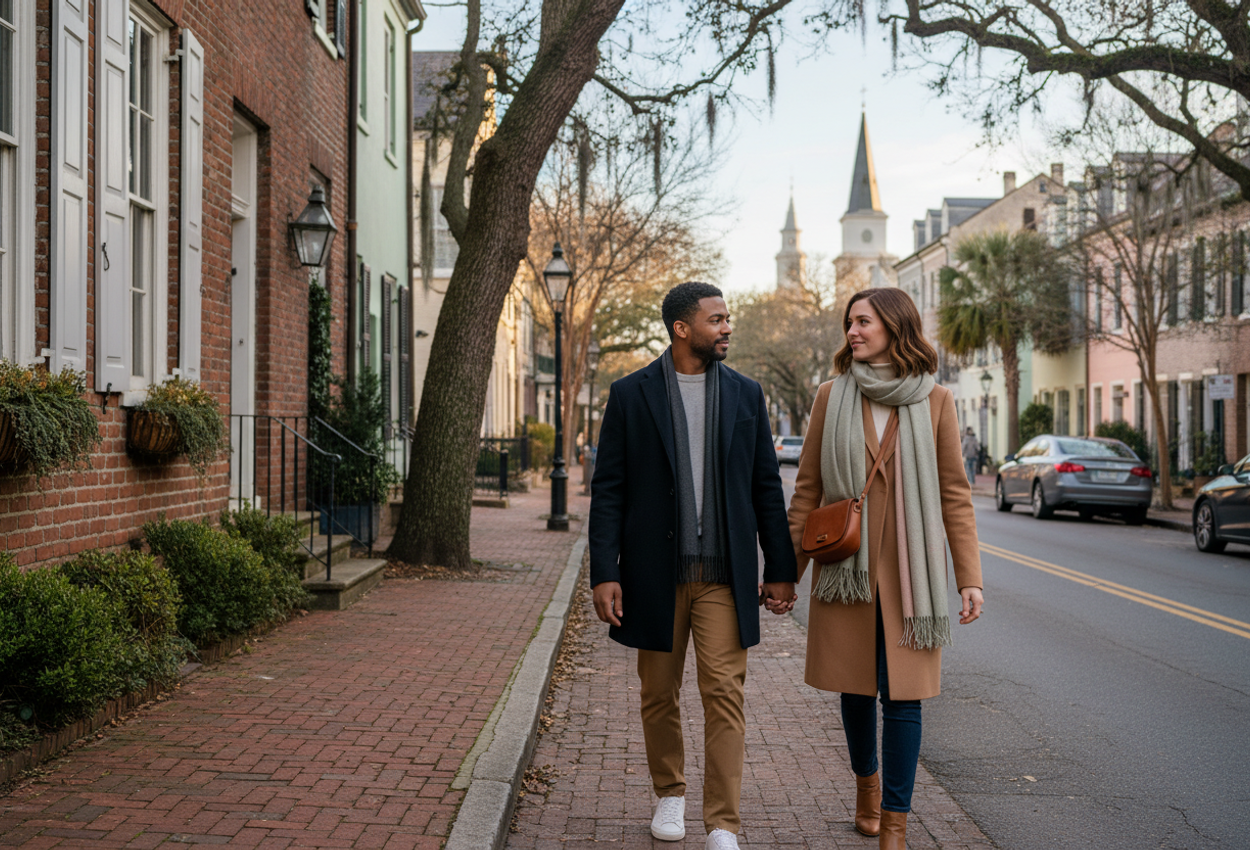
Whether you are celebrating a honeymoon, an anniversary, or the simple joy of escaping real life for a long weekend, Charleston offers a rhythm that encourages you to walk a little slower, linger a little longer, and hold each other a little closer. Begin with the city’s most famous strip of color along the harbor, and let the story unfold from there.
Stroll Hand-in-Hand Through Historic Rainbow Row
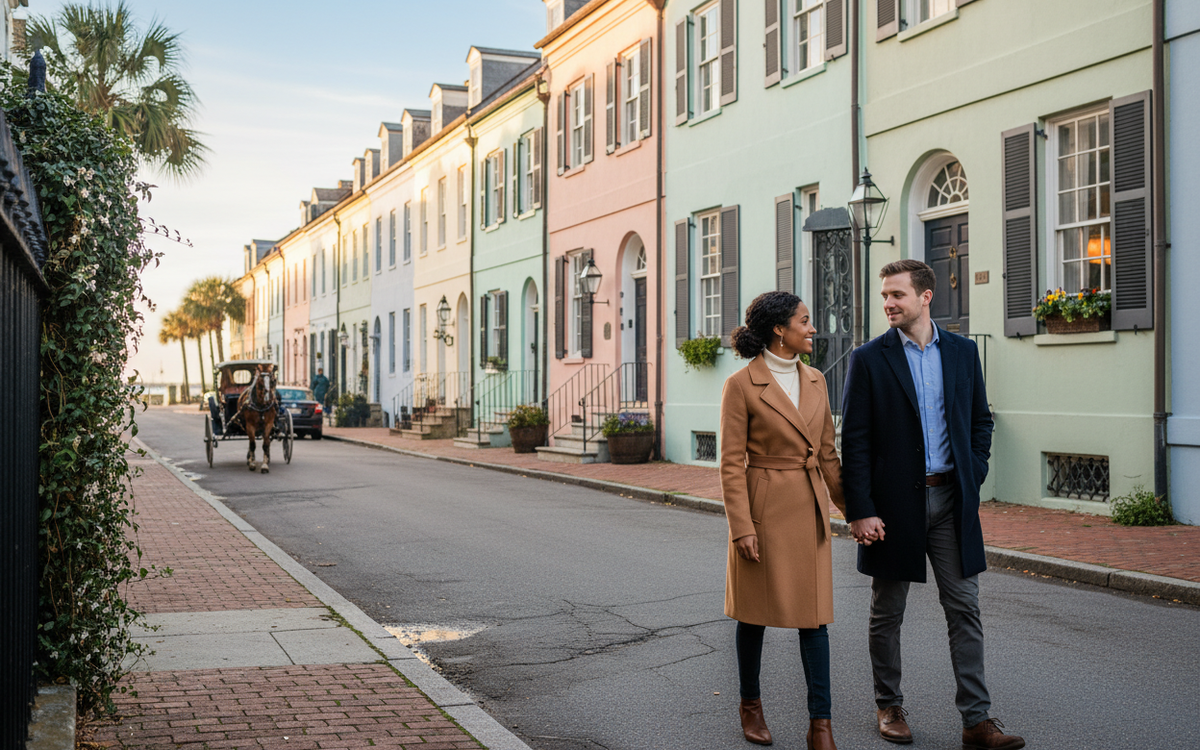
The moment you turn onto East Bay Street and the pastel facades of Rainbow Row come into view, Charleston’s romantic reputation feels utterly justified. Thirteen historic townhouses stand shoulder-to-shoulder between Tradd Street and Elliott Street, painted in shades of coral, mint, lemon cream, and seafoam that seem to soften even the most unforgiving midday light. In the quieter hours of the morning, when the streets are still damp from the night’s humidity and the air smells faintly of the nearby Cooper River, the row feels almost like a stage set awaiting its protagonists. That is where you and your partner come in.
Up close, Rainbow Row’s beauty is in the details. Stucco walls show the gentle imperfections of hand-applied plaster, while arched doorways are framed by fanlights of delicately etched glass. Wrought-iron window grilles curl into graceful tendrils, and shutter dogs shaped like sea creatures and scrolls pin open wooden shutters painted a slightly deeper hue than the walls they guard. Many of the buildings once housed merchants who kept their shops on the ground floor and lived above; today, private residences and offices give them a quieter, more lived-in feel. If you listen closely, you can sometimes hear muffled laughter or the clink of dishes from within, reminders that behind those photogenic facades are families going about their days.
Rainbow Row owes its survival, and its now-iconic colors, to a wave of preservation-minded Charlestonians in the early twentieth century. In the years after the Civil War, the neighborhood had fallen into disrepair. In the 1920s and 1930s, preservation pioneers began buying up the crumbling buildings one by one, determined to save them from demolition. One homeowner chose a warm pink inspired by Caribbean palettes, another followed with soft blue, then came pistachio green and butter yellow. What had been a row of tired storefronts gradually transformed into a pastel procession, a quiet act of civic romance that has since become one of the most photographed scenes in the South.
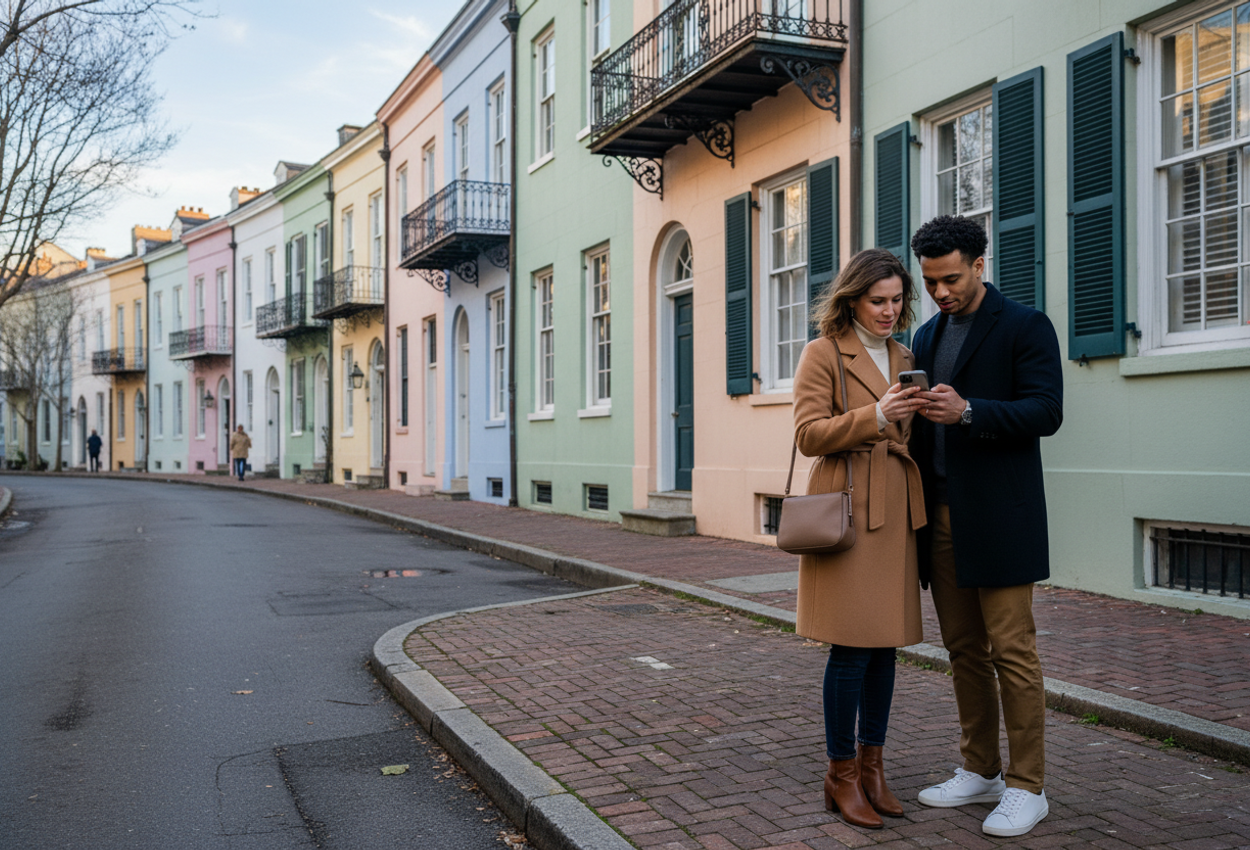
As you walk hand-in-hand along the narrow brick sidewalk, the sounds of traffic soften, replaced by the hollow tap of your footsteps and the occasional creak of a carriage rolling by. The river lies just beyond the houses, hidden by trees and the later-filled land of East Bay Street, but you can feel its cool breath against your skin. Jasmine vines snake up railings, and in late spring and summer the air is thick with their honeyed perfume, mingling with the mineral scent of old brick warming in the sun. Couples pause in front of doorways, laughing as they try to frame the perfect shot without another visitor wandering into the frame.
For truly romantic light, arrive in the golden hour before sunset or just after dawn. In the morning, soft light skims across the facades, catching the beveled edges of window frames and setting the pastel paint aglow, while the street is still hushed and locals walk dogs or carry coffee cups under the drape of overhanging branches. In the evening, the western sun bounces off the windows and warms the colors to a gentle burnish, while the sky above the harbor deepens from blue to violet. Stand on the opposite side of East Bay Street, backs against the low seawall, and you can take in the whole row at once, framed by palmettos and a strip of sky that feels made for a cinematic kiss.
Hidden just behind the spectacle are small, easily overlooked moments that reveal Rainbow Row’s quieter side. Peer through an open gate to glimpse a private courtyard where a wrought-iron fountain trickles into a mossy basin, or where a single cafe table waits under a citrus tree heavy with fruit. Some homeowners leave gas lanterns burning day and night, their gentle flames flickering against brick that remembers centuries of storms and celebrations. It is here, in these small pockets of domestic life, that Rainbow Row stops being just a backdrop and becomes part of Charleston’s ongoing love affair with its own history.
Whispered Secrets on a Horse-Drawn Carriage Ride
There is a distinct, almost ceremonial pleasure in climbing into a horse-drawn carriage in Charleston’s Historic District. The carriage springs low, the leather seats creak softly, and as you settle beside your partner, the horse tosses its head and the harness bells chime. Then comes the first resonant strike of hoof on stone, the rhythmic clip-clop echoing between brick facades, and in that instant the twenty-first century seems to loosen its grip. The pace slows to that of hooves and stories, and the city unfurls around you like an illustrated book.
Carriage companies cluster near the City Market, where guides in straw hats and suspenders pair visitors with their equine escorts. Once aboard, your carriage may thread its way down Meeting Street toward Broad Street, then slip into narrower lanes where centuries meet at every corner. As you roll past the gleaming white columns of St. Michael’s Church, your guide might recount how its steeple has served as a navigational beacon for ships since the eighteenth century, and how its bells once rang for both colonial assemblies and wartime alarms. Lovers lean closer, sharing a blanket on brisk evenings or the slight shade of a parasol on warm afternoons, as the stories layer over the soundscape of hooves and harness.
The route is determined in part by a lottery system, but romantics should request one that meanders past the fabled Sword Gate House on Legare Street. When your carriage turns beneath the live oaks of this elegant residential stretch, the mood shifts to something hushed and intimate. Here, stately mansions withdraw behind high brick walls softened by creeping fig and cascading ferns. At 32 Legare, the Sword Gate House’s imposing wrought-iron gate comes into view, its pair of crossed swords curving like something from a Gothic romance. Lanterns glimmer behind the ironwork, throwing lacy shadows across the cobbled street. As your carriage slows, your guide shares that the gates were forged in the early nineteenth century and that legends swirl about the house’s former inhabitants and their secrets.
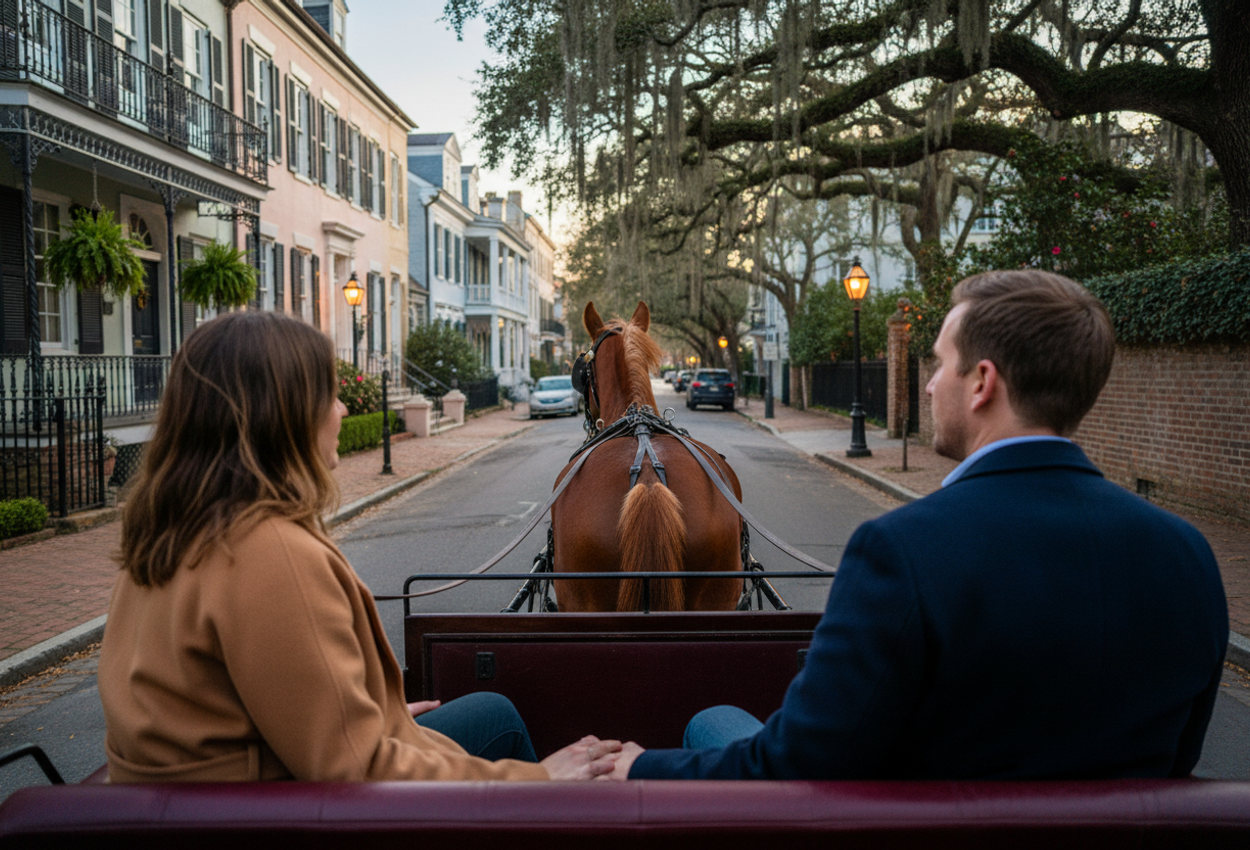
Cobblestone or Belgian block streets like Chalmers Street add their own texture to the journey, the wheels bumping in a slow, almost rocking rhythm that nudges you closer together. The horse’s breath puffs in small clouds on cooler evenings, rising briefly into the lamplight before dissolving into the night. As you pass the Gothic pinnacles of the French Huguenot Church and the weathered charm of the Dock Street Theatre, it is easy to imagine earlier couples tracing this same route in high-waisted gowns and tailcoats, listening for the same church bells and the same distant rush of tides.
The romance of the carriage ride lies not just in what you see, but in what you hear and feel. The cadence of the guide’s voice, part history, part folklore, rises and falls with the clatter of hooves, while the gentle sway of the carriage encourages you to lean in, to share a private smile or rest a head on a shoulder. When the horse pauses at intersections, there is a moment of stillness: the smell of horsehair and leather, the faint sweetness of blooming camellias in winter or gardenias in late spring, the rustle of palm fronds overhead. In a city that has known fire, hurricanes, and war, the simple continuity of a horse-drawn carriage making its slow path through the streets feels like an act of faith in the persistence of beauty.
As the ride draws to a close and your carriage returns toward the market, you may find yourselves surprised by how much ground you have covered without ever feeling rushed. That is the gift of Charleston’s carriage tours: they compress the city’s grand narrative into an hour or so, but they do it at a pace that allows romance to gather in the spaces between facts. Step down from the carriage, fingers still entwined, and you will carry with you the soft thunder of hooves and the lingering sense that you have just slipped through time together.
Sunset Serenade Aboard the Schooner Pride
For couples who want to see Charleston from the angle it was first introduced to the world, nothing rivals a sunset sail aboard the Schooner Pride. Moored at Aquarium Wharf along Concord Street, this 84-foot, three-masted tall ship looks like it has wandered out of a maritime painting. From the moment you step onto her wooden deck, the city’s church spires and rooftops become a backdrop, and the harbor takes center stage.
The Pride eases away from the dock with a low hum of the engine before the crew unfurls canvas and invites guests to help hoist the sails. Lines rasp through calloused hands, the sails billow, and suddenly the engine cuts, replaced by the shush of water against the hull and the faint creak of rigging overhead. Couples drift toward the rails or claim a spot along the bow, where the wooden planks are still warm from the afternoon sun. With the February air carrying a crisp edge but softened by the day’s warmth, you tuck closer under a shared jacket or shawl, a plastic cup of wine or local beer cool in your hand.
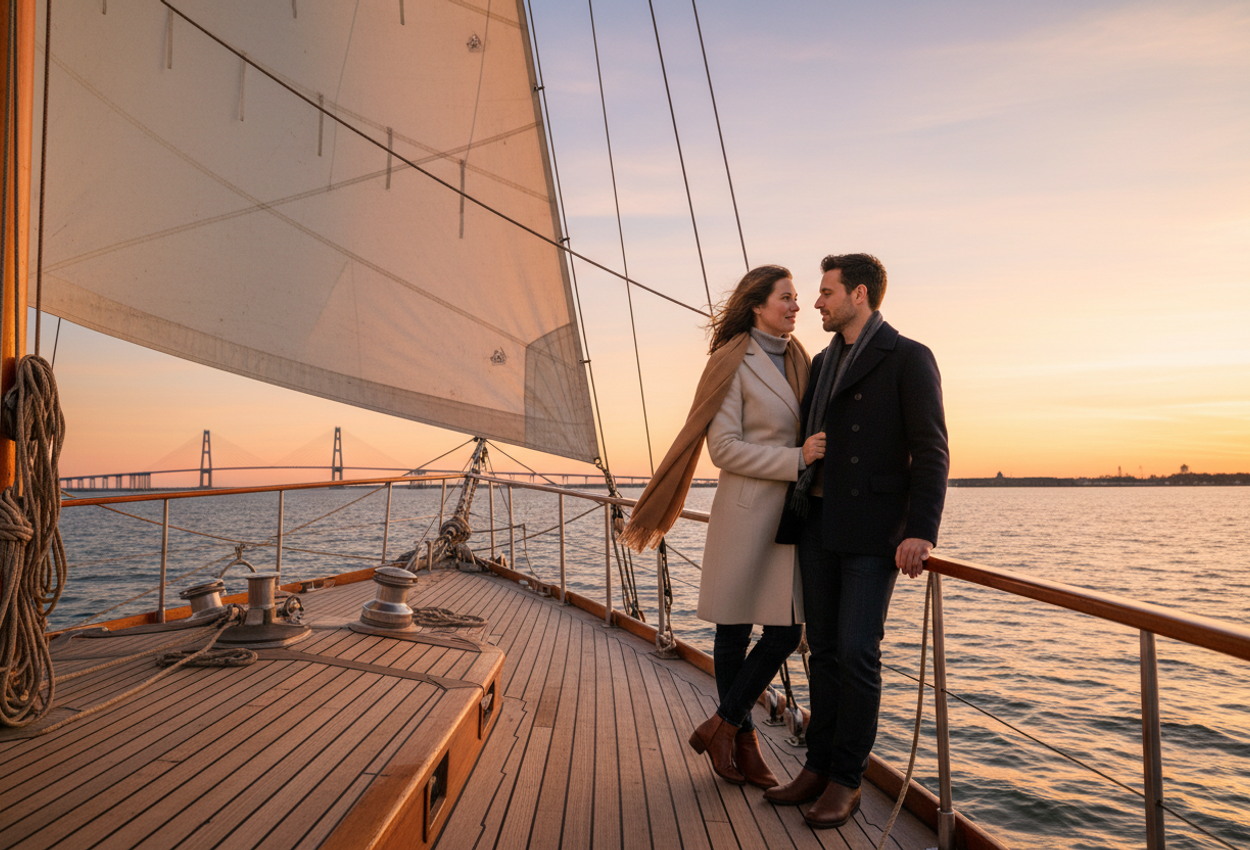
As the Schooner Pride glides toward the mouth of Charleston Harbor, the city slowly shrinks behind you, steeples of St. Philip’s and St. Michael’s etched against the sky. To starboard, the long, low silhouette of Fort Sumter appears, crouched on its artificial island where the first shots of the Civil War were fired. To port, the skeletal lattice of the Arthur Ravenel Jr. Bridge stretches across the Cooper River, its twin diamond towers catching the last of the sun like a piece of modern sculpture. Dolphins sometimes surface alongside the ship, their smooth backs slicing through bronze water, while pelicans glide low, wingtips skimming the waves.
The real romance, though, happens in the sky. As the winter sun tilts toward the horizon, it bleeds copper and rose across the water, painting a molten path that leads straight to your feet at the rail. Cloud wisps turn to brushstrokes of mauve and fire. The wind lifts strands of hair and carries the briny scent of the Atlantic, tinged with sea grass and distant pluff mud. With no narration droning in the background, conversations fall to a murmur, punctuated only by the soft pop of a bottle cap or the clink of ice in a cup. You and your partner can speak in low voices or stand in comfortable silence, lulled by the gentle heave of the ship.
The best spot for couples is near the bow on the leeward side, where the wind is gentler and the views are unobstructed. From here, as twilight deepens, Charleston’s skyline becomes a shadow play of spires and rooftop lines stitched with the first pricks of light. The bridge flickers to life in a string of glowing pearls, while lighthouses and channel markers wink on across the harbor. Above you, the masts rise into the indigo sky, ropes mapped like constellations. The Pride herself is a modern vessel built to evoke a nineteenth-century trading schooner, and that blend of history and comfort is part of her charm: enough authenticity to stir the imagination, enough stability and safety for you to forget everything but the person beside you.
By the time the Schooner Pride turns back toward the city, the sun has melted into the horizon, leaving a faint, apricot afterglow. The air cools quickly on the water in February, making your shared wrap or coat all the more welcome. Couples huddle closer, shoulders touching, hands clasped, faces softly illuminated by the deck’s small lights as the ship glides toward a harbor twinkling with restaurant windows and streetlamps. When you step back onto the dock and feel the solid pavement beneath your feet, you will likely share the same expression as your fellow passengers: a kind of drowsy contentment, as if the sail has rewound time just enough to give you a longer evening together.
A Culinary Love Affair at Chez Nous
In a quiet residential pocket just off Coming Street, the romance of Chez Nous begins before you even step through its doorway. The restaurant occupies a slender, two-story house from the nineteenth century, painted a soft, unassuming hue that lets the details shine: a narrow balcony with iron balustrade, wooden shutters slightly ajar, and a petite front garden where herbs and climbing vines soften the brick. A hand-lettered menu hangs by the entrance, often in French, listing just two starters, two mains, and two desserts for the day. The brevity feels like a promise: what you will eat here will be thoughtful, intimate, and ephemeral.
Inside, light pools in from tall windows, catching the dust motes that drift above polished wooden tables. On winter evenings, candles flicker in mismatched brass holders, their glow reflecting off whitewashed brick walls and old floorboards that creak underfoot. The dining room is small enough that you can hear the low murmur of other conversations without ever feeling crowded. Couples lean toward each other across the table, sharing not just plates but glances and quiet asides. A faint aroma of butter and shallots wafts from the open kitchen, mingling with the toastiness of bread just pulled from the oven.
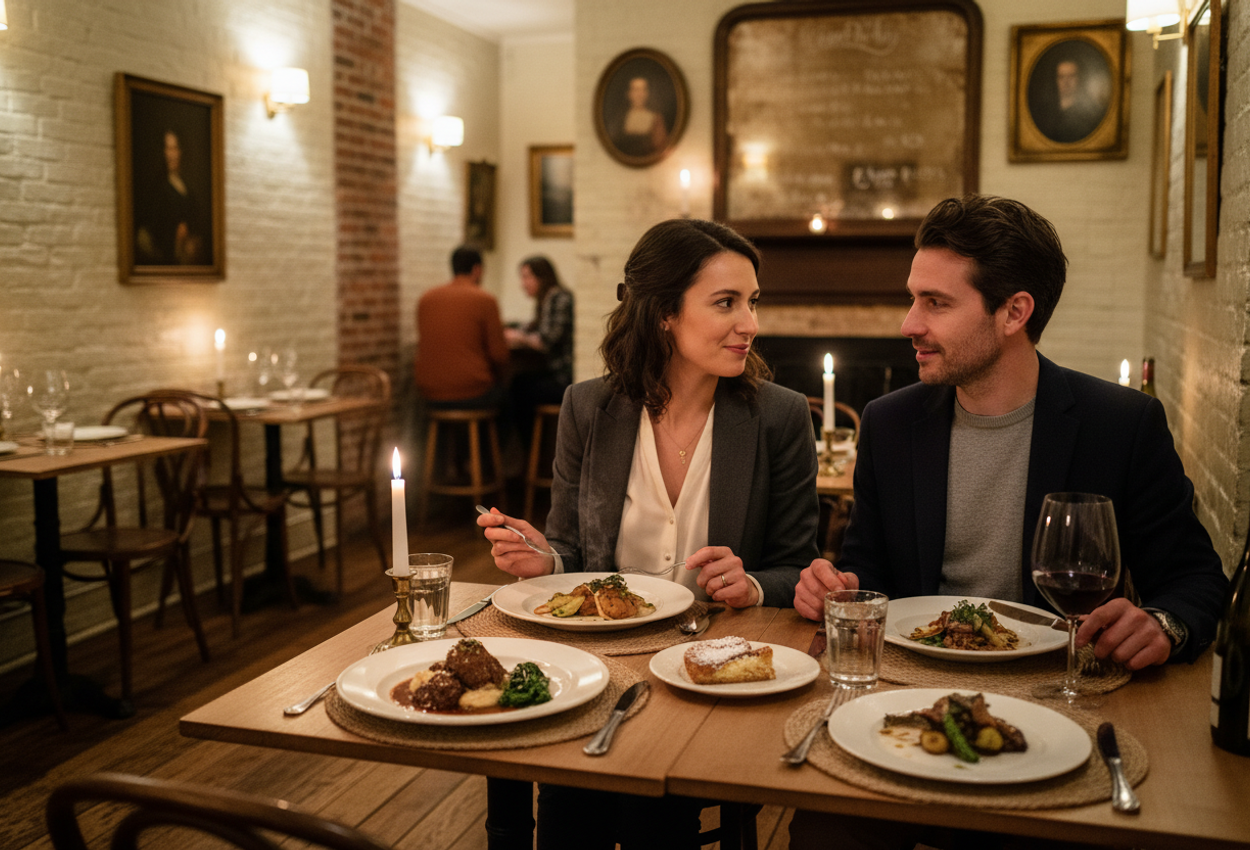
The menu changes daily, drawing inspiration from rustic French fare and Mediterranean coastal cooking. You might begin with a bowl of velvety chestnut soup, steam curling up into the candlelight, its earthy sweetness balanced by a drizzle of olive oil and a scatter of crisp lardons. Or perhaps there is a plate of delicate sardines grilled and laid atop toasted baguette, sharpened with lemon and crowned with a tangle of fennel and herbs. Shared between two, these dishes become part of a quiet ritual: dipping torn bread into the same pool of broth, trading bites from fork to fork, negotiating who gets the last morsel.
Main courses may lean toward slow braises in cooler months, like a coq au vin whose sauce has been coaxed into a rich, wine-dark gloss that clings to each bite of tender chicken and pearl onion. Or there might be a simple but perfect steak frites, the meat seared until its edges char and its center yields in rosy slices, crowned with a disk of herb butter that melts in slow rivulets onto a pile of crisp, salty fries. Even the salads here feel decadent: bitter greens slicked with a Dijon vinaigrette, jeweled with walnuts and shards of aged cheese, their bitterness underscoring the lushness of everything else on the table.
Dessert might be a cloudlike chocolate mousse that trembles slightly in its coupe glass, dusted with cocoa and sending up a fragrance of dark chocolate and cream. Or perhaps a rustic clafoutis arrives, studded with fruit and baked until the edges puff and caramelize, the custard within just barely set. A glass of Beaujolais or Loire white, chosen from a small but thoughtful wine list, rounds out the embrace. The soundscape is clinking cutlery, the occasional pop of a cork, and the soft cadence of French and English intermingling as servers describe dishes with quiet pride.
The building itself is a tangible link to Charleston’s deep French roots. In the seventeenth and eighteenth centuries, French Huguenots fleeing religious persecution settled in the city, bringing with them culinary traditions and a taste for convivial, lingering meals. While Chez Nous is a modern creation, its intimate scale and home-like setting echo those early dining rooms, where meals stretched late into the night and food was inseparable from conversation. Sitting at a small table here, with your knees almost brushing and the glow of a candle illuminating your partner’s face, you are participating in a long lineage of shared, leisurely suppers that have always defined Charleston’s more romantic side.
Reservations are essential, especially for prime evening slots and weekend brunches, and should be made well in advance for a special occasion. If you can, request a table by the window upstairs, where the street outside feels far away and the dining room takes on the aspect of a private salon. By the time you step back onto the quiet sidewalk, the air cool against your skin and the smell of wood smoke lingering from nearby chimneys, you will likely feel as though you have slipped out of ordinary time and into a story you will recount to each other for years.
Luxury and Lavender at The Dewberry Spa
High above the bustle of Meeting Street, the Dewberry Spa offers couples a cocoon of calm where city sounds dim to a soft murmur and the sensory world narrows to touch, scent, and breath. Tucked within The Dewberry Charleston, a mid-century modern hotel lovingly reimagined from a former federal building, the spa pares back excess in favor of quiet luxury. Cypress-paneled walls, dimmed lighting, and mid-century lines create a serene, almost cinematic backdrop for an afternoon devoted entirely to each other.
From the moment you step inside, a spa concierge invites you to sit, offers you a cup of herbal tea, and drapes a warm, lavender-scented neck pillow across your shoulders. The air is cool and softly humid, carrying notes of citrus and florals from the carefully chosen products lining the shelves. Voices are hushed, and the only persistent sounds are the distant burble of a small water feature and the whisper of thick robes brushing against tile. As you and your partner trade street shoes for slippers and shrug into plush robes, the city’s cobblestones and carriage wheels feel a world away.

The couples’ suite is a sanctuary of its own. Two massage tables are draped in crisp white linens, lit by the kind of warm, indirect light that makes everyone look well-rested. A hint of eucalyptus mingles with lavender as your therapists introduce a bespoke couples ritual designed specifically for shared relaxation. Perhaps you choose a signature treatment that combines a full-body massage with elements drawn from Lowcountry botanicals: warm oil infused with native dewberry, ginger, or sea minerals, smoothed over skin in long, rhythmic strokes. The tables are heated just enough for you to sink into them, tension slipping away as the therapists’ hands work along tired muscles and tight shoulders.
As the massage progresses, the outside world recedes further. You become aware of smaller sensations: the weight of a hand gently supporting your neck, the soft rasp of cotton as a sheet is adjusted, the distant, synchronized exhalations as both you and your partner release a breath at the same time. A quiet glance exchanged when you both open your eyes to turn over feels as intimate as a whispered declaration. In the background, low instrumental music, more suggestion than melody, keeps time with the careful choreography of touch.
After the treatment, you are invited to linger in the relaxation lounge. Here, a row of chaise lounges faces tall windows that frame Charleston from above: the bronze dome of a nearby church, the lacework of live oaks in Marion Square, the faint glint of the harbor beyond. Wrapped in robes, you sip cucumber water or perhaps a glass of sparkling wine, your feet sinking into the deep pile of the rug. The scent of lavender still clings to your skin, undercut by the clean, mineral sharpness of the steam room where you might spend a few minutes letting warmth loosen any last traces of tension.
The Dewberry Spa’s true hidden romance lies in its emphasis on time. Treatments are not rushed; transitions between spaces are deliberately gentle. A couples package that pairs side-by-side massages with hydrating facials or seaweed body wraps allows you to share the full arc of the experience, emerging together with the same slow-blink serenity. For those looking to mark a particular milestone, arranging a late-afternoon session that flows into cocktails at the hotel’s Citrus Club rooftop bar extends the mood: you step from the tranquility of the spa into the open air, the scent of essential oils giving way to fresh lime and sea breeze as the sun sinks behind the city.
Booking ahead is crucial, especially for couples experiences on weekends and around holidays. Request the dedicated couples’ suite and ask about packages that incorporate local ingredients or seasonal elements, like warming ginger oils in winter. When you finally leave, street clothes newly soft against freshly moisturized skin and the city’s sounds returning in layers, you will do so with that uniquely spa-induced sense of dislocation, as if you have slipped out of Charleston for a few hours and returned in a lighter, more luminous version of yourselves.
Picnic Perfection in Waterfront Park
Down by the banks of the Cooper River, where sea breeze threads through the palmettos and salt air sharpens the appetite, Waterfront Park unfolds as one of Charleston’s most inviting open-air salons. Long, shaded walkways lined with double rows of live oaks offer respite from the sun, while broad lawns slope gently toward the river’s edge. At the park’s heart, the Pineapple Fountain sends arcs of water cascading down the tiers of its bronze fruit, a joyful symbol of the city’s storied hospitality.
Arrive in the late afternoon with a picnic basket in hand, and the park feels like a shared living room for locals and visitors alike. Children dash across the grass, couples recline on blankets, and joggers pause to catch their breath beside the railings overlooking the harbor. In winter’s softer light, the sun hangs lower in the sky, painting the water in bands of silver and pale gold. The air carries a subtle chill, but it is tempered by the warmth that builds up in the brick paving and stone benches over the course of the day.
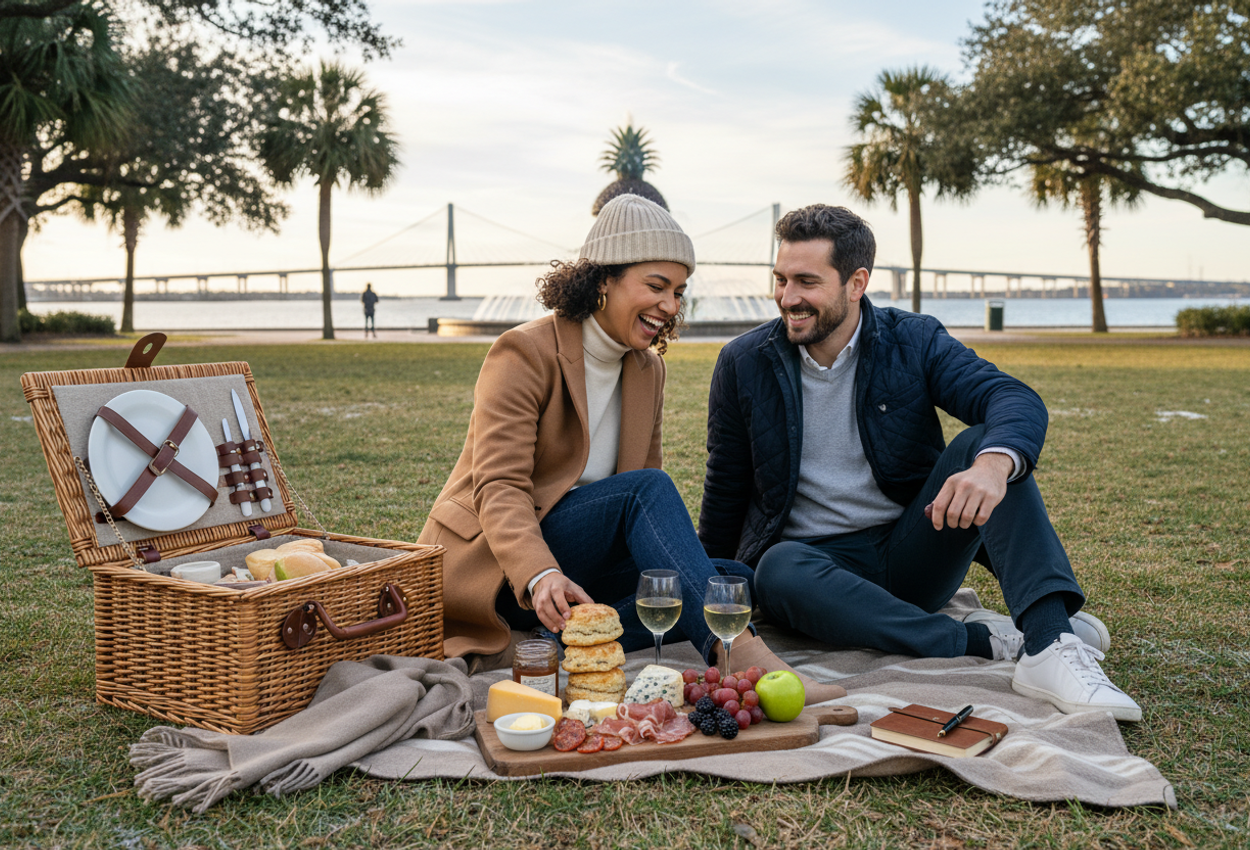
For a picnic worth lingering over, stock your basket with local delicacies before you arrive. From Callie’s Hot Little Biscuit, pick up a box of their signature biscuits still warm from the oven. Split one open and steam escapes in fragrant curls, carrying the buttery richness of dough and the faint sweetness of buttermilk. Some might be studded with sharp cheddar and chive; others layered with country ham that brings a salty, savory punch. Add a selection of cheeses and cured meats from Goat.Sheep.Cow. downtown: a creamy chèvre with a tang that cuts through the richness of the biscuits, a wedge of aged sheep’s milk cheese whose nutty aroma rivals that of the pecans scattered across your salad.
Spread a blanket on the grass near the water’s edge, a short stroll from the Pineapple Fountain but far enough that the splash becomes a soothing backdrop rather than a distraction. As you unpack, the textures build into a feast: the crackle of butcher paper as you unwrap cheeses, the glossy sheen of olives tumbled from a small jar, the sugary scent of seasonal fruit that leaves your fingers slightly sticky. Sips from a bottle of local sweet tea or sparkling water fizz at your tongue, and each bite seems heightened by the simple pleasure of eating outdoors, shoulders brushing, shoes kicked off to press bare toes into the cool grass.
For a more secluded feel, wander toward the park’s northern end, where a quieter stretch of lawn is shaded by oaks and buffered from the busier promenades. Here, couples lean against tree trunks and watch container ships glide by, their hulking silhouettes improbably silent at this distance. The river breathes in low, regular laps against the pilings, and the occasional cry of a gull slices through the gentle murmur of conversation. When the sun begins its descent, the sky over the Ravenel Bridge ignites in streaks of coral and lavender, mirrored in the river’s shifting surface.
Later, wander back toward the Pineapple Fountain and dip your hands into its cool basin, listening to the water drum against the lower pool. Streetlights flicker on, illuminating the fountain’s textured surface and throwing moving patterns of light across your faces as you lean close for a photo. The scent of the river grows slightly stronger at night, tinged with seaweed and the metallic tang of distant docks, but the park retains its easy grace. With the stars beginning to show above the dark outline of palmettos, it is easy to imagine returning here again and again, each picnic a new chapter in a shared Charleston story.
Moonlit Stroll Through Philadelphia Alley
When daylight fades and the last carriage wheels rattle back toward their barns, Philadelphia Alley reveals its most beguiling self. Tucked discreetly between Queen Street and Cumberland Street, the narrow passage might be missed by hurried daytime visitors. At night, however, the gas lamps along its brick walls flicker to life, casting wavering halos of amber light that transform the alley into a corridor of shadows and whispers.
The alley’s surface is a mosaic of worn brick and stone, uneven enough that you naturally slow your steps. As you walk, hand in hand, your footfalls sound louder here than they do on the broader streets outside, echoing off the high walls of townhouses that guard the passage. Ivy curls over the masonry in dark, velvety clumps, and the air, caught between the buildings, carries a cool dampness even on mild nights. You can smell old mortar and earth, a faint trace of coal smoke from an unseen chimney, and, in certain seasons, the ghost of jasmine or tea olive lingering long after the flowers have closed.
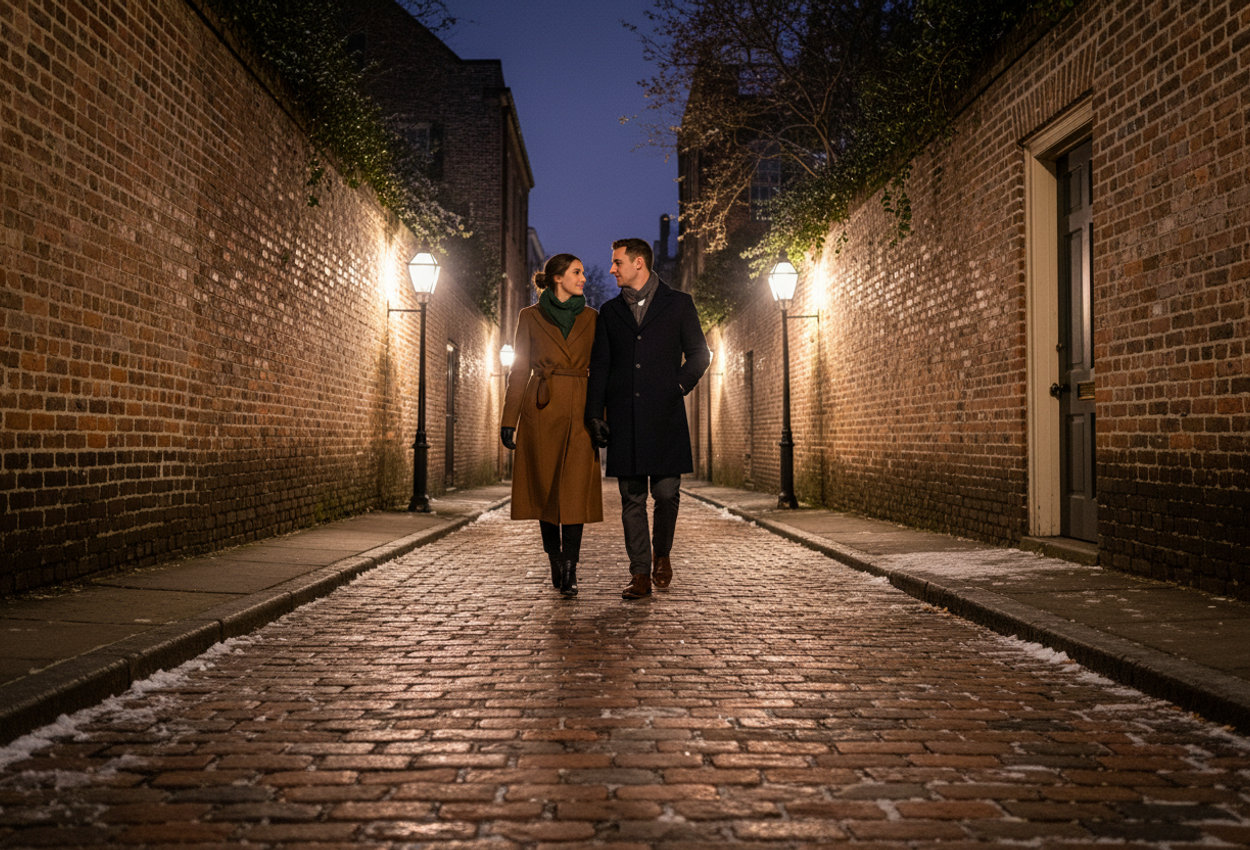
Philadelphia Alley’s romantic allure is inextricable from its reputation as a place of duels and hauntings. In centuries past, this passage was known as a ground where gentlemen settled matters of honor at dawn, when the light was low and the stakes high. Local lore tells of hot-headed rivals who faced each other here with pistols or swords, their seconds standing by, breath pluming in the cool morning air. Today, couples strolling beneath the lamps sometimes pause mid-step, imagining the tense silence that must once have filled this same narrow space, broken only by the sharp report of a shot or the ring of steel on steel.
Ghost stories cling to the alley like mist. Guides on evening walking tours sometimes stop at its entrance to share tales of a heartbroken duelist whose footsteps are said to echo long after midnight, or of a woman in old-fashioned dress glimpsed just for a moment at the far end of the passage before she disappears. Whether or not you believe in such things, the setting invites a touch of theatrical shiver. A breeze snakes down the alley, setting the flame in a nearby gas lantern to gutter and lean, and for a second the brick walls seem to press in closer, the past nearer than you thought.
Yet for all its ghosts, Philadelphia Alley is also profoundly tender at night. The close quarters create a sense of privacy, even when other couples or the occasional tour group passes by. You may find yourself speaking more quietly, as if the alley itself demands a softer tone. Shadows from overhanging balconies and tree branches trace wavering patterns on your faces, and when you glance up, a slice of star-salted sky appears between the eaves of the houses. In that pocket of darkness and lamplight, a simple act like pausing to adjust a scarf or brush a stray curl from a forehead becomes charged with intimacy.
Emerging from the alley back onto Queen Street, you will feel a small but distinct shift, as though you have passed through a portal. The broader street, with its restaurant chatter and scattered traffic, seems brighter and louder, the present rushing back in. But the mood of Philadelphia Alley lingers: the soft echo of your footsteps, the scent of old brick, the sensation of your partner’s hand warm and steady in yours as you walked through a place where history compresses into a single, shared moment. It is the kind of quiet, off-the-main-drag experience that transforms a romantic getaway into a story you will tell long after you leave.
Intimate Cooking Class at Zero George
On the edge of the historic district, a short stroll from the harbor, the collection of restored carriage houses and main residence that make up Zero George Street feel like a secret compound. Brick paths weave through manicured courtyards, gas lanterns glow beside paneled doors, and the hush here is almost monastic compared to the nearby bustle of East Bay Street. Tucked into one of these outbuildings is the Zero George Cooking School, where couples can trade restaurant reservations for a front-row seat at the stove, learning to coax magic from Lowcountry ingredients together.
The setting is pure Charleston charm. Inside the historic carriage house, exposed beams run overhead, and original brick walls hold the day’s warmth. A central demonstration counter gleams under pendant lamps, lined with cutting boards, gleaming knives, and small bowls of prepped ingredients that look almost too artful to use. As you take your seats at the counter or nearby bistro tables, glasses of wine or sparkling water in hand, the chef greets the group and outlines the evening’s menu: a three or four-course journey through the coastal South that might include she-crab soup, seared local fish, and a dessert perfumed with bourbon and pecans.
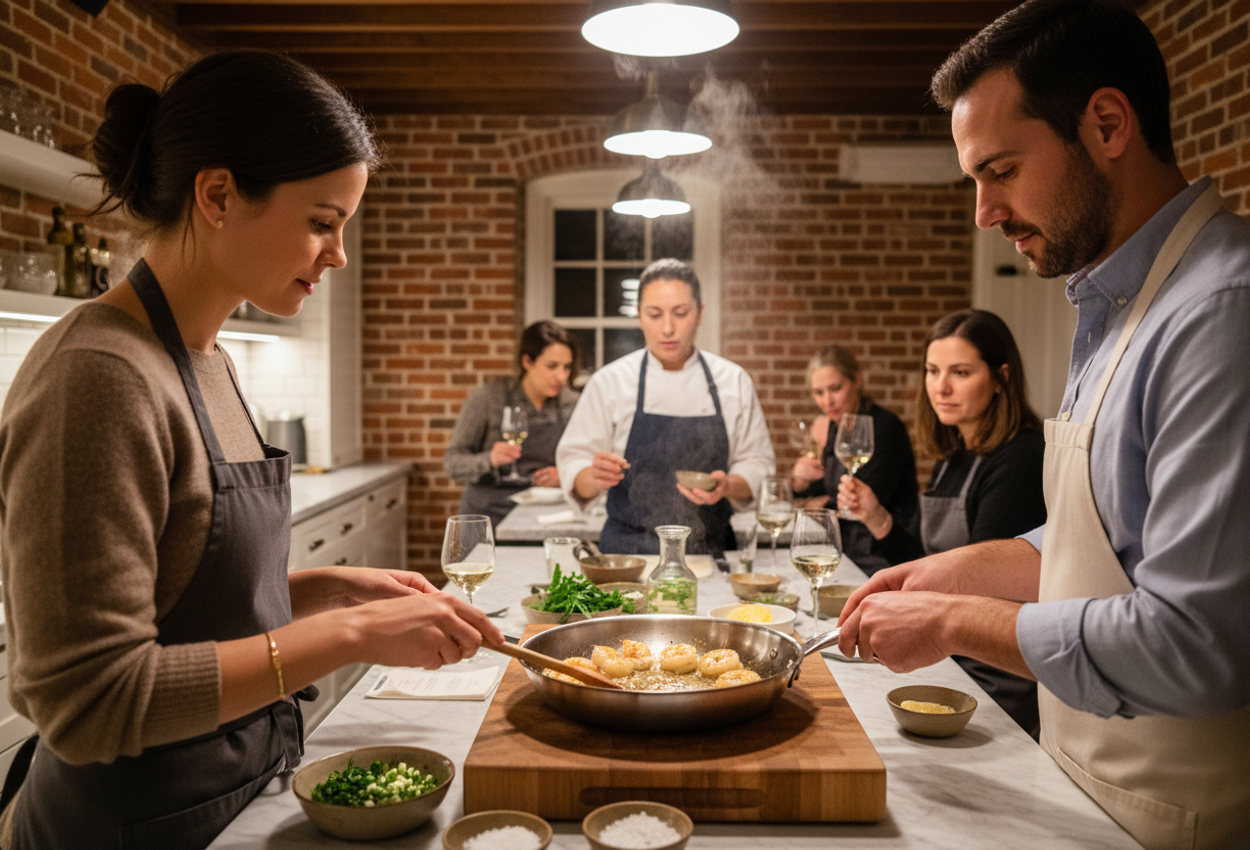
The sensory immersion begins immediately. Butter hits a hot pan with a low hiss, releasing a nutty aroma that winds through the room. Onions and celery soften, turning translucent and sweet, their scent a familiar base note for the rich she-crab soup that is Charleston’s signature. The chef encourages you to lean in, to inhale the transformation as flour is whisked in to form a roux, as sherry splashes into the pot and sends up a wine-scented cloud. You and your partner exchange looks over your cutting boards, amused at how something you have ordered countless times in restaurants suddenly feels new when you are the ones coaxing it into being.
Hands-on elements might include deveining shrimp, gently folding lump crabmeat into a creamy base without breaking its delicate clumps, or learning the wrist flick that yields perfectly golden, pan-crisped fish skin. A bowl of local stone-ground grits sits nearby, its surface glossy with butter, sending up steam that carries a faint whiff of sweet corn. You taste as you go, small spoons offered back and forth: a mouthful of velvety soup here, a flake of just-cooked fish there, each bite punctuated with whispered evaluations and the quiet satisfaction of getting it right.
Throughout, the chef weaves in stories of Lowcountry foodways: of rice once grown in the region’s tidal fields, of the deep West African roots in dishes like okra stew and red rice, of the way local fishermen still bring in she-crabs whose roe helps give the soup its distinctive richness. This cultural context adds a layer of meaning to the experience. You and your partner are not just learning techniques; you are participating in a living tradition, one that intertwines history, geography, and community on every plate.
By the time you sit down to eat the meal you have helped prepare, the room has taken on the conviviality of a dinner party. Candles flicker, glasses clink, and the conversation flows easily between couples and with the chef. A hidden gem of the Zero George experience is walking away with a recipe tailored for a romantic dinner at home: perhaps a simplified she-crab soup adapted to ingredients you can find in your own market, or a pan-seared fish with a lemon-butter pan sauce and creamy grits that you can recreate on a future anniversary. The knowledge that you can summon a bit of Charleston’s flavor in your own kitchen becomes a souvenir as potent as any photograph.
Stepping back into the night air after class, the scent of sautéed garlic and warm sugar clinging faintly to your clothes, you wander through the hotel’s hushed courtyards, past flickering lanterns and the silhouettes of palms. The harbor is just a few blocks away, and if the night is clear, stars glint above the black band of water. Cooking together, you realize, has become another way of writing yourselves into the city’s story: two more characters in Charleston’s long-running romance between place, palate, and the pleasures of good company.
Sunset Kayaking Adventure at Shem Creek
Across the Arthur Ravenel Jr. Bridge in Mount Pleasant, the working waterfront of Shem Creek offers a more laid-back, salt-stained kind of romance. Here, shrimp boats with weathered hulls and tall rigging line the docks, their names painted in fading script, while pelicans perch on pilings like patient, prehistoric sentries. As the day wanes, kayakers and paddleboarders slip into the water, gliding past dockside bars and restaurants before the creek widens into a maze of marsh grasses and tidal flats bathed in honeyed light.
Rent a tandem kayak from one of the outfitters clustered near the public landing, and you will push off into water that rocks the boat in gentle, rhythmic swells. The paddle blades dip and pull, sending little eddies swirling out behind you. At first, the sounds around you are lively: music floating from open-air decks, laughter from patrons leaning over railings with drinks in hand, the clatter of plates as servers clear tables for the dinner rush. But as you steer away from the docks and follow the sinuous path of the creek toward the open marsh, that soundtrack fades, replaced by the soft splash of your paddles and the chirr of marsh insects tuning up for the night.
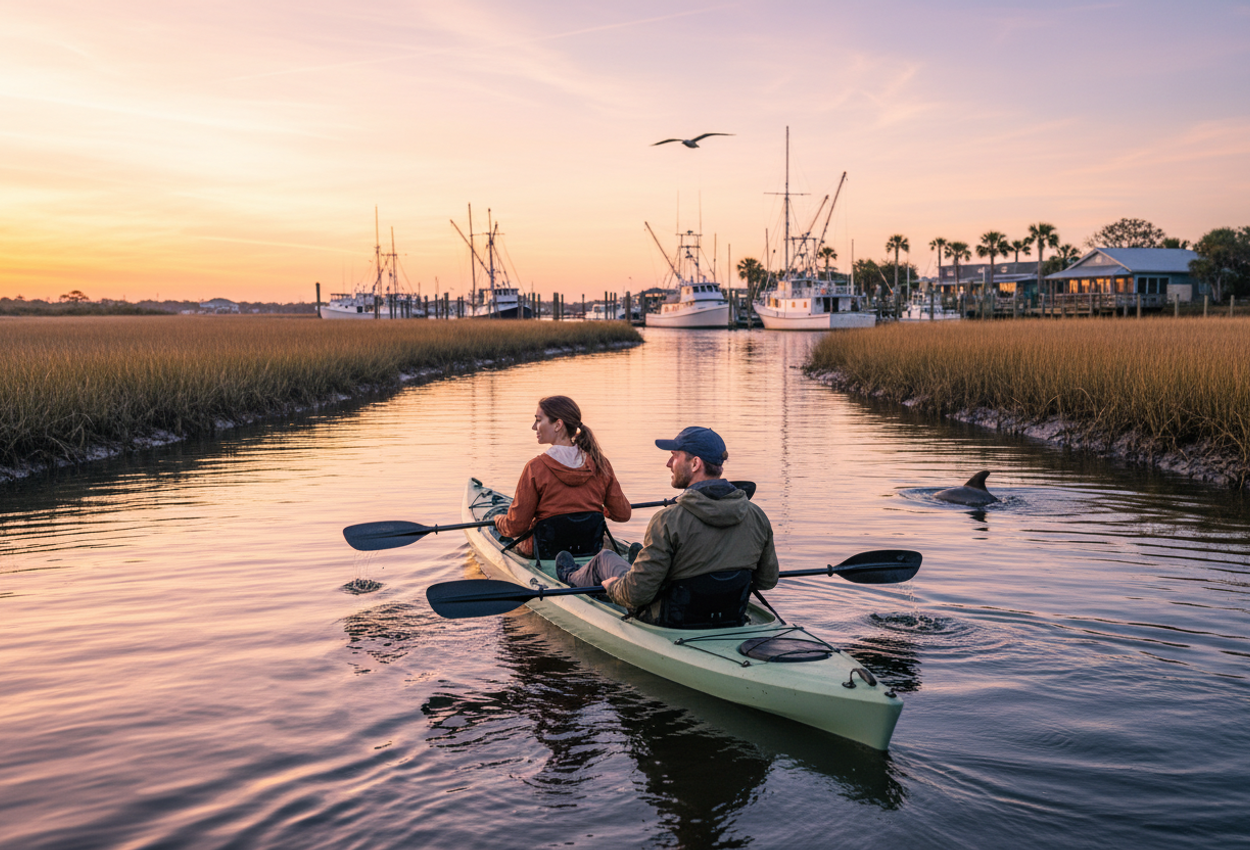
The air out here feels different, freer. It smells of salt and mud and sun-warmed spartina grass, with occasional notes of diesel from a passing shrimp boat reminding you that this is still a working waterway. Herons stand in the shallows, statuesque and intent, while egrets lift into slow, deliberate flight as you draw near, their white bodies briefly incandescent in the slanting sunlight. Pods of dolphins often cruise Shem Creek around sunset, their dorsal fins cutting brief, dark arcs through the water. When one surfaces near your kayak, exhaling with a soft, explosive puff, you and your partner will likely fall silent, grinning at each other in shared delight.
As the sun sinks lower, the whole landscape shifts color. The marsh, which at midday is a straightforward green, becomes a patchwork of yellows and ambers, each blade of grass rimmed in light. The water darkens to a deep slate blue, except where it catches the sun and flashes molten gold. Paddling becomes almost meditative: dip, pull, drip, the small splashes marking time. The breeze strokes your cheeks, cool but not cold in early February, carrying with it the taste of salt that dries in a faint film on your lips.
For an especially romantic vantage point, steer your kayak toward the broad bend where the creek opens up toward the Charleston Harbor, then drift and let the current hold you as the sun disappears behind the distant line of the city. The Ravenel Bridge rises in the distance, its silhouettes mirrored in the water, while behind you, the lights of Shem Creek’s boardwalk establishments begin to glow, string lights reflecting in little broken lines across the surface. In that in-between zone, you occupy a front-row seat to both wild marsh and human conviviality, your kayak a private island just large enough for two.
Returning to the dock in the gathering dusk, you will feel the shift as the bustle of evening service returns to your ears: clinks of silverware, live music tuning up, the smell of fried seafood and Old Bay wafting across the water. Your arms might ache pleasantly from the paddling, and drops of creek water will dry in irregular patterns on your clothes, but your minds will be softened by the slow rhythm of the outing. Later, perhaps over a shared plate of shrimp and grits at a creekside restaurant, you will replay the small moments: the first dolphin sighting, the egret’s takeoff, the way the sun turned the marsh to molten bronze. Shem Creek, in its mix of grit and glow, offers a different flavor of Charleston romance, as untidy and beautiful as real life.
Secluded Splendor at Magnolia Plantation & Gardens
A short drive up the Ashley River from downtown brings you to Magnolia Plantation & Gardens, where romance unfolds beneath the oldest public gardens in America. Founded in the late seventeenth century and reshaped in the nineteenth into a more naturalistic, English-style landscape, Magnolia is less about manicured symmetry and more about orchestrated wildness. For couples, it is a place to wander at will, letting winding paths, sudden vistas, and quiet benches guide the pace of the day.
In late winter, camellias bloom in profusion, their glossy green leaves and satiny blossoms turning the garden into a living painting of pinks, reds, and whites. You enter under canopies of ancient live oaks whose branches stretch horizontally, draped in curtains of Spanish moss that sway in the slightest breeze. Light filters through the moss in soft, silvery strands, dappling the dirt paths and the surfaces of the ponds that punctuate the grounds. Birdsong seems to come from everywhere at once: the liquid trill of warblers, the harsh caw of distant crows, the sudden splash of a duck landing in the water.
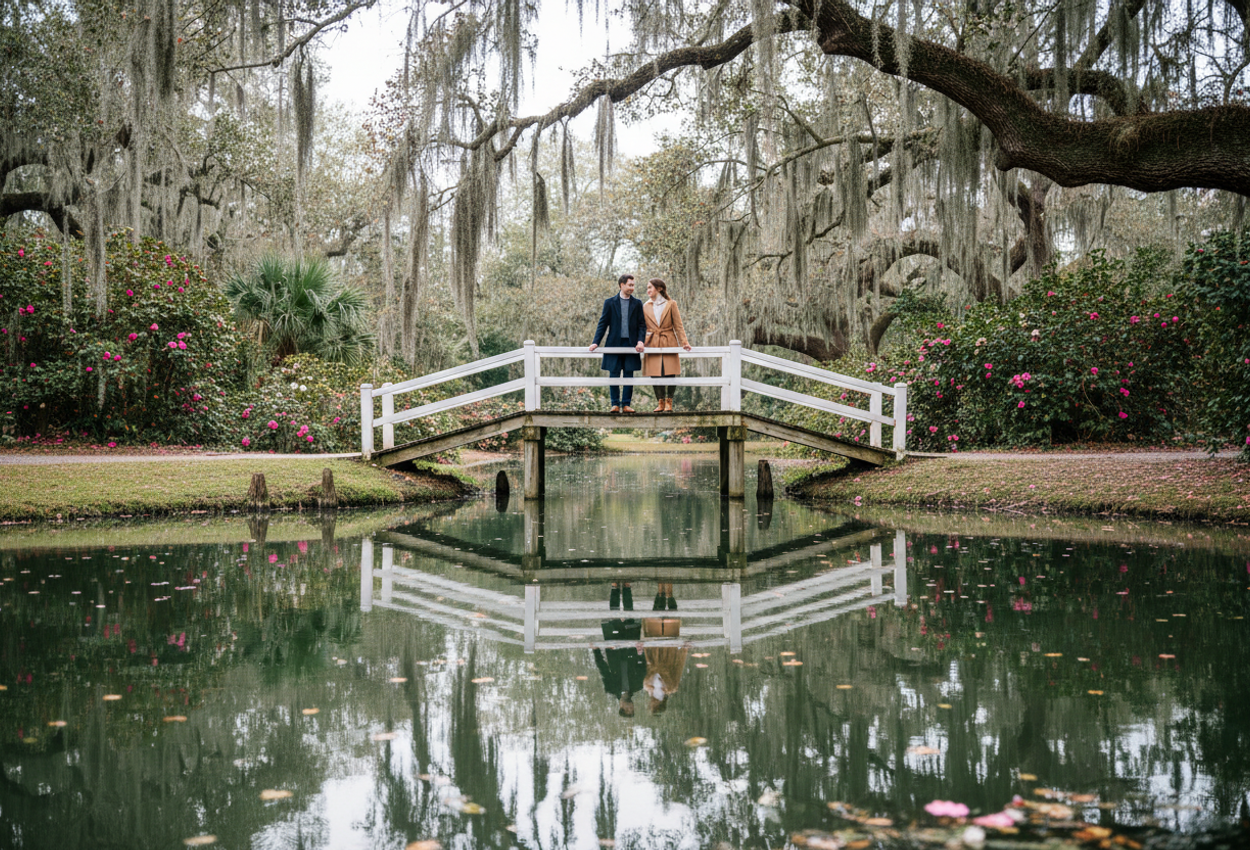
The Ashley River itself slides by in slow, brown-green curves, its banks thick with reeds and palmettos. Wooden footbridges painted white arc over still lagoons, their reflections forming graceful ovals in the water below. As you and your partner cross one of these bridges, hand resting lightly on the worn rail, you might pause at the highest point, where the view opens to reveal both water and forest, framed by moss and sky. The air here smells of damp earth, decaying leaves, and the faint sweetness of blossoms, a scent that seems to settle into your hair and clothes as you walk.
Magnolia holds its share of history, both beautiful and painful. The plantation house and preserved slave cabins bear witness to the complex legacy of the Lowcountry’s rice economy, and guided tours offer a deeper understanding of the lives once lived here. For couples, weaving this historical awareness into a romantic visit can make the experience richer and more grounded. Holding hands beneath the oaks, you are not just enjoying a picturesque landscape; you are acknowledging the human stories that shaped it, honoring resilience alongside beauty.
Amid the expanses of lawn and water, hidden pockets of seclusion invite quieter moments. One such gem is a small bench tucked under a camellia grove along a less-traveled path, where petals drift down like colored snow and carpet the ground in soft, fragrant drifts. Another hides near the edge of a secluded pond, where cypress knees jut from the water like small sculptures and turtles sun themselves on partially submerged logs. Find one of these spots and sit in silence together, listening to the lap of water against the shore and the rustle of wind in the reeds, the world narrowing to the person beside you and the ancient trees arching above.
As the afternoon wanes, the garden’s colors deepen. The camellias take on a richer glow, the moss darkens, and the sky above the river shifts toward amber. Walking back toward the entrance, you pass through tunnels of foliage that momentarily obscure everything but the immediate path, then emerge into sudden clearings where the plantation house stands in dignified profile against the horizon. In those alternating moments of enclosure and revelation lies much of Magnolia’s quiet romance. Here, in this interplay of history, nature, and carefully curated wildness, Charleston offers one more setting in which love can take its time, wandering at whatever pace feels right, leaving footprints in the soft earth that will be gone by morning but remembered much longer.
Together, these experiences form a tapestry of Charleston at its most romantic: pastel streets and haunted alleys, harbor breezes and garden shadows, shared meals and shared silences. In this city, romance is not confined to grand gestures. It resides in the small, cumulative details: the sound of a horse’s hooves on stone, the feel of old brick under your fingertips, the way gaslight reflects in your partner’s eyes. Leave room in your itinerary for serendipity, for detours down unexplored lanes and unscheduled pauses on shaded benches. Charleston, generous as ever, will meet you there.