

Free Bornholm Travel Guide & Mobile App
Explore Bornholm with free travel guides. Discover regional history, expert tips, proposed trips, and audio guides on web or mobile app.


Explore Bornholm’s medieval ruins, granite coast, sandy beaches, smokehouses, forests and distinctive Baltic island towns in Denmark.
Read more about Bornholm
When is the best time to visit Bornholm?
Best: June–August · 18–20°C| Month | High (°C) | Rainfall (mm) |
|---|---|---|
| January | 3 | 40 |
| February | 3 | 30 |
| March | 5 | 35 |
| April | 9 | 30 |
| May | 15 | 35 |
| June (best) | 18 | 40 |
| July (best) | 20 | 50 |
| August (best) | 20 | 50 |
| September | 17 | 45 |
| October | 13 | 50 |
| November | 9 | 55 |
| December | 4 | 60 |
Getting to and around Bornholm
How to get there
Transportation
Best attractions in Bornholm
Bornholm’s attractions combine a compact island’s varied landscapes with an unusually concentrated historic legacy. Hammershus dominates the north-western coast with its extensive medieval ruins and sea views, while the four round churches provide a distinctive insight into the island’s religious and defensive architecture. Prehistoric monuments, burial sites and the remains of Lilleborg add archaeological depth. In central Bornholm, Almindingen offers forest walks, lakes, heathland and viewpoints, including Rytterknægten, the island’s highest point. The southern coast is defined by Dueodde’s wide sandy beach and dunes, while the north offers granite cliffs and sheltered harbours. Rønne and Nexø have museums and maritime history, and smaller towns such as Gudhjem, Svaneke and Aakirkeby combine heritage streets with galleries, workshops and local food. Cycling, walking, sea kayaking and swimming are among the principal outdoor activities, although conditions vary with the season. Smokehouses, craft studios, food producers and cultural venues give the island’s visitor offering a strong local dimension rather than making it entirely dependent on scenery.
-
Fortress
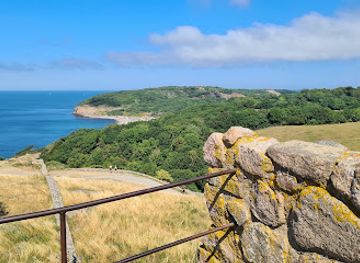
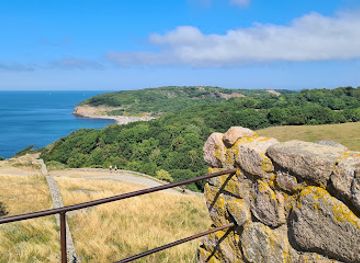
Hammershus Castle Ruins
Bornholm’s great clifftop fortress, where vast medieval ruins, Baltic Sea panoramas and a striking modern visitor centre bring 800 years of history to life.
-
Church
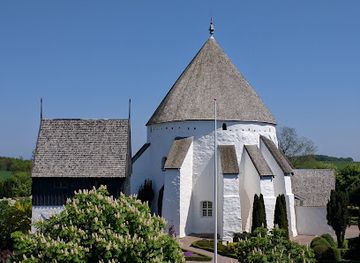
Østerlars Church
Denmark’s largest round church, Østerlars blends 12th‑century stone fortification, vivid medieval frescoes and Viking rune stones in a single atmospheric Bornholm landmark.
-
Marina
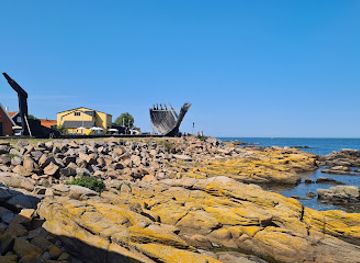
Svaneke Havn
A compact Bornholm harbour where granite rocks, fishing boats and gourmet treats meet in one of Denmark’s most charming little market towns.
-
Amusement park ride
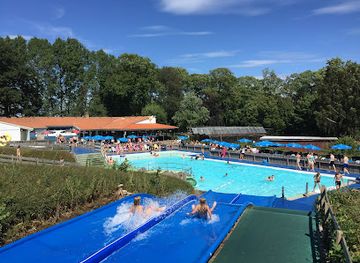
Brændesgårdshaven
Low‑key family amusement park in the Bornholm countryside, blending rides, water fun, animals and gardens into a relaxed full‑day outing near Svaneke.
Best landmarks in Bornholm
Hammershus is Bornholm’s defining historic landmark, a monumental medieval fortress whose walls and towers occupy a dramatic plateau above the north-western sea. Its scale reflects the island’s importance in Baltic power struggles, while the surrounding cliffs make the site visually prominent from land and water. The four round churches are another unmistakable feature: Østerlars, Olsker, Nylars and Nyker combine religious purpose with defensive construction and are among the clearest symbols of Bornholm’s medieval heritage. In the interior, the ruins of Lilleborg stand among the woodland of Almindingen, linking the forest landscape with royal and political history. Rytterknægten marks the island’s highest ground, and the Dueodde coastline provides a contrasting natural landmark of pale sand, dunes and open Baltic horizons. In the towns, Rønne’s old streets, Svaneke’s preserved buildings and harbour environments, and the steeply arranged waterfront of Gudhjem express different aspects of Bornholm’s maritime architecture. Nexø’s port and historic urban fabric further represent the island’s long relationship with fishing and trade.
-
Fortress
Hammershus Castle Ruins
Northern Europe's largest castle ruin crowning a clifftop fortress with Baltic views, free and open 24/7.
-
Historical landmark
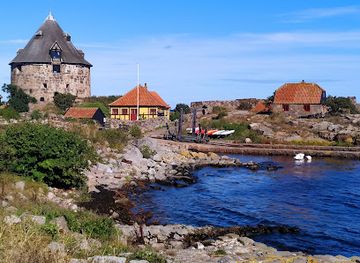
Big Tower
A 17th-century sea fortress tower reborn as a lighthouse and cultural beacon, with sweeping Baltic views from Denmark’s remote eastern outpost.
-
Lutheran church
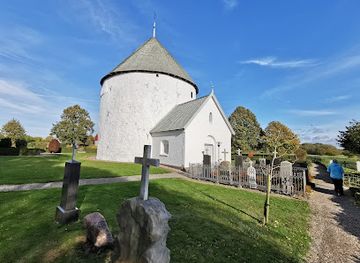
Nylars Church
Medieval fortress and artistic masterpiece—Bornholm's finest round church with stunning 12th-century frescoes.
-
Tourist attraction
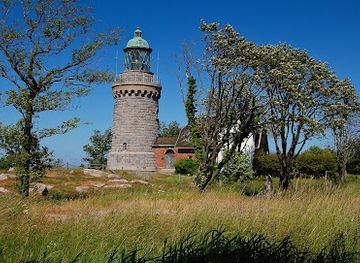
Hammer Odde Lighthouse
A modest granite lighthouse on Bornholm’s far northern tip, Hammer Odde Fyr pairs rugged coastal scenery with the quiet rhythm of a still‑working Baltic beacon.
Explore Bornholm on the map
Plan your trip on one map. See where the top cities, national parks and sights are, and book hotels and experiences in a few clicks.
Best hotels in Bornholm
Best restaurants in Bornholm
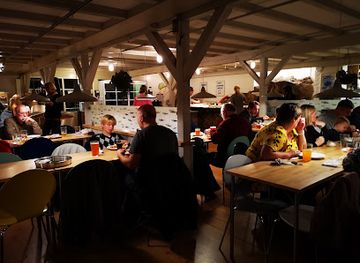
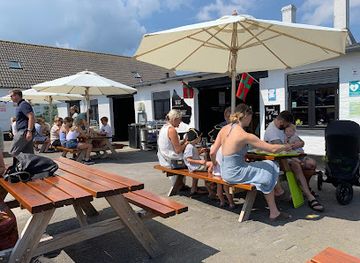
Bornholm’s dining identity is closely linked to the Baltic, island farming and a growing network of small producers. Traditional smokehouses serve smoked herring and other fish, often with rye bread, mustard, onion or potato, while coastal cafés and restaurants make use of seasonal catches when available. Local specialities associated with Bornholm also include Sol over Gudhjem, a rye-bread dish topped with smoked herring, egg yolk, radish and onion, although versions vary. Inland farms and artisan producers contribute vegetables, meat, cheeses, berries, honey, chocolate, ice cream and baked goods. Rønne and the larger harbour towns offer the broadest range of cafés, pubs and restaurants; rural inns and seasonal eateries provide a slower dining rhythm elsewhere. Bornholm-produced beer, spirits and other drinks are widely encountered, and food markets or farm shops can be a practical way to sample regional products. Opening patterns are seasonal, so visitors should check availability outside the main summer months.
-
Danish
Restaurant Ekkodalshuset
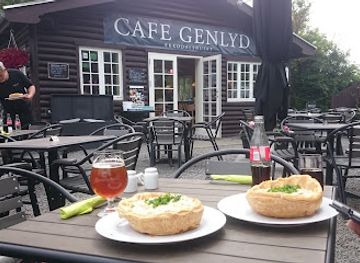
Hearty Danish lunches and giant tartlets served in a cozy forest inn beside Bornholm’s echo valley, perfectly paired with walks in Almindingen.
-
Restaurant
Nordbornholms Røgeri Butik & Restaurant
Bornholm's largest fish buffet on the cliffs, where smoked seafood and Baltic views define island dining.
-
Seafood
Svaneke Røgeri
Traditional Bornholm fish smokehouse and casual seaside restaurant in Svaneke, combining alder-smoked seafood, hearty buffets and open-air Baltic views.
-
Restaurant
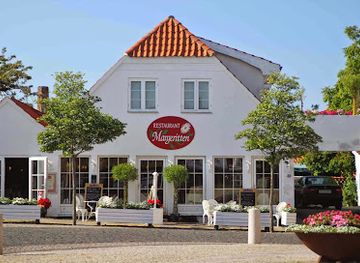
Restaurant Margeritten
Casual Danish family restaurant on Allinge’s church square, serving generous classics, pizzas and a salad bar in relaxed, central surroundings.
Best bars in Bornholm
Bornholm’s evening life is generally relaxed and town-centred rather than built around a large club scene. Rønne has the widest choice of pubs, cafés and places for a later drink, while Gudhjem, Svaneke, Allinge and Nexø offer harbour-side restaurants, traditional pubs and small bars that become busier in summer. Historic inns, breweries and venues with occasional live music provide alternatives to conventional nightlife, and cultural programmes may include concerts, theatre or seasonal events. In smaller villages and rural districts, evenings tend to centre on dining, local gatherings and accommodation-based hospitality, with limited late transport. Summer brings the greatest choice and longer activity around the coastal towns, whereas winter is quieter and more locally focused. Visitors should check current arrangements rather than assume that a venue operates throughout the year, and should plan transport back from remote restaurants or villages in advance.
-
Beer Garden
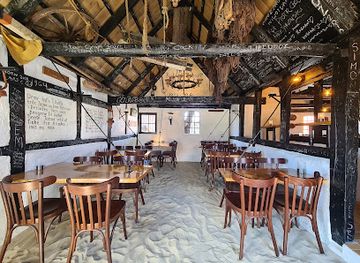
Sørens Værtshus
Casual seaside pub in Snogebæk serving deep-pan stone-oven pizza, cold drinks and live summer music a short stroll from Bornholm’s sandy beaches.
-
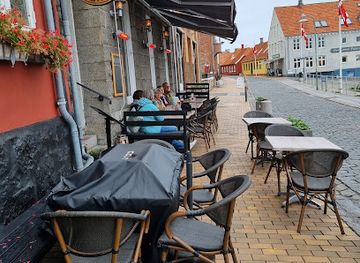
Bar
Ølstauan
Harbourside Bornholm bar where local craft beers, hearty Danish comfort food and Baltic Sea views come together in a relaxed, grown‑up atmosphere.
-
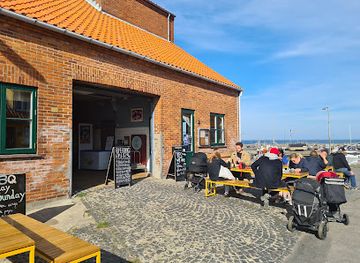
Bar
Mikkeller Aarsdale
Seasonal seaside craft beer bar and burger spot in a former smokehouse on Bornholm’s Aarsdale harbour, pairing inventive taps with relaxed Baltic Sea views.
-
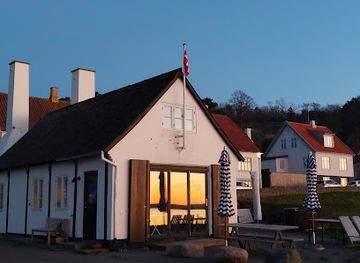
Bar
Norresan
Laid‑back seaside café and bar in a former smokehouse on Gudhjem’s quiet west harbour, serving coffee, ice cream and drinks with front‑row Baltic sunsets.
Best nightclubs in Bornholm
Bornholm’s evening life is generally relaxed and town-centred rather than built around a large club scene. Rønne has the widest choice of pubs, cafés and places for a later drink, while Gudhjem, Svaneke, Allinge and Nexø offer harbour-side restaurants, traditional pubs and small bars that become busier in summer. Historic inns, breweries and venues with occasional live music provide alternatives to conventional nightlife, and cultural programmes may include concerts, theatre or seasonal events. In smaller villages and rural districts, evenings tend to centre on dining, local gatherings and accommodation-based hospitality, with limited late transport. Summer brings the greatest choice and longer activity around the coastal towns, whereas winter is quieter and more locally focused. Visitors should check current arrangements rather than assume that a venue operates throughout the year, and should plan transport back from remote restaurants or villages in advance.
-
Live Music
Musikhuzet
Bornholm’s Musikhuzet in central Rønne offers an ever-changing lineup of live concerts, cultural performances, and community events in a buzzing local landmark venue.
-
Night club
Tucan Swinger & wellness Club
Upscale swinger and wellness club in rural Jutland, blending spa comforts, themed erotic rooms and a structured, adults-only atmosphere for adventurous guests.
-
Disco club
Palæcafeen
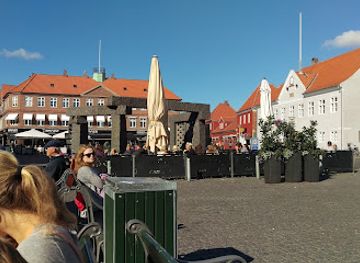
No‑frills late‑night disco bar in central Rønne, mixing local bodega charm with loud music, dancing and affordable drinks on Bornholm’s main island.
-
Night club
After Dark
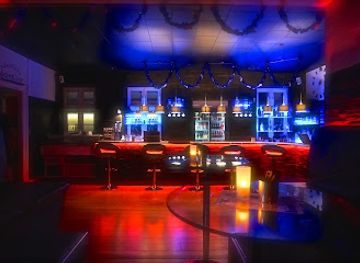
Compact weekend nightclub bringing big-city beats, DJ-driven dancing and a lively bar atmosphere to the otherwise quiet island town of Rønne on Bornholm.
Best shops in Bornholm
Shopping on Bornholm is strongest in its market towns and harbour communities, where independent shops, galleries and food producers reflect the island’s craft and agricultural economy. Rønne has the broadest everyday choice, including high-street services, books, design goods and practical supplies, while Svaneke and Gudhjem are particularly associated with galleries, ceramics, glass, textiles, confectionery and other locally made products. Nexø and Aakirkeby provide useful shopping alongside smaller specialist businesses. Farm shops, food halls and seasonal markets are good places to look for smoked fish, beer, spirits, honey, cheese, chocolate, preserves and baked goods, though opening days can change outside summer. Bornholm-made ceramics, glassware and craft objects make more distinctive souvenirs than generic tourist merchandise, and many workshops explain their production on site. Visitors should leave room for transport and customs allowances when buying food or alcohol, particularly if travelling by air or ferry to another country.
-
Shopping mall
Snellemark Centret
Bornholm's main shopping destination, conveniently located near the ferry terminal in charming Rønne.
-
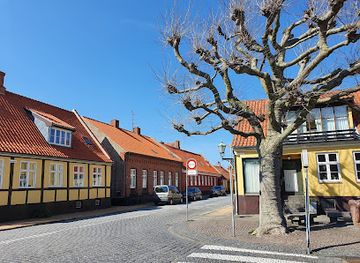
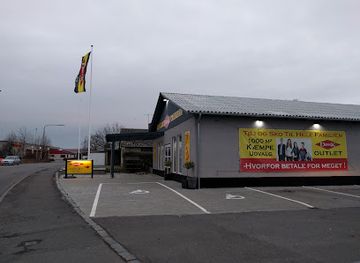
Clothing store
Dansk
Relaxed, value-focused clothing outlet in Rønne offering practical Danish fashion and everyday basics for the whole family, with a cosy coffee corner on site.
-
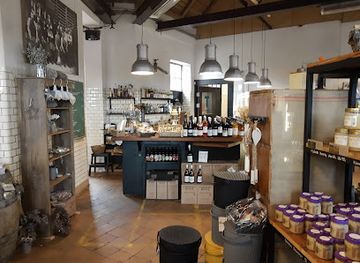
Natural goods store
Torvehal Bornholm
Compact Bornholm food hall and roastery café in Rønne, bringing local flavours, natural groceries and island coffee culture together under one relaxed roof.
-
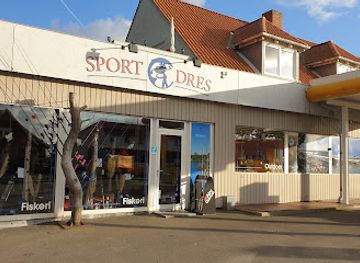
Fishing store
Sport Dres Bornholm v/Jesper Schiøtt
Compact but expertly stocked fishing specialist in central Rønne, where Bornholm’s anglers gear up, swap tips and prepare for time on the island’s lakes and coasts.
Get your free copy of our complete guide to Bornholm, delivered straight to you.
Everything on this page, from attractions and restaurants to essentials and local phrases, in one PDF you can read offline, print or share.
Already have an account? Sign in
Your Bornholm guide is ready.
We'll send it to · Not you? Sign out

Getting your guide ready…
We are putting together a fresh copy of the Bornholm guide. This can take up to a minute.
This can take a few moments. If your browser asks, choose Allow so the download can start. You'll find the guide in your Downloads folder.
Nothing happened? Download it again
Sorry, the guide is taking longer than usual. Please try again in a minute, or get it by email instead.
Bornholm essentials
Currency and Payment
Safety
Emergency Situations
Do's and Don'ts
Local Tips
From Eve
Local phrases worth knowing
You don't need to get them perfect. A few words go a long way, and locals appreciate the effort.
Basics
| English | Local | Say it |
|---|---|---|
| Hello | Hej | [hay] |
| Goodbye | Farvel | [fah-vel] |
| Yes | Ja | [yah] |
| No | Nej | [nigh] |
| Please/You're welcome | Vær så venlig | [vair so ven-lee] |
| Thank you | Tak | [tahk] |
| Excuse me/Sorry | Undskyld | [oon-skyl] |
| How are you? | Hvordan har du det? | [vor-dan har do deh] |
| Fine. And you? | Fint. Og dig? | [feent. oh die?] |
| Do you speak English? | Taler du engelsk? | [tay-ler do eng-elsk?] |
| I don't understand | Jeg forstår ikke | [yai for-stor ik-kah] |
Eating & Drinking
| English | Local | Say it |
|---|---|---|
| I'd like to see the menu, please | Jeg vil gerne se menuen, tak | [yai vil gar-neh say meh-noo-en, tahk] |
| I don't eat meat | Jeg spiser ikke kød | [yai spee-ser ik-kah kuhth] |
| Cheers! | Skål! | [skawl] |
| I would like to pay, please | Jeg vil gerne betale, tak | [yai vil gar-neh beh-tah-leh, tahk] |
Emergencies
| English | Local | Say it |
|---|---|---|
| Help! | Hjælp! | [yelp] |
| Go away! | Gå væk! | [go vek] |
| Call the Police! | Ring til politiet! | [ring til po-li-teet] |
| Call a doctor! | Ring til en læge! | [ring til en lay-eh] |
| I'm lost | Jeg er faret vild | [yai air fah-ret vil] |
| I'm ill | Jeg er syg | [yai air sue] |
Shopping
| English | Local | Say it |
|---|---|---|
| I'd like to buy... | Jeg vil gerne købe... | [yai vil gar-neh kuh-beh...] |
| I'm just looking | Jeg kigger bare | [yai kee-ger bar-eh] |
| How much is it? | Hvor meget koster det? | [vor mai-eth kos-ter deh?] |
| That's too expensive | Det er alt for dyrt | [deh air alt for dyert] |
| Can you lower the price? | Kan du sænke prisen? | [kan do sen-keh pree-sen?] |
Time & Numbers
| English | Local | Say it |
|---|---|---|
| What time is it? | Hvad tid er det? | [vahd teed air deh?] |
| It's one o'clock | Det er et klokke | [deh air et kloh-keh] |
| Half past (10) | Halv (10) | [halv (10)] |
| Morning | Morgen | [mor-en] |
| Afternoon | Eftermiddag | [ef-ter-mi-dahg] |
| Evening | Aften | [af-ten] |
| Yesterday | I går | [ee gor] |
| Today | I dag | [ee dai] |
| Tomorrow | I morgen | [ee mor-en] |
| 1 | 1 | [1] |
| 2 | 2 | [2] |
| 3 | 3 | [3] |
| 4 | 4 | [4] |
| 5 | 5 | [5] |
| 6 | 6 | [6] |
| 7 | 7 | [7] |
| 8 | 8 | [8] |
| 9 | 9 | [9] |
| 10 | 10 | [10] |
Transport & Directions
| English | Local | Say it |
|---|---|---|
| Where's a/the...? | Hvor er en/den...? | [vor air en/den...?] |
| What's the address? | Hvad er adressen? | [vahd air ah-dress-en?] |
| Can you show me (on the map)? | Kan du vise mig (på kortet)? | [kan do vee-seh mai (po kort-et)?] |
| When's the next (bus)? | Hvornår går den næste (bus)? | [vor-nor gor den nes-teh (bus)?] |
| A ticket (to ....) | En billet (til ....) | [en bee-let (til ....)] |
History of Bornholm
Prehistoric Bornholm and the Iron Age
Bornholm’s archaeological record includes megalithic tombs, stone settings, burial mounds, rock carvings and settlements that show long periods of farming, seafaring and exchange across the Baltic. The island’s position made it a point of contact between Scandinavia and the southern and eastern Baltic rather than an isolated outpost. Iron Age finds, including weapons, jewellery and ritual objects, indicate both local communities and connections with wider trading networks. Sites such as the monumental stone arrangements at Lilleborg and other preserved prehistoric remains help explain how the island’s landscapes were used before written history.
Medieval Churches and Fortifications
During the medieval period Bornholm occupied a strategically important position in the Baltic. The island’s four distinctive round churches, including Østerlars Church, served religious communities but also had defensive features, reflecting an age when churches could provide refuge. Hammershus was developed as a major fortress and administrative centre on the north-western coast, associated with the archbishops of Lund and later contested by competing powers. Its ruins, together with the remains of Lilleborg in Almindingen, reveal the political importance of controlling Bornholm’s harbours, resources and sea routes.
The Danish-Swedish Struggle for Bornholm
Bornholm was drawn into the prolonged rivalry between Denmark and Sweden over control of the Baltic. The island was ceded to Sweden in the Treaty of Roskilde in 1658, but local resistance led by Jens Kofoed and other figures helped return it to Danish rule later that year. The episode remains an important part of Bornholm’s historical identity because it linked local action with the larger wars that reshaped Scandinavia. Fortifications, old town environments and museum collections preserve aspects of this turbulent period.
Fishing, Trade and Maritime Communities
From the early modern period into the nineteenth and twentieth centuries, fishing, seafaring, agriculture and small-scale trade shaped Bornholm’s economy. Rønne, Nexø, Hasle, Gudhjem, Allinge and other coastal settlements developed around harbours, while herring, cod and other catches supported processing and commerce. Smokehouses became a characteristic part of the island’s food landscape, particularly through the modern era. The surviving harbour buildings, boat traditions, merchants’ houses and coastal town plans reflect an economy closely connected to the Baltic and to the practical demands of island life.
Bornholm in the Second World War
Bornholm was occupied by Germany during the Second World War, as was Denmark more broadly. Its position in the Baltic gave the island military significance, and German installations formed part of the wider wartime defensive system. In May 1945, after Germany’s surrender, Soviet forces bombarded and occupied Rønne and Nexø before taking control of the island. The Soviet presence lasted until April 1946, considerably longer than the liberation period elsewhere in Denmark. Memories of the destruction and occupation remain visible in local museums, memorials and the rebuilt urban fabric of the two towns.
Cold War Frontline and Modern Tourism
After the Second World War, Bornholm’s eastern position again gave it strategic importance. Surveillance, communications and military installations reflected Denmark’s place within the Cold War’s Baltic security environment. Some sites and traces can still be understood through museums and heritage interpretation, although much of the island’s military infrastructure is not publicly accessible. At the same time, tourism expanded around beaches, cycling, historic towns, art and local food. Bornholm’s modern identity therefore combines a working island economy and strategic history with a carefully promoted cultural and outdoor visitor offer.
Bornholm in Photos
Browse through our photo collection highlighting the charm and character of the destination.
Neighbouring regions of Bornholm
The closest regions to Bornholm, if you have time for more than one.
-

-

-

-

-


Swipe for more regions
Explore more

Explore more of Denmark
Discover Denmark: A perfect blend of history, modern design, and the cozy concept of hygge. Explore vibrant cities, serene landscapes, and world-class cuisine.
Explore Denmark