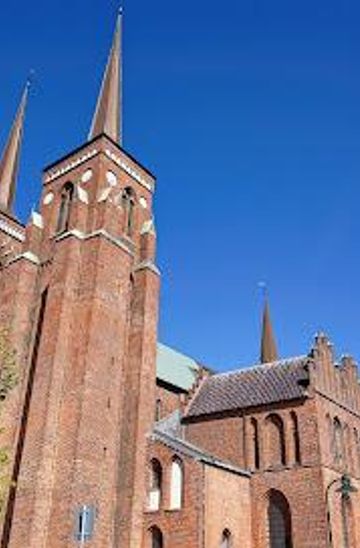
Roskilde Cathedral
800 years of Danish royal history and European architectural evolution in one magnificent red-brick cathedral.
A magnificent Gothic masterpiece built in red brick during the 12th–13th centuries, Roskilde Cathedral stands as one of Northern Europe's earliest and most influential brick structures. Serving as the royal burial church for Danish monarchs since the 15th century, it houses 40 kings and queens in ornate chapels representing 800 years of architectural evolution. Designated a UNESCO World Heritage Site, the cathedral showcases an extraordinary journey through European architectural styles—from Romanesque and Gothic to Renaissance, Neoclassical, and Byzantine Revival—each chapel a testament to its era's design sensibilities.
A brief summary to Roskilde Cathedral
- Domkirkepladsen 3, Roskilde, 4000, DK
- Click to display
- Click to display
- Duration: 1 to 2 hours
- Budget
-
 Indoor
- Mobile reception: 5 out of 5

Know before you go
Hi, I'm Eve. Here are a few practical things to know before exploring Roskilde Cathedral.
- Purchase a combined ticket with the nearby Viking Ship Museum for better value. The two sites are a 10–15 minute walk apart and complement each other perfectly for understanding Danish history.
- Visit in late spring or early summer (May–August) when the cathedral opens until 6 PM, allowing more time to explore the chapels and their architectural details without rushing.
- Consider the combo ticket that includes access to Saint Laurentius, a small museum featuring 12th-century church foundations, a historic jail, and a tower with views over the main square.
- If you have a Copenhagen Card, admission is free—a significant saving if you're visiting multiple attractions in the region.
- Join a guided tour led by the cathedral's expert guides to hear stories of Danish monarchs, architectural symbolism, and local legends like the ghostly helhest and the King's Pillar.
Do you manage this location?
Take control to get all the benefits, like improved information, better appearance, and stronger visibility across AI-powered discovery. Learn more
Activate your presenceOther nearby places you may find interesting
Getting There
-
Train from Copenhagen
Take an S-tog train from Copenhagen Central Station (København H) directly to Roskilde. Journey time is approximately 30 minutes. From Roskilde station, the cathedral is a 10-minute walk through the town center. Trains run frequently throughout the day. Standard single ticket costs approximately 70–90 DKK depending on time of travel.
-
Car from Copenhagen
Drive from central Copenhagen via the Holbæk 21 freeway toward Roskilde. Journey time is approximately 40 minutes depending on traffic. The cathedral is located at Domkirkepladsen 3 in central Roskilde. Street parking is available near the cathedral, though spaces can be limited during peak hours. No dedicated parking fee is charged at the cathedral itself.
-
Guided tour from Copenhagen
Book a full-day guided tour departing from Copenhagen that includes Roskilde Cathedral, Frederiksborg Castle, and Kronborg Castle. Tours typically last 8–10 hours and include hotel pickup and drop-off, transport, and entrance tickets. Prices range from approximately 1,500–1,800 DKK per person. Tours depart daily during peak season and several times weekly in winter.
-
Bus from Copenhagen
Regional bus services connect Copenhagen to Roskilde, with journey times of 45–60 minutes depending on the route and number of stops. Buses depart from various Copenhagen terminals. Single ticket costs approximately 60–80 DKK. Check local transport schedules for current timetables and service frequency.
For the on-the-go comforts that matter to you
-
 Restrooms
-
 Drink Options
-
 Food Options
-
 Seating Areas
-
 Information Boards
-
 Visitor Center
Discover more about Roskilde Cathedral
Eight Centuries of Architectural Innovation
Roskilde Cathedral represents an unparalleled architectural chronicle spanning 800 years of European design history. Construction began around 1170 as a Romanesque basilica, but the structure that stands today emerged around 1200 as a revolutionary Gothic edifice built entirely of red brick—one of the earliest major brick churches in Northern Europe. This innovation was transformative: brick proved more durable and fire-resistant than wood, and its successful application at Roskilde catalyzed the spread of brick Gothic architecture throughout the entire region. The cathedral's soaring pointed arches, vaulted ceilings, and external buttresses were architectural innovations that influenced ecclesiastical construction across Scandinavia and beyond.The main structure required approximately 2.5 million hand-produced red bricks, a staggering feat of medieval craftsmanship. The cathedral's design drew inspiration from French Gothic traditions while incorporating influences from the large brick churches of Northern Germany, creating a distinctly Northern European interpretation of the Gothic ideal—churches flooded with light through enormous windows and soaring interior spaces.The Royal Mausoleum and Its Successive Chapels
Since the 15th century, Roskilde Cathedral has served as the principal burial site for Danish monarchs, housing the remains of 40 kings and queens. Three Viking kings—Harald Bluetooth (died 986), Sweyn Forkbeard (died 1014), and Sweyn Estridsson (died 1074)—are interred here, their presence linking the cathedral to Denmark's earliest Christian period. From the 16th century onward, every Danish monarch has been buried within these walls.Each royal burial prompted the construction of new chapels, and each was designed in the architectural style of its patron's era. This practice created an extraordinary architectural palimpsest. Christian I's chapel, completed in the 15th century, features two floors in Gothic style—the lower serving as a burial vault, the upper as a Great Hall for the Order of the Elephant, Denmark's highest honor. Christian IV's chapel, constructed between 1614 and 1641 in Dutch Renaissance style by the renowned Steenwinckel brothers, showcases a stunning vaulted blue ceiling decorated with stars and employs trompe l'oeil techniques to create illusionistic effects. Frederick V's chapel, spanning 51 years of construction (1774–1825), presents two neoclassical chambers of refined elegance. The Glücksburger Chapel, completed in 1924, introduces Byzantine Revival aesthetics with its cruciform plan, grey walls, and domed roof—a choice that sparked considerable debate in Danish newspapers upon completion.Architectural Significance and UNESCO Recognition
The cathedral's designation as a UNESCO World Heritage Site in 1995 acknowledges two fundamental contributions to European architectural heritage. First, it stands as an outstanding example of the earliest major ecclesiastical brick buildings in Northern Europe, demonstrating the revolutionary potential of this material and directly inspiring the proliferation of brick Gothic throughout the region. Second, as a royal mausoleum with successive chapels representing distinct architectural periods, it offers an unmatched visual encyclopedia of European religious architecture from the medieval period through the modern era.Walking through Roskilde Cathedral is an education in stylistic evolution. The red brick exterior remains constant, yet within, each chapel presents its own complete architectural experience. Gothic pointed arches give way to Renaissance ornamentation, which yields to neoclassical restraint, then to historicist revival and modernist intervention. This layering of styles, each reflecting the aesthetic values and royal preferences of its time, creates a unique architectural narrative impossible to replicate elsewhere.Craftsmanship and Restoration
The cathedral's construction techniques were groundbreaking for their era. The rediscovery of brick-burning around 1100 revolutionized Danish building practices, replacing dependence on natural stone or limestone blocks. The cathedral's wooden roof structure, reconstructed after a devastating fire in 1968, underwent major restoration under orders from King Christian IV in 1635, when the iconic spires were added and the roof radically redesigned. These restoration efforts, continuing into modern times, reflect the cathedral's ongoing significance as both a living religious space and a monument requiring constant conservation.Spiritual and Cultural Significance
Beyond its architectural importance, Roskilde Cathedral functions as an active place of worship, hosting regular services, concerts, and ceremonial events. The cathedral maintains a storm bell, one of Denmark's oldest, adding another layer of historical depth. Visitors encounter not merely a museum of royal tombs but a breathing spiritual space where Danish history, monarchy, and faith intersect. The sepulchral monuments of monarchs such as Queen Margrete I and King Christian IX invite contemplation of Denmark's political and dynastic evolution, while the recent placement of Queen Margrethe II's monument—upon which visitors may sit until her death—creates a poignant connection between past and present.Explore the best of what Roskilde Cathedral has to offer













More about Zealand
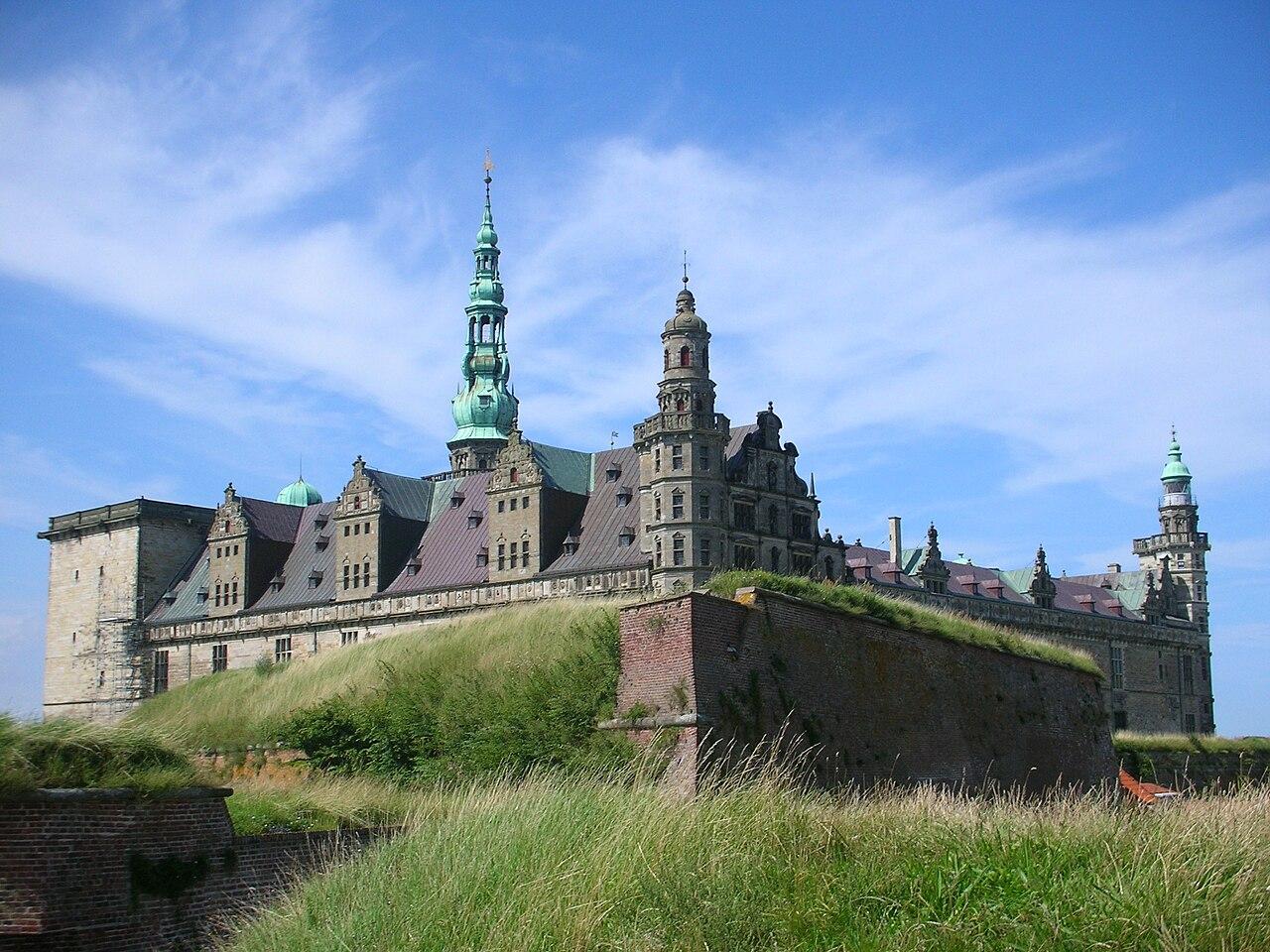
Discover the charm of Zealand, Denmark's largest island, blending vibrant city life in Copenhagen with serene coastal beauty and rich cultural heritage.
Tell me more about Zealand