

Tordenskjold statue, Frederikshavn Travel Guide
Free Guide: Bronze tribute to Scandinavia's most audacious naval hero, forever standing guard in Frederikshavn's heart.


A brief summary of Tordenskjold statue
Bronze tribute to Scandinavia's most audacious naval hero, forever standing guard in Frederikshavn's heart.
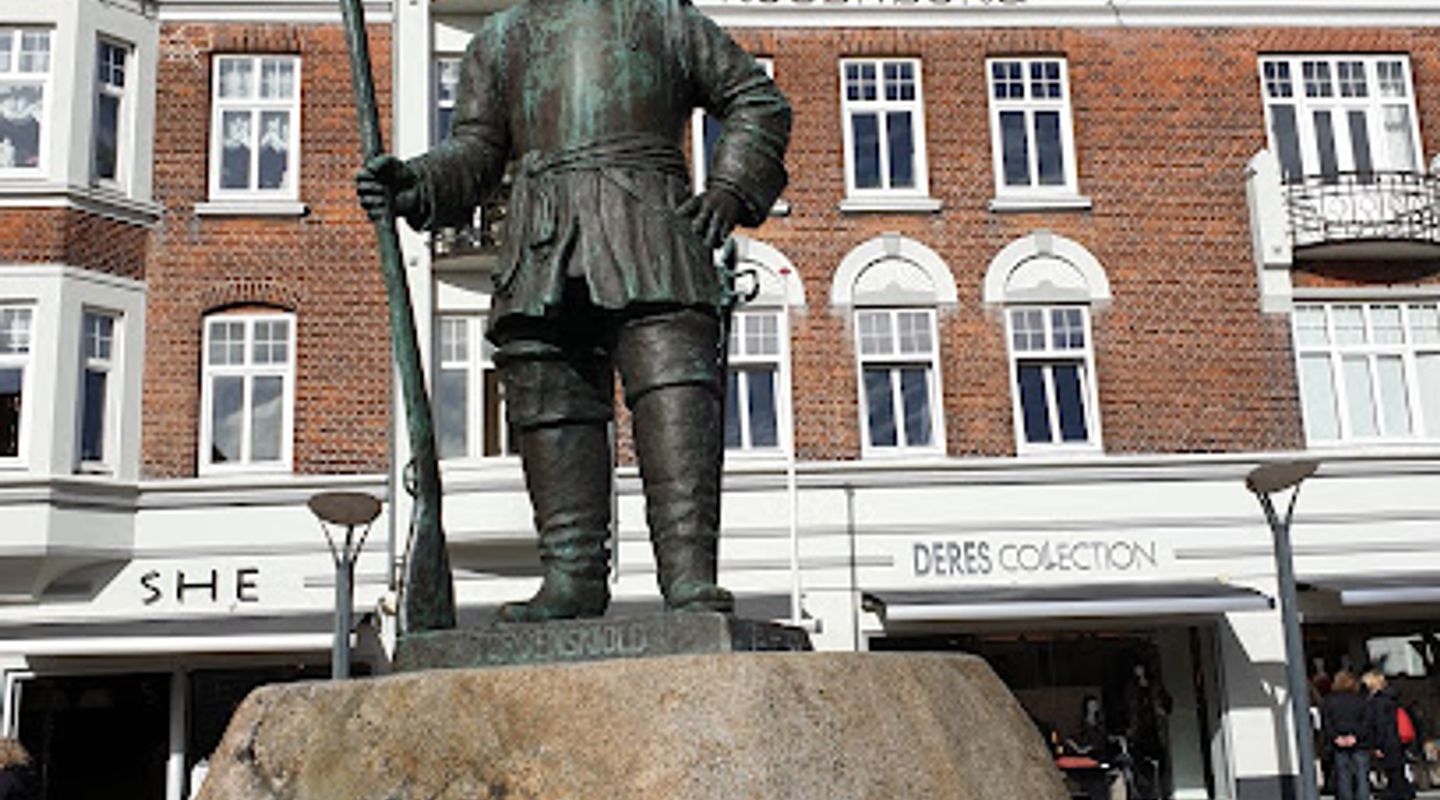
A striking bronze monument in central Frederikshavn honoring Peter Wessel Tordenskjold (1690–1720), the celebrated naval hero of Denmark and Norway. Standing in the pedestrian zone since 1990, the statue depicts the young admiral in military dress beside a cannon, commemorating his legendary exploits during the Great Northern War. The figure remains a symbol of courage and cunning in Scandinavian maritime history.
On-site amenities
 Seating areas
 Information boards
 Trash bins
- Address
- Søndergade 1, 9900 Frederikshavn
Getting there
Public Bus
Train
Private Vehicle
Walking
Discover more about Tordenskjold statue
A Naval Legend Immortalized in Bronze
The Tordenskjold statue stands as a tribute to one of Scandinavia's most celebrated military figures. Peter Wessel Tordenskjold (1690–1720) was a Dano-Norwegian naval commander whose audacity and seamanship earned him legendary status across both Denmark and Norway. Ennobled by King Frederik IV in 1716 and given the name Tordenskjold—meaning "Thunder Shield"—he rose through the ranks with remarkable speed, ultimately achieving the rank of vice admiral before his death at just 30 years old. The bronze sculpture, positioned prominently in Frederikshavn's pedestrian zone, captures him in military garb standing beside a cannon, a visual representation of the warrior who became a national symbol.
The Battle That Saved a Nation
Tordenskjold's greatest triumph came in July 1716 during the Great Northern War, when he orchestrated a daring attack on the Swedish transport fleet in the harbor of Dynekilen, near the Norwegian border. This audacious strike destroyed or captured the majority of Sweden's supply vessels, forcing King Charles XII to abandon his invasion of Norway and lift the siege of Fredriksten fortress. The victory earned Tordenskjold the title "Saviour of Norway," a designation that would echo through the centuries and cement his place in Scandinavian folklore. His exploits demonstrated that courage and tactical brilliance could overcome superior numbers and resources.
From Controversy to Canonization
Tordenskjold's career was not without controversy. Early in his service, he faced court-martial after an encounter with a Swedish privateer, accused of disclosing military information to the enemy. He was acquitted, and his reputation only grew stronger. In 1720, following the peace treaty between Denmark and Sweden, Tordenskjold embarked on a Grand Tour of Europe. His life ended tragically that same year when he was killed in a duel at the age of 30. Despite the circumstances of his death—dueling was illegal under Danish law—his legacy only expanded in the decades that followed.
A Transnational Memory Site
In the nineteenth century, Tordenskjold experienced a remarkable cultural revival. Both Denmark and Norway claimed him as a national hero, and his image was cultivated extensively through art, literature, and public monuments. Statues were erected in Copenhagen (1876), Trondheim, Stavern, Oslo, and Haakonsvern, while artists such as Otto Bache and Christian Mølsted immortalized him on canvas. Streets, squares, parks, schools, ships, and even Denmark's most popular brand of matches were named after him. This widespread veneration reflected a deeper need: as the Dano-Norwegian Union dissolved in 1814 and Denmark's power waned following the Napoleonic Wars, Tordenskjold was revived as a symbol of the "little guy" outsmarting far more powerful adversaries—a myth-making process that resonated deeply with both nations.
Frederikshavn's Living Monument
The Frederikshavn statue, erected in 1990, stands in the heart of the town's pedestrian zone at Søndergade, serving as a focal point for local pride and historical reflection. Each year, the town honors its most famous son with a summertime festival celebrating his legacy. The monument's central location ensures that both residents and visitors encounter this bronze figure regularly, keeping the memory of Tordenskjold alive in contemporary Scandinavian consciousness. The statue's expressive quality and excellent preservation make it a compelling historical landmark that invites contemplation of an era when individual valor could shape the course of nations.
Evendo Review Centre
 Google
Guest reviews
Best time to go
Quietest: Jan, Feb & Dec · before 6am or at 10pm
Busy times are Evendo estimates for a typical year, to help you plan. Actual crowds vary with events, school holidays and the weather.
Explore Tordenskjold statue on the map
A handpicked selection of must-see spots near Tordenskjold statue, mapped for you.
Get your free copy of our complete guide to Tordenskjold statue, delivered straight to you.
Everything on this page, from opening hours and how to get there to Eve’s tips and the best time to go, in one PDF you can read offline, print or share.
Already have an account? Sign in
Your Tordenskjold statue guide is ready.
We'll send it to · Not you? Sign out

Getting your guide ready…
We are putting together a fresh copy of the Tordenskjold statue guide. This can take up to a minute.
This can take a few moments. If your browser asks, choose Allow so the download can start. You'll find the guide in your Downloads folder.
Nothing happened? Download it again
Sorry, the guide is taking longer than usual. Please try again in a minute, or get it by email instead.
Other nearby places you may find interesting
The closest places of the same kind, if this one is not quite what you had in mind.
-
-
-
-
-


Swipe for more places
More to explore near Tordenskjold statue

 Best experiences near Tordenskjold statue
 Best hotels near Tordenskjold statue
 Best landmarks near Tordenskjold statue
 Best attractions near Tordenskjold statue
 Best shops near Tordenskjold statue
 Best restaurants near Tordenskjold statue
 Best bars near Tordenskjold statue
Do you manage this location?
Take control to get all the benefits, like improved information, better appearance, and stronger visibility across AI-powered discovery.
Explore more

Explore more of Frederikshavn
Explore Frederikshavn, Denmark's coastal gem, where history, scenic beaches, and vibrant maritime culture combine to create an unforgettable travel experience.
Explore Frederikshavn
Explore more of Denmark
Discover Denmark: A perfect blend of history, modern design, and the cozy concept of hygge. Explore vibrant cities, serene landscapes, and world-class cuisine.
Explore Denmark
