Background

The Uncovered Bridge (Den Genfundne Bro)

A once-buried red steel railway bridge reborn above the Gudenå, blending dramatic industrial heritage with serene forest trails and river views.

4.5

A forgotten railway giant in the Danish hills

Standing above the gentle flow of the Gudenå, The Uncovered Bridge tells a story that feels almost improbable. Completed in 1899 as part of the private railway between Horsens and Bryrup, this red steel lattice structure once soared 13.4 metres above the river, making it the tallest of its type in the Nordic countries. It carried trains across a deep valley in the rolling Bakkelandet landscape, a visible symbol of industrial ambition cutting through rural East Jutland. Within just a few decades, though, changing track standards rendered the narrow‑gauge line obsolete. Rather than demolish the bridge, engineers chose a more radical solution: they buried it. By 1929, the entire structure had disappeared into an embankment supporting a new alignment, leaving the Gudenå forced through pipes in the newly formed dam. For generations, hardly anyone suspected there was a complete steel bridge hidden inside the hillside.

Rediscovery and meticulous restoration

The secret emerged when plans were made to restore a more natural river course and improve the landscape. Investigations confirmed that the old bridge still lay intact inside the dam. In 2014, excavators began to peel away tens of thousands of cubic metres of soil, slowly revealing a surprisingly well‑preserved structure. The process became an event in its own right, watched by curious onlookers as the red steel grid met daylight again after 85 years underground. Once uncovered, the bridge underwent careful restoration. Old paint and surface corrosion were removed, the metal primed and repainted, and robust handrails were added. A timber deck in dense tropical hardwood was laid over the original rail bed, turning the former railway into a broad footbridge. The banks were stabilised with boulders and new spawning grounds for trout were created, so the project strengthened both heritage and river ecology.

Crossing Denmark’s only river on foot

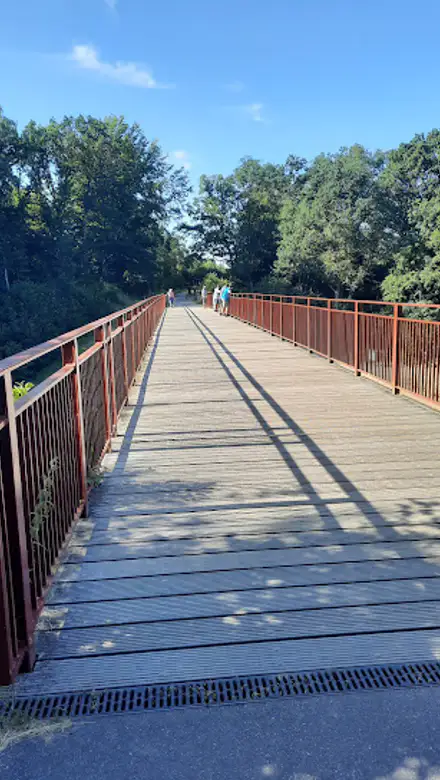
Today you approach the bridge along a smooth asphalt path from a large car park set back among trees, with the red latticework gradually appearing between trunks. Stepping onto the deck, you follow the line once taken by steam trains as they rattled between Horsens and Bryrup. Instead of smoke and clatter, there is the muted thud of footsteps on wood and the sound of water sliding beneath the girders. From the middle of the span, you look down onto the Gudenå’s green watercourse, its banks lined with reeds and willow. Upstream and downstream, the valley opens in soft folds of woodland and meadow, a quiet scene that contrasts with the bridge’s industrial geometry. Paths lead beneath the structure as well, giving a dramatic view up through the steel towers and a sense of its full height above the river.

Forest paths, lakes and slow afternoons

The bridge sits on a popular section of a former railway line now converted into a recreational trail, inviting walkers and cyclists to explore further into the Bakkelandet hills. In one direction, the route follows the river towards Vestbirk Lakes, where Naldal Lake and Vestbirk Lake form a chain of water framed by forest. In the other, the trail runs through mixed woodland all the way to the small town of Brædstrup, offering an easy day out for families on bikes or on foot. Near the bridge you find picnic tables and benches, some with direct views towards the steelwork and the river below. On warm days, this becomes a spot for leisurely lunches, children exploring the water’s edge and unhurried time in the shade of trees. The setting works equally well in colder seasons, when bare branches reveal more of the valley and mist lingers over the Gudenå.

Industrial heritage in a living landscape

Although The Uncovered Bridge is a striking object in its own right, part of its appeal lies in how seamlessly it now sits within the wider landscape. The project to reveal it went hand in hand with efforts to improve the river’s flow and habitat, so trout can spawn in newly laid gravel and stones. Nearby, the historic Vestbirk hydroelectric plant adds another layer to the story of how this valley has been shaped by both water and engineering. Informative boards on site explain the bridge’s construction, burial and excavation, offering context without overwhelming the sense of place. Whether you come as a railway enthusiast, a photographer chasing lines and angles, or simply someone looking for a scenic pause in East Jutland, this rediscovered span over Denmark’s only river offers a rare combination of calm nature and tangible history.

Planning your visit among hills and river bends

Practical facilities make a visit straightforward. The nearby car park has room for cars and coaches, and the short, even approach allows wheelchairs and prams to reach the bridge deck with ease. More adventurous visitors can integrate the site into longer cycling or hiking trips through the surrounding hills, using the former railway as a gentle, mostly level corridor through the terrain. With no entrance fee and no fixed visiting hours, the bridge can be experienced in many moods: early‑morning mist over the Gudenå, bright midday sun catching the red paintwork, or quiet evenings when the forest begins to darken. However long you stay, The Uncovered Bridge invites you to pause and consider how a piece of infrastructure, once literally buried, has returned as a focal point in the landscape it once simply spanned.

Local tips

  • Wear sturdy shoes: forest paths and riverbanks can be muddy after rain, especially if you plan to walk beneath the bridge or extend your visit on nearby trails.
  • Arrive early or late in the day for softer light and fewer people on the deck, ideal if you want uncluttered photos of the red latticework and the Gudenå valley.
  • Bring a picnic or thermos and use the tables near the bridge; there are no cafés on site, and the peaceful setting rewards unhurried breaks.
  • If mobility is a concern, stick to the asphalt path and bridge deck, which are wheelchair- and stroller-friendly, and skip the steeper paths down to the riverbank.
  • Combine the visit with a walk or ride along the former railway towards Vestbirk Lakes or Brædstrup to appreciate how the bridge fits into the wider landscape.
widget icon

Buy tickets

    No tickets available

Book tours with entry

    No tours available

Book tours without entry

    No tours available

A brief summary to The Uncovered Bridge

  • Vestbirkvej 2, Braedstrup, 8740, DK
  • Monday 12 am-12 am
  • Tuesday 12 am-12 am
  • Wednesday 12 am-12 am
  • Thursday 12 am-12 am
  • Friday 12 am-12 am
  • Saturday 12 am-12 am
  • Sunday 12 am-12 am

Getting There

  • Car from Horsens

    From Horsens town centre, driving to The Uncovered Bridge typically takes 20–30 minutes, following regional roads north-west through rolling countryside. There is a large free car park at Vestbirkvej with space for cars and coaches, but it can fill on sunny weekends and holidays. The final approach is via a short, level path, which is suitable for wheelchairs and prams. Fuel stations and food options are in Horsens and Brædstrup rather than at the bridge itself.

  • Regional bus and short walk

    Buses run between Horsens and Brædstrup, usually taking around 30–40 minutes depending on the service and time of day. From Brædstrup, you can continue by local bus or taxi towards Vestbirkvej, or plan a longer walk or cycle along the former railway trail to reach the bridge in about 45–75 minutes on foot. Standard regional bus fares are typically in the range of 20–50 DKK one way within this part of Jutland, and services run more frequently on weekdays than late evenings or Sundays.

  • Cycling via the former railway route

    Experienced cyclists can include The Uncovered Bridge in a day ride using local cycle routes and the converted railway path between Horsens, Brædstrup and Vestbirk. Expect 45–90 minutes of riding from either Horsens or Brædstrup, depending on your starting point and pace. The gradients are generally gentle, but surfaces vary from asphalt to compacted gravel, so wider tyres and lights for tunnels and shaded sections are advisable. There is no dedicated bike parking on the bridge, but you can leave bicycles near the car park or along the trail.

Popular Experiences near The Uncovered Bridge

Popular Hotels near The Uncovered Bridge

Select Currency