Vikingelandsbyen Travel Guide
Free Guide: A hands-on Viking Age village above the Store Vejleå valley, where reconstructed halls, workshops and fields bring everyday Norse life vividly back to Albertslund.


A brief summary of Vikingelandsbyen
A hands-on Viking Age village above the Store Vejleå valley, where reconstructed halls, workshops and fields bring everyday Norse life vividly back to Albertslund.
Vikingelandsbyen in Albertslund is a reconstructed Viking Age village set above the green valley of Store Vejleå, just west of Copenhagen. Clustered around a richly decorated longhouse, small timber dwellings, workshops and animal enclosures bring Norse daily life into sharp focus. Used as a hands‑on historical workshop, the site blends archaeology, craftsmanship and storytelling, making it an engaging stop for families, school groups and anyone curious about how Vikings really lived beyond the legends.
On-site amenities
 Restrooms
 Seating areas
 Sheltered areas
 Trash bins
 Information boards
 Visitor centre
- Address
- Ledøjevej 35, 2620 Albertslund
- Phone
- Website
Getting there
S-train and local bus from central Copenhagen
Regional bus from Albertslund center
Bicycle from Albertslund Station
Taxi from Albertslund or western Copenhagen
Discover more about Vikingelandsbyen
Life in a Recreated Viking Age Settlement
Vikingelandsbyen is a full‑scale reconstruction of a Viking Age village on the edge of Albertslund, designed to show how ordinary people once lived rather than to celebrate warriors and raids. Timber houses, stake‑lined fences and trodden paths trace the outline of a compact settlement set amid meadows and gentle slopes above the Store Vejleå valley. Smoke-blackened rafters, thatched roofs and earthy smells give the place a tangible sense of age even though it is a modern reconstruction grounded in archaeological knowledge.Wandering between the buildings, you can imagine the rhythms of a small Norse community: animals being driven out to pasture, children learning chores, and craftspeople shaping everyday tools. The scale feels human and intimate, with everything clustered around the largest hall rather than spread out like a fortress.
The Great Hall and Handcrafted Details
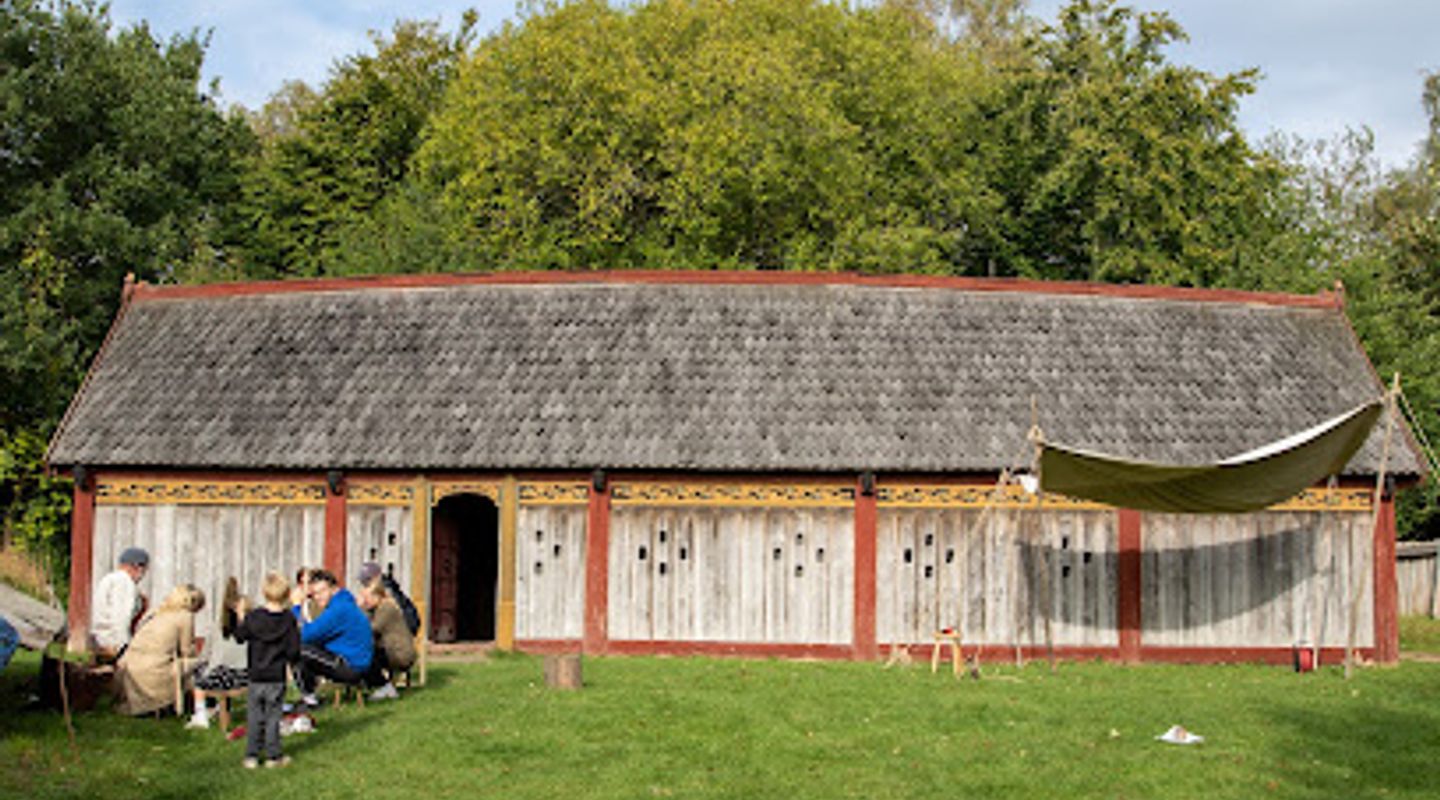
The architectural heart of Vikingelandsbyen is Salshuset, an imposing longhouse painted in deep colours and richly ornamented. Its carved posts, patterned bargeboards and woven and embroidered textiles draw on finds from across the Viking world, translated into a coherent Danish setting. Inside, long benches run along the walls, central hearths once used for cooking and warmth, and decorative objects hint at status and storytelling traditions.Elsewhere in the village, smaller houses show variations on Viking domestic space: simple one‑room dwellings with earthen floors, storage lofts and sturdy wooden doors. Many details are hand-made using traditional techniques, from iron fittings to simple clay vessels. These touches are what turn the site from a generic movie set into a thoughtful evocation of a real period.
Workshops, Craft Traditions and Education
Vikingelandsbyen functions as a historical workshop, used heavily for school programmes and courses that explore crafts, agriculture and everyday technology. On activity days, the village fills with the ring of hammers, the rasp of wood-shaving knives and the smell of smoke from outdoor hearths. Demonstrations might include textile work, simple blacksmithing, bread baking or archery, linking abstract history lessons to tangible skills.Interpretation focuses on how people in the Viking Age organised work, shared knowledge and managed resources. Rather than presenting Vikings only as seafarers, the village underlines their role as farmers, traders and craftspeople anchored in a landscape much like the one you see around Albertslund today.
Animals, Fields and the Surrounding Landscape
Just beyond the houses, fenced pens and a barn illustrate how livestock fitted into village life. The barn, added as the site expanded, reflects research into historic animal keeping and provides shelter for heritage breeds when they are present. Together with small cultivated plots, it gives a sense of how closely fields, pastures and homesteads once intertwined.The wider setting is part of the experience. Vikingelandsbyen overlooks the green corridor of Store Vejleådalen, where walking paths follow the stream and views open over wetlands, grazing land and tree‑lined slopes. This landscape context helps explain why such sites were placed where water, fertile soil and routes of movement converged.
Visiting the Village Today
On many days you can stroll freely among the buildings, taking in the architecture and landscape from the outside. At selected times, interiors open and costumed staff or craftspeople animate the spaces with stories and demonstrations. Seasonal events, themed days and courses deepen particular aspects of Viking life, from midwinter traditions to maritime culture, while the village also serves as a backdrop for educational projects and collaborations.Plan enough time to move slowly, examine the construction details and follow the paths out toward the valley for broader views. Vikingelandsbyen rewards curiosity: the more closely you look at tools, textiles and timber joints, the more the distant Viking Age begins to feel like an understandable, lived-in world rather than distant myth.
Evendo Review Centre
 Google
Guest reviews
Best time to go
Quietest: Jan, Feb & Mar · before 7am or from 7pm
Busy times are Evendo estimates for a typical year, to help you plan. Actual crowds vary with events, school holidays and the weather.
Explore Vikingelandsbyen on the map
A handpicked selection of must-see spots near Vikingelandsbyen, mapped for you.
Get your free copy of our complete guide to Vikingelandsbyen, delivered straight to you.
Everything on this page, from opening hours and how to get there to Eve’s tips and the best time to go, in one PDF you can read offline, print or share.
Already have an account? Sign in
Your Vikingelandsbyen guide is ready.
We'll send it to · Not you? Sign out

Getting your guide ready…
We are putting together a fresh copy of the Vikingelandsbyen guide. This can take up to a minute.
This can take a few moments. If your browser asks, choose Allow so the download can start. You'll find the guide in your Downloads folder.
Nothing happened? Download it again
Sorry, the guide is taking longer than usual. Please try again in a minute, or get it by email instead.
Other nearby places you may find interesting
The closest places of the same kind, if this one is not quite what you had in mind.
-
Frederikssund Viking Village Open‑air Viking village and legendary summer saga play on the shores of Roskilde Fjord, where costumed warriors, longhouses and Norse myths come vividly to life.
-
Gummistranden Compact urban beach on Helsingør’s waterfront, with Kronborg Castle on the horizon, easy promenade access and big Øresund views just minutes from the town centre.
-
Esrum Kloster & Møllegård A 12th-century Cistercian abbey turned cultural hub, where red-brick history, herb gardens and North Zealand’s gentle landscapes meet around Esrum Lake.
-
Island of imagination A quiet royal ruin on a forested lake, where fragments of a 19th‑century retreat invite you to weave Nordic myths, royal tales and your own stories together.
-
Udsigtsplateau A modest wooden platform with a million‑kroner view over Øresund, Kronborg’s silhouette and the Swedish coast, perfect for a quiet coastal pause in Helsingør.
Swipe for more places
More to explore near Vikingelandsbyen

 Best experiences near Vikingelandsbyen
 Best hotels near Vikingelandsbyen
 Best landmarks near Vikingelandsbyen
 Best attractions near Vikingelandsbyen
 Best shops near Vikingelandsbyen
 Best restaurants near Vikingelandsbyen
 Best bars near Vikingelandsbyen
Do you manage this location?
Take control to get all the benefits, like improved information, better appearance, and stronger visibility across AI-powered discovery.
Explore more

Explore more of North Zealand
Explore North Zealand, Denmark's enchanting region of castles, beaches, and royal estates, perfect for history buffs, nature enthusiasts, and seaside lovers.
Explore North Zealand
Explore more of Denmark
Discover Denmark: A perfect blend of history, modern design, and the cozy concept of hygge. Explore vibrant cities, serene landscapes, and world-class cuisine.
Explore Denmark