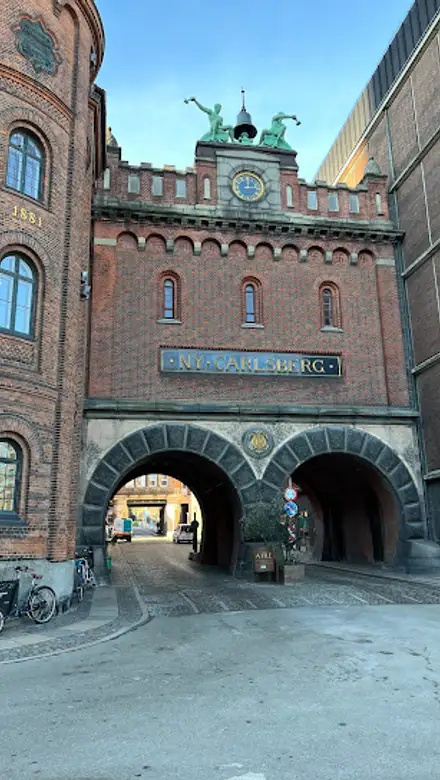
Elefantporten, Copenhagen Travel Guide
Free Guide: Four monumental granite elephants carry a historic brewery tower on their backs, blending whimsy, symbolism and industrial heritage in the heart of Carlsberg Byen.


A brief summary of Elefantporten
Four monumental granite elephants carry a historic brewery tower on their backs, blending whimsy, symbolism and industrial heritage in the heart of Carlsberg Byen.
Guarding the historic Carlsberg brewery district in Copenhagen, Elefantporten is a striking granite gateway supported by four monumental elephants, completed in 1901 as part water tower, part grand entrance. Designed by architect Vilhelm Dahlerup for brewer Carl Jacobsen, the sculptural tower blends industrial function with whimsical symbolism, from Latin mottos to family references, making it one of Carlsberg Byen’s most distinctive landmarks and a magnet for architecture lovers and photographers.
On-site amenities
 Restrooms
 Drink options
 Food options
 Seating areas
 Trash bins
 Information boards
Opening hours
- Every dayOpen 24 hours
Opening hours as listed on the venue’s Google Business Profile. Hours can change for services and special events, so check with the venue before you go.
- Address
- Elephant Gate and Tower, 1760, 1799 København
Getting there
S-train and walking
City bus connection
Bicycle from central Copenhagen
Taxi or rideshare
Discover more about Elefantporten
Granite Giants at the Heart of Carlsberg
Completed in 1901 as part of the Ny Carlsberg brewery complex, Elefantporten — also known as the Elephant Tower — forms one of the most recognisable entrances to Carlsberg Byen. Four massive granite elephants stand in pairs on either side of the roadway, their broad backs and raised trunks supporting a compact tower above. The stone comes from quarries on Bornholm, adding a quietly Nordic note to what is otherwise a surprisingly playful structure.The gateway once served as the main entrance from the Valby side of the brewery, signaling that you were passing into Carlsberg’s industrial world. Today the surrounding area has transformed into a mixed urban district of housing, offices and cafés, but the elephants still mark the symbolic threshold between old brewery grounds and the new city quarter built around them.
From Water Tower to Urban Icon
Behind the sculptural drama lies a practical purpose: the tower was originally built as a water tower serving the brewery and later converted into a grain silo as production needs changed. This dual life as both industrial infrastructure and exuberant artwork captures the spirit of Carlsberg at the turn of the 20th century, when engineering, architecture and branding were tightly intertwined.Look up and you notice how modest the tower’s footprint actually is, with a relatively small floor area perched on these monumental animals. The façades show rich brickwork and ornamental details characteristic of Danish historicist architecture, yet the compact scale keeps the composition almost playful, as if a child’s fantasy of a castle had been realized in full-size brick and stone.
Carl Jacobsen’s Roman Inspiration and Family Symbols
The concept for Elefantporten came from brewer and art patron Carl Jacobsen after a visit to Rome. There he encountered Gian Lorenzo Bernini’s famous sculpture of an elephant carrying an obelisk on its back at Piazza della Minerva. Fascinated by the combination of strength and whimsy, Jacobsen brought the idea home and commissioned a gateway where not one but four elephants would shoulder a tower instead of an obelisk.The elephants themselves were designed by architect Vilhelm Dahlerup and modeled by sculptor H.P. Pedersen-Dan before being carved in granite. Each animal carries symbolic meaning: collectively they represent Jacobsen’s four surviving children, a personal layer of storytelling embedded in the brewery’s architecture. Two elephants are depicted with balls, a playful nod often interpreted as children at play heading towards nearby parkland, while the others face toward the city, hinting at urban life and opportunity.
Mottos, Motifs and Subtle Controversies
Inscribed on the tower is the Latin motto "Laboremus pro patria" – "Let us work for the fatherland" – a phrase Jacobsen used in several of his architectural commissions. It speaks to an era when industrial success and national pride were closely linked, and when Carlsberg’s expansion was seen as part of Denmark’s modernisation. The combination of public slogan and private symbolism turns the gateway into a stone manifesto for the brewery’s ambitions and values.If you examine the bases and ornamentation closely, you may spot motifs that reflect the design language of the time, including forms that would later become politically charged in the 20th century. Here they belong to a pre-war decorative vocabulary rather than any later ideology, a reminder that symbols can shift meaning over time while the stone itself quietly endures.
A Photogenic Landmark in a Changing District
Today Elefantporten stands within a redeveloped urban quarter where former malt silos, brewhouses and warehouses have been converted into homes, studios and cultural venues. The elephants remain one of the most photographed sights in the area, often framed against red-brick brewery buildings, steel malt tanks and new residential towers.Traffic still passes between the paired elephants, but pedestrian life has claimed much of the surrounding space. Visitors linger beneath the arches to admire the craftsmanship, trace the carved skin folds with their eyes and capture the contrast between heavy granite and the light, often windy Copenhagen sky. In the evenings, gentle lighting emphasizes the contours of the animals and the tower above, keeping Carlsberg’s granite guardians watchful long after the old brewing whistles fell silent.
Evendo Review Centre
 Google
Guest reviews
Best time to go
Quietest: Jan, Feb & Mar · before 6am
Busy times are Evendo estimates for a typical year, to help you plan. Actual crowds vary with events, school holidays and the weather.
Explore Elefantporten on the map
A handpicked selection of must-see spots near Elefantporten, mapped for you.
Get your free copy of our complete guide to Elefantporten, delivered straight to you.
Everything on this page, from opening hours and how to get there to Eve’s tips and the best time to go, in one PDF you can read offline, print or share.
Already have an account? Sign in
Your Elefantporten guide is ready.
We'll send it to · Not you? Sign out

Getting your guide ready…
We are putting together a fresh copy of the Elefantporten guide. This can take up to a minute.
This can take a few moments. If your browser asks, choose Allow so the download can start. You'll find the guide in your Downloads folder.
Nothing happened? Download it again
Sorry, the guide is taking longer than usual. Please try again in a minute, or get it by email instead.
Other nearby places you may find interesting
The closest places of the same kind, if this one is not quite what you had in mind.
-
City Hall Square Copenhagen's grand civic plaza where history, culture, and urban life converge in one iconic square.
-
Amalienborg Palace The octagonal heart of Danish monarchy where history, art, and royal tradition converge in perfect Rococo harmony.
-
 The Little Mermaid
Copenhagen’s most famous bronze figure, a small mermaid with a grand story, gazing from Langelinie’s harbour rocks toward the meeting of fairy tale and sea.
The Little Mermaid
Copenhagen’s most famous bronze figure, a small mermaid with a grand story, gazing from Langelinie’s harbour rocks toward the meeting of fairy tale and sea.
-
Frederiksholms Kanal Historic waterway encircling Denmark's political heart, where regal grandeur meets relaxed Nordic charm.
-
Nyhavn Copenhagen's iconic 17th-century harbor where colorful townhouses, maritime history, and vibrant waterfront culture converge.
Swipe for more places
More to explore near Elefantporten

 Best experiences near Elefantporten
 Best hotels near Elefantporten
 Best landmarks near Elefantporten
 Best attractions near Elefantporten
 Best shops near Elefantporten
 Best restaurants near Elefantporten
 Best bars near Elefantporten
Do you manage this location?
Take control to get all the benefits, like improved information, better appearance, and stronger visibility across AI-powered discovery.
Explore more

Explore more of Copenhagen
Discover Copenhagen: A perfect blend of history, modernity, and vibrant culture, where picturesque canals, stunning architecture, and world-class dining await you.
Explore Copenhagen
Explore more of Denmark
Discover Denmark: A perfect blend of history, modern design, and the cozy concept of hygge. Explore vibrant cities, serene landscapes, and world-class cuisine.
Explore Denmark