

Riberhus Slotsbanke, Ribe Travel Guide
Free Guide: Grassy castle ramparts, a serene Queen Dagmar statue and wide Ribe panoramas reveal the quiet remains of Denmark’s former royal stronghold by the Wadden Sea.


A brief summary of Riberhus Slotsbanke
Grassy castle ramparts, a serene Queen Dagmar statue and wide Ribe panoramas reveal the quiet remains of Denmark’s former royal stronghold by the Wadden Sea.
Riberhus Slotsbanke is the grassy castle mound of Ribe’s former royal stronghold, once a favoured residence of medieval Danish kings. Today the earth ramparts, water-filled moat and low ruins hint at the grandeur of the 12th‑century fortress built by King Niels and later home to Queen Dagmar. A bronze statue of the beloved queen crowns the hill, which doubles as a peaceful vantage point with open views across Ribe’s red roofs, church towers and the surrounding Wadden Sea marsh landscape.
On-site amenities
 Seating areas
 Trash bins
 Information boards
Opening hours
- Every dayOpen 24 hours
Opening hours as listed on the venue’s Google Business Profile. Hours can change for services and special events, so check with the venue before you go.
- Address
- Erik Menveds Vej, 6760 Ribe
- Phone
- Website
Getting there
Train + Walk from Esbjerg
Car from Esbjerg and wider Jutland
Regional Bus within the Ribe area
Discover more about Riberhus Slotsbanke
From Royal Stronghold to Quiet Green Hill
Riberhus Slotsbanke is all that remains of Ribe’s former royal castle, Riberhus, once one of the most important strongholds in the Danish kingdom. The fortress was established in the early 12th century by King Niels, taking advantage of a low island in the marshes just outside the town. For centuries it served as a royal residence and administrative centre, a place where kings stayed while overseeing trade and politics along the Wadden Sea coast.By the 15th century the castle had begun to decline, and the Swedish wars of the 17th century finally ended its role. The buildings were torn down, stones reused elsewhere, and the royal complex slowly vanished. What you see today is the castle mound itself, its outline clearly defined against the flat landscape, still encircled by water.
The Shape of a Lost Castle
Standing on the grassy plateau, it is easy to read the old defences in the landscape. The mound rises around eight metres above the marsh, roughly forming a square of about 90 by 90 metres. Around it, the broad moat shimmers, evidence of the engineering that once protected royal power here. Low stretches of ruin masonry mark the footprint of a building commonly referred to as the writing room, a reminder that this was not only a fortress but also a place of administration and royal correspondence.In the 1940s the area was carefully restored to clarify its original form. The moats were cleared so that they again hold water, and the banks were reshaped, giving today’s visitors a clear sense of how the stronghold once dominated the approach to Ribe. The absence of high walls and towers invites you to imagine their former presence.
Queen Dagmar’s Gentle Presence
One figure is closely associated with Riberhus: Queen Dagmar. Brought from Bohemia to marry King Valdemar the Victorious in the early 13th century, she is remembered in Danish tradition as a kind and gentle queen. She lived at Riberhus, and over time legends grew around her, blending history with song and folklore.On the mound you find a striking bronze statue of Queen Dagmar, created by sculptor Anne Marie Carl-Nielsen. The queen is depicted seated, thoughtful and calm, gazing out over the town and marshes that once framed her everyday life. The sculpture adds a human scale to the site and anchors the stories of courtly life, pilgrimage and royal power in a single, contemplative figure.
Views Across Ribe and the Wadden Sea Marshes
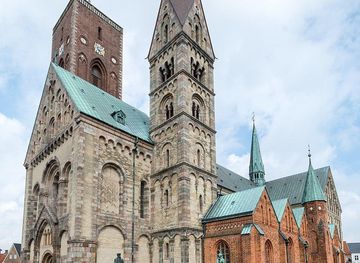
Riberhus Slotsbanke also functions as a natural viewpoint. From the top, the silhouettes of Ribe Cathedral and the tiled roofs of the old town rise to one side, while to the other the flat meadows and channels lead the eye toward the Wadden Sea. The openness of the setting makes it easy to sense how the castle once controlled approaches by land and water.The grassy slopes invite unhurried wandering, with benches and open lawn areas providing informal spots to pause. In fine weather people sit along the edges of the mound or by the water’s edge, listening to the wind and birds. Even on overcast days the interplay of light over marsh and town gives the place a quiet drama.
A Simple, Atmospheric Pause in Ribe
Today Riberhus Slotsbanke is an unfussy historic landscape rather than a museum-style attraction. There are no reconstructed towers or elaborate displays; the story lies in the contours of the ground, the ruin fragments, and the statue on the hilltop. Simple paths lead up and around the mound, and open lawns make it an easy place for children to explore or for a short reflective walk.Because the site is open at all hours and free to enter, it works well as a flexible pause during a day in Ribe: a place to stretch your legs, frame wide photos of the town skyline, and connect briefly with the centuries when Ribe was home to kings and queens.
Evendo Review Centre
 Google
Guest reviews
Best time to go
Quietest: Jan, Feb & Mar · before 8am or at 9pm
Busy times are Evendo estimates for a typical year, to help you plan. Actual crowds vary with events, school holidays and the weather.
Explore Riberhus Slotsbanke on the map
A handpicked selection of must-see spots near Riberhus Slotsbanke, mapped for you.
Get your free copy of our complete guide to Riberhus Slotsbanke, delivered straight to you.
Everything on this page, from opening hours and how to get there to Eve’s tips and the best time to go, in one PDF you can read offline, print or share.
Already have an account? Sign in
Your Riberhus Slotsbanke guide is ready.
We'll send it to · Not you? Sign out

Getting your guide ready…
We are putting together a fresh copy of the Riberhus Slotsbanke guide. This can take up to a minute.
This can take a few moments. If your browser asks, choose Allow so the download can start. You'll find the guide in your Downloads folder.
Nothing happened? Download it again
Sorry, the guide is taking longer than usual. Please try again in a minute, or get it by email instead.
Other nearby places you may find interesting
The closest places of the same kind, if this one is not quite what you had in mind.
-
-
-
-
-


Swipe for more places
More to explore near Riberhus Slotsbanke

 Best experiences near Riberhus Slotsbanke
 Best hotels near Riberhus Slotsbanke
 Best landmarks near Riberhus Slotsbanke
 Best attractions near Riberhus Slotsbanke
 Best shops near Riberhus Slotsbanke
 Best restaurants near Riberhus Slotsbanke
 Best bars near Riberhus Slotsbanke
Do you manage this location?
Take control to get all the benefits, like improved information, better appearance, and stronger visibility across AI-powered discovery.
Explore more
Explore more of Ribe
Discover Ribe, Denmark's oldest town, where medieval charm meets modern allure. Experience Viking history, stunning architecture, and breathtaking natural wonders.
Explore Ribe
Explore more of Denmark
Discover Denmark: A perfect blend of history, modern design, and the cozy concept of hygge. Explore vibrant cities, serene landscapes, and world-class cuisine.
Explore Denmark
