Background

Kongeskibet Dannebrog – The Danish Royal Yacht

A graceful 1930s royal yacht moored in Copenhagen’s harbour, Kongeskibet Dannebrog is a floating palace and naval vessel that quietly showcases Denmark’s maritime monarchy.

4.7
Find your perfect hotel, anywhere in the world.

When's your trip?

Who's coming?

Adult (18-90)
Min: 1 Max: 6
Add a child
At least one participant is required. Please adjust and try again.

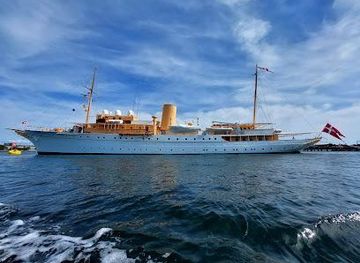
Moored along Copenhagen’s inner harbour, Kongeskibet Dannebrog is the elegant royal yacht that serves as the official and private residence of the Danish monarch when at sea. Launched in 1931–32 to replace an earlier paddle steamer of the same name, the 78-metre vessel is a working naval ship and floating palace in one. Visitors on the quayside can admire its classic clipper bow, elliptical stern, tall masts and immaculate white-and-ochre profile, and, with a little luck, witness ceremonial departures or arrivals during the royal family’s summer voyages.

A brief summary to Kongeskibet Dannebrog

  • Copenhagen, Indre By, 1259, DK
  • +4533401010
  • Visit website
  • Duration: 0.5 to 1.5 hours
  • Free
  • Environment icon Outdoor
  • Mobile reception: 5 out of 5

Local tips

  • Check the Danish Royal House website or local listings before your visit; on days when the yacht is preparing for or returning from a royal voyage, there is often extra ceremonial activity worth watching from the quay.
  • Bring a zoom lens or binoculars to pick out details such as the polished brass, royal insignia and crew routines on deck, since the yacht is typically viewed from the harbour edge.
  • Combine your stop at Dannebrog with a longer walk along Copenhagen’s inner harbour to enjoy additional viewpoints and waterfront landmarks in the same area.
widget icon

Getting There

  • Metro and short walk from central Copenhagen

    From central Copenhagen, take the M1 or M2 metro line to Kongens Nytorv station; trains run every few minutes and a single-zone ticket typically costs around 20–25 DKK. From Kongens Nytorv, allow 10–15 minutes on foot along level pavements to reach the harbour area where the royal yacht is usually moored. The route is suitable for wheelchairs and strollers, though winter weather can make surfaces slippery.

  • City bus within the inner districts

    Several inner-city bus lines connect central Copenhagen with the harbourfront near the royal residences and Nordre Toldbod area in about 10–20 minutes, depending on traffic. Use a standard city bus ticket or travel card, with fares typically around 20–25 DKK for a short journey. Buses run frequently during the day but less often late at night and on some public holidays, so check the timetable in advance.

  • Bicycle from the city centre

    Copenhagen’s extensive cycle lanes make it easy to reach the royal yacht area by bike in roughly 10–20 minutes from most central neighbourhoods. You can use your own bicycle or rent one from shared bike schemes or rental shops, with prices for short-term rental generally starting from about 75–150 DKK per day. Most of the ride is flat and separated from car traffic, but be prepared for wind along the harbourfront and follow local cycling rules carefully.

Kongeskibet Dannebrog location weather suitability

  • Weather icon Any Weather
  • Weather icon Clear Skies
  • Weather icon Mild Temperatures
  • Weather icon Cold Weather
  • Weather icon Windy Conditions

Unlock the Best of Kongeskibet Dannebrog

Buy tickets

    No tickets available

Book tours with entry

    No tours available

Book tours without entry

    No tours available

Discover more about Kongeskibet Dannebrog

A floating symbol of the Danish monarchy

Kongeskibet Dannebrog is much more than a handsome ship tied up in Copenhagen’s harbour – it is one of the clearest symbols of Denmark’s modern monarchy. Launched in 1931 and commissioned in 1932, the royal yacht was named by Queen Alexandrine and has since served as the official and private residence for Denmark’s monarch and royal family during summer cruises in Danish waters and on state visits abroad. When you see its distinctive silhouette against the city skyline, you are looking at a vessel that has carried generations of Danish sovereigns on diplomatic missions, jubilee tours and anniversary celebrations. From the quay, you can trace the yacht’s elegant lines: a clipper bow cutting forward, an elliptical stern aft, and a superstructure painted in pristine white with warm ochre details. The Danish flag that gives the yacht its name – the red-and-white Dannebrog – flies prominently, signalling both national pride and royal presence whenever the ship is in use.

Classic naval craftsmanship and design

Dannebrog was built at the Naval Dockyard in Copenhagen in 1931–32, replacing an earlier royal vessel from 1879 that shared its name. Its hull is constructed of riveted steel on transverse frames, a traditional technique that today feels like a time capsule of early 20th-century shipbuilding. At roughly 78 metres in length and 10 metres in width, it is substantial enough to function as a palace at sea yet compact compared with modern cruise ships, allowing it to reach smaller ports around Denmark, Greenland and the Faroe Islands. Seen from the outside, the yacht can be thought of in two halves. Forward of the funnel lie the crew quarters, cargo spaces and engine rooms that keep the vessel operating as an active naval unit. Aft is the royal section, where the ship’s character shifts from military precision to intimate residence, signalled even from shore by polished woodwork, gleaming brass and the sheltered quarterdeck used for receptions in port.

Life on board: from crew routines to royal apartments

Although visitors cannot normally board the yacht, it remains an independent naval command with a full-time crew. Dannebrog typically sails with nine officers, seven sergeants, a small number of able seamen and several dozen carefully selected conscripts. Each new group begins its naval training in winter before joining the yacht in spring, taking on roles from helmsman and lookout to ceremonial duties on deck. The conscripts are also responsible for the yacht’s immaculate appearance, maintaining the extensive brass and paintwork that you notice shining even from the pier. Hidden from public view, the royal apartments are fitted out with furniture and decorative pieces transferred from the older 19th-century royal yacht. Within this private world are studies for the monarch, a dining saloon, lounge spaces and bedrooms, all designed for extended life at sea. The arrangement reflects the yacht’s original dual purpose: not only a royal residence in peacetime but, on paper, convertible into a hospital ship in wartime, with the rear accommodation capable of receiving patients if ever required.

Ceremony, tradition and coastal journeys

Over the decades Dannebrog has travelled hundreds of thousands of nautical miles, visiting most Danish ports as well as destinations in Greenland, the Faroe Islands and across Europe. Each departure from Copenhagen’s harbour is a piece of living theatre. When the royal family embarks on their annual summer voyage, the scene often includes salutes from shore batteries, bands playing on the quay and crowds waving flags as the yacht eases away from the pier. In foreign ports the yacht acts as a floating embassy. The covered quarterdeck transforms into a refined reception space for official dinners, cultural events and diplomatic meetings. From your vantage point on land in Copenhagen, it can be intriguing to watch as flowers, luggage, official cars and staff move on and off the gangway, offering a glimpse of the choreography behind a royal tour.

Experiencing Dannebrog from the quayside

For most travelers the experience of Kongeskibet Dannebrog is visual and atmospheric rather than hands-on. When the yacht is moored in the inner harbour, it becomes an eye-catching focal point for a waterside stroll, its masts and rigging framing views across the canal. The contrast between the ship’s historic lines and the surrounding mix of classical and contemporary architecture makes it a rewarding subject for photography. There is no regular public access on board, which adds a certain mystique. Instead, the pleasure lies in small details: watching sailors at work on deck, spotting ceremonial pennants flying during special occasions, and imagining the journeys the yacht has made from this very berth. Combined with nearby waterfront landmarks, Dannebrog turns a simple walk along the quays into a quiet encounter with the country’s maritime and royal heritage.

Busiest months of the year

Busiest hours of the day

Popular Experiences near Kongeskibet Dannebrog

Popular Hotels near Kongeskibet Dannebrog

Select Currency