

Fregatten Jylland Travel Guide
Free Guide: Step aboard one of the world’s longest wooden warships in Ebeltoft and explore battle history, royal voyages and everyday life on a meticulously restored frigate.


A brief summary of Fregatten Jylland
Step aboard one of the world’s longest wooden warships in Ebeltoft and explore battle history, royal voyages and everyday life on a meticulously restored frigate.
Moored in a dry dock in the harbour town of Ebeltoft, Fregatten Jylland is one of the world’s longest and best‑preserved wooden warships, transformed into a vivid maritime museum. Launched in 1860, the Danish frigate fought in the 1864 Battle of Helgoland, later served as a royal yacht and expedition ship, and narrowly escaped scrapping. Today you can explore its decks from gun batteries to cramped hammocks, discover immersive exhibitions on 19th‑century naval warfare and life at sea, and experience how this single ship reflects a turbulent chapter in Denmark’s history.
On-site amenities
 Restrooms
 Drink options
 Drinking water
 Food options
 Seating areas
 Sheltered areas
 Picnic areas
 Trash bins
 Information boards
 Visitor centre
Opening hours
- Every day10 am–5 pm
Opening hours as listed on the venue’s Google Business Profile. Hours can change for services and special events, so check with the venue before you go.
- Address
- S. A. Jensens Vej 4, 8400 Ebeltoft
- Phone
- Website
Getting there
Car from Aarhus
Bus from Aarhus
Local travel within Ebeltoft
Cycling in Djursland
Discover more about Fregatten Jylland
A 19th‑Century Giant in a Modern Dry Dock
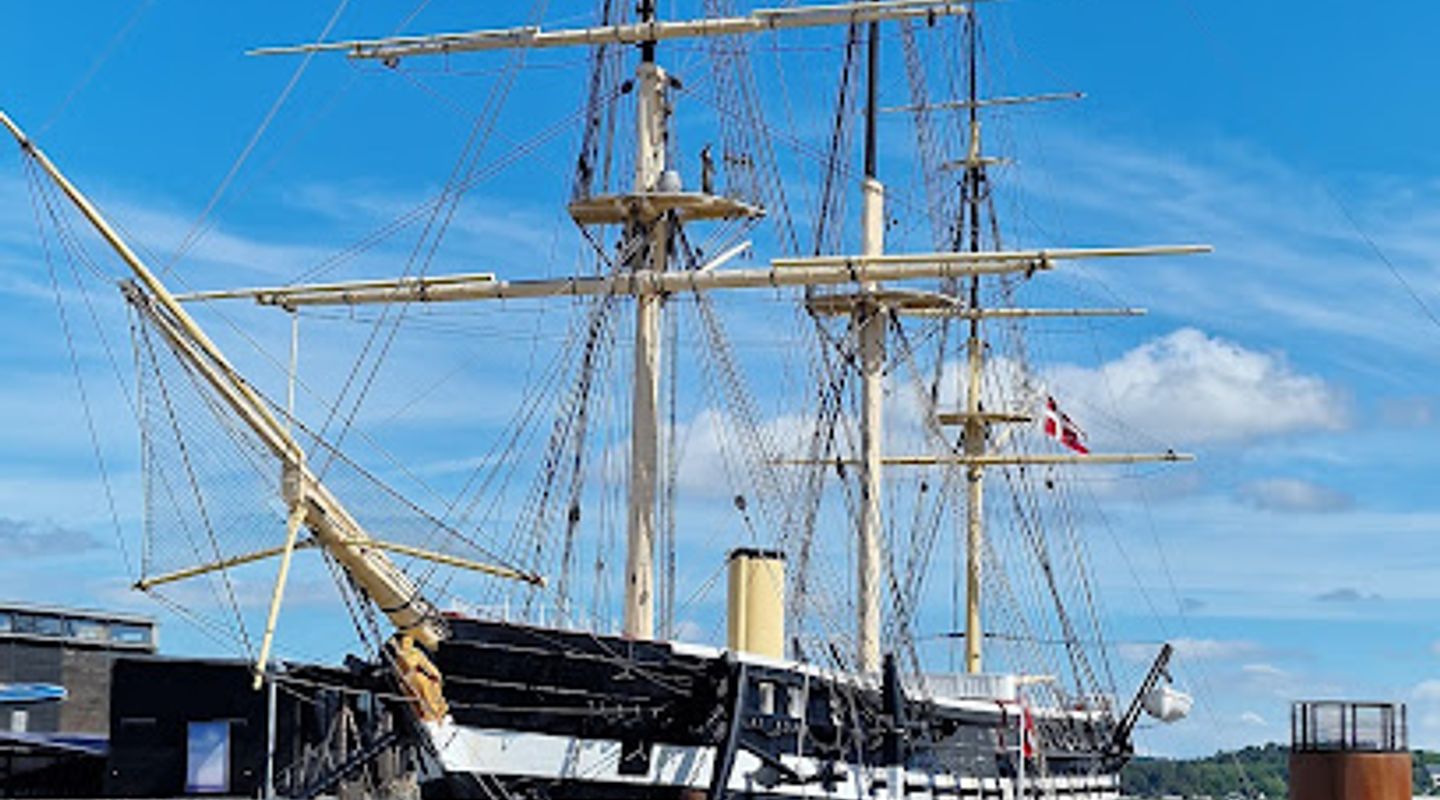
Fregatten Jylland dominates its dry dock in Ebeltoft with a hull of massive oak and a forest of rigging that instantly transports you to the age of sail and steam. Built between 1857 and 1860, the frigate was a transitional warship, combining traditional masts and canvas with a steam engine and screw propeller. Standing alongside the hull, you appreciate the scale: at more than 70 metres long, it is among the longest wooden warships ever constructed, yet it is held delicately aloft on keel blocks so you can walk right beneath it.The dry‑dock setting allows close inspection of details rarely visible on historic ships. You can study the copper sheathing, the sweeping lines of the bow and stern, and the scars of battle and repair that mark the planks. Information panels in the surrounding museum buildings explain how shipwrights sourced and shaped thousands of wooden components, and how later restoration campaigns saved the vessel from decay and dismantling.
From Battle of Helgoland to Royal Voyages
Jylland’s story is closely tied to Denmark’s 19th‑century struggles and ambitions. In 1864 the frigate took part in the Battle of Helgoland during the Second Schleswig War, duelling with Austrian and Prussian ships in one of the last great naval engagements fought under sail. On board you find exhibits that trace the course of the battle, show where shells hit the hull, and explain how the outcome became part of Danish national memory.After its war service the ship gained a more ceremonial role. In the 1870s it was converted into a royal yacht, carrying King Christian IX on voyages to the Faroe Islands, Iceland and the Danish West Indies. Displays along the route through the museum contrast the relatively comfortable royal cabins with the more modest spaces used when the ship undertook long expeditions as a training and station ship. Photographs, models and artefacts connect these journeys to the wider story of Denmark as a maritime nation.
Life Below Deck: Cannons, Hammocks and Hard Work
Descending into the frigate, you step into atmospheric gun decks lined with heavy artillery, ammunition racks and thick timber beams. Sound and light installations evoke the noise of broadsides and the commands shouted during battle, while labels pick out details such as the recoil paths of the cannons and the way the crew worked in teams. You learn how 400‑plus sailors lived and fought in a space designed for efficiency rather than comfort.Further down, the between‑decks and lower decks reveal cramped hammocks, mess tables and storerooms where provisions were stacked for months at sea. Reconstructions of a surgeon’s corner, a carpenter’s bench and officers’ cabins give a sense of the hierarchy on board and the skills needed to keep the ship operational. For children and curious adults there are hands‑on elements, from knot‑tying stations to replica signal flags, that turn abstract history into something tangible.
Museum Halls, Play Spaces and Seasonal Activities
Alongside the ship, the museum halls expand the narrative with models, interactive exhibits and thematic displays on navigation, shipbuilding, climate and naval technology. Here you can follow a detailed historic timeline, examine uniforms and personal belongings, and explore how sailors experienced storms, routine drills and long periods away from home. Temporary exhibitions often add contemporary angles, linking 19th‑century conflict and seafaring to modern questions about war, identity and the environment.Outside, a maritime‑themed playground offers climbing structures and imaginative play inspired by rigging, masts and small boats, making the site especially engaging for families. In peak summer, short sailing trips in a traditional launch depart from nearby, giving a sea‑level view of the frigate’s profile. Throughout the year, special programmes such as guided historic introductions and children’s storytelling sessions bring different aspects of the ship’s past to life.
Preserved Heritage on the Ebeltoft Waterfront
The frigate sits at the edge of Ebeltoft’s harbour, framed by low waterfront buildings, cobbled streets and views across the bay. From the upper deck you can look over the town’s red roofs and church towers, with the smell of saltwater and tarred rope adding to the sense of place. The surrounding museum complex includes ticketing, exhibits, a shop and access to nearby eateries, so you can easily spend several hours exploring both ship and shore.Fregatten Jylland is more than a photogenic relic: it is a large‑scale conservation project and an anchor point for understanding how wooden warships were built, used, neglected and finally restored. A visit offers a layered experience, blending close‑up craftsmanship with big‑picture history, and leaving you with a vivid impression of life on board one of Denmark’s most storied vessels.
Evendo Review Centre
 Google
Guest reviews
Best time to go
Quietest: Jan, Feb & Nov · before 8am or from 7pm
Busy times are Evendo estimates for a typical year, to help you plan. Actual crowds vary with events, school holidays and the weather.
Explore Fregatten Jylland on the map
A handpicked selection of must-see spots near Fregatten Jylland, mapped for you.
Get your free copy of our complete guide to Fregatten Jylland, delivered straight to you.
Everything on this page, from opening hours and how to get there to Eve’s tips and the best time to go, in one PDF you can read offline, print or share.
Already have an account? Sign in
Your Fregatten Jylland guide is ready.
We'll send it to · Not you? Sign out

Getting your guide ready…
We are putting together a fresh copy of the Fregatten Jylland guide. This can take up to a minute.
This can take a few moments. If your browser asks, choose Allow so the download can start. You'll find the guide in your Downloads folder.
Nothing happened? Download it again
Sorry, the guide is taking longer than usual. Please try again in a minute, or get it by email instead.
Other nearby places you may find interesting
The closest places of the same kind, if this one is not quite what you had in mind.
-
-
-
-
-


Swipe for more places
More to explore near Fregatten Jylland

 Best experiences near Fregatten Jylland
 Best hotels near Fregatten Jylland
 Best landmarks near Fregatten Jylland
 Best attractions near Fregatten Jylland
 Best shops near Fregatten Jylland
 Best restaurants near Fregatten Jylland
 Best bars near Fregatten Jylland
Do you manage this location?
Take control to get all the benefits, like improved information, better appearance, and stronger visibility across AI-powered discovery.
Explore more

Explore more of South Jutland
Discover the beauty and charm of South Jutland, Denmark's southern treasure, with its rich history, stunning landscapes, and delightful local cuisine.
Explore South Jutland
Explore more of Denmark
Discover Denmark: A perfect blend of history, modern design, and the cozy concept of hygge. Explore vibrant cities, serene landscapes, and world-class cuisine.
Explore Denmark
