

Bøgsted Rende Travel Guide
Free Guide: Where Thy’s coastal forest meets dune and sea, a rust‑coloured brook and red hourglass beacon create one of Denmark’s most quietly dramatic coastal valleys.


A brief summary of Bøgsted Rende
Where Thy’s coastal forest meets dune and sea, a rust‑coloured brook and red hourglass beacon create one of Denmark’s most quietly dramatic coastal valleys.
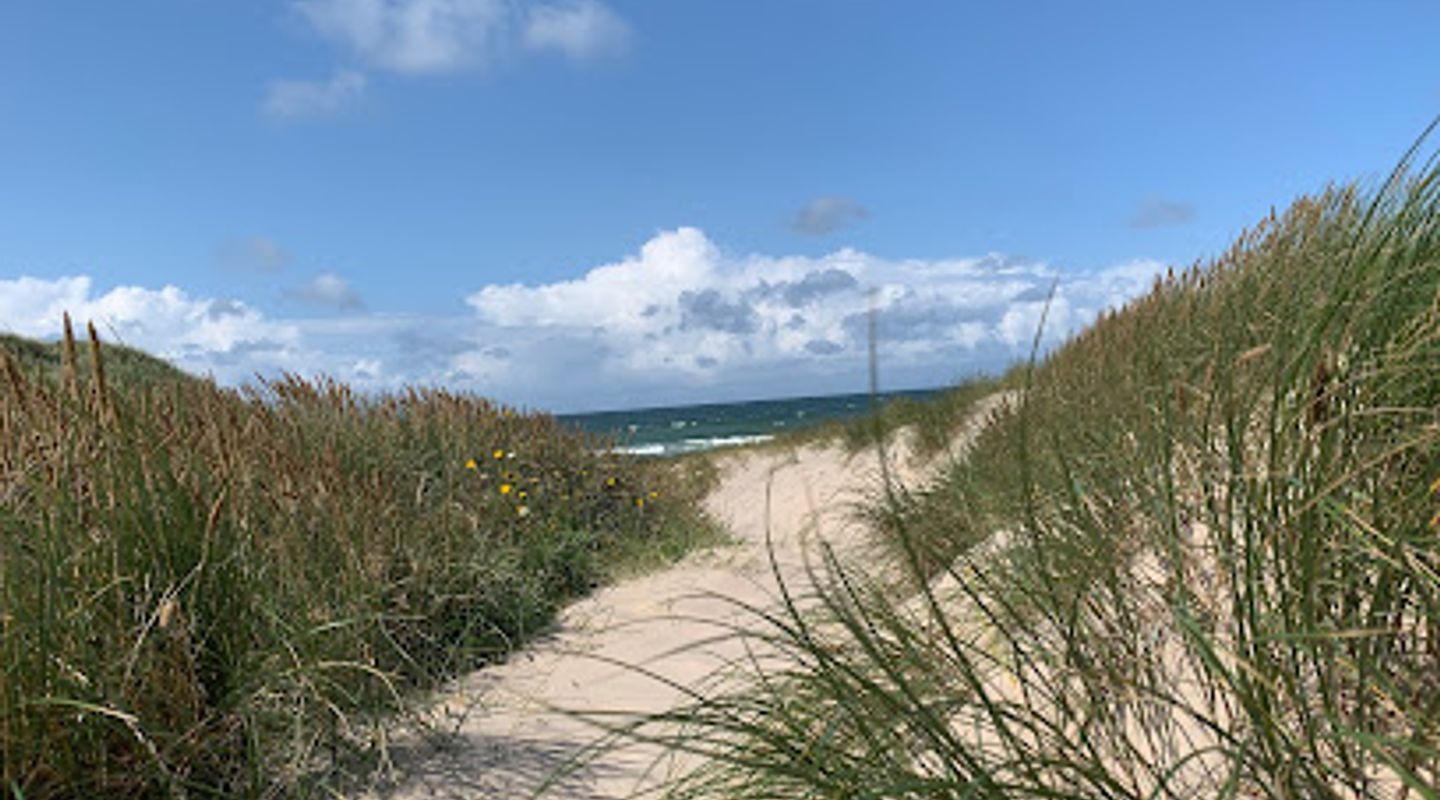
Bøgsted Rende is a sheltered valley and brook where Thy National Park’s coastal forest runs almost all the way to the North Sea. Here wind‑bent oaks, pines and spruce huddle in the dunes, a rust‑coloured stream threads its way to the beach, and a striking red hourglass‑shaped sea beacon towers above the landscape. Once home to a watermill and early nature excursions, it is now a peaceful spot for walks, picnics and quiet contemplation by the waves.
On-site amenities
 Trash bins
 Information boards
Opening hours
- Every dayOpen 24 hours
Opening hours as listed on the venue’s Google Business Profile. Hours can change for services and special events, so check with the venue before you go.
- Address
- Bøgsted Rende Vej, 7700 Thisted
Getting there
Car from Thisted
Car from Klitmøller
Cycling in Thy National Park
Discover more about Bøgsted Rende
Forest Reaching for the Sea
Bøgsted Rende is the point on the Thy coast where the plantation forest stretches furthest towards the North Sea, stopping only at a final belt of beach dunes. The scene feels almost unlikely for Denmark’s west coast: dense conifers and low oak scrub pressing right up against open sand and roaring surf. Sheltered paths weave between pines and thickets, giving a sense of walking through a green tunnel that suddenly breaks into bright, wind‑whipped shore.The oldest trees here were planted in the late 19th century, when large parts of this coastline were afforested to stabilise drifting sands. Close to the sea you pass mountain pines and waist‑high oaks, bent and twisted by relentless westerly winds. Further inland along the brook the forest becomes taller and darker, with silver fir and Austrian pine drawing deep strength from clay soils hidden beneath the sand.
The Ochre‑Tinted Brook
The name Bøgsted Rende refers to the site by the brook that cuts through the dunes to reach the sea. In the 17th and 18th centuries a watermill stood by this stream, using its flow for power until drifting sand clogged the watercourses and ruined the mill’s operation. Today nothing of the mill remains, but the brook still shapes the valley and the way visitors move through it.You will quickly notice the water’s unusual brownish‑red colour. The tint comes from ochre – oxidised iron washed out from drained, once‑waterlogged soils in the plantation. At times the brook can look almost rusty, with orange films on stones and plants. Restoration work in Thy increasingly aims to restore a more natural water balance, so this intense staining may gradually fade in the future, but for now it is a striking part of Bøgsted Rende’s character.
The Red Hourglass Beacon
Climb the sandy path up from the valley floor and the landscape opens onto one of Bøgsted Rende’s most distinctive features: a tall, red sea marker rising high above the surrounding vegetation. Built in 1884–85 from heavy iron girders and timber, it carries an hourglass‑shaped top that makes it instantly recognisable against the sky.This beacon is one of a chain of individually shaped seamarks that once lined Jutland’s west coast. In the days before electronic navigation, crews identified each structure from their charts to fix their position in daylight. Modern technology has long since taken over their function, but several of these markers, including Bøgsted Rende’s, are now protected. Seen up close, the beacon feels almost like a piece of industrial sculpture, a bold geometric form set in shifting dunes and low forest.
Traces of Early Nature Tourism
From the early 20th century Bøgsted Rende emerged as a favoured destination for local outings. The combination of forest, stream and sea made it an obvious place to escape for fresh air and scenic walks, and for a time even a small pastry shop welcomed day‑trippers on the road down to the brook. Although those facilities have long disappeared, the area still carries that atmosphere of a classic excursion spot.Picnic tables and clearings offer natural pauses along the brook, while sandy tracks invite you to explore at your own pace. The gentle gradients in the valley contrast with steeper, looser dunes near the sea, so you can choose between leisurely strolls under trees or more energetic climbs towards wide coastal views. In every direction the sounds are elemental: wind in needles, water over sand, the muted roar of distant breakers.
Walking, Wildlife and Quiet Moments
For today’s visitors Bøgsted Rende is mostly about simple outdoor pleasures. Short loop walks along the brook are suitable for families, while longer rambles can link into wider trails through Tvorup Klitplantage and the broader Thy National Park. The mix of habitats – conifer plantation, oak scrub, open dunes and stream corridor – makes the area interesting for amateur naturalists, with birds moving between forest edge and coast and plenty of plant variation in a compact space.Despite its accessibility, the valley retains a tranquil feel, especially outside peak holiday weeks. It is easy to find a quiet spot by the water or in the shelter of the trees to sit, listen and watch the light change over the dunes. With no built attractions to distract from the setting, Bøgsted Rende offers a gentle, timeless kind of coastal experience: one that invites you simply to be present in the landscape.
Evendo Review Centre
 Google
Guest reviews
Best time to go
Quietest: Jan, Feb & Dec · before 6am or from 10pm
Busy times are Evendo estimates for a typical year, to help you plan. Actual crowds vary with events, school holidays and the weather.
Explore Bøgsted Rende on the map
A handpicked selection of must-see spots near Bøgsted Rende, mapped for you.
Get your free copy of our complete guide to Bøgsted Rende, delivered straight to you.
Everything on this page, from opening hours and how to get there to Eve’s tips and the best time to go, in one PDF you can read offline, print or share.
Already have an account? Sign in
Your Bøgsted Rende guide is ready.
We'll send it to · Not you? Sign out

Getting your guide ready…
We are putting together a fresh copy of the Bøgsted Rende guide. This can take up to a minute.
This can take a few moments. If your browser asks, choose Allow so the download can start. You'll find the guide in your Downloads folder.
Nothing happened? Download it again
Sorry, the guide is taking longer than usual. Please try again in a minute, or get it by email instead.
Other nearby places you may find interesting
The closest places of the same kind, if this one is not quite what you had in mind.
-
-
-
-
-


Swipe for more places
More to explore near Bøgsted Rende

 Best experiences near Bøgsted Rende
 Best hotels near Bøgsted Rende
 Best landmarks near Bøgsted Rende
 Best attractions near Bøgsted Rende
 Best shops near Bøgsted Rende
 Best restaurants near Bøgsted Rende
 Best bars near Bøgsted Rende
Do you manage this location?
Take control to get all the benefits, like improved information, better appearance, and stronger visibility across AI-powered discovery.
Explore more

Explore more of Thy National Park
Discover Thy National Park, Denmark's first national park, a coastal wilderness offering diverse landscapes, rich wildlife, and countless outdoor activities for nature lovers.
Explore Thy National Park
Explore more of Denmark
Discover Denmark: A perfect blend of history, modern design, and the cozy concept of hygge. Explore vibrant cities, serene landscapes, and world-class cuisine.
Explore Denmark
