Tower Bridge Travel Guide
Free Guide: Walk across London’s most famous bridge, explore its high-level walkways and glass floors, and discover the Victorian engineering behind this iconic landmark.


A brief summary of Tower Bridge
Walk across London’s most famous bridge, explore its high-level walkways and glass floors, and discover the Victorian engineering behind this iconic landmark.
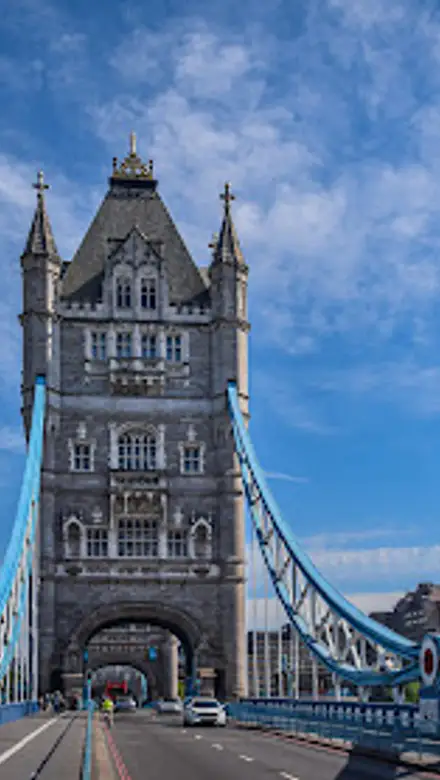
Tower Bridge is one of London’s most iconic landmarks, a Victorian-era bascule bridge spanning the River Thames. Completed in 1894, it combines Gothic-style towers with cutting-edge engineering of its time. Visitors can explore the high-level walkways, walk across glass floors 42 metres above the river, and see the original steam engines in the Engine Rooms. The bridge remains a working crossing, lifting around 800 times a year for river traffic, and offers panoramic views of the city from the walkways.
On-site amenities
 Restrooms
 Drink options
 Drinking water
 Food options
 Seating areas
 Trash bins
 Information boards
 Visitor centre
Opening hours
- Every day9:30 am–6 pm
Opening hours as listed on the venue’s Google Business Profile. Hours can change for services and special events, so check with the venue before you go.
- Address
- Tower Bridge Rd, London SE1 2UP
- Phone
- Website
Getting there
Underground (Tube)
Bus
Walking
Riverboat
Discover more about Tower Bridge
Engineering Marvel of the Victorian Age
Tower Bridge is a masterpiece of late 19th-century engineering, designed to solve the growing need for a new river crossing without blocking the busy shipping lanes of the Thames. Completed in 1894, it was the largest and most sophisticated bascule bridge of its time, with two massive towers connected by high-level walkways and a complex system of counterweights and hydraulics. The bridge’s distinctive Gothic style, with its ornate stonework and pointed arches, was chosen to harmonise with the nearby Tower of London, giving it a grand, almost castle-like appearance that has become synonymous with London’s skyline.Inside the structure, the original Victorian steam engines that once powered the bascules are preserved in the Engine Rooms, where visitors can see the massive pumps, boilers, and machinery that kept the bridge operating for over 80 years. Interactive displays and historical photographs bring to life the stories of the engineers, stokers, and bridge operators who maintained this vital piece of infrastructure, offering a vivid glimpse into the industrial heart of Victorian London.
Views from the High-Level Walkways
The high-level walkways, suspended 42 metres above the River Thames, provide one of the most dramatic vantage points in central London. From here, the city unfolds in all directions: to the west, the Tower of London, St Paul’s Cathedral, and The Shard dominate the skyline; to the east, Canary Wharf and the modern towers of Docklands rise above the river. The walkways stretch 70 metres between the two towers and were originally intended for pedestrians when the bascules were raised, though they were closed to the public for much of the 20th century before reopening as part of the visitor attraction in 1982.Today, the walkways are a highlight of the Tower Bridge Exhibition, offering panoramic views of the river, passing boats, and the bustling city below. The addition of glass floor panels adds an extra thrill, allowing visitors to look directly down at the road and river 43.5 metres beneath their feet. These glass sections are engineered to support immense weight and are periodically replaced to ensure safety, making them both a feat of modern engineering and a unique perspective on London life.
Bridge Lifts and the Working River
Tower Bridge is not just a museum piece; it remains a fully functioning bascule bridge, lifting around 800 times a year to allow tall vessels to pass along the Thames. The lifts are scheduled in advance and can be checked online, making it possible to time a visit to witness the roadway rising and the bascules opening to let ships through. The entire process takes just a few minutes, but the sight of the massive steel sections swinging upwards, framed by the Gothic towers, is unforgettable.From the walkways or the riverbanks, watching a bridge lift is a powerful reminder of London’s long history as a port city. The vessels that pass beneath range from historic paddle steamers and sailing yachts to modern cruise boats and working tugs, each adding to the ever-changing rhythm of river traffic. The bridge’s continued operation, now controlled by a modern remote system, shows how Victorian engineering has been adapted to serve a 21st-century city.
Exploring the Towers and Engine Rooms
The visitor experience begins at the ticket office on the northwest side of the bridge, from where you ascend through the North Tower to reach the high-level walkways. The route takes you through the bridge’s internal structure, with exhibits that trace its construction, maintenance, and role in London’s transport and cultural life. QR codes and audio guides provide detailed commentary on the bridge’s history, the lives of those who worked on it, and the evolution of its technology over more than a century.Descending through the South Tower, the narrative shifts to the people who have maintained and operated Tower Bridge since 1894, from the original stokers and engineers to modern bridge operators. The journey continues into the Engine Rooms, where the original steam engines, boilers, and accumulators are displayed alongside films and interactive displays that explain how the bridge was powered and how it functions today. The contrast between the ornate Gothic exterior and the raw, industrial interior underscores the bridge’s dual identity as both a civic monument and a working piece of infrastructure.
Evendo Review Centre
 Google
Guest reviews
Best time to go
Quietest: Jan, Feb & Mar · before 7am or from 8pm
Busy times are Evendo estimates for a typical year, to help you plan. Actual crowds vary with events, school holidays and the weather.
Explore Tower Bridge on the map
A handpicked selection of must-see spots near Tower Bridge, mapped for you.
Get your free copy of our complete guide to Tower Bridge, delivered straight to you.
Everything on this page, from opening hours and how to get there to Eve’s tips and the best time to go, in one PDF you can read offline, print or share.
Already have an account? Sign in
Your Tower Bridge guide is ready.
We'll send it to · Not you? Sign out

Getting your guide ready…
We are putting together a fresh copy of the Tower Bridge guide. This can take up to a minute.
This can take a few moments. If your browser asks, choose Allow so the download can start. You'll find the guide in your Downloads folder.
Nothing happened? Download it again
Sorry, the guide is taking longer than usual. Please try again in a minute, or get it by email instead.
Unlock the best of Tower Bridge
Skip-the-line tickets, guided tours with entry, and walking tours of the area, booked in a few clicks.


Other nearby places you may find interesting
The closest places of the same kind, if this one is not quite what you had in mind.
-
-
-
-
-


Swipe for more places
More to explore near Tower Bridge

 Best experiences near Tower Bridge
 Best hotels near Tower Bridge
 Best landmarks near Tower Bridge
 Best attractions near Tower Bridge
 Best shops near Tower Bridge
 Best restaurants near Tower Bridge
 Best bars near Tower Bridge
Do you manage this location?
Take control to get all the benefits, like improved information, better appearance, and stronger visibility across AI-powered discovery.
Explore more
Explore more of Middlesex
Discover Middlesex: A blend of historic charm and modern excitement, offering scenic beauty, cultural events, and easy access to London.
Explore Middlesex
Explore more of United Kingdom
Discover the United Kingdom: A blend of rich history, stunning landscapes, and vibrant cities, offering a unique travel experience for every visitor.
Explore United Kingdom