Background

Rainbow Square (Regnbuepladsen)

A modest gray stone plaza beside Copenhagen City Hall, Rainbow Square quietly anchors the city’s public commitment to LGBT+ rights and civic openness.

Find your perfect hotel, anywhere in the world.

When's your trip?

Who's coming?

Adult (18-90)
Min: 1 Max: 6
Add a child
At least one participant is required. Please adjust and try again.

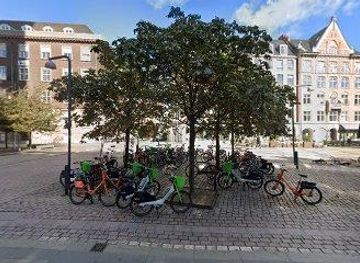
Tucked beside Copenhagen City Hall, Rainbow Square (Regnbuepladsen) is a compact urban plaza with big symbolic weight. Once a car park, it was redesigned in 2014 as a calm, stone-paved space framed by trees and granite seating blocks whose patterns echo the historic Vartov building. Named after the rainbow flag to honor the LGBT+ rights movement, it now stands as a quiet yet powerful civic statement in the very heart of the city.

A brief summary to Rainbow Square

  • Regnbuepladsen, Copenhagen, Indre By, 1552, DK
  • Duration: 0.5 to 1 hours
  • Free
  • Environment icon Outdoor
  • Mobile reception: 5 out of 5

Local tips

  • Bring a takeaway coffee and sit on the granite blocks to watch city life flow between City Hall, Tivoli and H.C. Andersens Boulevard.
  • Look for the Hans Christian Andersen quotations engraved into two of the granite blocks; they deepen the link between the square and Vartov.
  • Time your visit around Copenhagen Pride in August if you want to see the rainbow symbolism come fully to life with flags and events.
widget icon

Getting There

  • Metro from central Copenhagen hubs

    From major hubs like Nørreport Station or Kongens Nytorv, take the M3 or M4 metro line to Rådhuspladsen Station. Trains run every few minutes and the journey takes about 3–8 minutes depending on your starting point. A single zone ticket or city transport pass is valid; expect to pay roughly 20–30 DKK for a single adult ticket if you do not have a pass. From the metro concourse it is a short, step-free walk on level pavements to the square, suitable for wheelchairs and strollers.

  • S-train plus short walk

    If you are arriving by regional or S-train, travel to Copenhagen Central Station. From there, it is about a 10–15 minute urban walk along wide sidewalks to the City Hall area and Rainbow Square, with mostly flat terrain and frequent pedestrian crossings. Walking is free and gives you a good first impression of the city’s core; allow extra time in bad weather or if walking with young children.

  • City bus services to City Hall area

    Several inner-city bus routes stop near City Hall Square, just a couple of minutes’ walk from Rainbow Square. Typical travel times from inner districts such as Østerbro or Vesterbro range from 10–20 minutes depending on traffic. Standard city bus fares apply, around 20–30 DKK for a single adult ticket if you pay per ride, and services generally run from early morning until late evening with reduced frequency at night.

Rainbow Square location weather suitability

  • Weather icon Any Weather
  • Weather icon Clear Skies
  • Weather icon Mild Temperatures
  • Weather icon Cold Weather
  • Weather icon Rain / Wet Weather

Unlock the Best of Rainbow Square

Buy tickets

    No tickets available

Book tours with entry

    No tours available

Book tours without entry

    No tours available

Discover more about Rainbow Square

A small city square with a bold message

Rainbow Square, or Regnbuepladsen, occupies a modest corner beside Copenhagen City Hall, but its name and story are anything but modest. The square was officially renamed in 2014 in honor of the rainbow flag and the long struggle for equal rights for LGBT+ people. Here, a simple street sign declares the site as a symbol of tolerance and openness, right next to the seat of local government. This corner of the city has long been tied to civic life and protest. City Hall Square and the streets around it have hosted demonstrations, celebrations and Pride parades for decades. Choosing this precise spot for Rainbow Square made the message unmistakable: equality is part of the city’s public face, woven into its everyday spaces rather than hidden at the margins.

From anonymous car park to designed urban space

Before its redesign, the area was largely used as parking, a leftover space rather than a place in its own right. In 2009, Irish architects Hall McKnight won a competition to transform it into a proper plaza, opening it up, adding trees and creating a more generous connection between City Hall Square and the historic Vartov building. The new design is deliberately restrained. The surface is a patchwork of cobblestones, gray tiles and granite, all held in a controlled, almost graphic composition. Low granite blocks double as sculptural elements and informal seating, inviting you to pause between museums, shops and the bustle of H.C. Andersens Boulevard.

Subtle patterns inspired by Vartov and Andersen

Look closely at the paving and you notice that the stone patterns echo the grid of windows on Vartov’s red-brick façade. The architects used the old building as a template, mirroring its rhythm on the ground so that the square and the architecture visually lock together. Two of the large granite blocks carry engraved text from Hans Christian Andersen’s tale “From a Window in Vartov,” a quiet literary nod to the city’s most famous storyteller and to the building’s past. The inscriptions invite a slower type of visit: you may find yourself tracing the carved letters while traffic hums just out of reach.

Rainbow symbolism in shades of gray

Despite its name, Rainbow Square is mostly rendered in muted grays and earthy tones. The color comes not from painted surfaces but from the rainbow flag and related installations that periodically animate the space, especially around Copenhagen Pride. This contrast between subdued stone and vivid flags reinforces the idea that the rainbow is an overlay on everyday civic life, not a separate stage. The decision to use minimal materials and a limited palette also means the square works year-round. In bright summer light, the granite and cobbles glow softly; on wet winter days, the surfaces darken and reflect headlights and neon from the surrounding streets, giving the small plaza an atmospheric, almost cinematic quality.

A quiet pause between major sights

Set just steps from attractions like Copenhagen City Hall and Tivoli Gardens, Rainbow Square offers a breather in the city center. Locals use it as a shortcut, a meeting point or a place to sit with a takeaway coffee. Travellers can use the granite blocks as a perch to watch cyclists sweep past and listen to church bells and tram noise mingling with street music from nearby squares. In the evening, the area around the square glows with the lights of the City Hall façade and nearby cafés, while the open layout keeps it feeling safe and visible. It is not a destination that demands a long visit, but rather a compact, meaningful stop that adds a layer of contemporary values to Copenhagen’s historic core.

Layered histories and ongoing activism

The naming process itself reflects wider debates within Danish society about how to commemorate people and movements. Earlier proposals focused on specific LGBT+ figures, but controversies and disagreements led to the more inclusive, symbolic name Rainbow Square. That choice sidestepped individual biographies and instead foregrounded a collective struggle. Today, the plaza quietly anchors that narrative in stone. During Pride, it can form part of larger celebrations and marches; on ordinary days, it reads as a calm, thoughtfully designed space whose very name keeps questions of rights and recognition in public view.

Busiest months of the year

Busiest hours of the day

Popular Experiences near Rainbow Square

Popular Hotels near Rainbow Square

Select Currency