Memorial Park Travel Guide
Free Guide: A solemn green sanctuary in Hellerup where execution grounds, grave fields and memorial walls honour Denmark’s World War II resistance and their sacrifice.


A brief summary of Memorial Park
A solemn green sanctuary in Hellerup where execution grounds, grave fields and memorial walls honour Denmark’s World War II resistance and their sacrifice.
Ryvangen Memorial Park, known as Mindelunden, is Denmark’s official memorial cemetery for the resistance movement, set in a solemn green enclave on former military grounds in Hellerup. Here, execution and burial sites from World War II sit among lawns, trees, and sculpted monuments, commemorating resistance fighters executed in Ryvangen, those who died in concentration camps, and others whose remains were never found. It is a tranquil yet deeply affecting place for reflection on Denmark’s wartime history.
On-site amenities
 Restrooms
 Seating areas
 Information boards
Opening hours
- Every day10 am–5 pm
Opening hours as listed on the venue’s Google Business Profile. Hours can change for services and special events, so check with the venue before you go.
- Address
- Tuborgvej 33, 2900 Hellerup
- Phone
- Website
Getting there
S-train from central Copenhagen
City bus within Copenhagen area
Bicycle from inner Copenhagen
Taxi within the Copenhagen region
Discover more about Memorial Park
A quiet landscape carrying Denmark’s wartime memory
Ryvangen Memorial Park, or Mindelunden, occupies former army training grounds in Hellerup that were seized by German forces during World War II and turned into a place of executions and secret burials. Today, the lawns, trees and clipped hedges create a deceptively peaceful setting, carefully designed to honour members of the Danish resistance who were killed during the occupation. Paths lead you through open grass, shaded groves and clearings, each space revealing another layer of the story.Unlike a conventional city park, Mindelunden is both cemetery and national memorial. The mood is deliberately restrained: straight sightlines, simple stonework and low planting keep the focus on names, dates and the human cost of occupation. Signs explain the events that unfolded here between 1943 and 1945, but much of the impact comes simply from walking in silence and noticing how the landscape has been shaped around absence and loss.
The great grave field and the grieving mother
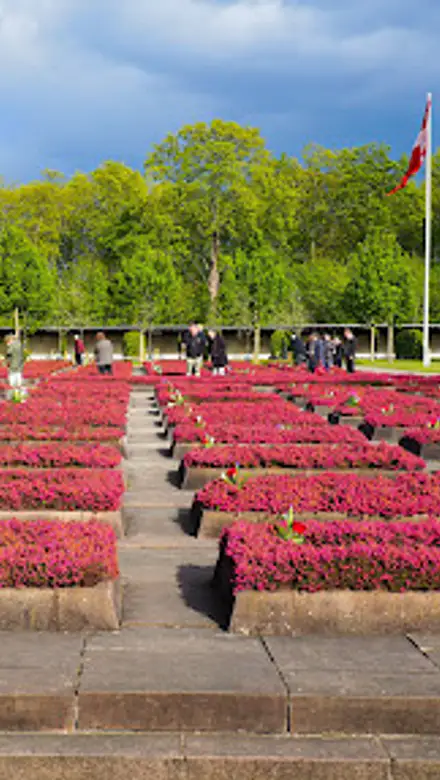
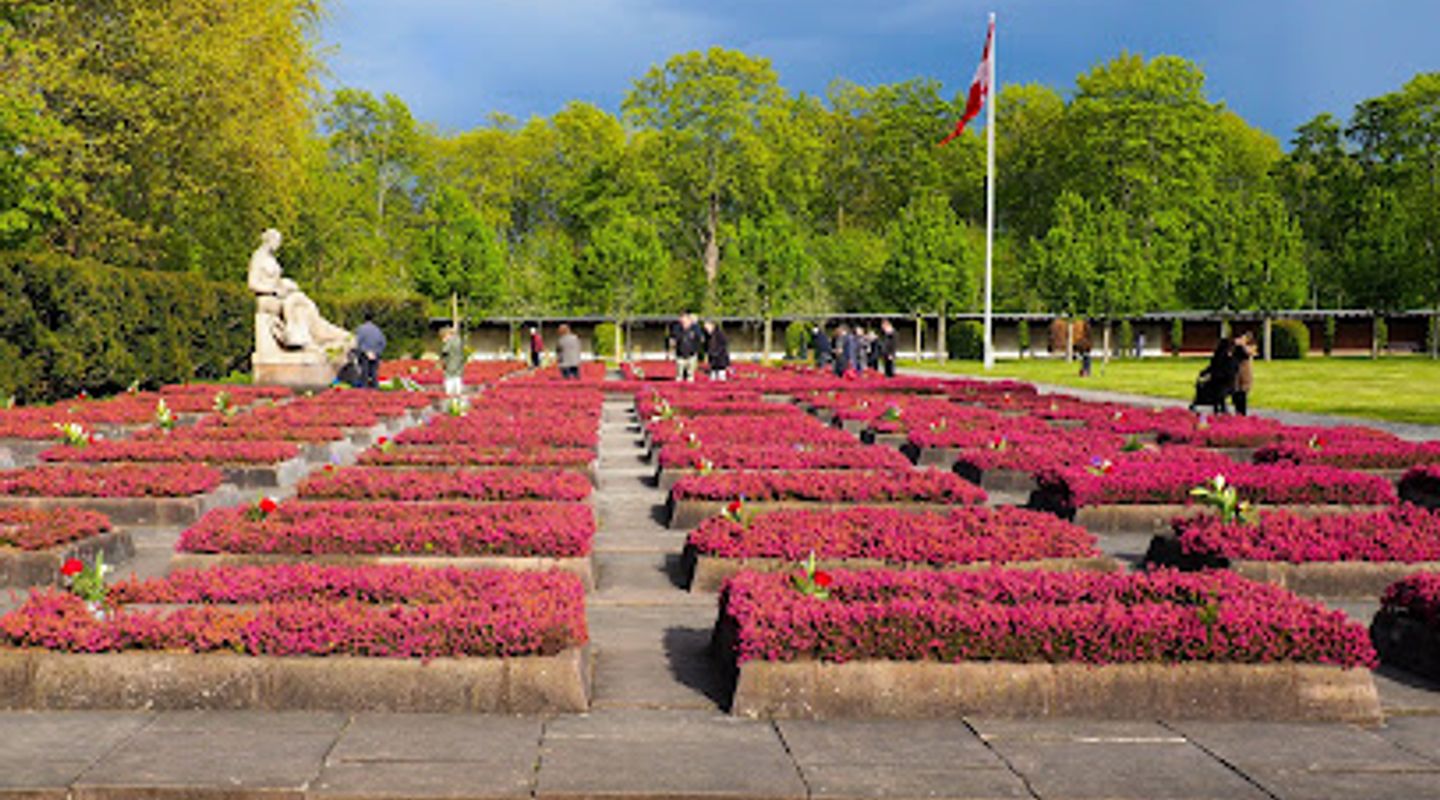
At the heart of the memorial lies the large grave field, where over a hundred resistance fighters are buried in uniform rows. Each grave is marked with a low stone slab set on red marble, giving the area a strong visual rhythm when seen from the main path. In the centre stands Axel Poulsen’s powerful sculpture often known as “The Mother with the Slain Son”, a sandstone figure of a seated woman holding her dead child, created as a monument “For Denmark”. The statue anchors the space, turning the grassy field into a single unified memorial.Around the grave field, additional stones and plaques record the names of those who were executed here but later reburied elsewhere. An inscription by the writer and pastor Kaj Munk, himself killed during the war, is placed near the central monument. Together, the sculpture, inscriptions and orderly graves convey both personal grief and a broader sense of collective sacrifice, making this one of the park’s most moving corners.
Wall of names and the concentration camp garden
Along the eastern edge of the park, a pergola walkway frames the Memorial Wall, where plaques list Danish resistance members whose bodies were never recovered. Each plaque carries just a few stark details: a name, sometimes a date, and the knowledge that their resting place is unknown. Standing here, you sense how incomplete the story remains, even in an official memorial cemetery.Opposite, a circular garden is dedicated to Danes who died in German prisons and concentration camps. Low horizontal stones lie in the grass around a central monument, many engraved with the names of camps such as Neuengamme or Stutthof. The design is intentionally simple, with open sky above and soft planting around the edge, encouraging you to linger, read and quietly connect distant places of suffering with this gentle patch of Copenhagen greenery.
Execution sites preserved in the landscape
Further south within the grounds, the atmosphere tightens as the paths lead to the preserved execution site. Here a horseshoe-shaped earthwork encloses a small clearing where resistance fighters were tied to poles and shot. The current poles are bronze replacements of the originals, which were found splintered with bullet holes after liberation, but their placement and scale convey the brutal intimacy of the events. A commemorative stone at the entrance carries another text by Kaj Munk, setting a solemn tone as you step inside.Near the main site, information boards describe the sequence of arrests, transfers from Vestre Prison and early-morning executions carried out here. Just beyond the formal boundary of the memorial lies the former pistol shooting range, where the first executions took place; it is now integrated into the broader green surroundings of Ryvangen, but its connection to the story is clearly marked.
Commemorations, symbolism and visitor experience
Mindelunden was inaugurated as a memorial cemetery in 1950, five years after liberation, and annual ceremonies on 5 May still mark Denmark’s freedom. The overall design by architect Kaj Gottlob and landscape architect Aksel Andersen emphasises calm and order: straight avenues, modest plantings and restrained materials create a setting where even small details, such as a single wreath or flag, stand out strongly.For visitors, the park offers a contemplative experience rather than a conventional outing. There are benches but no playgrounds, sports fields or café terraces, and activities like jogging or dog walking are discouraged to preserve the site’s character as a state cemetery. Spending time here is less about sightseeing and more about walking slowly, reading names and texts, and allowing the quiet to bring the events of the 1940s closer. In doing so, Ryvangen Memorial Park turns a former execution ground into a lasting space of remembrance at the edge of modern Copenhagen.
Evendo Review Centre
 Google
Guest reviews
Best time to go
Quietest: Jan, Feb & Nov · before 7am or from 9pm
Busy times are Evendo estimates for a typical year, to help you plan. Actual crowds vary with events, school holidays and the weather.
Explore Memorial Park on the map
A handpicked selection of must-see spots near Memorial Park, mapped for you.
Get your free copy of our complete guide to Memorial Park, delivered straight to you.
Everything on this page, from opening hours and how to get there to Eve’s tips and the best time to go, in one PDF you can read offline, print or share.
Already have an account? Sign in
Your Memorial Park guide is ready.
We'll send it to · Not you? Sign out

Getting your guide ready…
We are putting together a fresh copy of the Memorial Park guide. This can take up to a minute.
This can take a few moments. If your browser asks, choose Allow so the download can start. You'll find the guide in your Downloads folder.
Nothing happened? Download it again
Sorry, the guide is taking longer than usual. Please try again in a minute, or get it by email instead.
Other nearby places you may find interesting
The closest places of the same kind, if this one is not quite what you had in mind.
-
-
-
-
-


Swipe for more places
More to explore near Memorial Park

 Best experiences near Memorial Park
 Best hotels near Memorial Park
 Best landmarks near Memorial Park
 Best attractions near Memorial Park
 Best shops near Memorial Park
 Best restaurants near Memorial Park
 Best bars near Memorial Park
Do you manage this location?
Take control to get all the benefits, like improved information, better appearance, and stronger visibility across AI-powered discovery.
Explore more

Explore more of North Zealand
Explore North Zealand, Denmark's enchanting region of castles, beaches, and royal estates, perfect for history buffs, nature enthusiasts, and seaside lovers.
Explore North Zealand
Explore more of Denmark
Discover Denmark: A perfect blend of history, modern design, and the cozy concept of hygge. Explore vibrant cities, serene landscapes, and world-class cuisine.
Explore Denmark