Background

Gefion Fountain

Myth meets harbour spray at Copenhagen’s Gefion Fountain, where a powerful bronze goddess and her oxen forever plough the island of Zealand from the sea.

4.6

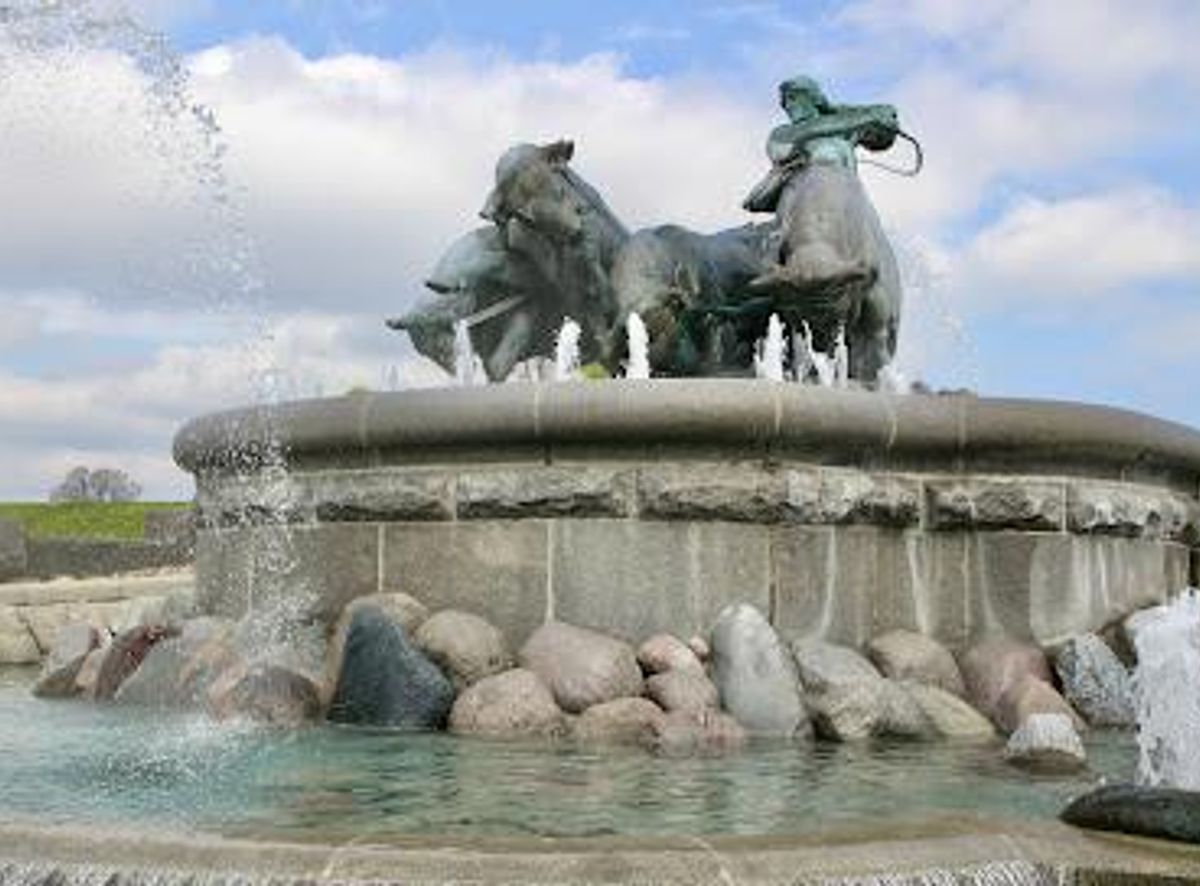
Surging with spray on Copenhagen’s harbourfront, the Gefion Fountain is a dramatic bronze tableau of the Norse goddess Gefion driving four straining oxen through the water. Gifted to the city in 1908 by the Carlsberg Foundation, it illustrates the mythic creation of Zealand, the island on which Copenhagen stands. Set between Langelinie Park, Kastellet fortress and St Alban’s Church, this free, open-air monument is as much storytelling in bronze as it is a refreshing city landmark.

A brief summary to Gefion Fountain

  • Churchillparken, København K, København K, 1263, DK
  • +4570222442
  • Visit website
  • Duration: 0.5 to 1.5 hours
  • Free
  • Environment icon Outdoor
  • Mobile reception: 5 out of 5
  • Monday 12 am-12 am
  • Tuesday 12 am-12 am
  • Wednesday 12 am-12 am
  • Thursday 12 am-12 am
  • Friday 12 am-12 am
  • Saturday 12 am-12 am
  • Sunday 12 am-12 am

Local tips

  • Aim to visit in the early morning or late evening for softer light and fewer people around the basin, which makes it easier to appreciate the sculpture’s fine details and take photographs.
  • Walk a slow circle around the fountain to see how Gefion and the oxen line up with Kastellet, St Alban’s Church and the harbour, giving very different backdrops in each direction.
  • Read up on the legend of Zealand’s creation beforehand or bring a short summary; understanding the myth adds another layer to what you see in the composition.
  • Combine your stop here with a stroll through Kastellet and along the Langelinie promenade to the Little Mermaid for a compact harbourfront walking route.
widget icon

Getting There

  • Metro from central Copenhagen

    From central Copenhagen, take the M3 or M4 metro line to Østerport Station; trains run every few minutes and the ride typically takes 5–10 minutes from inner-city stops. A single adult ticket for the necessary zones generally costs around 20–30 DKK. From Østerport it is an easy, mostly level 10–15 minute walk through the Kastellet and Langelinie area, suitable for most visitors with basic mobility but with some cobblestones and park paths.

  • City bus to the harbourfront

    Several city bus routes serve the streets around Churchillparken and Nordre Toldbod, with journey times of about 10–20 minutes from the historic centre depending on traffic. Standard bus tickets are usually 20–30 DKK within the central zones and can be paid via travel card, app or ticket machines. Buses typically run every 5–15 minutes during the day; expect slightly lower frequency in the evening and on weekends. From the nearest stops, you should allow a 5–10 minute walk along paved sidewalks.

  • Harbour bus by water

    In good weather, consider the harbour bus service that shuttles along the Copenhagen waterfront. The ride from central quays to the stops near Nordre Toldbod usually takes 15–25 minutes, with services departing roughly every 20–30 minutes during the day. Harbour buses use the same ticket system as other public transport, so expect prices in the 20–30 DKK range per adult trip. Access involves boarding from floating piers and short walks along the promenade, which may be less convenient in strong wind or heavy rain.

  • Bicycle from inner Copenhagen

    For a local-style approach, rent a city bicycle or use a shared-bike scheme and follow signposted cycle routes toward Langelinie and Kastellet. The ride from many central neighbourhoods typically takes 10–20 minutes on mostly flat terrain, with dedicated bike lanes for the majority of the way. Rental costs vary, but casual visitors can expect to pay roughly 75–150 DKK for a few hours, depending on the service. Be prepared for occasional cobblestones and pedestrian traffic near the fountain, where you may need to dismount and walk.

Gefion Fountain location weather suitability

  • Weather icon Any Weather
  • Weather icon Clear Skies
  • Weather icon Mild Temperatures
  • Weather icon Cold Weather
  • Weather icon Hot Weather
  • Weather icon Rain / Wet Weather

Unlock the Best of Gefion Fountain

Buy tickets

    No tickets available

Book tours with entry

    No tours available

Book tours without entry

    No tours available

Discover more about Gefion Fountain

A myth carved into water and bronze

The Gefion Fountain is one of Copenhagen’s most theatrical sights: a vast cascade where bronze oxen seem to heave themselves out of the water, driven on by the determined figure of the Norse goddess Gefion. Jets of water arc around them, turning the scene into something between sculpture and stage set. From the edge of the basin you can trace every muscle in the animals’ shoulders and every fold in the goddess’s cloak, frozen in the moment of supreme effort. The fountain retells a foundational Norse legend explaining how Zealand, Denmark’s largest island, came to be. A Swedish king promised Gefion as much land as she could plough in a single night and day. She transformed her four sons into powerful oxen, harnessed them to a plough and ripped a huge chunk of earth from Sweden, which became Zealand when it fell into the sea. The empty scar in the landscape became an inland lake in Sweden, often linked to the shape of Lake Vänern or Lake Mälaren.

From Carlsberg gift to city landmark

Although the story it tells is ancient, the fountain itself is a product of the early 20th century. Danish sculptor Anders Bundgård worked on the powerful figures around 1897–1899, and the basins and decorative details were completed in the following years. The Carlsberg Foundation commissioned and donated the monument to mark the brewery’s 50th anniversary, choosing a subject that tied Danish identity to deep mythological roots. Originally intended for a central city square, the fountain was instead given a stage on the harbourfront, where the constant presence of water echoes its theme of earth being dragged from the sea. It was first turned on in 1908, instantly adding a sense of drama to this stretch of shoreline. Decades later, extensive restoration around the turn of the millennium repaired worn stonework and mechanics, and the fountain was ceremonially re‑inaugurated, its bronzes cleaned and water displays renewed.

Harbourfront setting among green parks and fortifications

Gefion Fountain occupies a prime spot in Langelinie Park, close to the old harbour area known as Nordre Toldbod. On one side rise the grassy ramparts and star-shaped earthworks of Kastellet, Copenhagen’s historic citadel; on another, the slender spire of St Alban’s Church adds a neo‑Gothic accent to the skyline. The harbour itself glints just beyond, with ships and ferries moving through the Øresund. This setting makes the fountain as much a pause point on a wider walk as a destination in its own right. Paths lined with trees and lawns radiate out in several directions, inviting you to wander further into the fortress, along the Langelinie promenade or towards the famous Little Mermaid statue. Benches nearby offer a front-row seat to both the sculpture and the play of light on water, while seasonal flowers and foliage soften the stone surroundings.

Details, craftsmanship and changing moods

Up close, the craftsmanship reveals itself in fine textures: the straining veins on the oxen, splashes caught mid‑flight on their flanks, and the concentrated expression on Gefion’s face as she leans into the reins. The bronze has weathered to a rich patina, contrasting with the pale stone basins below. As the water crashes down the steps, it fills the air with a constant rushing sound that partially masks city noise and adds a sense of movement. The fountain changes character with the seasons and light. On bright days, spray throws tiny rainbows into the air; at dusk, the figures stand out in silhouette against the harbour sky. In colder months, reduced spray and low light emphasise the sculpture’s contours rather than its drama. After rain, the surrounding pavements gleam and reflections of the oxen shimmer in shallow puddles, giving photographers plenty of perspectives to play with.

Experiencing the legend in the rhythm of daily life

For many visitors, Gefion Fountain becomes a place to pause between more formal sights, a momentary amphitheatre of myth in the midst of everyday movement. Cyclists and commuters pass along the waterfront, while tour groups gather briefly to hear the tale of Zealand being ploughed from Sweden. Children watch the spray and toss coins into the basin, treating it as a wishing well in keeping with local custom. Because the monument is open at all hours and free to access, it lends itself to spontaneous visits: an early-morning contemplative stop when the air is cool and quiet, a midday break amid sightseeing, or a lingering look in the long northern evening light. Standing beside the rushing water, you are reminded how stories of land and sea, gods and humans, are still being retold—this time in bronze, stone and the endlessly falling water of Copenhagen’s harbourfront.

Busiest months of the year

Busiest hours of the day

Popular Experiences near Gefion Fountain

Popular Hotels near Gefion Fountain

Select Currency