

Melville Monument, Edinburgh Travel Guide
Free Guide: A towering neoclassical column in Edinburgh’s New Town commemorating Henry Dundas, blending rich history with complex legacies of empire and memory.


A brief summary of Melville Monument
A towering neoclassical column in Edinburgh’s New Town commemorating Henry Dundas, blending rich history with complex legacies of empire and memory.
The Melville Monument is a towering neoclassical column located in Edinburgh's St Andrew Square, erected between 1821 and 1827 to commemorate Henry Dundas, 1st Viscount Melville, a prominent Scottish statesman. Standing about 45 meters tall and topped by a 4.2-meter statue of Dundas, the monument is a key landmark in Edinburgh’s New Town, visible from the Firth of Forth and symbolizing complex historical legacies tied to empire, politics, and the slave trade.
On-site amenities
 Seating areas
 Information boards
Opening hours
- Every day7 am–8 pm
Opening hours as listed on the venue’s Google Business Profile. Hours can change for services and special events, so check with the venue before you go.
- Address
- 42 St Andrew Square, Edinburgh EH2 2AD
Getting there
Tram
Taxi
Walking
Discover more about Melville Monument
A Monument Rooted in Scottish Political History
The Melville Monument was constructed between 1821 and 1827 as a tribute to Henry Dundas, 1st Viscount Melville, a dominant figure in late 18th and early 19th-century Scottish and British politics. Dundas served as Lord Advocate, Home Secretary, and First Lord of the Admiralty, playing a pivotal role in shaping Scotland’s political landscape and the British Empire’s naval power. The monument was funded by voluntary contributions from Royal Navy officers, sailors, and marines, reflecting Dundas’s influence and support within naval circles. It stands as a symbol of his legacy, both celebrated and contested, embodying the complexities of his political career and imperial policies.
Architectural Grandeur and Symbolism
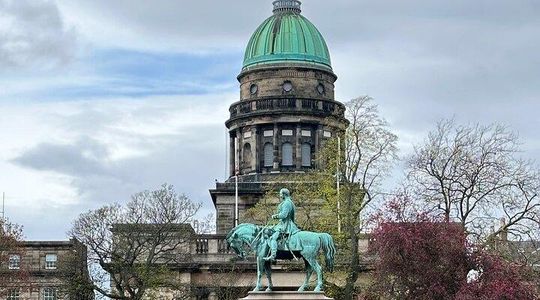
Designed by architect William Burn and inspired by Trajan's Column in Rome, the monument features a striking neoclassical marble column approximately 45 meters tall, crowned by a 4.2-meter sandstone statue of Dundas sculpted by Francis Leggatt Chantrey and carved by Robert Forrest. The statue depicts Dundas in peer robes, facing west along George Street, embodying authority and stature. The monument’s prominent position at the eastern end of Edinburgh’s New Town ridge makes it a dominant feature of the city skyline, historically visible from ships entering the Firth of Forth, symbolizing Dundas’s naval associations and Scotland’s imperial reach.
Contested Legacy and Modern Reinterpretations
Henry Dundas’s legacy is deeply contested due to his role in delaying the abolition of the transatlantic slave trade by nearly 15 years, despite earlier actions opposing slavery in Scotland. This duality has sparked debate and reflection in Edinburgh, leading to the installation of a plaque in 2021 acknowledging the impact of Dundas’s policies on enslaved Africans and colonial subjects. The plaque and ongoing discussions represent efforts to provide a fuller, more nuanced historical context, recognizing both Dundas’s contributions and the moral controversies surrounding his legacy. The monument thus serves as a focal point for dialogue about Scotland’s imperial past and its contemporary memory.
The Monument in Its Urban and Social Setting
Situated in the centre of St Andrew Square, part of James Craig’s original New Town plan, the monument anchors a vibrant public space surrounded by historic buildings, shops, and gardens. The square has evolved from an exclusive residential area to a bustling urban hub hosting events, markets, and festivals. Visitors can enjoy the lively atmosphere, gardens, and photographic opportunities the monument and its surroundings provide, especially during sunset when the column’s façade is beautifully illuminated. The site remains a significant cultural and historical landmark within Edinburgh’s city centre.
Artistic and Cultural Significance
The Melville Monument is recognized as a Category A listed structure by Historic Environment Scotland, highlighting its architectural and historical importance. It exemplifies early 19th-century neoclassical design and commemorates a figure emblematic of imperial Britain’s political and naval history. The monument is part of a broader pattern of imperial memorials in Edinburgh, alongside the Nelson Monument and others, reflecting the city’s historical role in the British Empire. Its artistic features and commanding presence continue to attract interest from historians, architects, and visitors alike.
Engagement with History and Memory
The monument invites reflection on the complexities of historical memory, empire, and justice. Recent debates and council initiatives to reinterpret the monument’s meaning demonstrate an evolving public consciousness about Scotland’s colonial legacy. The Melville Monument stands not only as a tribute to a historical figure but also as a site of ongoing dialogue about history’s contested narratives, the legacies of power, and the importance of inclusive remembrance in contemporary society.
Evendo Review Centre
 Google
Guest reviews
Best time to go
Quietest: Jan, Feb & Dec · before 7am or at 10pm
Busy times are Evendo estimates for a typical year, to help you plan. Actual crowds vary with events, school holidays and the weather.
Explore Melville Monument on the map
A handpicked selection of must-see spots near Melville Monument, mapped for you.
Get your free copy of our complete guide to Melville Monument, delivered straight to you.
Everything on this page, from opening hours and how to get there to Eve’s tips and the best time to go, in one PDF you can read offline, print or share.
Already have an account? Sign in
Your Melville Monument guide is ready.
We'll send it to · Not you? Sign out

Getting your guide ready…
We are putting together a fresh copy of the Melville Monument guide. This can take up to a minute.
This can take a few moments. If your browser asks, choose Allow so the download can start. You'll find the guide in your Downloads folder.
Nothing happened? Download it again
Sorry, the guide is taking longer than usual. Please try again in a minute, or get it by email instead.
Unlock the best of Melville Monument
Skip-the-line tickets, guided tours with entry, and walking tours of the area, booked in a few clicks.


Other nearby places you may find interesting
The closest places of the same kind, if this one is not quite what you had in mind.
-
-
-
-
-


Swipe for more places
More to explore near Melville Monument

 Best experiences near Melville Monument
 Best hotels near Melville Monument
 Best landmarks near Melville Monument
 Best attractions near Melville Monument
 Best shops near Melville Monument
 Best restaurants near Melville Monument
 Best bars near Melville Monument
Do you manage this location?
Take control to get all the benefits, like improved information, better appearance, and stronger visibility across AI-powered discovery.
Explore more

Explore more of Edinburgh
Discover the enchanting blend of history, culture, and natural beauty in Edinburgh, Scotland's captivating capital city.
Explore Edinburgh
Explore more of United Kingdom
Discover the United Kingdom: A blend of rich history, stunning landscapes, and vibrant cities, offering a unique travel experience for every visitor.
Explore United Kingdom
