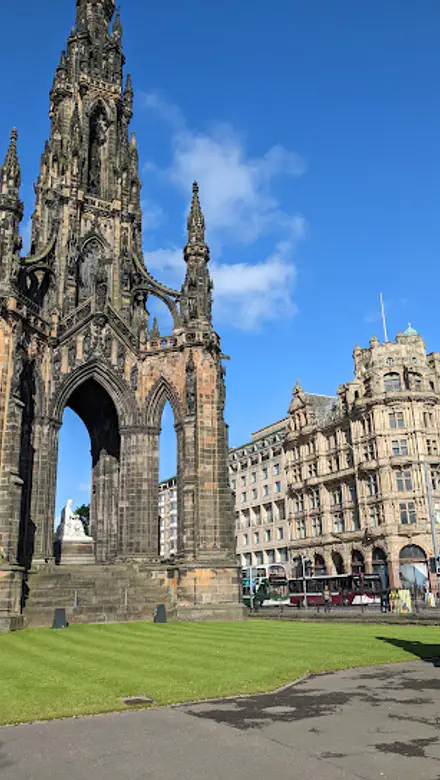
Scott Monument, Edinburgh Travel Guide
Free Guide: Climb 287 steps to Scotland's greatest literary tribute and Edinburgh's most iconic skyline views.


A brief summary of Scott Monument
Climb 287 steps to Scotland's greatest literary tribute and Edinburgh's most iconic skyline views.
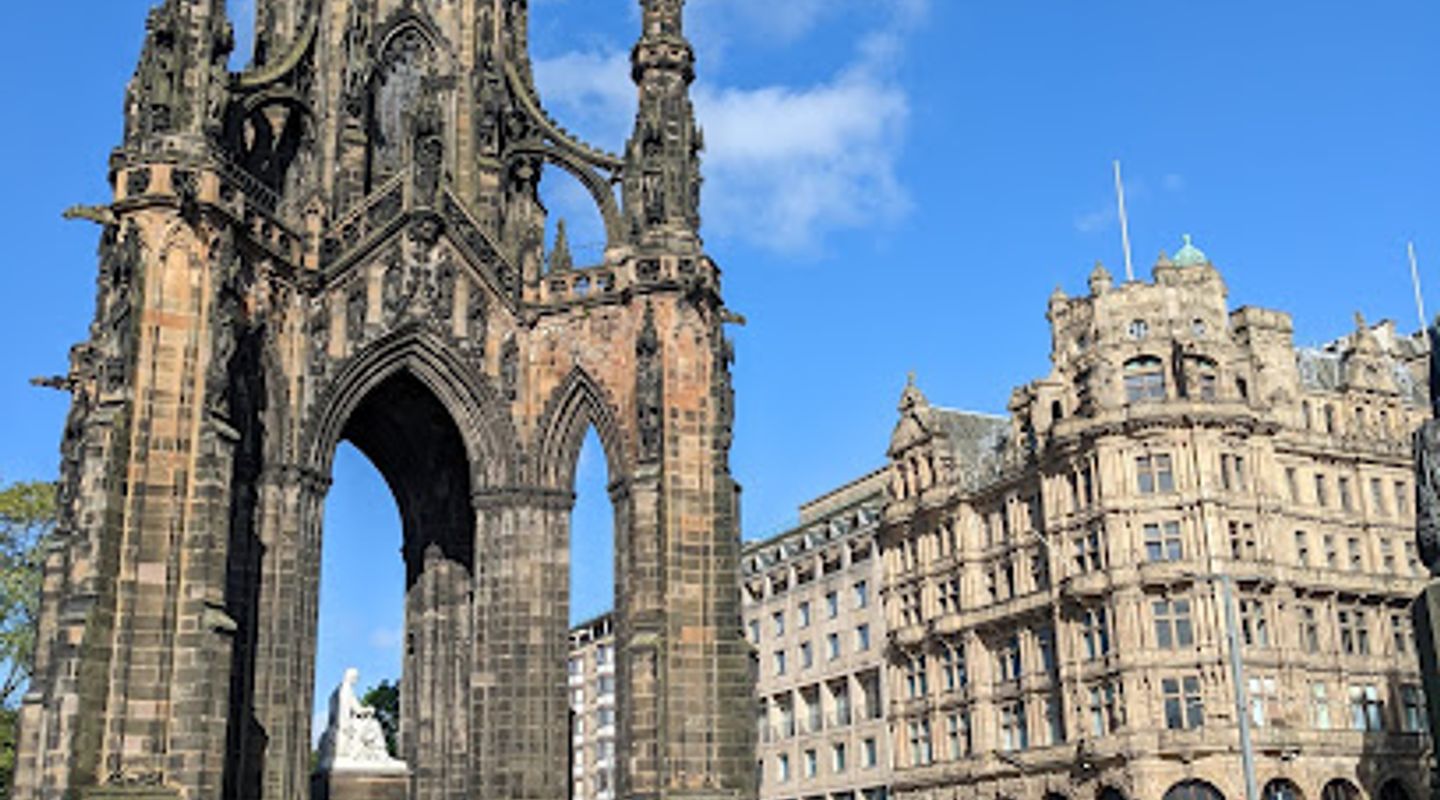
A towering Victorian Gothic spire rising 200 feet above Princes Street Gardens, the Scott Monument stands as the world's largest tribute to a writer. Built between 1840 and 1846 to honour Sir Walter Scott, Scotland's celebrated novelist and poet, this iconic landmark features intricate carvings, 64 statues of characters from Scott's novels, and a striking white marble statue of Scott with his faithful dog Maida at its base. Visitors can climb 287 narrow spiral steps across four levels to reach panoramic viewing platforms offering breathtaking 360-degree vistas of Edinburgh Castle, the Royal Mile, Arthur's Seat, and the city's New Town.
On-site amenities
 Restrooms
 Drink options
 Food options
 Seating areas
 Information boards
Opening hours
- Every day10 am–4:30 pm
Opening hours as listed on the venue’s Google Business Profile. Hours can change for services and special events, so check with the venue before you go.
- Address
- E. Princes St Gardens, Edinburgh EH2 2EJ
- Website
Getting there
Edinburgh Tram
Local Bus Services
Walking from Edinburgh Waverley Station
Taxi or Ride-Share
Discover more about Scott Monument
A Monument to Scotland's Greatest Writer
Following Sir Walter Scott's death in 1832, Edinburgh's civic leaders recognised the need to honour one of Scotland's most celebrated literary figures. In 1836, an architectural competition was launched to design an appropriate memorial. George Meikle Kemp's winning design was approved in 1838, and construction began in 1840, culminating in the monument's opening to the public in 1846. Standing at 200 feet (61 metres) tall, the Scott Monument remains the largest tribute to a writer anywhere in the world—a testament to the profound impact Scott's novels, poetry, and historical works had on Scottish culture and beyond.
Gothic Splendour and Architectural Mastery
The monument's Victorian Gothic design is immediately striking, with its dark, brooding silhouette dominating the Edinburgh skyline. Constructed from oily shale stone, the structure's blackened appearance—caused by decades of atmospheric pollution and soot—lends it an eerie, dramatic beauty that contrasts sharply with the white Carrara marble statue of Scott seated at its base, sculpted by Sir John Steell. The monument's exterior is adorned with 64 intricately carved statues representing characters from Scott's novels, along with decorative gargoyles and ornamental details that showcase the craftsmanship of 19th-century Scottish artisans. Despite restoration efforts in the 1990s, the monument retains its distinctive dark complexion, which has become integral to its iconic identity.
The Ascent and Viewing Platforms
The climb to the summit involves navigating 287 narrow, winding spiral steps divided across four levels, each offering opportunities to pause and absorb the surroundings. As visitors ascend, the staircase becomes progressively narrower and more challenging, creating an increasingly intimate experience within the tower's core. The effort is rewarded at each level: the first-floor Museum Room provides respite and context, while subsequent platforms offer expanding vistas of the city. The final ascent leads to a small door opening onto a 360-degree viewing deck at the spire's peak, where visitors can walk the full circumference and take in unobstructed views of Edinburgh's most celebrated landmarks—Edinburgh Castle perched on its volcanic crag, the cascading buildings of the Royal Mile, the distinctive outline of Calton Hill's acropolis, and the rolling hills of the New Town stretching northward.
The Museum Room and Scott's Legacy
On the first level, the Museum Room serves as a contemplative space dedicated to Sir Walter Scott's life and literary achievements. Designed with wooden-panelled walls and ornate arched windows, the room evokes the hallowed atmosphere of a chapel. Four exquisite stained-glass windows, designed by renowned 19th-century Scottish artist David Roberts and crafted by James Ballantine, dominate the space—depicting the coat of arms of Edinburgh, the coat of arms of Scotland, Saint Andrew (Scotland's patron saint), and Saint Giles (Edinburgh's patron saint). A circular wooden bench in the centre provides a place for reflection, while audio installations offer visitors the opportunity to hear extracts from Scott's own writings, bringing his words to life within the monument he inspired. Information displays chronicle Scott's tumultuous life, his prolific output, and his enduring influence on Scottish identity and literature.
Sensory Experience and Practical Considerations
The climb itself is an embodied experience—the cool stone walls, the narrowing passages, the echoing footsteps of other visitors, and the increasing wind at higher levels all contribute to a sense of ascending into the monument's heart. The viewing platforms provide natural rest points where visitors can catch their breath and absorb the panoramic scenery. On clear days, the vistas extend across Edinburgh's historic centre, encompassing the Festival Wheel in adjacent Princes Street Gardens, the Balmoral Hotel's distinctive clock tower, and the distant East Coast shoreline wrapping around seaside communities. The monument's location opposite the Old Waverley Hotel and adjacent to Jenners department store places it at the heart of Edinburgh's bustling city centre, making it easily accessible yet offering a surprising sense of elevation and escape from the street-level crowds below.
Visitor Experience and Accessibility
While the monument's narrow spiral staircase and 287 steps present a physical challenge, the experience is designed to accommodate visitors at different fitness levels through its multiple viewing platforms. The Museum Room on the first floor is accessible to all visitors and provides valuable context without requiring the full ascent. However, the monument does not feature wheelchair access, lifts, or ramps, and some sections have low lighting. A complimentary ticket policy exists for personal assistants accompanying visitors with disabilities. The monument's popularity, particularly during Edinburgh's festival season, means that visiting during early morning or late afternoon hours can provide a more leisurely experience with shorter queues. Audio displays in the Museum Room are available in French, German, Spanish, and Italian, enhancing accessibility for international visitors.
Evendo Review Centre
 Google
Guest reviews
Best time to go
Quietest: Jan, Feb & Dec · before 9am or from 7pm
Busy times are Evendo estimates for a typical year, to help you plan. Actual crowds vary with events, school holidays and the weather.
Explore Scott Monument on the map
A handpicked selection of must-see spots near Scott Monument, mapped for you.
Get your free copy of our complete guide to Scott Monument, delivered straight to you.
Everything on this page, from opening hours and how to get there to Eve’s tips and the best time to go, in one PDF you can read offline, print or share.
Already have an account? Sign in
Your Scott Monument guide is ready.
We'll send it to · Not you? Sign out

Getting your guide ready…
We are putting together a fresh copy of the Scott Monument guide. This can take up to a minute.
This can take a few moments. If your browser asks, choose Allow so the download can start. You'll find the guide in your Downloads folder.
Nothing happened? Download it again
Sorry, the guide is taking longer than usual. Please try again in a minute, or get it by email instead.
Unlock the best of Scott Monument
Skip-the-line tickets, guided tours with entry, and walking tours of the area, booked in a few clicks.




Other nearby places you may find interesting
The closest places of the same kind, if this one is not quite what you had in mind.
-
-
-
-
-


Swipe for more places
More to explore near Scott Monument

 Best experiences near Scott Monument
 Best hotels near Scott Monument
 Best landmarks near Scott Monument
 Best attractions near Scott Monument
 Best shops near Scott Monument
 Best restaurants near Scott Monument
 Best bars near Scott Monument
Do you manage this location?
Take control to get all the benefits, like improved information, better appearance, and stronger visibility across AI-powered discovery.
Explore more

Explore more of Edinburgh
Discover the enchanting blend of history, culture, and natural beauty in Edinburgh, Scotland's captivating capital city.
Explore Edinburgh
Explore more of United Kingdom
Discover the United Kingdom: A blend of rich history, stunning landscapes, and vibrant cities, offering a unique travel experience for every visitor.
Explore United Kingdom